Sometimes, when things seem grey, or we can’t quite see as much as we’d like, we give into fear or stress. When we experience the lack of clarity, and the feelings that come with it, we often embrace it all as truth, and begin to tell ourselves a story filled with greyness, uncertainty, and melancholy.
The good news is we can do something else.
First, we can simply breathe, be, and notice. As we sit, or stand, with open hearts, minds, and eyes, we may notice that beauty, joy, or peace are present in this space that first seemed only grey and uncertain. As we can take another breath, we can acknowledge whatever is there. If we are open to the possibility, we might even express gratitude for what is.
The ocean view on a Monday.
We may not see a blessing in front of us. We may not feel at ease or peaceful. Sitting in the moment, breathing and being open and grateful may appear to be failing us. When that happens we can reassure ourselves, no matter how we feel, it’s helping. It’s science. It’s the way we are built.
Finally, we can remind ourselves that tomorrow is another day, and we’ll get there. We’ve done it before, and we’ll do it again. Tomorrow will come! And when it does, it will be different from today. Let us hold onto the hope that it will be filled with many good things.
Same ocean view, two days later.
Here’s to experiencing the beauty and gift in the grey, and soaking in the awesomeness of a new day filled with light, color, life, and joy.
Have you ever captured wonder? Ever been (lovingly) slapped in the face with awe?
I have.
This day it was the wonder of this sky.
I’ve driven this dirt road many times. Sometimes I notice the dust and unevenness of the road. But today I was present to this. Or perhaps more accurately this was present to me — calling me to look, to see, to breathe, and to be open to the wonder of the ordinary. I snapped a picture in my mind, and with my camera.
My brother and I hiked, chatted, and pointed out various things to each other. I’m blessed to have him as my hiking partner. No matter how many leaves I notice, or how many times I say “Oh, look at that!” he never tells me “You know we just saw that last week.” or “You said the exact same thing 5 minutes ago.” He, too, is open to being in the moment, present to the wonder, joy, blessing, and amazingness of nature.
We walked and noticed new paths, and different vistas. And we sat. Exploration is super. Hiking is a joy. But sitting, sitting is absolutely necessary! It reminds me of Savasana in yoga. It’s a few moments, intentionally taken, to allow ourselves to experience who we are in the moment, to notice what our practice, our hike, our noticing, our awe, has produced in our bodies, minds, and spirits. It’s a time to rest.
We always find at least one lovely spot to sit. Sometimes we chat. Sometimes we photograph or paint. Sometimes we just rest in the awe of the present moment.
Ginny Graves wrote — in A Healthier Life (Real Simple Special Edition 10/21)
Positive emotions, like awe, love, and gratitude, suffuse your body with an uplifting sensation that can make you feel more at peace with yourself and at one with the world.
Mindfulness might help you train your brain to be less worried and more buoyant.
I love the idea and believe it to be true. Another day I’ll find the science to share with you. For now, I just share my experience.
My brother and I practice mindfulness as we hike. Sometimes it’s in mindful walking, sometimes it’s being present to the sights, sounds, and smells that surround us as we move. Other times it is the discovery of something we hadn’t yet seen. And always, it’s the sitting, and soaking in the space.
Look at all the shades of green. The plethora of plants. The amazing reflections in the water. This was a day for breathing and allowing the awe that I felt, and the almost magical bigness of the space and moment hold me. It’s funny to speak of it in that way. But that is the experience. It is being in the presence of something greater than me, of being surrounded by beauty. As I sit there I don’t know how to describe it other than being held, supported, with space to just breathe and be.
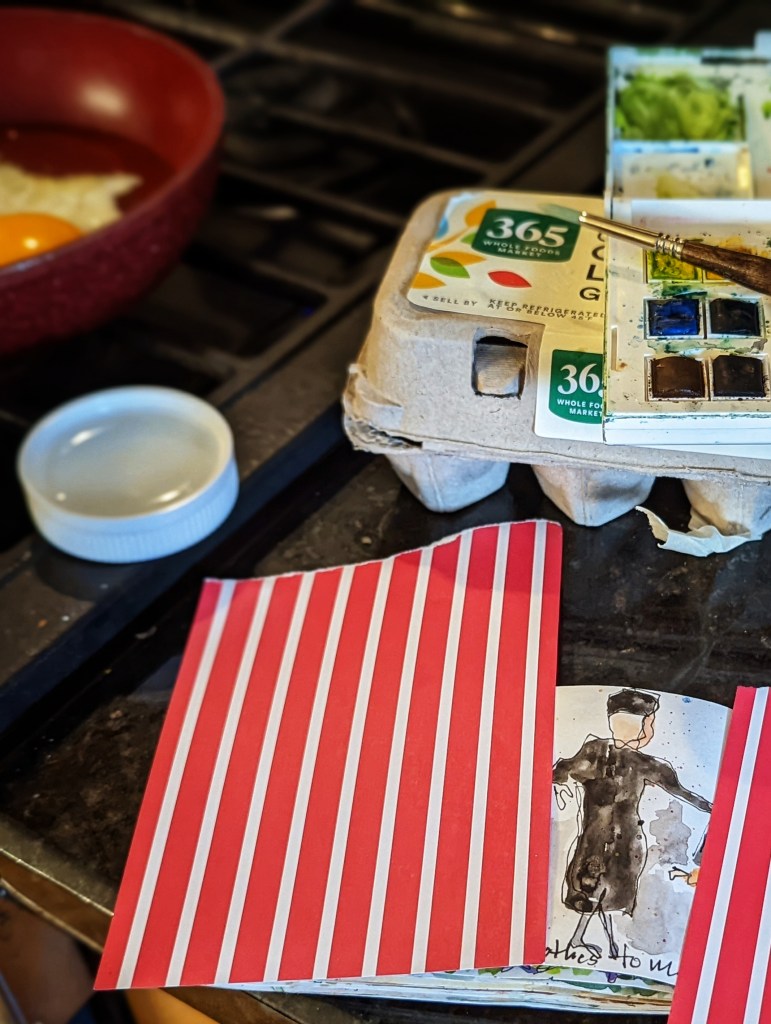
Another day at the same spot, I captured my wonder by looking deeply and using watercolor to capture a tiny bit of nature in my mini hiking journal. It’s funny because watercolor is something else that fills me with wonder and awe, and draws me deeply into a place of mindfulness. After painting I captured the moment to keep with me.
This is, for me, the image of an day well spent. Hiking shoes off. My feet in the green bed of clover at the bottom of the step on which I’m sitting. My view captured on the mini watercolor journal I carry with me. Looking at this image brings me back to that moment. I feel the joy I felt as I looked at all this in front of me. I see the brilliant green that stretches out in front of me, and I hear the water gurgling over the rocks. Amazing the wonder that can be held in an image, on the page, and in my heart and mind.
I couldn’t get out to hike the next day. Instead I brewed a big cup of matcha and sat in the quiet coolness of morning. I flipped through some photos from previous hikes. I took them with the intention of having watercoloring inspiration.
I decided to use this image of a small patch of flowers. The wildness of overlapping leaves, a plethora of different plants, and flowers popping out all over drew me. I liked the wildness — somehow it seemed like sweet cacophony of beauty. Is it possible for a cacophony to be sweet and beautiful?
As I sipped my tea, and zoomed in on the various areas of the photo, I was brought back to that moment in nature. I revisited the many different shades of green in the leaves, the darkness of the shadows and the soil, the textures, and the pops of color. I played with the paint and water mixtures, noticing how it moved on the page. As I did, I felt my breath and my spirit ease a bit. I painted and sipped tea in joy-filled silence.
I found myself in an unusual emotional space at the end of this school year. I had the same bittersweet feelings about my students and I leaving one another. But, I also had rather strong feelings of angst, frustration, stress, and honestly, just overall ick. Top it all off with the perception that I couldn’t shake the ick, but instead was somehow stuck in that grey, disgusting, frustrating, depressing, putrid space.
How’s that for an image?
So, what’s an educator to do when she finds herself in that spot? Choose a new story.
Kindra Hall says “In life, the most important stories are the ones we tell ourselves.”
If I were in the audience when she said it, I might have jumped up and yelled “Preach it, sister!”
Ah, but how to do that? It seemed the story I was telling myself was quite true. It certainly felt true. And, in some very real way, it was true. But was it the whole story? Was it the only story? Was it the story I wanted to choose to tell myself about the year, or me, or teaching, or the world? No, no, no, and no, it certainly was not.
Well then, what was that story? What was the truth I was overlooking, or not highlighting as the star of my story? What is the story I want to tell myself about this year, and perhaps about every year?
It is a story filled with love, triumph, learning, and inspiration. Listen as I tell myself (and you) the truest stories about this year.
One night this spring, I just broke down. Crying, I said “I don’t know what the matter is.” My brother paused and softly said “It’s been a hard two years.” It has indeed. I did cancer treatment – during a pandemic. I didn’t teach or coach for what seemed like forever. I felt awful more than I felt good during my six months of treatment. I taught Kindergarten virtually after spring break – that’s a remarkable new level of exhaustion. I took a 200 hour yoga, SEL, and mindfulness course as I recouped over the summer. I returned to the classroom in person this school year with a compromised immune system, no antibodies, masks, seating charts, tons of new tech, and tons of new teaching load. For sure it’s been a hard two years.
And yet, at the same time, and for many of the same reasons it’s been a year of triumph, grace, gift, and amazing strength, love, and overall fantabulousness. Let me explain.
I did cancer treatment, during a pandemic, with drugs that compromised my immune system more than it already was. I did it! Not by myself, mind you. I did it with the help of the amazing docs, nurses, and researchers. I did it with the love and support of family and friends. We did it! Me, and my tribe, did cancer treatment during the pandemic, and lived to tell about it with smiles and deep gratitude to God.
I taught Kindergarten — virtually! Not by myself. I did it with the help of many beautiful, kind people who helped me, encouraged me, affirmed me, and sometimes sat with me while I cried. And I didn’t just do it. I did it well. I proved that distance is not a deterrent to learning or to relationship. It’s an opportunity to rethink, to collaborate, and to figure out ways to make it amazing.
Fall of 2021, I returned to my Kindergarten classroom with a compromised immune system, no antibodies, masks, seating charts, tons of new tech, and tons of new teaching load, in a year that was difficult, exhausting, and taxing to the best of us. I returned. I struggled. I ideated and iterated. I breathed through a lot. I imagined possibility and I worked to bring it to pass. I entered into relationships with my Kindergartners and their parents. Together we created a year of learning, joy, discovery, and creativity. Together we created and lived a year of triumph!
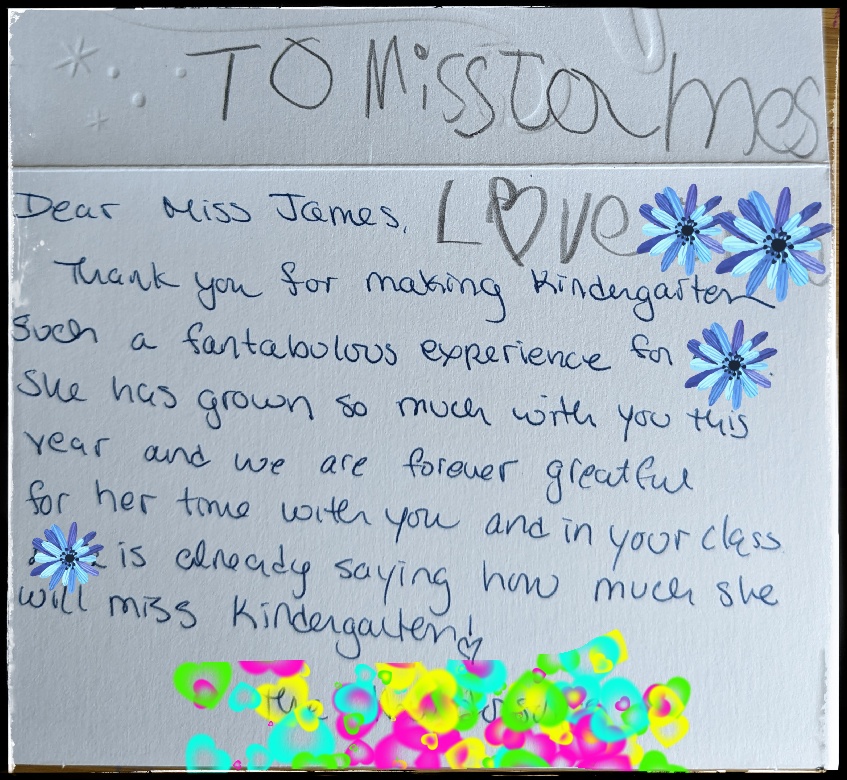
A sentiment I send right back to all my Kindergartners and their families!
As I processed this to share, I noticed the Kindergartner’s handwriting. It is ALL correct upper and lower case letters with beautiful legibility. That is a triumph on so many levels!
At times this year was fraught with stress and anxiety. Unwilling to have that be our experience of the year, we worked together to fill the year with joy, peace, affirmations, breath, and mindfulness. As those dear sweet Kindergartners wept — missing their parents, unsure of what their friends where feeling — we breathed together. Sometimes I held their hands, and did the affirmation and breath practice while they simply stayed with me. I trusted that their mirror neurons would do their job and calm them by simply observing my practice of self-regulation. At other times the Kindergartners were the ones reminding me to breathe and practice mindfulness of doors, or helping their friends with affirming thoughts and suggestions of ways to proceed. They embraced their classroom jobs of peace person and positivity proclaimer and daily led their peers through mindful, beautiful moments of breath, affirmation, and peace. They even asked if they could increase their having a holiday job to include leading their friends in two yoga poses each morning. They also took their practice home and shared it with their families and friends. I know, because parents regularly shared their amazement and gratitude with me.
As I gathered my thoughts for this post I went through the notes from this year, as well as ones I’ve saved from years past. These add weight and validity to my stories. They strengthen the positive neural pathways in my brain.
The Kindergartner made affirmations for the letters that spell my name.
Love notes from the Kindergartners
Thank you for creating a warm, peaceful, exciting, artistic, free thinking and child driven classroom.
You are a warrior queen — determined and victorious!
Remember what an inspiration you are to so many.
You encouraged her to try new things no matter how scary they seemed. You taught her to not be afraid to ask questions.
We appreciate your fantabulousity.
I’m not the only educator who had a difficult year of triumphant teaching and learning. I’m not the only creative one. I’m not the only amazing one. There are so many others. I hope each educator that reads this post, takes the time to carefully choose the story you are telling yourself. Make it about your triumphs, your discoveries, the lives you’ve changed, the relationships you’ve forged, the difficulties you have overcome. Make it the best and truest story about yourself, who you are, and what you do.
With gratitude to God and all the amazing people who encourage me to be me, and who help make what I do possible, I say, “I am capable, and strong. I have a big beautiful brain and am always learning. I am kind. I am brave. I can do hard things — and regularly do. I have an awesome heart. I make a difference. I inspire others. I am deeply loved. I am, and always will be, fantabulous. My year was not easy, but it was amazing.”
Post Script: If you’re anything like me, it may feel a bit uncomfortable to say all these things in such a public way. It may even seem somehow improper to do so.
But, the truth is it is completely proper, and absolutely necessary!
We must treat ourselves as we would a good friend or colleague. We acknowledge their foibles and the times they have fallen short, but we champion their fantabulousness and all their victories, and gains. We tell them the stories that help them understand who we know them to be. We tell others those same stories and more — because they are valuable stories — to tell and to hear.
Please tell your amazing stories! I’m happy to listen if you want to share them in the comments. But feel no pressure. Just tell them to yourself and at least one other.
Gosh it’s been a long time since I posted anything. I’ve crafted several posts in my mind, saved photos that I wanted to blog about, and sat down at the computer. But, my brain was mush attending to the plethora of items on my end of school year to do list. Finally I have a moment where I feel I can write. I think it might be because my topic makes my heart, mind, and eyes, brim over, and I need to let it out in words and witness.
It was time to make my end of the year gifts. Actually it was almost past time to do them in order to give them to my students before they left. I headed out to the store with my brother to buy photo paper, picked up some cute triangular sheets of paper that I thought might make nice cards, and hurried home to start the process. The gifts are ABC affirmation cards — 26 letters in the alphabet plus two cover cards means 28 cards per Kindergartner. 23 Kindergartners means I had to cut out 644 cards. It was Sunday night. I was giving the gifts on Wednesday morning. Can you say, “Oh my gosh?!?!?!” Perhaps you already have.
As I waited for my brother to print the cards, I thought how cool it would be to make an origami box that would fit the cards perfectly. Surely someone had figured out how to do that. They had. Here’s the video I used — with gratitude to the creator! And how cool is it that it involves using the math? (Yes, yes, I carry my math-loving-nerd card with great pride.) Thankfully, I had paper at home that would work for the project. Now I wasn’t silly enough to make a top and a bottom. I would never have slept if I did that. Instead I made a bottom, and then used the triangular sheet of paper to craft a sleeve that went around the box and served as my card as well.
My Kindergartners listened intently as I told them about the gift. They accepted the gift as though accepting something very special. I loved that, and was struck by how carefully they opened them. They flipped through every card. Some read them on their own, some with a friend, and others asked me to read them to them. When they finished reading them, they looked at me and asked “Can we make some?”
Make some? You want to make some?!?! I didn’t say that out loud. Instead I said “Of course you can!” Their next question was “Where can we get this paper?” referring to the photo paper I used. “Oh,” I replied. “I don’t have any of that here. But I have white index cards, and I have these colored post-it notes.” They gathered up their supplies and started writing and drawing. They made cards for their parents, siblings, friends, and themselves. One worked on many cards. “What can I write for D? I am …. Hmmmm… What’s something for D, Miss James?” I thought a moment and said “Delightful!” She liked the suggestion, and worked on. She took some post-it notes home to finish her deck.
The next day she came in, and handed me this.
She said, with a smile, “Here you go, Miss James. It’s for you” I opened it to find this. An deck of affirmation cards — one for each letter of the alphabet — made and gifted to me by one of my fantabulous Kindergartners.
How remarkable, right? I gift them. They are inspired and feel empowered to do their own work, to create their own cards, to affirm people in their lives. And then, they gift me right back. It’s all a gift — the opportunity to be together this year, choosing to gift them, experiencing their reactions, living our relationships, feeling their power, and receiving the sweet gift of these Kindergarten handmade cards from A-Z.
My Kindergartners returned from a special the other day, and after counting I presumed one of them had stopped at the nurse. Moments later she came into my classroom, arms wrapped tightly around the leg of the specialist teacher. Turns out she had gone to the bathroom as the specialist brought the Kindergartners back, and ended up alone in the other building. She remembered how to get back to our building, but without a teacher, was locked out. Thankfully, a colleague was opening the door as she arrived and found her, shoulders lifting and falling with her tears, hands sweating with work and worry.
She and I talked — with the other Kindergartners — and breathed many breaths together. It helped to debrief and to breathe, but I could tell it wasn’t enough. I abandoned my original lesson and said “Hey Kindergarten! For social studies we are going to take a field trip.” Gasps and questions filled the air: “We’re going on a field trip? Wow! Will we take a bus? Where are we going?” Even the student who had been lost was intrigued and a bit excited. When she discovered that she was a much needed part of the field trip, she breathed a bit deeper — distracted and empowered by her role.
I told them it was a walking field trip, and we were going to explore the school a bit. First we walked to the stairwell at the end of the hall. The door has a latch that requires you to push the latch down with your thumb while simultaneously pulling on the handle. For adult hands it is quite easy, for Kindergartner sized hands it requires some thinking, and problem solving to make it work. Some could make it work with one hand, others used two to accomplish the task. As each was successful, she ascended the stairs and waited for the next part of our field trip.
As we continued to the next building I asked the Kindergartners to notice the many things they were passing. I told them we would be making a map when we finished our field trip and they would need to remember the important bits to add to their map.
We entered the next building, and again examined the door to determine how we might get out if we needed to do so without a teacher. The first student pushed and pushed on the handle to no avail. Then another said “It says to push the green button!” Another said “Yeah, I knew it said that.” I acknowledged their knowledge but pointed out that sometimes, when we are nervous we have a much harder time reading, so it’s good to have a simple memorable way to remember what to do. We decided “Green for go!” was a good reminder.
Once outside again, I asked the Kindergartners to look around and think. Where are we? Where do we usually go? Where else might we go? What would be the best place to go? They noted that we usually go one way but we would come to a locked door. They commented that we could go to the Upper School and the Kaleidoscope playground by going another way but didn’t think that would be helpful. I encouraged them to keep looking and thinking. Finally they decided to try yet another way and realized it took them to our Kindergarten playground. I asked what they might do when they reached the playground if they weren’t with a teacher. They thought, and talked, and finally decided they could knock on the window to get a teacher’s attention.
Them: “Can we try it, Miss James?” Me: “Sure! But wait for me to get inside, then carefully knock on the window to our classroom. Best to knock on the wood around the window. It’ll be loud and you won’t risk breaking the glass.” Them: “Ok!”
There was lots of whispering and watching as I jogged down our little hill towards our learning space. I looked back as I neared the door. Their eyes watched me intently as they stood in their line encouraging one another with “Not yet. .. She’s almost there…. We can do it!” I think I may always have that vision of them burned into my brain. Such small humans, with such big hearts, brains, and courage.
As I ran into our learning space, I yelled to a colleague, “Don’t open the door for my class! We’re working on a problem!” Entering the room I sat down and waited for their knock. I didn’t have to wait long. The knocks were loud and clear. I came to the window, listened as they told me what happened, and then let them in through our outside door.
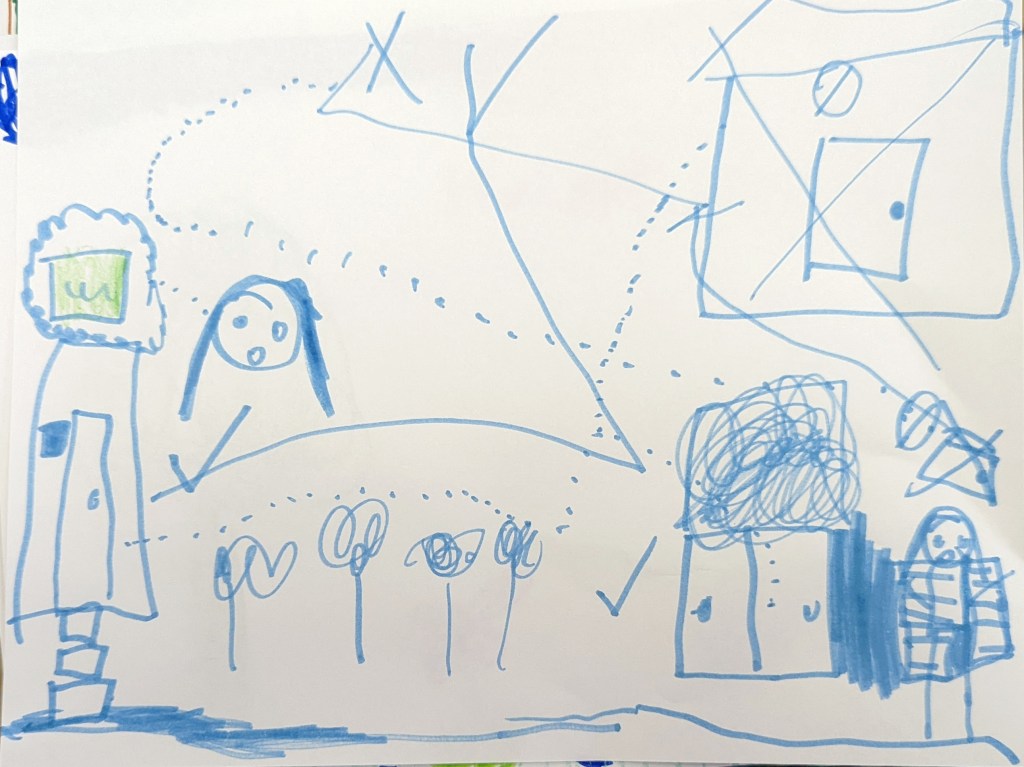
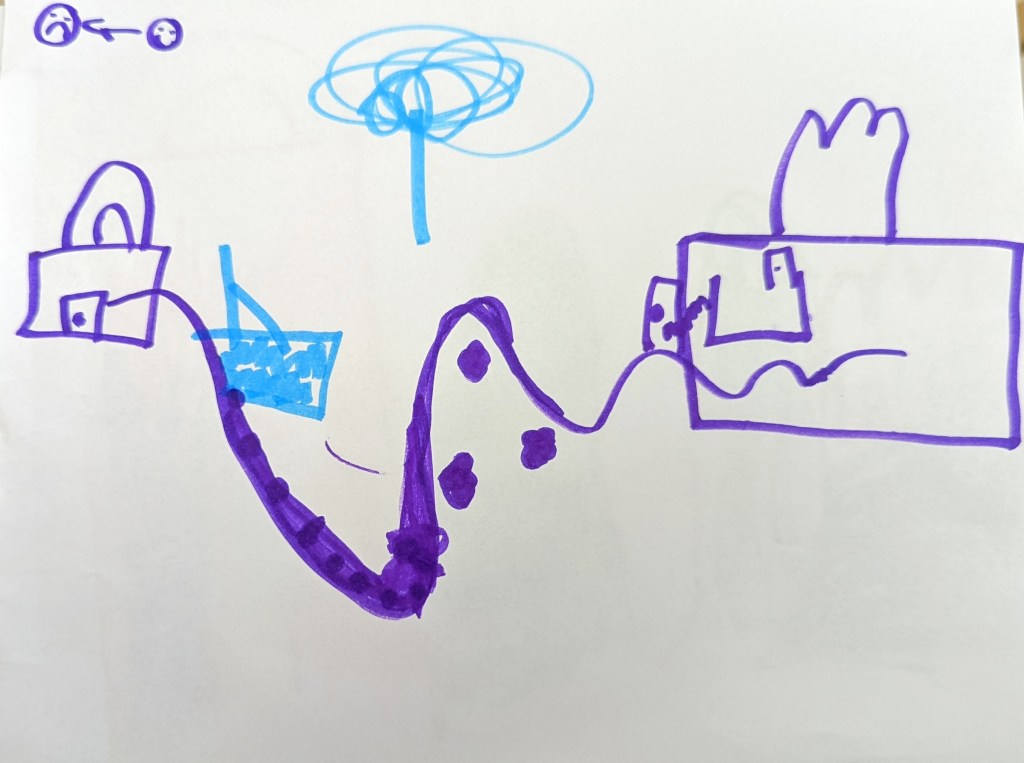
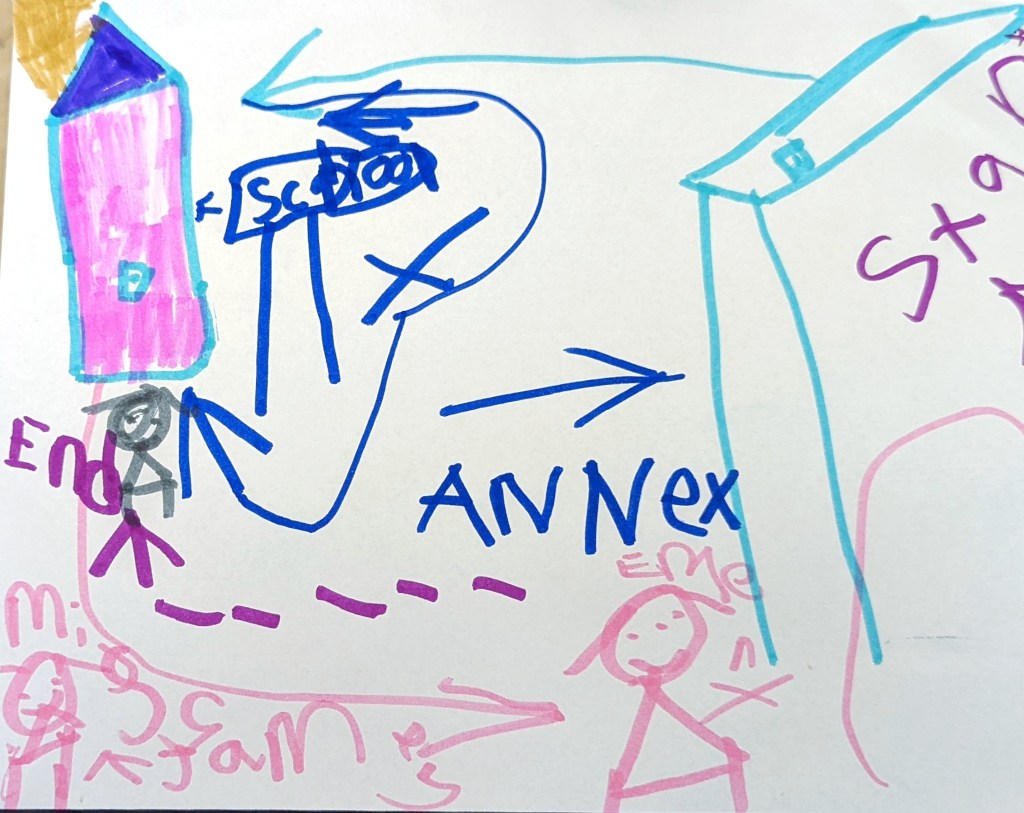
Once inside, my fantabulous Kindergartners became cartographers. Each, in their own way, documented the information they felt was important about how one might get from the other building back to our learning space. As they finished, the cartographers eagerly explained their maps to me before asking with great delight if they might take them home. One asked if I knew how other maps were folded. When I told her I did, she asked if I could fold hers like that. I did my best, and with a big smile, she safely tucked it into her pocket.
I had a parent teacher conference the other day. As we talked about the many ways the Kindergartner had grown and blossomed, the mom said “Her handwriting is the one thing I think can still use work.” I chuckled, agreed, and then said “But — and I mean this in the best possible way — I think her handwriting hasn’t improved because she doesn’t care about it. She isn’t invested in it.” Now it was the mom’s turn to chuckle. “Oh yeah, you’re absolutely right. She just wants to get it done so she can move on to something else.”
As I went about my day that stayed on my mind. I recalled this post of mine — Teach for Delight. How might I infuse our handwriting work with a bit more delight? Even saying it sounds funny, but I’m sure there is a way. Here are some of my first thoughts: practicing words they love, writing to people they love, writing sentences and phrases they love, writing jokes, making name tags, decorating their cubbies and the room. The possibilities are endless. I just need to embrace the idea that interest and delight are important and possible — even with handwriting — and then set to making it happen.
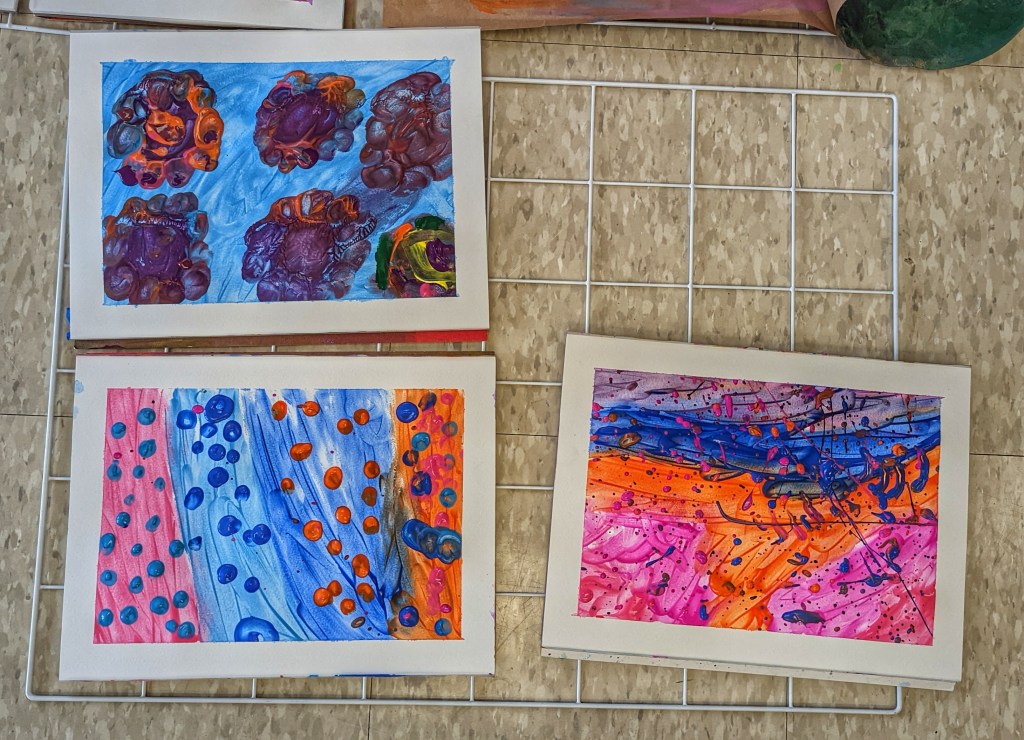
I thought about teaching for delight again last week as I prepared for art. My curriculum has many fantabulous inspiration artists, coupled with processes and products that are Kindergarten friendly and appropriate. The Kindergartners enjoy art, and their products are beautiful. But, I was sensing that there was just too much structure for them at the moment. They needed the freedom to simply and completely play. They needed an assignment that allowed them to embrace the process and product with the smallest amount of outside interference possible.
I thought and thought. What artist might we use? How can we do it in the time allotted? How might I structure it so that their process and product would be enjoyable and satisfying? I quickly landed on finger painting as the process. But, how to elevate it a bit to show them, and others, that their work is indeed art? That was a sticking point for a bit of time. Finally, I decided I could help by taping a boarder on their paper, and by trusting them as artists.
With a good bit more thinking, I had the process and rules in place. * Each artist could choose up to 4 colors. * Each artist must do at least one practice piece, but could do a total of three. * Each artist would be kind to themselves and others by: not touching their face or hair, not touching their friends, walk with clasped hands when walking around the room. * I will prepare a tray, paper, and a paint holder/plate for each artist.
When I announced the project, there were audible gasps and expressions of delight. They listened intently as I explained the process and rules. They were patient, but clearly wanted to get started right away. I told them I would let them know when we were nearly half way through the class so that they could know they should begin working on their final piece. They all agreed that they understood, and had no questions, so I began handing out supplies.
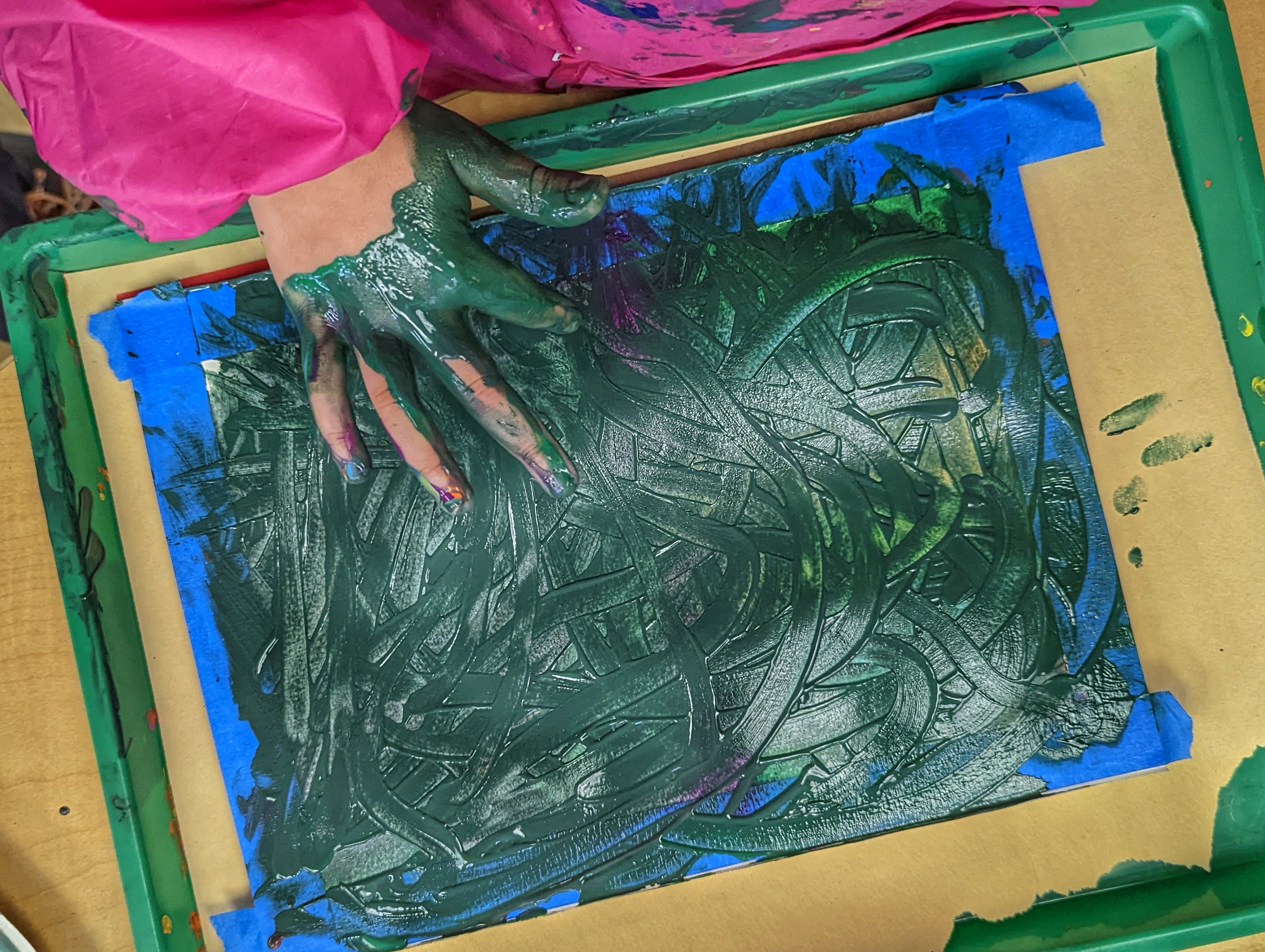
Each artist placed their tray — lined with construction paper — at their spot. They placed one 9X12 inch practice sheet on top of the tray, and one underneath the tray. If they wanted to keep their practice sheets they placed their initials on the back. If they wanted to donate it to the maker trolley for everyone to use, they left the page blank. Then, they picked up their paper plate and stood in line for paint. Their choices were deliberate and purposeful. Each artist was clear about the colors they wanted to work with for this project. Once they received their colors they began creating.
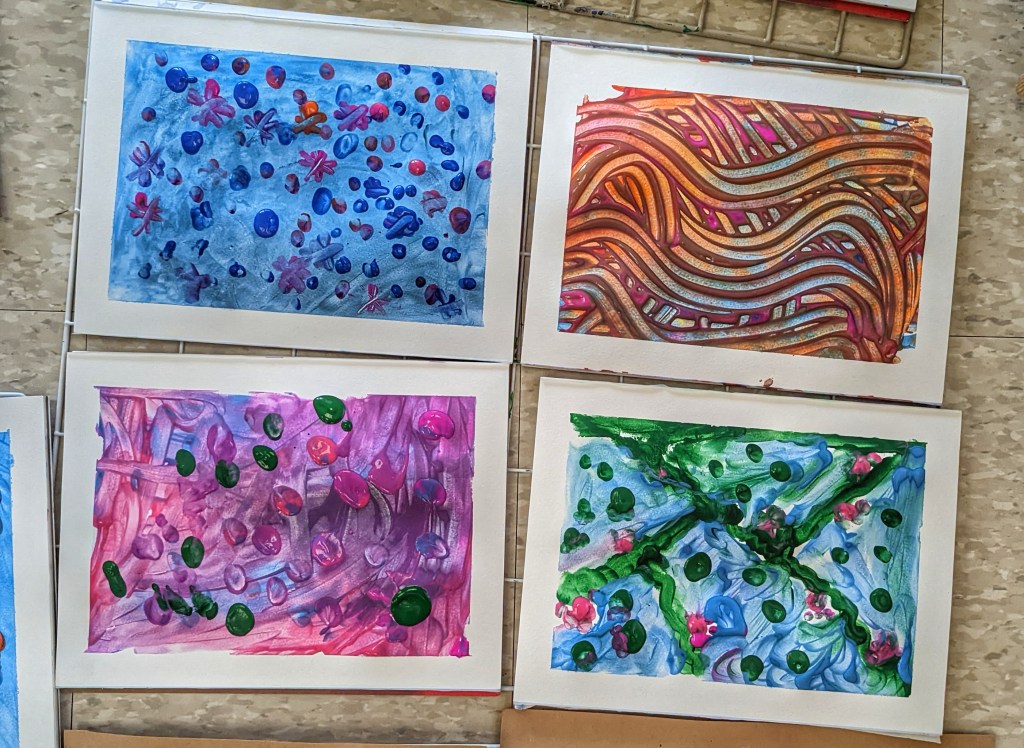
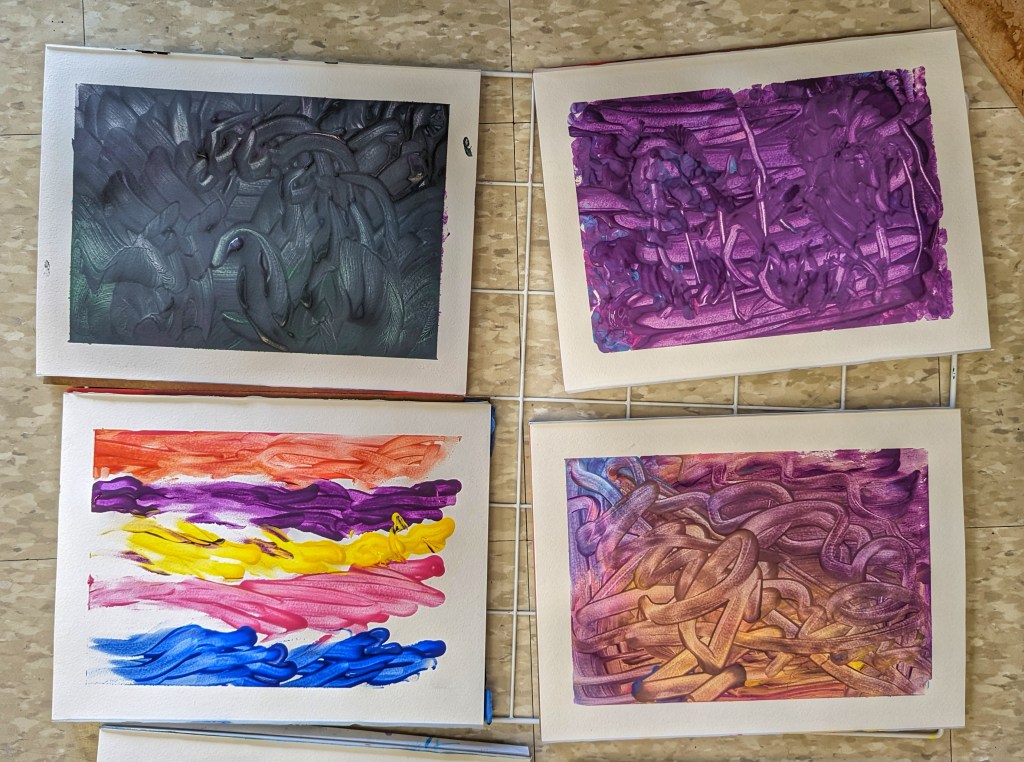
It was interesting to watch the various ways they chose to interact with the paint. Some worked with one color at a time. Others worked with a few at a time. Some worked with one finger. Others worked with both hands, covering the paper — and their hands — with color. On some pieces the colors were distinct, on others the colors melded into one.
I wandered around the room, stopping at each artist’s work to comment on what I noticed. I frequently said “Oh! That is lovely! What a great idea. I never thought of doing that!” I also asked “Are you finished?” Most of the time, the artists responded to my question with a definite “No.” I was committed to allowing this to be a moment when I taught for delight, and to respecting the fact that this was their piece of art and delight, not mine, so each time I responded, “Okay.”
Sometimes that’s a difficult place for us to stand as educators. But, it truly doesn’t matter if I think it’s beautiful. It matters that the artist thinks it’s beautiful, and it matters that I respect that. The only time I intervened was if I thought the paint was so thick that it might crack off the page, or if artist’s hands were dripping wet after washing and were likely to destroy their paper or process.
The results — in both process and product — were remarkably varied and beautiful.
The delight they experienced helped them to be more invested in the process. Being invested in the process helped them stay on task. Seeing, experiencing, and supporting their delight helped me to breathe a bit more, which allowed for there to be increased relaxation and ease in our learning space. All in all, it was lovely, and served to reinforce my believe that teaching for delight is essential.
My Kindergartners have been choosing a name from the kindness cup each morning. They make something for the person they choose. Sometimes they ask me to help get the person away from their desk so they can leave their messages secretly. Other times they leave them in each other’s cubbies.
Today, as I gathered my things after a very long day, I saw this in the cubby nearest my closet.
What a gift.
I hope the Kindergartner who was gifted this gem felt its power. I did.
I’m grateful for this act of kindness. I’m grateful it was left behind today and I got to see it. And, I’m grateful for the reminder that kindness doesn’t stay with the one to whom you give it, but instead, reaches out to bless others.
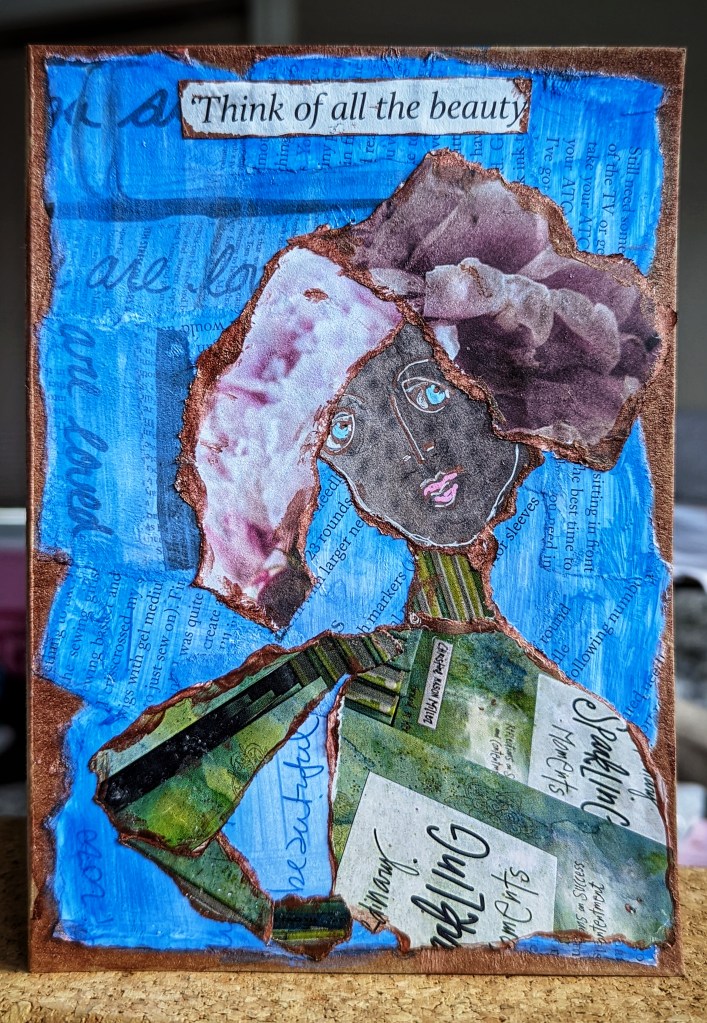
As I finished putting her together, I thought, “She looks pretty good, not perfect, but pretty good.” Since my inner critic was in a talkative mood, I engaged. “True, but is perfection the goal?” I wasn’t being sassy. I was genuinely inquiring. We were both quiet for a bit.
Then I noticed the words “think of all the beauty.” I didn’t specifically pick them to be part of this piece. They fell out of my box as I was choosing other things. But, I noticed them. And, I let them speak to me. Once they spoke, I knew they were the answer, and I knew I had to figure out a way to include them in this piece.
That’s the goal. Think of all the beauty — in art, in life, in ourselves and others. Think of all the beauty.
Learn, be, create, enjoy, and think of all the beauty. Notice it. Acknowledge it. Accept it. Celebrate it. And, preach it.
So, my art and I sit here and preach on. Think of all the beauty.
The other day I got to go to the infusion suite and get some monoclonal antibodies — to, fingers crossed, help protect me against any Covid infections. As I got ready to go, I loaded up my backpack with things I might read or do to help me relax while I was there. A couple books, a magazine, a small notebook, a few favorite pens and pencils, my phone, and my rosary all made the cut.
As I was settled into the waiting room, I pulled out my copy ofCreative Acts for Curious People. I was intrigued by Act #1 by Charlotte Burgess-Auburn. She suggested the act might help to silence my inner critic a bit. Or, perhaps more correctly, help us work better together. Too often, our inner critics are constantly evaluating instead of allowing us to experiment, play, and create without judgement. We want our inner critic’s opinion, but it’s often helpful if we first have the opportunity and freedom to just look, see, think, do, and make without continual critiquing.
Charlotte tasked me to find someone in my field of vision, and then draw them. To avoid conflict with my inner critic, I was to draw the person without looking away from them at my paper, and without lifting my pen from the paper. As I waited to be called in, I glanced about the waiting room to find a subject. I sketched for just a few moments, but quickly stopped, as It seemed too intrusive for me to focus on one person, without looking away for any length of time. I put my notebook and pen away, and waited for a more opportune time to try again.
Once in my recliner and little personal space in the infusion room, I pulled out the book and notebook again. I couldn’t see anyone else, so I looked about my space to see what else I might attempt to draw in the way Charlotte suggested. I decided on the shelf that sat next to me, heaped with supplies the nurses gathered just in case I had an allergic reaction.
I sketched, doing my best to find my place on the page, as well as try to figure out how to create the shapes of the various items, and the space between and behind them, without lifting my pen from the page. I was using a rather small notebook, and one of the most challenging and interesting things to accomplish was figuring out how much space I had left on the page.
I was pleasantly surprised when I looked at the drawing. It was no masterpiece for sure, but it resembled what I was trying to capture. I tried once more — including the IV machine and plug. Again, I was quite pleased with the result.
It may look like nothing to you, but I can pick out the various items. A purple roll of tape, a blue elastic, bags of stuff, the IV pole and machine, the blue plug and grey cord plugged into the electrical socket next to the sockets for plugging in your USB should you want to charge your phone, and the slatted divider between my section and the next.
I enjoyed the process and the product. For some reason it allowed my creative inner self and my inner critic self to be friends – kind to one another, learning from one another, rather than competing. As I looked at my sketch a bit more, I was struck by the looseness of the work. It was a feeling I’ve been searching for — and being eluded by — in my art and sketching. I’m going to try this more often when I’m out and about! Today I gave it a go with a small nativity set I have keeping me company on my window sill.
Again, it’s not a masterpiece. But, it is recognizable. To quote my brother “I knew what you were drawing when I looked at it.”
When you have a moment, give this creative act a go. Don’t fret. It’s not supposed to be perfect. It’s supposed to teach your things, help you make friends with your inner critic, and be fun. If you do give it a try, let me know how it goes.
I’m wondering if this is something I can try with my Kindergarten artists and how I might best present it to allow them to have an equally positive experience. If I try it with them I’ll be sure to write about it.
I embarked on some spring cleaning the other day. To my delight, amidst the piles of things to go through, I discovered a few Barnes and Noble gift cards. The best part is, they still had money on them!!! (By the way, are you wondering why I’d be delighted to find a gift card with no money on it? I wouldn’t be as delighted as I am now, but I’d be happy, because they are nice substitutes for palette knives, and they’re free!) The cards had enough money on them that I was able to buy a cooking magazine for my mom, a magazine about Johnny Cash for my dad, and a Keto bread baking book for my brother. Today I bought some ingredients we needed to make wheat free keto bagels! Can you say “Oh, my, GOSH!?
But I digress.
This is what I bought for myself.
The cover gave me a great idea of how to combine two art projects into one that I think will have my Kindergarten artists quite enthralled. But, the inspiration doesn’t end there. There’s a ton more inside, along with — like it says — artist papers and interactive pages. How can you contain yourself? Go buy it now! And, alas, no, I won’t get a commission if you purchase this magazine. I just think it will make you happy, and give you ideas for more creativity and art in your life, and that would be fantabulous.
After flipping through the book, I marked a few spots with paper clips, and set to work on a project of torn paper collage. This particular collage was small in scale, and relatively simply in form. The artist used one set of torn paper to create a background, and then another to create a person in the foreground. Her work was amazing, and her paper choices were great – one particular choice made me laugh out loud it was so awesome.
After reading her instructions, and studying her work a bit more, I pulled out my paper stash, and began picking papers I might use in my art. For my background, I chose papers with text from a handwritten and printed. I allowed my choices to be a combination of purposeful and random. I moved the papers around until I was satisfied with the layout, and pasted them to my base.
I went back to my stash to find the papers I wanted to use to create the image of the girl. I picked out a few different ones, placed them next to one another, and imagined them as the various parts of the girl. I ripped a few and tried them again next to one another. I rejected some as others came together into a pleasing semblance of face, hair, and body. I looked at my compilation from various angles. I re-ripped and re-placed. I added my own twist to the form of the girl so that I could see words I had purposefully chosen to have in the background. I lost track of how many times I said, “Hmmm, I wonder … ”
Finally I got to a stage that was photo-worthy. I want to remember how I placed her so as not to lose that inspiration as I continue to think. I’m loving the way it looks now but I’m also pretty sure there is more to come. This stage is lovely, but it’s also a bit safe. There’s a lot of wondering and thinking I’m going to have to test out before adding it to my work.
Do I want to do an acrylic wash on the background? Do I want to add a color to the edges of the ripped pieces making up the girl? What color? What facial features do I want to add? Do I want to keep it as a card, or cut it and frame it?
I shared this image with a friend. She said, “You’re so talented” Then, she chuckled and said, “How come you’re so talented?” She’s the second person to tell me how talented I am in as many days. I should probably take it as a sign to embrace, accept, and celebrate the talent I have been given. And yet, at the same time, I want to point out that I don’t think I’m that much more talented than anyone else.
What I am is super willing to try, and try again and again. I sit with things, look at them, take them apart, and wonder about what I notice. I love to play. Sometimes I play just for the fun of it — not noticing anything I learned until later. Other times I play in order to discover if there are new ways to do things, or ways to synergistically combine things, or ways to switch things up to make something even better.
So, am I talented? Yes. Am I crazy talented more than everyone else? No.
Everyone is creative and artistic — yes, even you! And, everyone can be more creative and more artistic. You just have to take a breath and give it a go. Put in the time, the thought, and the energy. Have fun, play, and trust the process.