A Bit of Fantabulous Math Chaos

Ring It was always a favorite game in my Kindergarten space. The Kinders and I would play it all day if we could. It’s a game that can be used with those who are beginning math thinkers and doers, as well as the more advanced thinkers and doers. (Btw, it’s now called Tap A Bell’o. Why? I do not know.)

I bought the game for my pre-K-ers this year, and I’m happy to report it is beloved by them as well! Playing together was a joyful, fascinating learning experiment for me and my pre-K-ers.

After paying close attention to how the kiddos play the game, I usually explain and add rules. It all helps to keep the fun, reduce unnecessary chaos, and increase math and social emotional learning.

These two rules help with the smooth running of the game:
***If you ring it and there is no match, you must sit on your hands for one round. Or, if you’re like one sweet soul today who said, “I can’t sit on my hands, Ms. James. It makes them hurt.” just put them under the table on your lap.
***We begin each round of the game by whispering, “3, 2, 1 flip.”

These two allow for greater math thinking and doing, and I introduce them after we play for a bit.
***Dot cards (I enhanced the deck with them) can be matched to each other or to a number.
***You can add cards to make matches. For instance, 4 dots and the number one can be added together and form a match for 5.

One of our first games, my director joined in the fun. She marveled at the whispered “3-2-1 flip” and then laughed out loud as the bell was rung at least 5 times in quick succession after the first flip. As I place my hand over the bell, she laughed and said, “Phew, Ring It is a little chaotic in preK.” I laughed, too, and replied “Oh yeah! We’re still learning. This is only our second time playing.” She nodded in understanding and continued to play the game with us. The kids loved that she joined us.

Bell ringing, patience, and expedient announcements of your match were areas of learning, and with practice we all got better!

The need for me to cover the bell so that the ringer could think and claim their match decreased dramatically. In moments of passion it sometimes returned, but it was much better. In fact the mighty mathematicians began to develop their own rules to help with one of the difficulties. When we began, there was arguing about who rang the bell first. But, as we continued to play, they young mathematicians started to split the cards, explaining, “Since we both rang, it’s only fair that we both get one of the cards.”

As I watched them play, I noticed one young mathematician always seem to ring the bell first. I was amazed. Then, I realized she flipped her card last, and instantly rang the bell after her flip. Further observation showed she rang before she had a match. She wanted to win and had developed a way to do so. She didn’t understand what she was doing was against the rules. It took her several times to internalize the idea that she shouldn’t just ring as fast as should could, but instead wait until she saw a match. I chuckled sharing it with her mother because I was impressed that she had figured out a way to be successful. Her mother apologized thinking her daughter was cheating. I explained she wasn’t cheating, she was problem solving, searching for possible ways to score matches.

As I mentioned, as the game playing progressed, I introduced the dot cards, and then the idea of adding cards to get a sum that matched another card on the table. In Kindergarten I set it as a goal. For instance, “Today we are playing for 8.” The only way you could gather cards was if there were 8’s to match, or ways to make 8 with addition or subtraction. They could add, subtract, or add and subtract. It was amazing! With my pre-Kers I instead offered addition while playing as a matching option

Once, as they started to whisper “3-2-1 flip.” I said, “Wait there’s another match.” I let them think for quite some time. Finally I gathered the cards saying “4 and 1 more is 5.” I played that strategy a few more times, and then they began using it on their own. Sometimes there was a match and they didn’t find it, sometimes there was a match and they found it, and sometimes they tried all the combinations and discovered there were no matches. I enjoyed sitting back and pausing as they thought and “talked math” with one another.
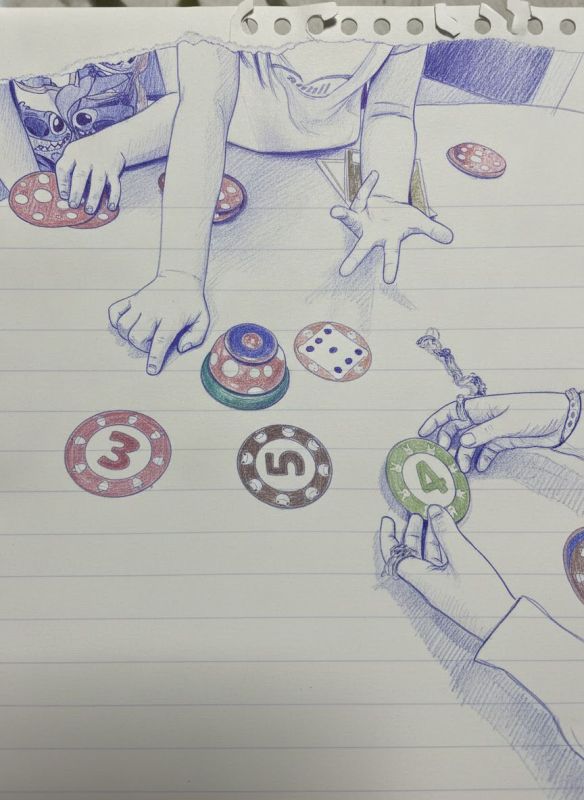
Math talk and problem solving.

Once one of the marvelous mathematicians who was playing “as a helper” figured out the match. Instead of simply using her big, beautiful brain to give her friend the answer she put the numbers on her fingers, then turned to her friend and said, “Here, count my fingers.”
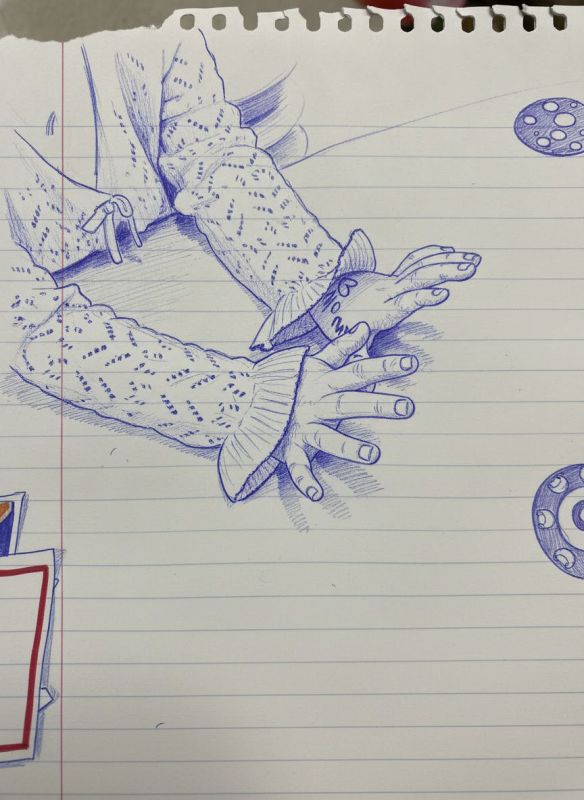
Addition using our fingers.

Some of the mathematicians thrived in the face-paced, mildly chaotic world of Ring It. Others took a while to warm up to it. I was pleased to see that some of the mathematicians would win a match and then announce “I won this for you, Phoebe.” as they handed the match with a smile to a friend who had less matches. The gesture was always welcomed with a “Gee, thanks.” Some would regularly ask to play with partners so they could help each other. They always came up with new ways to partner — for instance: take turns, one ring and call, one pick up the match, or just be a team. I was ok with it all — they were learning math and using math strategies, they were growing as thinkers, problem solvers, and community members, they were engaged, and they were having fun. I learned so much about them as we played together, and just like them, I had a blast.
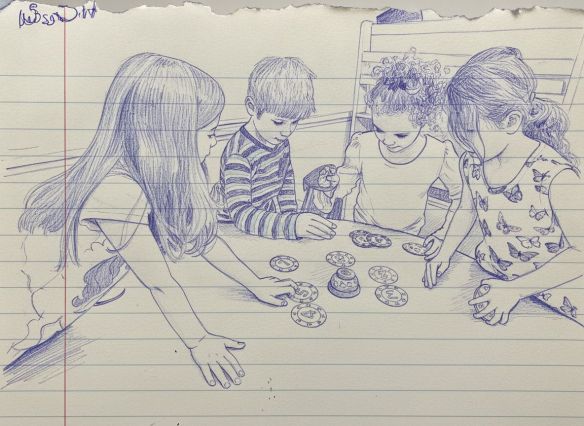
the intense focus of preK mathematicians

Playful Learning, Reflection, and Possibility

Yesterday a fantabulous colleague and I presented — virtually — about maintaining play as a core learning resource as we move forward this school year. It was spectacular to dig into the research, and then enthusiastically share our findings and thoughts with one another. I never cease to be amazed by the power of play in our lives — whether we are kids or adults!

Classroom culture is a key component of play and playful learning. Collaborating with Maribel was the perfect example of that — she is a beautifully kind, joy-filled, and playful educator. Much of our time was spent laughing and saying “Oh yeah! And then we could do this …” Positivity, listening, sharing ideas, practicing “yes, and” and being willing to risk and play, made our time together super productive and enjoyable.

We talked a lot about our classroom culture. What does it look like? What does it feel like? How will it exist, change, or stay the same, if we aren’t together with our kids in the classroom.

How might we create — and help our students create — our classroom, culture, and community when we are separate from one another? Where are our bulletin boards to share art, ideas, work? How do we post our inspirational messages and quotes? If we are stripped of the comfort of our communal learning space how might we recreate it in our own individual homes? We’re all different, with different homes, different comfort levels regarding sharing, and different ideas of what is appropriate for school. How might we enable opportunities for equity and comfort within our own homes for ourselves, our students, and our students’ families?

We had so many questions — which felt a bit daunting — but we decided to look at them as opportunities.

As we speculated, I chuckled and mentioned Sesame Street: Elmo’s World News. Each of the muppet characters created their own cardboard set for the news cast. “Perhaps,” I suggested ” We could have our students make some sort of classroom background for themselves.”

“That’s perfect! Each student can create their own personal classroom at home. They’re doing that anyway, now they’ll actually make the walls,” said Maribel. “Everybody has boxes now. We don’t even have to buy anything!”

I didn’t have to buy anything, but I did have to rescue a box from the porch before the storm hit this week. So rescue I did. Then, in rescue mode, I noticed all the treasures hiding in my recycling bin. As Tropical Storm Isaias raged outside my windows, I got to work.

Occasionally the storm grew in intensity and pulled my attention away from the work at hand. But, for the most part, creating my walls occupied me so fully that I was granted a respite from any worry about the storm. I experienced flow of playful learning as I wondered, thought, researched, drew, painted, measured, cut, folded, looked, tested, and reworked. It was a great experience of the power of play.

I had so much fun creating, thinking, tinkering, and making. And I must say I learned a lot — about construction, possibility, perspective, and much more. Here are my homemade classroom walls.

All that’s missing is me!

I chuckled at just how much it is me. Even in the classroom I rarely if ever put colored paper or boarders on the bulletin boards. I want the student work to be the highlight and pops of color. I much prefer making things to using store bought things. I’m always intrigued by various types of design and engineering one can do with paper and paper like products, and I love making unexpected connections. Even my laptop stand and table were improvisations — a stack of canvases and my ironing board!

As I sat in front of my homemade classroom walls, and watched myself present for the virtual workshop, I was reminded of some of my Kindergarten learners who were anxious about this unusual method of being together. They were only able to join us on our synchronous calls if they were participating from within their cardboard box fort. We established a few rules, and it worked remarkably well. But, as I saw myself surrounded by cardboard I thought — Wow! Talk about a great equalizer. If I had thought about this in the spring we could have all been in our cardboard creations together.

As I created, I realized there are a zillion ways to use this for playful learning at any age or ability level. Here are some of my thoughts:

Differentiate the possibilities for age, ability, and purpose. Which of the following would you encourage?
* only color
* color and decorations
* words or sentences
Imagine the possibilities for learning through the play of making the background. Might you encourage engineering exploration and problem finding/solving?
* Add 3 dimensional elements – shelves, containers, doors, drawers, or a spinner.
* Create the 3D elements using found objects.
* Create the 3D elements from scratch.
* Create the 3D elements from a combination of found objects and from scratch.
Imagine the possibilities for assessment through the play of making the background. How might our learners show what they know and have learned with their background? I am finding a ton of thought provoking ideas for this from Tony Ryan’s Thinkers Keys.
* Create a background that represents a particular artist without specific artwork or name.
* Create a set to use for a video presentation showcasing learning.

A large part of my playful learning happened because I reflected upon my thought and working processes. Sometimes I think we as educators give the impression that fast work, done well the first try, is somehow the goal. But, I find it’s in the iterations, failures, research, struggle, and problem finding/solving that I experience the most joy, satisfaction, and learning. So, I’m going to encourage my learners to reflect and document their own process — including the ways they failed, and failed forward.

Enabling our learners to engage in reflection and documentation will add to their experience, and our understanding of them. Don’t let their age or ability stop you or them. There are so many ways they can document — photos, writing, recording videos. It’ll be great. I promise.