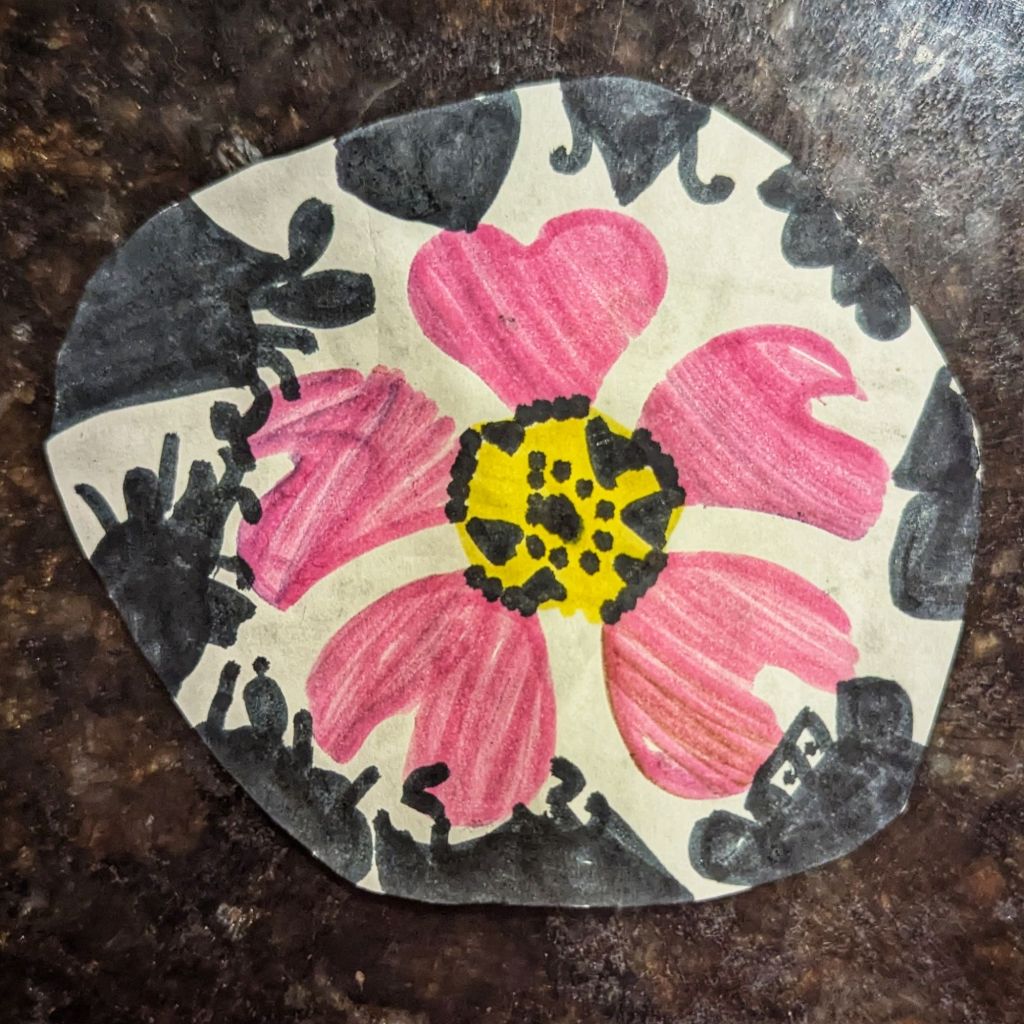
My Kinders’ art, love, and affirmations are powerful.
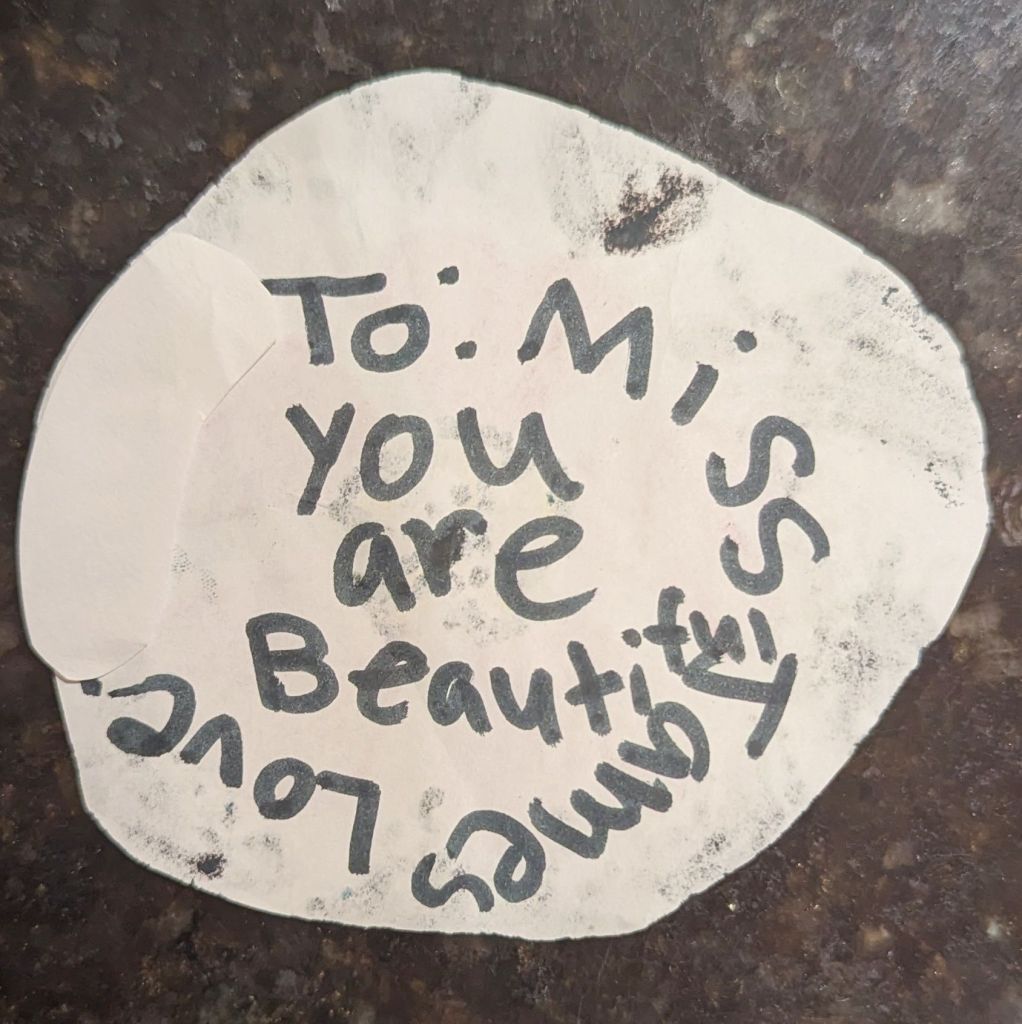
This was given to me months ago. I misplaced it a few days later, and with very pleasant surprise, found it today.
It never ceases to amaze me how much power is in a child’s affirmation!
It touched me when I received it and when I look at it now. I’m nearly 62 years old, and still, the words of a 6 year old have the power to touch my heart and mind, and remind me of a truth about myself. I am beautiful. Perhaps part of my beauty is that I can set aside my own angst and perfectionism and learn from a 6 year old.
Maybe you too need to be reminded about the truth of who you are. My Kinders’ would gladly bless you with their love and affirmations. Feel free to substitute your name for mine.
It feels a bit surreal, and amazing, and a bit nerve wracking. But, yes, I’ve been asked to paint three paintings, and I’ve agreed.
So funny to put that out into the world.
But funny or not, nerve wracking or not, I’m an artist. I’m a creative, wonderful, amazing artist who is going to sell her work! Makes me laugh out loud, and want to throw up, all at once!
I’m going to stick with the laughing out loud and, I’m going to change the tapes in my own head. Yup, i’ve got more to learn. Yup, I can become even better at what I do. But to quote my Kindergartners “You’re very arty, Miss James.” and “Wow! You’re so good at that, Miss James!”
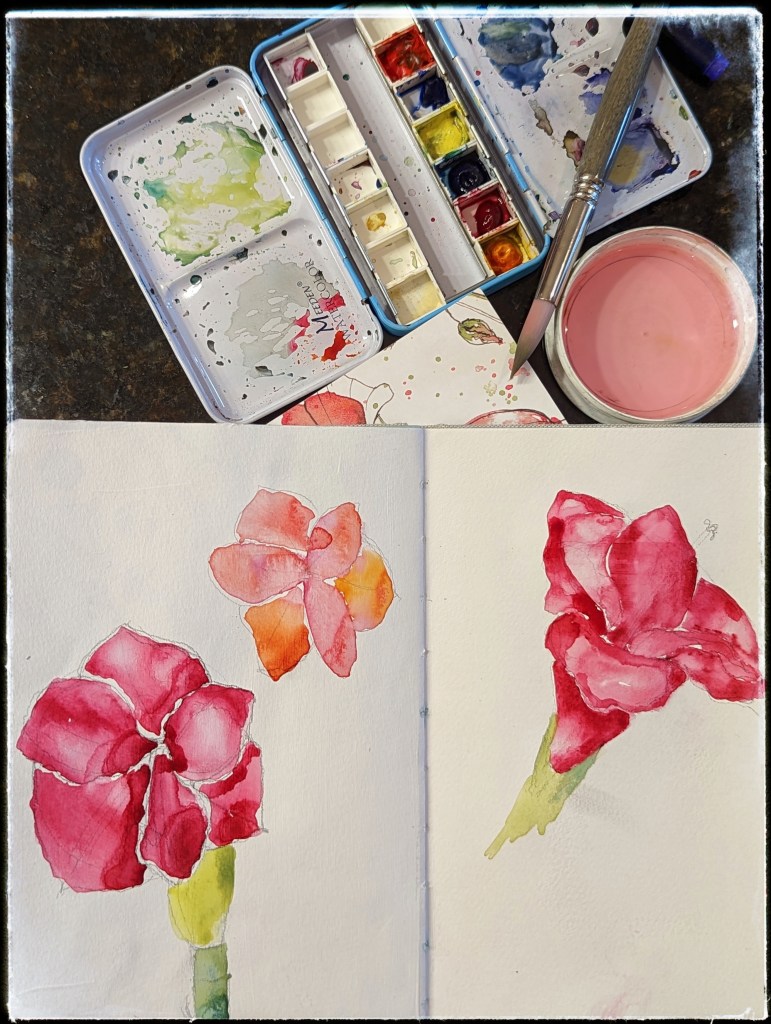
I don’t have time right now to create the paintings – teaching, coaching, and being rested and healthy fill my days. BUT, I do have time to play, experiment, learn, and enjoy my art. This was a quick morning session today.
I worked on sketching, then on laying in paint wet on wet. It was fun and I learned a lot. And, when my brother saw it, he immediately recognized it as my waxed amaryllis.
I really despise making bad drawings — especially if someone is going to see them. But somehow, the planets aligned for me when I flipped to the page that held that quote the other day. Somehow, the quote found its place in my heart and brain, and now that page is one of my favorite pages in the book.
I care about learning to draw, and being able to record what I see. I care about being able to teach others to draw. But, if I care about each mistake, each less than perfect drawing, each wonkily drawn mug handle — the ability to draw a good mug handle eludes me so far — then I will never get at what I really care about — drawing, learning, teaching, and joy. AND if I can’t sit with my own bad drawings, if I can’t embrace them, be willing for others to see them, and learn from them, then I can’t help anyone else do that either.
So I care about bad drawings, but I’m not fretting about them. I’m having fun. I’m laughing at my mug handles all askew. I’m noticing, thinking, wondering and trying again. And, every once in a while the handles look pretty darn accurate.
I started with a bit of trepidation. Eee gads, could I really do it? Could I really not care? Could I really put aside my ego and embrace a beginners mind?
All I could do was try.
I started with the first page. I grabbed a pen, and I drew it. Then I grabbed two more and drew them.
It was a great first go because it was something it could do with a bit of ease and relatively little “badness.” That ease helped my protective brain relax, and allowed my thoughtful brain to draw, learn and have fun.
I’ve been drawing little bits of whatever is in front of me. I fill in the space on the pages in whatever ways bring me joy. I am embracing, and actually enjoying, the challenge of drawing without fretting about my mistakes.
This is what we want all our learners to do — regardless of their age or level of proficiency. We want them to give it a go. Try. Try again. It’s like the creative design process. Try something. Learn something. Try again. Learn again. Talk with others. Have fun. Try again.
Ideate and iterate are two of my favorite words. That’s what Michael is asking his readers to do. That’s what we should be asking our learners to do. Have ideas. Give them a go. Stop fretting. Have fun. Learn.
I want to remember my experience with Michael’s challenge when I’m with my students. Sometimes the task in front of them may feel a bit too difficult. Instead of pushing, perhaps we can allow them to do a similar less difficult task where success is more assured. That experience may give them the confidence to try and tackle the weightier task. Perhaps, we should even construct these activities and make them a regular part of the learning process. Athletes warm up, why not learners?
But, since it’s not, I’ll just have to continue to explore these things on my own, and press on teaching the Kindergarten version of FAIL FASTER!
I’m serious. This is important stuff. Failing – early and often is how we ALL learn. It’s how we learn to walk, ride bikes, spell, do math, make art, have ideas, have conversations, and collaborate — to name just a few.
Failure is NOT a bad thing. Failure is how we learn. Instead of being afraid of it, instead of avoiding it, instead of being ashamed of it, let’s embrace it, let’s celebrate it, let’s see each failure as an opportunity to learn. Let’s even develop one of two tasks where fail is expected, explored, and valued.
Some people baulk at the idea of failing early and often, or failing faster. They’re concerned it implies a lack of thinking, or the encouragement to rush rather than do your best work. On the contrary, lack of thinking, or rushing without learning, would be the antithesis of the idea proposed the the dschool.
Being willing to fail in order to learn, and produce the best thinking, work, or product possible is a mindset I want my Kindergartners to develop with me. I want them to be confident and comfortable in their ability to try, to fail, and to learn. I want them to know it is how we ALL learn, not just how Kindergartners learn. Failure is, to quote Benjamin Zander, “Fascinating!”
If my learners, and their parents, might come to an understanding of the value of experiencing and examining failure with an eye for what might we learn, wow, that would be fantabulous.
I love to sit on my back porch. I sit, sip delicious green tea, breathe, and look.
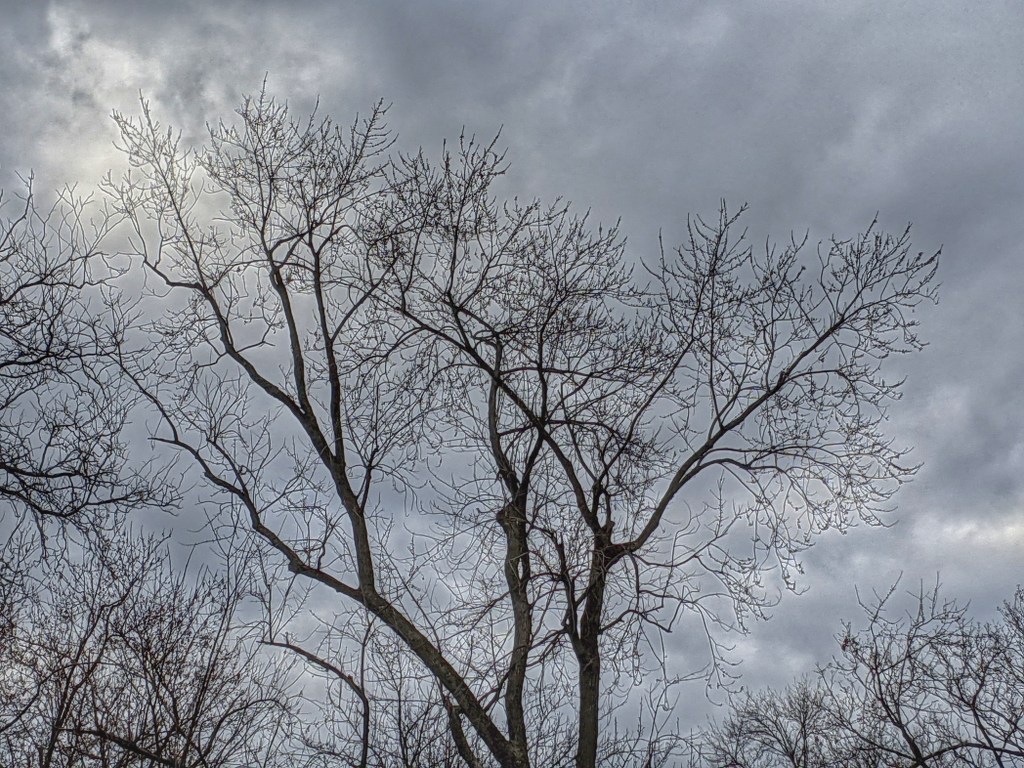
One tree is particularly attractive to me. It stands in my neighbor’s backyard, and greets me from above their fence. I first noticed it as its leaves turned from green to brilliant gold. Its trunk and branches stood in spectacularly stark contrast to the blazing leaves.
I began to wonder if I could capture it in art. Each time I’m on the porch, I look at this tree. I study it. I admire it. I imagine how I might capture its shape and structure. I wonder what colors and techniques I might use to create the fiery leaves glistening in the sun.
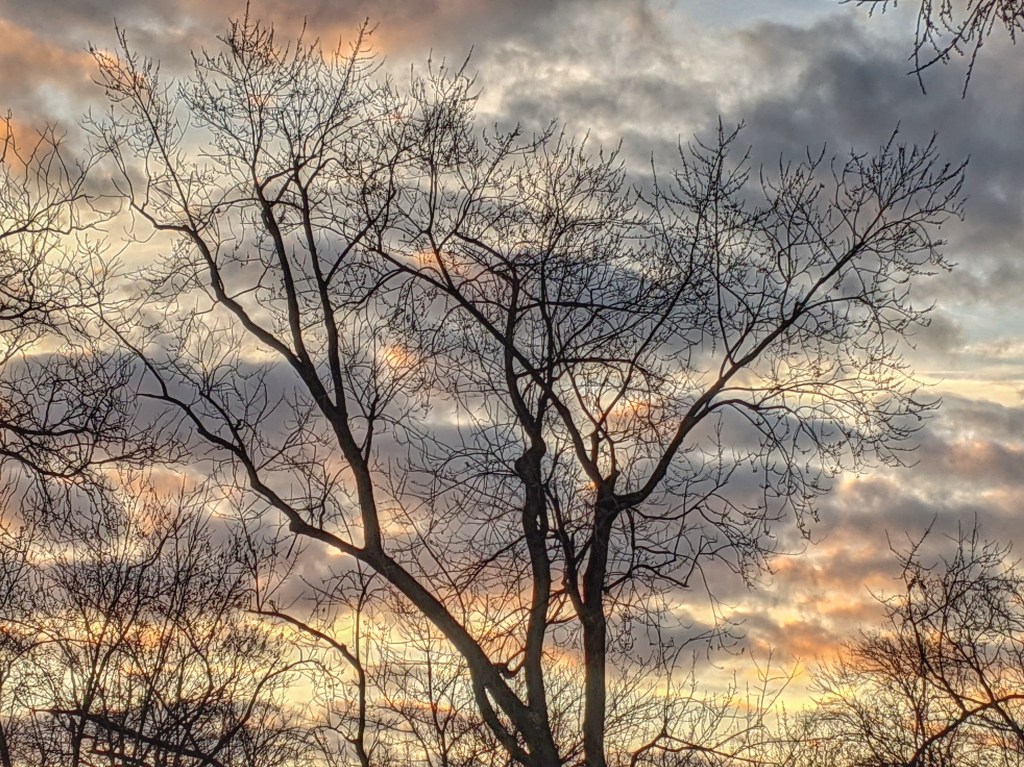
Then, one day, in a remarkably unexpected turn of events, I noticed the tree was bare. All its leaves had fallen to the ground …
… and I saw the sky.
Wow!
Same tree. Same sky.
And yet, completely new.
New perspective. New information. New understanding. New love.
(Click on each photo to see an enlarged version.)
It’s amazing isn’t it?
I’m contemplating doing a study of this tree and sky. Can you imagine? Each day, maybe more than once a day, I would capture this tree and sky in my journal. Every page the same, and yet wildly different! Even if two pages end up being the same, I will grow in my understanding of the tree, the sky, my materials, and my process. And, who’s to say I have to make the sky blue, or the clouds white? It’s my journal, my study, my discovery, my process, my learning, my joy!
I’m excited … and a bit nervous.
PART TWO:
While I wonder if I have a watercolor journal lying around, and where it actually might be, my thoughts turn to my Kindergartners.
Wouldn’t it be amazing if I did this tree and sky study, and then shared it with them? Not as an art project, but as a way to be, and as a powerful way to learn!
I should copyright and market this as a new pedagogical practice – The Sit, Sip, Breathe and Look, Method of Learning. Sit, Sip, Breathe, and Look — Increased learning through relaxation and curiosity. For short I could call it the SSBL Method of Learning.
I started writing the paragraph above with a chuckle. I thought, typed, deleted, and thought some more as I crated a title for my learning method. My chuckles — and clarity– increased as I typed the quick explanation and abbreviation. Naming it seemed to enhance the legitimacy of this as a fantabulous pedagogical practice! Hmmm. I think there’s an article, or some coaching possibilities here.
Until then, back to my students. How would I present my study and the SSBL Method to them? What would I want to them to know? *It’s good — and important — to sit, sip, breathe, and look. *Our brains learn best when we, and they, are relaxed. *Noticing, thinking, and wondering are fascinating, fantabulous, and fun. *Be curious. *Be open to more — more noticing, more thinking, more wondering. *Look, and then look again. *Even when you think you know something, look again. *Especially when you think you know something, look again. *Be willing to be surprised. Expect it, even! *It’s ok to not know, yet. It’s actually kind of exciting! *It’s ok to be a little nervous. *Keep looking. *Keep learning. *Be inspired by others. *Share your noticing, wondering, thinking, ideas, with others. *Create a study. *You can do it.
And, there’s no point in telling them all of this, if I don’t also help them do it.
So what might I do to help them embrace the SSBL method of learning? *Create the infrastructure they need to be successful. *Talk with their parents and invite them into the SSBL method and concept of learning. *Explain some of the brain science the supports this method of learning. *Encourage the parents to create opportunities for the children to sit, sip, breathe, and look. *Inspire the parents to join their children in their sit, sip, breathe, and look sessions. *Gift parents with their own study journal. *Incorporate this form of inquiry and learning as a regular part of our school day. *Provide time for students to sit, sip, breathe, and look — for their own interests, and curricular purposes. *Create journals for them to use to record their studies. *Teach them how to make journals that they can make for their studies. *Join them in their studies, and invite them into mine. *Model curiosity, wonder, and awe. *Value their study and make time to let them share it with others.
I can’t wait to give this a bit more thought, and then give it a go with my girls! Oh, (wink) and market it!
Looking to give my mind something interesting and positive to focus on, I grabbed my sketch book. Then, in a change of perspective, I made some of today’s medications the focus of my morning artistic play and study.
The first cylindrical container was pretty simple. But the others? Not so much. It seemed impossible to translate what I saw with my eyes into an image on the page. I saw shapes, but was unclear how to create them on the page.
Perplexed, I returned to looking, comparing, and analyzing. I realized the shapes I thought I saw, weren’t accurate. And, to my surprise, the slightest change in gaze totally changed my perspective, and hence what my eyes saw. It makes me chuckle to say I was surprised. But, I was.
At this point I abandoned my pen, and employed my blue pencil to sketch in the various shapes. That gave me the opportunity to try, re-look, and try again. I was able to have some aha moments, and finally create something that was satisfying and relatively accurate.
Then it was time to add color. I experimented with the loose watercolor technique I’ve been reading about. It’s interesting that the lack of precision — when embraced in a sort of organic, unforced way — added to my enjoyment of the process, and, I think, gave me a better product.
So, yeah, perspective. It’s remarkably important — transformative, even. How I looked at those bottles — with my eyes, and my heart and mind — made a difference in how I saw them. It was amazing how much they changed with the each change in my perspective — no matter how small. Equally remarkable was how difficult it was for me to see with accuracy, and translate that accuracy onto the page.
Rarely does the first look tell us everything. It may give us an abundance of information, but it leaves a myriad of other things yet to be discovered. Looking at things repeatedly from different perspectives opens us to new ideas, realizations, discovery, wonder, and awe. Unfortunately, we are frequently so enamored with success, knowing, and getting things right, that we forget, skip over, and devalue the incredible power of inquiry, exploration, and discovery of the more.
So, let’s grab our blue pencils, notice, think, wonder, make mistakes, be kind to ourselves and others, and learn! I’m betting our art, thinking, and world will benefit.
I first heard of Frank Gehry, several years ago, when I visited the EMP (Experience Music Project — now know as the Museum of Pop Culture) in Seattle, Washington. It’s a remarkable building! It features Gehry’s folds, and some awesome finishes that reflect light, images, and shadows in fascinating ways.
It’s wild, and so unlike other buildings I had experienced. I was fascinated by how it interacted with the things around it – including me. I could have taken photographs for days!
I was reminded of Gehry and his building, the other day when I noticed Master Class, offered a class of Gehry teaching design and architecture! How cool is that? I haven’t finished the class yet, but I’ve already been inspired.
Now, to be clear. Frank and I didn’t sit down over a cup of tea, and converse. Our conversation began when I experienced his building, and picked up again with his master class. As I think, talk with others, and allow his words and ideas — as well as my thoughts and responses — to impact me as a creative and an educator, our conversation continues.
Two thoughts really struck me.
“My advice is forgot about creative block. Assume you’re always blocked. Just keep trying. Creative block is an excuse out of fear. I don’t think it’s relevant, and I think you should forget about it.”
Interesting, right? Instead of being bothered if you feel blocked, just let it be. Recognize it as a natural state of being as a creative, and keep doing your thing.
I’m reminded of Uri Alon’s idea of the cloud, and think Gehry’s idea can have similar power in the classroom. Much like our thinking, sometimes our creating appears to happen easily, almost magically. Often my girls ask me, with voices filled with awe and disbelief, “Wow. How did you do that, Miss James?” They only see what I can do after hours of struggling with my own blocks. Even the blocks that I may be experiencing at the time they query me, are invisible to them, because like Gehry, I just accept them and move forward.
What an amazing concept to share with my students. Being blocked is a natural state for creatives. It would be fabulous to help lessen the power of their own blocks and worries. It’d be amazing to help them get to the point where they felt the blocks, even acknowledged they were feeling them, and then dismissed them, with a “No worries!”
Perhaps I need to think of a Gehry mini lesson. Maybe I should include other artists as well. Or, it could be that it’s not a mini lesson at all. It could be I just live a bit more transparently — sharing my own process of blocks, fretting, noticing, breathing (with an eye-roll in the general direction of my blocks), and moving on.
The second quote follows nicely after the first.
“Trust it, don’t force it, don’t leave it. Take a risk even if you know it doesn’t work … Where’s the line and what can you do with that information? If you’re relentless you can make the fly that stops the train.”
I love the idea of balance — trust, without force and without abandonment. Take a risk. See what innovative, creative, outlandishly wild, and fabulous ideas you can hatch. Then, see how far forward you can take your ideas.
And his question is power-packed. “What can you do with that information?” You don’t just create something, or fail, no matter how spectacularly you do either. You notice, you learn, and you do something with the information.
Thanks for the conversation, Frank! I have so many great thoughts and truths to share with my students.
Now to integrate these understandings more deeply into my life and being, so I can bring them into my practice and classroom with ease. I’m looking forward to the conversations, provocations, questions, learning , risks, successes and failures …. and things I have yet to imagine.
Just saying those words makes me breathe deep, and experience a wave of peace and enthusiastic child-like joy. Summer break, is the perfect time to engage in the many creative things that nourish me. Yesterday I took five online ukulele lessons. It was fabulous. I learned a lot, laughed at myself, enjoyed playing and singing, and discovered it is quite easy to trip up my brain and fingers. But, no worries, the laughter and enjoyment had me taking notes, and jotting down exercises to practice in order to increase my proficiency.
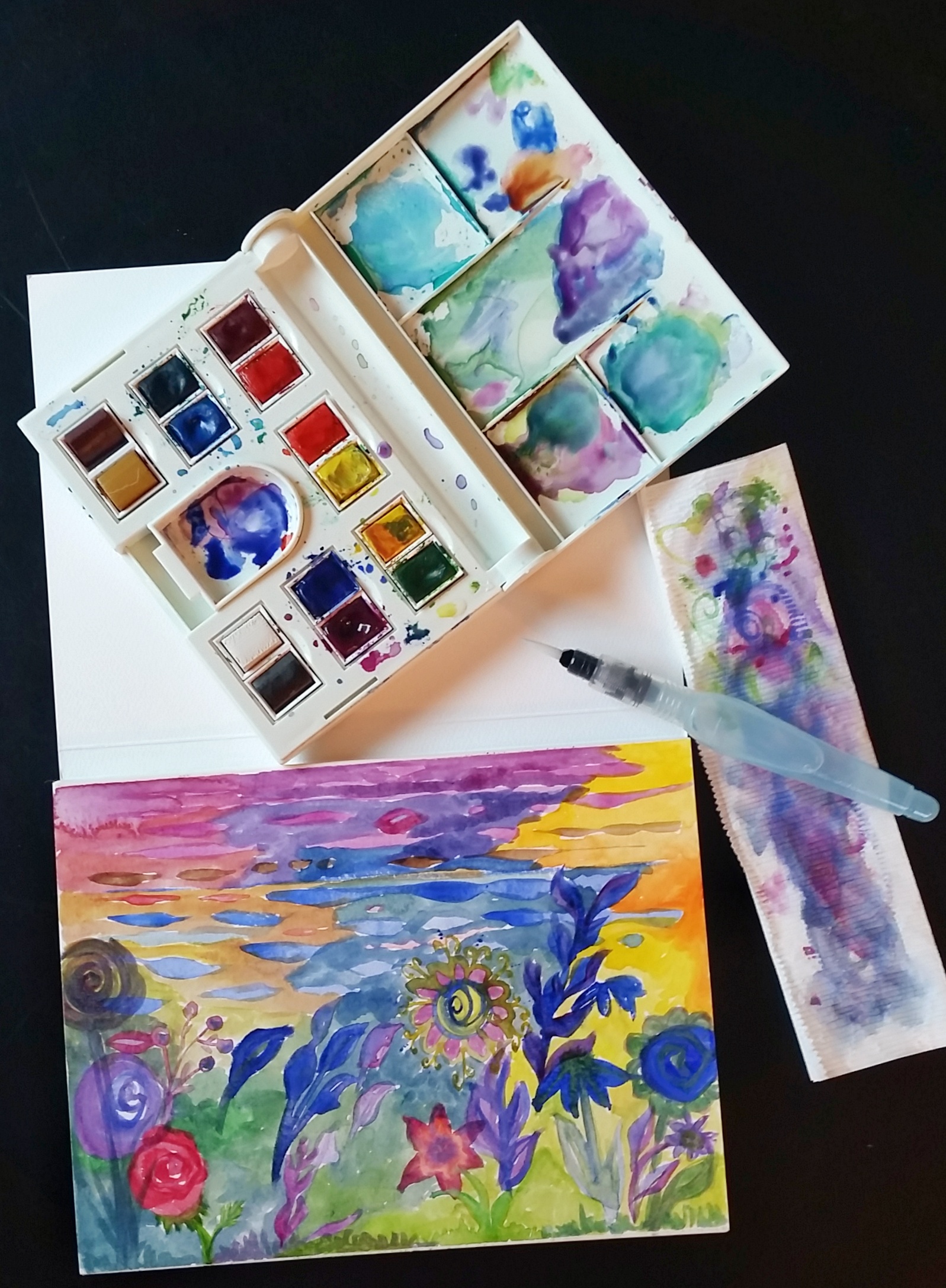
Today I’m in Princeton waiting to take a fencing lesson with my brother, Harry (He’s a fantabulous coach, by the way). Knowing that I would have a long wait, I packed a bag with yoga magazines, a mindfulness book, my laptop, and my traveling watercolor set. Settling at the table, I didn’t even consider the many things I brought. I immediately grabbed the watercolor set. I chuckled to myself thinking “Why did you even bring the other things. You knew you would paint if given the chance.”
So, a little background. For months now, I’ve been thinking about a leaf painting I’ve promised a friend. A few nights ago I sat down with the paper determined to begin to work on it, instead of just think about it.
It sat there, looking at me. I sat there, looking at it. I loved the leaf shapes I had traced — from real leaves found on the trail. I loved the black and white starkness, and if I may continue speaking of the paper as though it were a living, breathing, thinking being, so did it. But, we both wanted to see it come alive with color. More sitting, looking and thinking ensued. Then, it seemed we reached a decision together — I would start, not with paint, but with ideas and inspiration.
I googled “watercolor leaf painting.”Wow! A plethora of fantabulous videos popped up. I was enthralled, and watched videos until my eyes were closing. I had to do more exploring and practicing before I painted the leaves, but I had to paint something. So, instead of the leaves, I painted the background a black watercolor. I set the painting on my desk to inspire me when I awoke.
I mentioned my evening of study to the friend who will someday have the painting. She said “Molly, don’t spend so much time on it. It’s ok. Just enjoy your summer.” What she didn’t immediately understand was the joy I find in the process of watching someone create, and in learning how I might do the same.
Today I came prepared to move from simply watching, to watching and playing. I once more googled watercolor leaves, and found this video by Yashima Creates.
Her ideas and sensibilities resonated with me — experiment, try, be ok with my lack of expertise, and just paint. I enjoyed discovering the benefits and deficits of my brushes and my hand. I embraced the process, and enjoyed playing and seeing what emerged.
I have so much to learn, explore, master, and enjoy. But, for now I’m happy with this process and product. The color, and the composition that grew from the practice marks on the page rather than a plan are very pleasing to me. I know there is a lesson beyond watercolors that I am learning. For now I cannot express it in words, but it is there none-the-less.
As I painted, and cleaned my brush on the towel next to me, I thought about my students. They would “ooh” and “ahh” about my painting, and tell me I am the best painter in the world. They would love my cleaning towel, and declare it a work of art, or a paper suitable for other creative pursuits.
It is lovely to have them encourage me even while they are not with me. I hope they hear my voice in their heads, over the summer and in years to come, encouraging them, affirming them, and calling them on to even greater things.
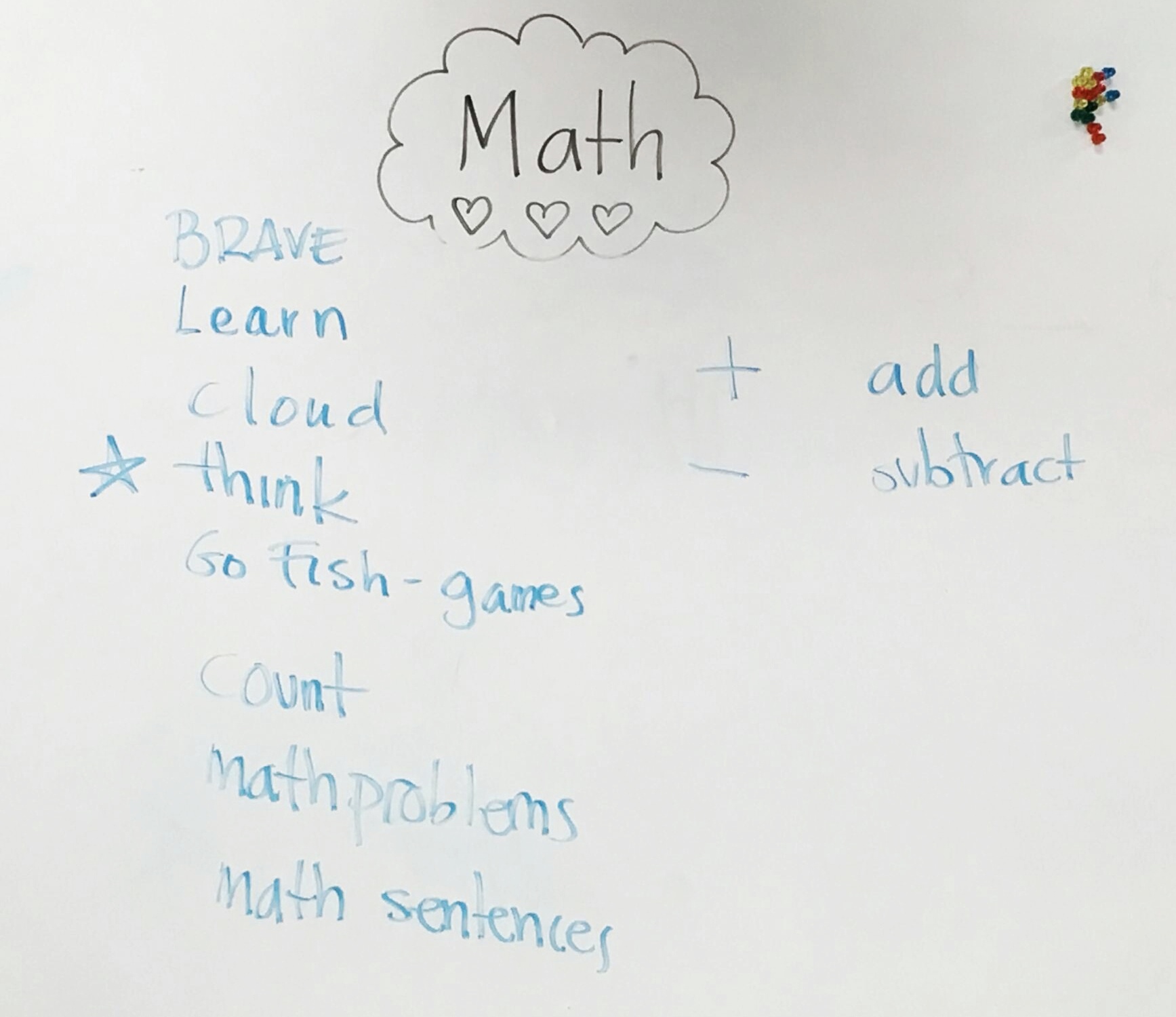
Our number of the day routine includes writing, spelling, and making a given number. We build math-muscle as we explain our thinking to each other – answering questions raised by our partner.
I love math and want my students to love it, too! Hoping to infuse a bit of passion into their routine, I tweaked the process last Friday.
Me: “Pick a number, over 20, and complete your number of the day booklet.”
Them: (with equal amounts incredulity and excitement): “Any number?”
Me: “As long as it’s greater than 20.”
Some jumped head-first into the cloud – challenging themselves more than I might have challenged them. They worked with excitement – fending off any negative feelings – as we sprawled on the carpet, and navigated the cloud together.
Others chose safer numbers. But, they too were stretched and challenged as they wondered, discussed and devised methods to show numbers greater than 20 given only 2 ten frames and blank space.
At first glance perhaps it seems like a very small innovation. Choice. But, the result was stupendous. Trust, freedom, choice, joy, thinking, learning and growth experienced by all. What could be better?
My thinking cap is on, imagining ways to continue to tweak and innovate within our routines!
Woo hoo!!! I am officially an IDEO U student in their Leading for Creativity Course.
Tim Brown, CEO of IDEO, is one of our instructors, along with many other creatives. Oh, and did I mention there are lots of other creative types from around the globe as my fellow students?
I’ve been craving something like this since the day I finished my Creative Thinking MA, with my cohort, and the fabulous Karl Jeffries, at the University of Central Lancashire.
I’m a combination of mild nervousness and tremendous excitement as I begin working with IDEO U and my fellow learners.
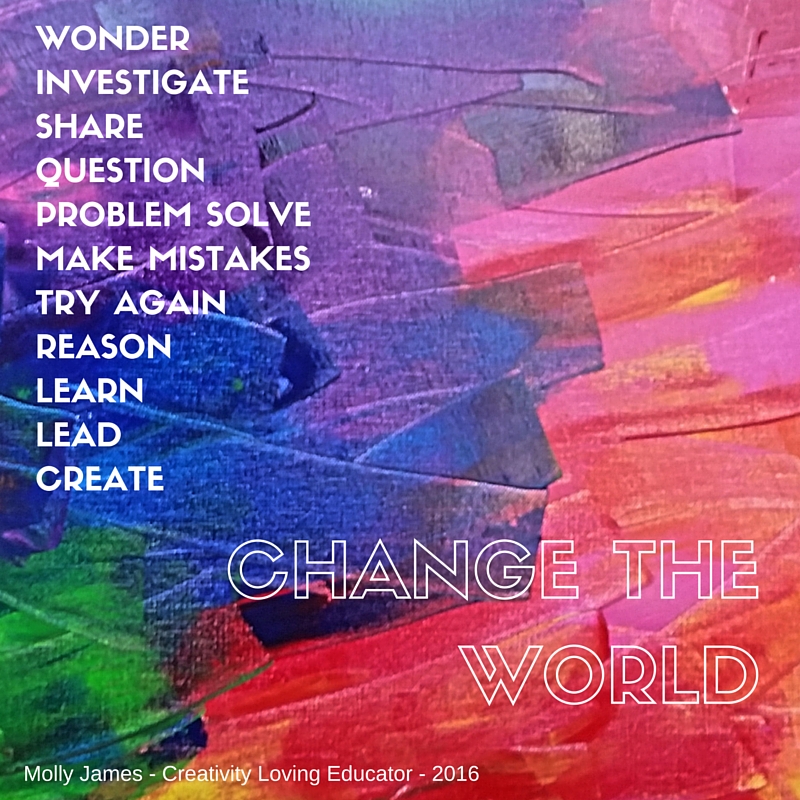
Together we shall …
Yes, that’s my plan — change the world — or at the very least, my little part.










 Life lived with relentless creativity