Classroom Setup 2017-18

Merriam-Webster’s sixth definition of setup is “the manner in which the elements or components of a machine, apparatus, or system are arranged, designed, or assembled.”

I love to remind myself of this definition while I’m going about my classroom setup. I am designing a system in which I, and my students, colleagues, and parents, will work, create, play, and learn. If I’m any example, creating a classroom system requires a lot of thought, reflection, iteration, sweat, and muscle!

As I worked, thought, and sweated, I reminded myself of the truth about myself and my students. We are “rich in potential, strong, powerful, competent(Loris Malaguzzi quoted in The Hundred Languages of Children, 2nd addition, p. 275). I also thought back to my MA research where I considered the environment that might best support creativity and academic excellence.

I read so many thought provoking things as I researched for my MA. I synthesized them in an article in Creative Education.  If I were writing my dissertation, or the article now, I think I might title it Managing the Classroom for Creative and Cognitive Excellence. I want my classroom setup to support creative excellence, and cognitive excellence. To do that, it has to include and support the 6 elements of Teresa Amabile’s KEYS I adapted for classroom management in Managing the Classroom for Creativity:

  • Freedom which enables and and encourages ownership, motivation, and engagement of all the learners.
  • Positive challenge which helps everyone know the tasks/skills they engage in are important and valuable.
  • Supervisory Encouragement which values work and thought, and encourages inquiry and exploration.
  • Work group support which encourages the generation and exchange of new ideas.
  • Easy access to sufficient resources.
  • Organizational Support of our shared vision and an infrastructure that enables and empowers everyone in my learning space.

I’ve finished my initial classroom set up, and am super happy with the result. There is more work to be done, but I’m ready for my learners to join me in the space.

In addition to including the 6 elements listed above, I worked on including more visibility this year. I was mindful of balancing beauty and utility. I wanted our work, vision, thought, prototypes, iterations and our creative and cognitive “mess” to be visible. It adds a richness to the space — telling our story while increasing curiosity, inquiry, wonder, learning, understanding, creativity and excellence!


Here are a few photos with my reflections.

Last year our maker projects where stored in a classroom cabinet. This year, some awesome maintenance people ripped out the cabinet, and I replaced it with this open shelving unit. The wall behind and beside it is covered with a large art piece my students made last year. (How awesome is that?!!!) The use of that artwork, the trays for student work, and the words on the front of the shelving unit let everyone know these things are valued and supported.

20170901_133455


A second smaller shelving unit — on the coolest, gigantic wheels — keeps our tools neat and easily accessible. There’s opportunity for remarkable exploration and learning through the use of these tools.

20170901_133646


The maker trolley has always been a part of the makerspace, but this year I am repurposing the back to hold more materials, and storing our large item bins in the open. I am hopeful this will increase use and understanding.

20170901_133817


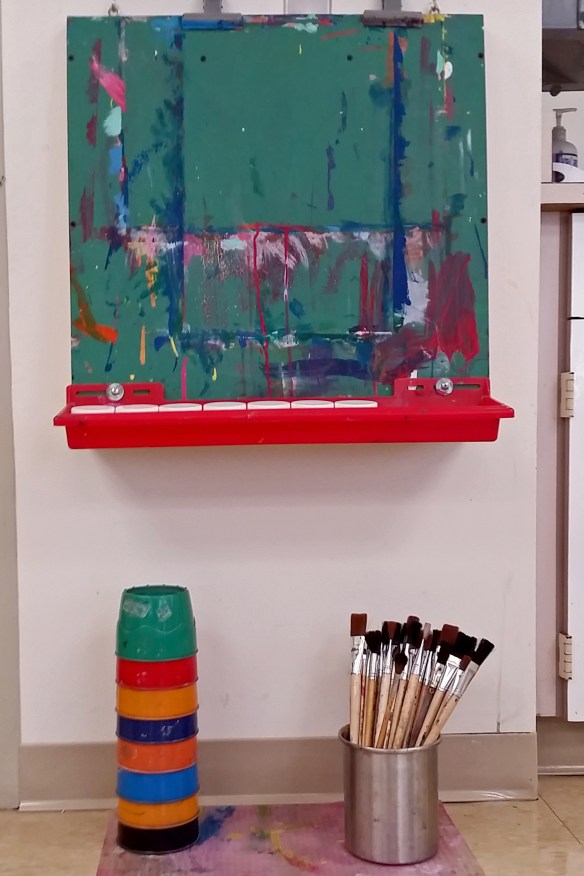
The two classroom easels provide opportunities for creative art experiences outside the regular art curriculum. The second is actually a double easel – fabulous for conversation and inspiration! I love leaving the dried paint on the easels. It adds an element of beauty and history to the space, and allows for freedom as one paints.

I’m thinking about the resources I have that might enable me to store paper beneath the easels — enabling the artists to be autonomous in their work. I have some ideas I’m going to try this week.

20170901_133829

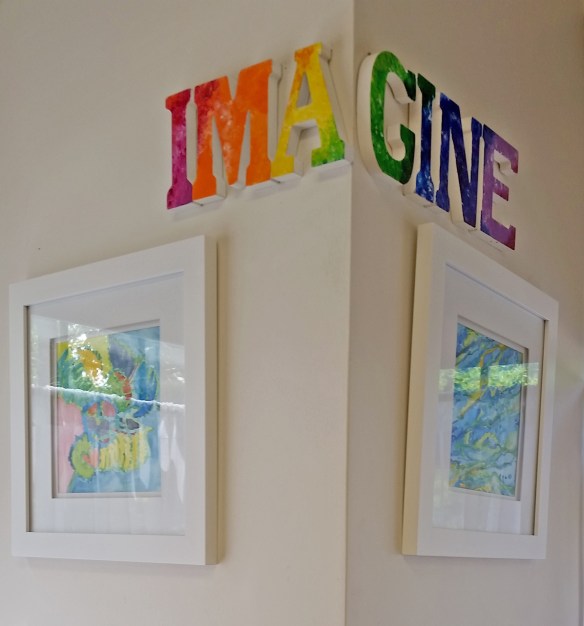
I love the connection between my learners’ art experience and mine (the watercolors are my work). I also like the suggestion of a connection between painting, shapes, blocks and building.

20170901_133525


Print is plentiful and purposeful in my learning space. I want my students to read the room and learn. I want them to become more skilled at letter recognition and use, and to be inspired — to see, read, absorb, and live, what is important.

20170901_13440420170901_13374120170901_133705


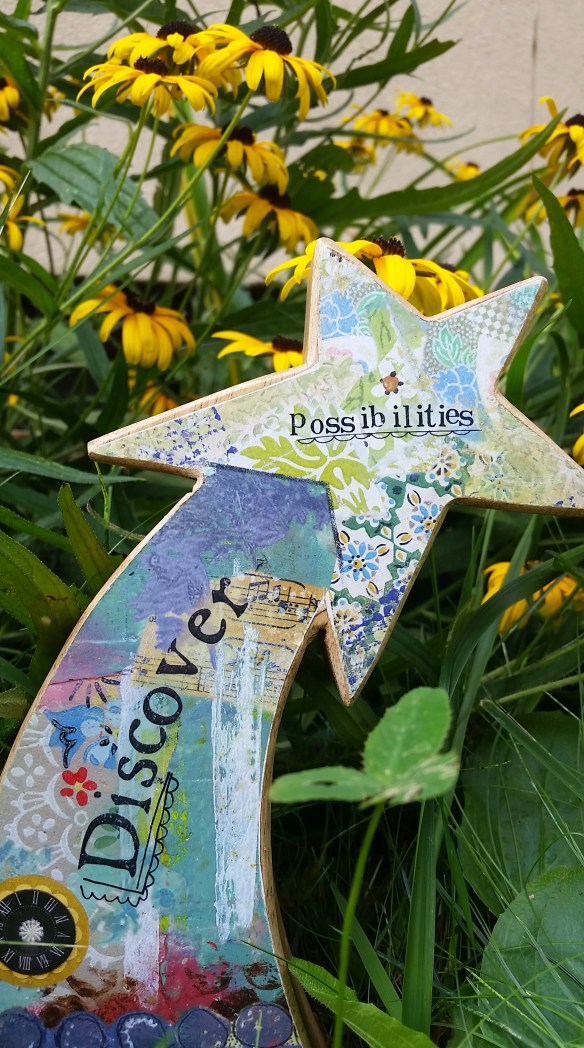
I love all the little print treasures in my space, so it’s nearly impossible to choose a favorite. However, I am enjoying this one quite a bit!  I wonder what it will evoke or awaken in those who see it. For me it stirs up joy, possibility, positivity, and continuing even when obstacles arise.

20170901_133536


And this, partially hidden gem, out of the way of traffic, is a message from me, to me. “Be a superhero every day. The kids and the world deserve it!”

20170901_134151


All the best to all my fellow educators. Arm yourself with another Malaguzzi truth “Nothing without joy!” and have a fantabulous year!


NOTE:

Whenever I write, I think of all the remarkable people I’ve read, talked with, and researched . I think about adding tons of links to each post. Instead, I offer my deep gratitude to all those who informed my research and learning,  and remind my readers there is a great bibliography at the end of my Creative Education article.


Save

Creative Arts and the Art of Creativity

Amazing how much past learning, reading and conversation is coming to mind and  informing this post.  Thinking of a title for the post I considered Creative Arts or the Art of Creativity. Almost immediately, Uri Alon’s TEDtalk, and his use of the phrase “Yes, and …” popped into my mind. Nope, can’t be or, must be and. Hence the blog post title —  Creative Arts and the Art of Creativity. Both are valuable and important, and I don’t want to suggest anything different in my title.

Will Burns wrote an article entitled Should Education Focus Less on the Creative Arts, More on the Art of Creativity? I loved his conversation with his son about creativity.

Just this morning I asked my son who just graduated high school to name the most creative person in his class and why he thought so. He thought about it and said, “I think it would be Cassidy Davis (changed name) because she is incredibly good at drawing people’s faces.” My son seemed to equate “creativity” with a talent. But, interestingly, he went on to say, “Yeah, she does these drawings of people but then puts them into these scenes that are totally trippy and surreal.” (Will Burns, Forbes, August 7, 2017 @ 01:26 PM)

Burns exclaimed “Now that is creativity.”

I chuckled when I read that. I agree, that does sound creative. Cassidy moved beyond her talent to produce “good drawings” and interjected some creativity — placing the expertly drawn faces in fantastical scenes, created in her imagination and translated onto the page through her fingers.

Considering the definition of creativity, and whether or not something was creative, brings me back to the many awesome conversations with Karl during and after my MA Creative Thinking work at UCLan.

What exactly is creativity? Is it the same as talent? Is it connected to talent? Can we teach it? How? (And, a zillion other questions.) For now, the important conversation centers on the definition of creativity.

Creativity is new and useful or appropriate. So yes, when I read Burn’s son’s description I thought “Wow, that sounds creative, and quite cool.” But, if Cassidy’s drawings were not appropriate to the task at hand, they would not be creative. Talented and unique, perhaps, but not creative. Interesting, right?

I thought of this the other day as I did some plein air painting in the Adirondacks.

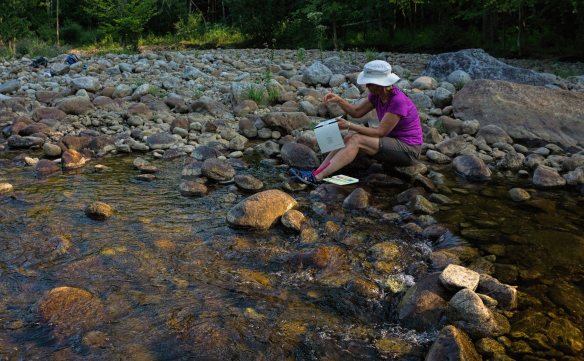
After hiking in, I settled myself, and my watercolors, on rocks in the river. I love this spot on the Ausable River, and I wanted to enjoy the river, the air and the moment. My artistic/creative goal was to capture the movement and spirit of the water, while incorporating a bit of the color mixing I had done at home.
20988281_10214174473455348_9111282026649197347_o

As I sat — breathing and thinking in this great space — I was splashed repeatedly by the river as it flowed by me. Through those splashes, I felt the river asking for my attention, gently nudging me to capture its essence by actually using it in my painting.

I put aside my waterbrush and began gathering water from the river. Slowly, splashes, drips, and then rivers of water, formed on my paper. Grabbing my brush, I wet my paints with the river water. The many colors of nature began to form on the page as the paints moved through the water. Sometimes they glided past one another without mixing, and other times they crashed into one another, swirling into ribbons and pools of new colors.

It was a fascinating and enjoyable process. I noticed the many things I could, and could not control in the process. Much like I must do when walking on the river, I accepted and relaxed – respecting the power but not fearing it.

20935042_10214174473815357_3718381406671347195_o

I am not sure anyone would consider me a great watercolor talent after seeing this painting. I am growing in my knowledge, skill, understanding and talent. But, a great talent? Not yet.

But, is it creative? Yes — it is a new idea that is appropriate to my task and goal.

I wasn’t sure I had achieved the essence of the river until I tried to photograph the painting. It looked best when it sat amidst the rocks. Just like the water around it, it gathered strength, grace, beauty and meaning from the rocks.

Back to one of my original questions. Is creativity the same as talent? No.

Is it then, completely different, completely removed from creativity? Again, no.

Thesaurus.com includes ability as a synonym for talent. They define it as “natural or acquired power” in something.

I am, for the first time, having this insight about talent and creativity. Perhaps talent and creativity are related just the way talent and playing the piano, talent and doing math, or talent and fencing are related. As my skills grow, my talent grows. As my understanding grows, my talent grows. As I practice, try, fail, learn, succeed — my talent grows. The talent can be in relationship to a plethora of different things — including creativity.

And, as my creativity grows – as a thinker in general, or in a specific arena – my talent, so to speak, always grows. Think of jazz musicians, scientists developing life saving drugs, mathematicians proposing or solving incredible problems, poets writing exquisite poems — their talent feeds their creativity, which in turn feeds their talent! It is a beautiful feedback loop.

Neither talent nor creativity are fixed abilities. We all have the ability to be talented and creative. Some may be more innately talented or creative, and levels of talent and creativity vary.  But, and this is an incredibly important thing for everyone — perhaps especially, parents, teachers and young people — to hear, with learning and practice, everyone can grow in talent and creativity.

This leads me back to Mr. Burn’s article Should Education Focus Less on the Creative Arts, More on the Art of Creativity?  and back to my “Yes, and …” from the beginning of this post. I love Burn’s thoughts in his article about the importance of creativity, and of a teacher with an MA Creative Thinking to help others navigate. However, I lean towards Uri Alon’s idea — Yes, and.

Yes, creative arts, AND, yes, ABSOLUTELY, POSITIVELY the art of creativity.

I think, perhaps, Mr. Burn’s would agree with that statement. But, that’s for another post!
Are You a Possibilitarian?


My friend Jojo gifted me with, among other things, a lovely pair of socks. The artist, Kelly Rae Roberts, whose work is on the socks has a tag line that reads artist – author – possibilitarian.

When I read that, I thought, “POSSIBILITARIAN?!?!?! Is there actually a word — possibilitarian — and I don’t know about it?!?! Oh my gosh!”

I laughed out loud, and grabbed my laptop to do a bit of searching.

Yup, possibilitarian is a word. It hasn’t yet made it to dictionary.com, but it can be found on UrbanDictionary.com, and google returned about 77,400 results to my search.

As far as I can tell, the word originated with Norman Vincent Peale.

“Become a possibilitarian. No matter how dark things seem to be or actually are, raise your sights and see possibilities – always see them, for they’re always there.” 

Raising our sights, seeing possibility — being a possibilitarian — has the potential to increase our ideas, exploration, discoveries, inventions, innovation, collaboration, creativity, life, and joy.

Really, how fantabulous is that? Super duper wicked amazing fantabulous?  Yes, I think so, too.

Now, how super duper wicked amazing fantabulous would it be to help our students become possibilitarians?! Even better, right?! Right!

Let’s get on it!

20170814_102245-01

As an added note: I wanted a photo to add to the post. I remembered this cool little piece of art my mom bought me for my classroom. PERFECT! After I took the photo I turned it over and guess what I saw. The artist is Kelly Rae Roberts. Rock on with your possibility loving self, Kelly! 

To Examine or Not to Examine

I’m enjoying the look and content of the latest Flow magazine. Beautiful designs and thought provoking ideas fill the pages.

This is one of them.

20170722_121756-01.jpeg

That statement made me think … a lot.

With all due respect to Mr. Albee, after much consideration, I must disagree.

Yes, yes! There are definitely moments when creativity feels like magic. There are moments of inspiration, and moments where we proclaim “Oh, now I see! That’s it!!!” But, I think if we examine those moments carefully, we frequently, if not always, discover a copious amount of thought, research, making, and/or, hard work which preceeded, and helped create, our “magical moments.”

I love the moments that seem steeped in magic. Part of me wants to protect the moments, the experience, and the phrase, by embracing them and, like Albee, discouraging others from examining them too deeply. But, I think that may be detrimental to creativity because sometimes magic is elusive, and creativity is actually so much more than magic!

Better, I think, to closely and carefully examine creativity, and its magic. The study need not detract from those deliciously wonderful aha-moments.

Understanding the creative process, the environments that support it, and the plethora of things that often help, or hinder it, may help us experience more “creative magic,” be creative — in all aspects of our lives and work — and impact the world in beautiful, amazing ways.

Meanwhile, don’t give up if the magic is eluding you. Work. Think. Imagine. Make. Believe in yourself. Be confident in your own creativity and your ability to experience awesome “creative magic.”

But, bear in mind, creativity often requires a lot of hard work and time. Don’t avoid it.

And, sometimes, when the magic finally does appear, it appears as a simple little spark. Don’t miss it.

Beauty

There were so many beautiful things to see at the museum. Spectacular paintings, sculpture, metal work.

This was the most beautiful.

IMG_20170718_114328_processed

No, not the statue, or the paintings, or the stunning gallery — the woman and child huddled together.

They entered the gallery with quiet interest. The woman carried a folded stool which she casually opened out of the way of any traffic. I thought perhaps it was for her. I was wrong.

The girl scanned the gallery with a bit of child-like enthusiasm — notebook and pencil clutched in her hand. They whispered to one another. The woman moved the stool slightly, and the girl took a seat, opened her notebook, and began to sketch.

Their faces gazed up and down — contemplating the artwork of the gallery artists, and creating new work in the notebook.

The woman was always present — sometimes whispering, sometimes watching, sometimes gazing at something in the distance. The girl worked — her face buried in the notebook — for as long as I remained in the gallery.

For me, the beauty in that relationship far outweighed the beauty of any piece of art. I am not sure I can adequately explain why. But, I will try.

The girl was young and completely captivated by the art in the gallery and on her page. I don’t know if she was recording what she saw, or being inspired to make her own creation. It doesn’t matter so much to me. It was her joy, her passion, and her intentness that drew me.

And then the woman. She served as such a beautiful counterpart to the young artist. Everything she did appeared to encourage, empower and support the girl and her creative endeavors.

I hope to always be a beautiful counterpart to others. Might we all be!


Creating and Curating Their Own Creativity

We frequently visit our school art gallery. We go armed with sketch books and pencils — ready to sketch anything we can see from within the gallery. Sometimes this is art, sometimes each other, and sometimes things we notice through the windows.

Most days our conversation goes like this:

Them: “Miss James, can we take off our shoes?”

Me: “You may — as long as you understand if we have a fire drill you are going outside without your shoes.”

They always agree, and I always cross my fingers that we don’t have a fire drill! Typically, once their shoes are off, they stow them under a shelf in the gallery and happily get to work sketching.

On this particular visit, the removal of their socks and shoes fueled their imagination and provided a unique medium for their creativity.

As I walked about the gallery. I came upon this …

20170216_132710

Returning a few moments later, I found this …

20170216_132720

And, finally, a bit later, this …

20170216_132842

I love their creativity, collaboration and inclusion. Did you notice the number of shoes and socks increased in each photo? Each time someone asked to join, the original artists expanded their work to include their friends.

In the last photo, they are working together to collect the signatures of all the artists who contributed to their “double-flower art.”

I love that the freedom I gave them — to take off their shoes and wander the gallery in bare feet  — resulted in such beautiful, examples of their powerful and joy-filled agency and creativity! I never cease to be amazed how such simple things — though profound when you think about it — as time, space, freedom, trust, resources (bare feet, socks and shoes, pencils and sketch books) and agency, allow these young creatives to do their thing.

They are fantabulous.


Our Door

“I want my art to be sensitive and alert to changes in material, season and weather. Each work grows, stays, decays. Process and decay are implicit. Transience in my work reflects what I find in nature.” (Andy Goldsworthy)

I don’t know how Andy Goldsworthy does it – in a couple of ways! I have no idea how he makes the art he does. It’s quite spectacular. And, more importantly for my thoughts today, I have no idea how he deals with the transience of his work. It’s remarkable to work for so long on something just  to have to fade away.

I felt a bit of that as I took down the final vestiges of our supermarket build. The last thing to go was the door.

IMG_20170609_225845_processed

I kept it up a few days after the girls left. It seemed odd, in some ways, to feel such a connection to the door. But I did. Funny, even writing about it feels me with emotion.

That door was a part of our classroom for months – first in our thoughts, imagination and conversations. Then in uncompleted form, forgotten it would seem, on the side of our build. Still later, in our day-to-day exploration, experimentation, and work to build it. And finally, as a working door, providing the only access to the main part of our classroom.

We went in and out of that door a zillion times! We marveled at it. We kibitzed with it – trying to make the hinges more stable, and prototyping different handles. And, we just lived with it.

Perhaps that’s it. Andy sees his art and creativity as a statement of transience. He creates it as such and in some way revels in the transient nature.

I, however, did not.

I knew the supermarket would only be up for a short period of time. But, I didn’t enter into the relationship with the girls and the build with transience as my goal, or even as my understanding. Each day we entered into the now of the build, the some time of our imaginations, and the ever deepening forever of our relationships with each other.

That door held deep meaning. It was the way we entered into a lovely, safe, joy-filled space in the classroom. Perhaps even more important, it was also a way we entered more deeply into relationship with each other. We imagined hard, thought hard and worked hard to get the door up and functioning – and that drew us together as a community.

I laughed at myself a bit as I looked at the door, standing alone in the classroom. What good is a door with no walls? Why would someone keep up a door to no where?

But, as I thought I chuckled. It isn’t so silly to be attached to this door. It’s not a  door to no where. It’s a door still open to all those moments, all those ideas, all that love, angst, joy, celebrating, collaboration, hope and possibility.  It’s a marvelous magical door, imbued with the spirits of all of us who worked on it, marveled at it and enjoyed it.

Perhaps after all, in some ways, our creativity is just like Andy’s. Our relationships, memories, hopes, and all the possibility that fills them, last forever. But, Kindergarten, is transient and brief. So too, is our build, and our remarkable door.

Thankfully, similar to Andy’s art, it lives on in our hearts, memories and photographs!


Creativity and Leadership

I recently had an article published entitled Cultivating Dynamic Leadership through Creativity.

I give three examples of leadership in a creative venue:

  • She leads through her curiosity and sensible risk taking, and all emerge with new understanding and innovative methods.
  • She leads with empathy, which drives her to connect and comfort others.
  • She leads through her belief in the power of possibility, discovery, research and experimentation.

When a friend of mine read the article, and these examples, she said “I wonder if people just read these examples, if they’d know who you are writing about.”

I wonder that, too!

So, who do you think she (or he) might be?

A teacher? An entrepreneur? An artist? An IT professional? A psychologist? A parent? A scientist? A researcher? A doctor?

While each are suitable guesses, they are not who I had in mind when I wrote.

I didn’t write of a professional, or even of an adult. Instead, I wrote of my kindergarten students.

build leadership sized

They are remarkable, strong, powerful children. While they are fantabulous, these characteristics are not unique to them. All children, have incredible strength, power and potential.

My teaching practice is informed by my belief in this profound power and potential of children. I try, as best I can, to allow my teaching, and my reflection, to be nourished and driven by the “joy, passion, wonder and conviction” of my understanding of the truth of the strong, powerful child. (Managing the Classroom for Creativity, James 2015)

Children are natural leaders. Placed in an environment that enables and encourages creativity, their innate leadership abilities germinate, increase and flourish.

Resources:

James, M. (2017). Cultivating Dynamic Leadership Through Creativity. KPS Voyager, 2017, 8.  (https://issuu.com/kentplace/docs/voyager2017_final?e=1889902/47525909)
James, M. (2015). Managing the Classroom for Creativity. Journal of Creative Education Vol. 6, No. 10, 1032-1043 (http://file.scirp.org/pdf/CE_2015061915593867.pdf)

Hinges in Kindergarten

20170501_204911-1-01

How will we make our own hinges? Hmmm …

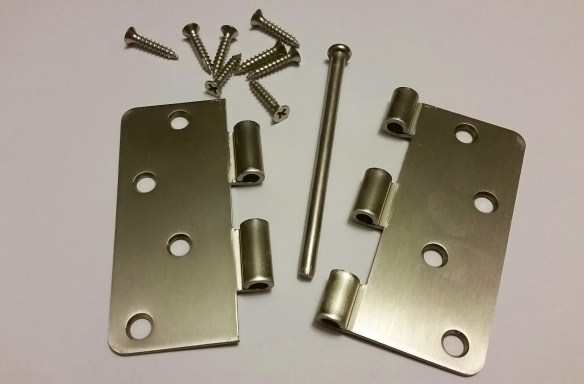
The girls and I have been thinking about this for some time now. Last night I ran out to the hardware store and bought a hinge so we’d be able to look at the pieces, and problem solve together today.

Seems we have many problems to solve:

  1. We don’t have a way to screw in the hinge plates.
  2. We don’t have the remarkable stable structure of concrete walls.
  3. We don’t actually have hinges or hinge plates for our door.
  4. We don’t yet have the door completed.

How might we:

  1. Make our door more secure and stable? (Tomorrow we’re going to take a look at some door designs.)
  2. Create hinges, or hinge-like things, to hang our door?
  3. Create a stable structure to anchor our door?
  4. Make our door workable?

When I look at all the problems, and all the how might we questions, I’m a tad overwhelmed. But, then I see, in my minds eye, my girls, this morning.

I told them I had tubes that might work for the door. With a good deal of excitement, they asked if they could work on the door. “Sure, go ahead!” I replied.

When I popped my head in the makerspace, it was a remarkable scene. Four large columns were being constructed by four groups of girls. They were talking, pointing, sharing ideas, collaborating, and working hard. Some were standing on chairs (the door is much taller than they are). Some were straining their necks to see to the top of the door. All were engaged, empowered, invested, and joy-filled. It was AWESOME.

There is hope!


P.S.

Perhaps you are wondering:

  1. Why do you need to make hinges?
  2. You’re making a door?
  3. Why do you need a working door, doesn’t your classroom already have one?

We are making hinges and doors as part of our Social Studies supermarket build.

More on that later!


Are They Listening?

I was inspired by a colleague to truly make my word wall interactional – student driven and written. It’s a whiteboard, so it’s easy to revise. I erased everything I had on it, and moved it a bit closer to the floor. They would still need a chair to write at the top, but they could do it!

During guided reading, I rolled out the plan. Everyone was to write 3 words. They could be words they really liked, or words they used a lot in their writing, or words they wanted to use in their writing. They could be any words, BUT, they had to be written the way they are in library books. (Usually, when we write, the words need to be encoded so that the authors, and I, can read them.)

They got papers and set to work with enthusiastic determination. As each finished, they shared their list with me. We worked to spell each word the way it was in a library book. Sometimes we worked harder at hearing sounds and encoding them. Other times we recalled spelling rules and combinations. Still others times I asked permission to show them how it would be spelled in a library book.

Finally, they joined me at the wall and added their words. It took us a few days to get all the words written, but it was worth it! It was such a joy to watch them work, and to work with them.

They reached as high as they could to add their words.

20170406_111814-01

And the words they chose were …

I cannot think of an adequate descriptor …

…. amazing, fantabulous, wonderful, overwhelming.

Take a look at two of the word lists.

20170407_155511-01

Yes, there are sight words on the wall such as  — we, and, of — and other words they know and enjoy like — candy, cup.

But the wall is filled with things I have said, written and encouraged!

One student wrote “I’m possible!” as an Ii word. It’s a reference to the statement “Impossible just says ‘I’m possible.”

Are they listening? Yes, they are! 

Note:

You might be wondering about the word fantabulous. You may not find it in a dictionary, but it is a word in our classroom. I made it up a few years ago. It’s a combination of fantastic and fantabulous — two words I say with some regularity. One day, while chatting with the kids I said it’d be great if there were a word that was both fantastic and fabulous … like … FANTABULOUS! 

It has joined the lexicon of our classroom, and appears to be moving on with the students and their families. Soon, perhaps, it will be found in the dictionary!