Celebrating Little Moments: A Kinder’s Art of Noticing

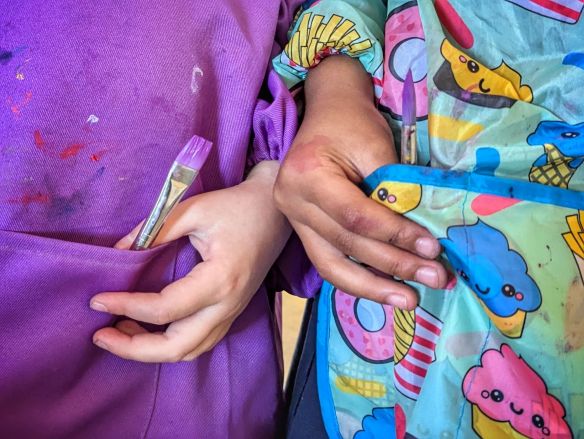
The other day two of my Kindergarten artists were moving excitedly to a new spot in our learning space — paint brushes in hand. Paint brushes that were dripping with lovely purple watercolor paint.

Me: “Careful with the paint brushes. Maybe you can leave the here while you go there.”

Them: “Ok.”

They didn’t drop them off with me. Instead, a few moments later, as I wondered where they and their paint filled brushes were, I heard squeals of delight as the two of them hurried back to me.

Them: “POCKETS! Miss James, we have POCKETS!”

Me: (laughing out loud) “Indeed you do. What a great way to use them!”

Little things. Are there really any little things? Or is it simply the way we look at them.

Pockets — when I don’t need them or notice them — become small insignificant things. But when noticed, found, needed, and used, they become wonderous things to celebrate.

I’ve been wanting to bring more joy, positivity and hope into my life these days. I think this is an answer — notice and celebrate the little things.

Oh! How fantabulous is this?!?! I’ve also been looking for ways to encourage my Kinders to reflect and write. Perhaps a little-things-noticing ritual with a lovely handmade little-things-noticing journal is the answer! Art, writing, and mindfulness all wrapped up in one. This can be a beautiful ritual that allows us to slow down, take a moment, notice, celebrate, and keep track of the lovely little things. I think I can find a bit of time in the morning and afternoon for us to note one little — wonderful — thing.

Fingers crossed I’ll keep you posted.

Here’s a few of mine for right now:

  • sunshine
  • naps
  • sprouts growing
  • birds chirping
  • my flute
  • greeted by name by a kind soul
  • conversations with old friends
  • delicious green tea
  • my inhale-exhale mug
  • a blog post

I wonder how the Kinders will experience this ritual of reflection and writing. I will have to think how I might structure it — the journal, the time, the selling — to help them experience it’s power.

My experience? I found that seeing one thing brought another, and another to mind. Occasionally I felt a bit of reticence — thinking other might find my ritual silly, I think. But, as I brushed that away, I found more things to note.

Let us all learn from my Kindergartners. Let’s notice, celebrate and share the little moments — even when we think others might think us silly.

I’ll go first … “A nap! I got a nap!”

Play, Paint, and Learn

Lately, I’ve been painting in a 6.5 inch square watercolor sketchbook. I’m able to do a good bit of playing and still finish in a comfortable amount of time. When I feel like doing more, I use both sides of the page to create a 6.5 x 13 inch spread. I like having the option of the two sizes, as well as my previous art for provoking ideas and bringing me joy.

I played with circles the last few days. I did the one with the colored shapes first. It was a multi-day process:

  • Tape the edges and paint the circles.
  • Look, enjoy, and wonder, “What might I add?”
  • Draw the flowers.
  • Add the splatters of paint.

I unintentionally got paint on the other page of the spread. It’s what happens when you forget to cover it before splattering paint. It was, at first, a bit annoying. When I let go of the annoyance I saw the opportunity to play.

  • How else might I make circles?
  • How might I use my mistake in a new piece?
  • How would it look to add a border and paint the inside with payne’s gray?

I’m pleased with how the two images look. There’s something quite satisfying and entertaining to have them next to each other, supported by the round-ish rocks gathered on a previous hiking trip.

My playing, painting, and thinking — was fantabulous and fruitful. I’m struck by how important my playful exploration was to me as a creative, a thinker, a watercolorist, a designer, an educator, and a learner!

  • How I hold my brush makes a big difference in the quality of my painting.
  • Even though I’ve painted for quite some time, I continue to experiment, notice, learn, and perfect how I hold the brush.
  • The very same paint yields wildly different results depending on the combination of water and paint.
  • As I play I develop and deepen my relationship with the paint, the paper, the brush, myself, my brain, and what’s possible.

As I played and reflected, I thought of my young learners. I want to create space, time, opportunities, routines and rituals that afford them the same opportunities I have as I sit at my kitchen table, or out on my patio, with plenty of paint, paper, markers, pencils and time at my disposal.

Here are some things I’m wondering about:

  • How else might we store and use our sketchbooks, markers, paint.
  • How might we integrate art (painting, clay, drawing) writing and reading.
  • How might we engage in intentional reflection — self reflection and reflection together — about our noticing, thinking, and playing.
  • How might I make time to regularly join my Kindergartners in these things.

Carry Kindnes

I had a new idea this week!

Typically I talk with my Kindergartners about being real life super heroes. This year, that didn’t seem to reach them, so, early on, I changed my teaching point to kindness. Our whiteboard declared “Kindness is Powerful!” We posted photographs of ways we are kind at home — helping with the dishes, playing cards with our sister, making dinner with our grandma. Then the Kinders drew images of ways they are kind in our school and classroom. Our kindness exploration, noticing, naming, and celebrated continued through the year in various moments of our day.

Since our focused moved from super heroes to kindness I needed to rethink our end of year art project. While it added a bit to my feelings of stress, it also gave me the opportunity to rethink, reimagine, and try new things. I wanted the project to include sewing, and give them something to wear or carry with them.

A friend had gifted me thick white felt at the beginning of the year. it sat on my top shelf waiting for me to figure out how to use it. For most of the year I wondered if there were any way for me to use it. Now, with the new opportunity and challenge, my eyes and mind returned to the felt. Might I use it to create a everyday kindness carrying bag?

I spent a few days thinking of the art materials I have, and the various ways we might use them — and other things — to create and decorate the bags. I wanted to find the simplest –and at the same time most beautiful and impactful — way for the Kindergartners to work with the material. It needed to be accessible to them, bring them joy, and include ideas and thoughts of kindness. After a good bit of time and some experimentation, I decided the Kindergarten artist could create a beautiful piece of art using acrylic paints and paint markers. We could then sew this into a purse/bag.

Yesterday, I taped the pieces of felt to their desks. Their curiosity was piqued and they did their best to wait patiently as I taped the last pieces of felt. As they grabbed their smocks out of the cubbies, I gathered paint brushes, acrylic paint tubes, and paper plates. Kindergartners surrounded me asking for my help with their smocks. Each request was answered the same way — “Find a friend who can help you.” Not only did I not have enough hands, I wanted them to keep learning that they are capable and kind. If they asked for help, they would receive it. If they were asked for help they would give it. Finally we were ready.I

Joining them at our cluster of desks, I shared the project.

Me: Hey, Kindergarten artists!

K Artists: Hey, Miss James, artist!

Me: You all have been so patient! I love how curious you are. You’ve shared some great wondering and given some remarkable ideas of what we might be doing. Thanks! Do you want to know what we’re doing?

K Artists: YES!!

Me: We’re going to make a purse. (Insert gasps from the artists.) But not just any purse. We’re going to make a kindness carrying purse.

Their excitement warmed my heart. I continued with a few instructions and rules. One of the biggest change I shared was that they would be able to get more paint as they needed it. I shared my trust and knowledge that they could be careful and kind. I told them I knew they would only take a small amount paint at a time, and would be patient, kind, and helpful to their fellow artists. I’m happy to report they were all of those things.

I joined them in the process which meant I didn’t get photos of them making their pieces. But, I was able to reinforce the truth that we are all artists — I have practiced for far longer than they have but none-the-less we are all artists. We each worked with joy and purpose and completed our acrylic painted purse bases. They are spectacular. I’m excited to see and share the rest of the process and product with you as it happens and is created.

As I cut the pieces today — preparing them for the next step in the process — I was struck by the realization that the acrylic paint and felt combination felt very fabric-like. I have altered my conversation with my artists to include this fact. I talk, not about their art, but the fabric they have designed and created.

Teach for Delight: Part 2

I had a parent teacher conference the other day. As we talked about the many ways the Kindergartner had grown and blossomed, the mom said “Her handwriting is the one thing I think can still use work.” I chuckled, agreed, and then said “But — and I mean this in the best possible way — I think her handwriting hasn’t improved because she doesn’t care about it. She isn’t invested in it.” Now it was the mom’s turn to chuckle. “Oh yeah, you’re absolutely right. She just wants to get it done so she can move on to something else.”

As I went about my day that stayed on my mind. I recalled this post of mine — Teach for Delight. How might I infuse our handwriting work with a bit more delight? Even saying it sounds funny, but I’m sure there is a way. Here are some of my first thoughts: practicing words they love, writing to people they love, writing sentences and phrases they love, writing jokes, making name tags, decorating their cubbies and the room. The possibilities are endless. I just need to embrace the idea that interest and delight are important and possible — even with handwriting — and then set to making it happen.

I thought about teaching for delight again last week as I prepared for art. My curriculum has many fantabulous inspiration artists, coupled with processes and products that are Kindergarten friendly and appropriate. The Kindergartners enjoy art, and their products are beautiful. But, I was sensing that there was just too much structure for them at the moment. They needed the freedom to simply and completely play. They needed an assignment that allowed them to embrace the process and product with the smallest amount of outside interference possible.

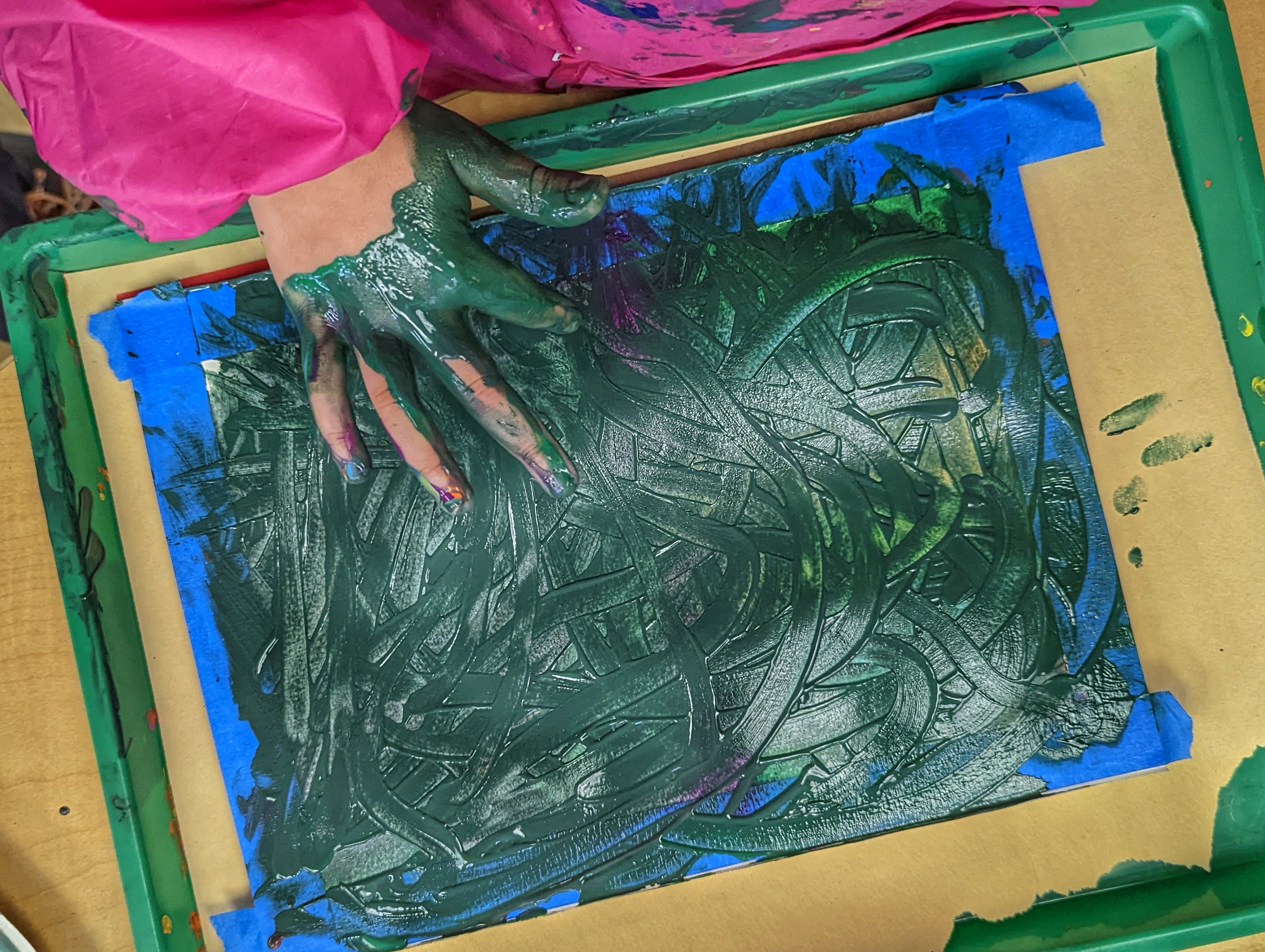
I thought and thought. What artist might we use? How can we do it in the time allotted? How might I structure it so that their process and product would be enjoyable and satisfying? I quickly landed on finger painting as the process. But, how to elevate it a bit to show them, and others, that their work is indeed art? That was a sticking point for a bit of time. Finally, I decided I could help by taping a boarder on their paper, and by trusting them as artists.

With a good bit more thinking, I had the process and rules in place.
* Each artist could choose up to 4 colors.
* Each artist must do at least one practice piece, but could do a total of three.
* Each artist would be kind to themselves and others by:
not touching their face or hair,
not touching their friends,
walk with clasped hands when walking around the room.
* I will prepare a tray, paper, and a paint holder/plate for each artist.

When I announced the project, there were audible gasps and expressions of delight. They listened intently as I explained the process and rules. They were patient, but clearly wanted to get started right away. I told them I would let them know when we were nearly half way through the class so that they could know they should begin working on their final piece. They all agreed that they understood, and had no questions, so I began handing out supplies.

Each artist placed their tray — lined with construction paper — at their spot. They placed one 9X12 inch practice sheet on top of the tray, and one underneath the tray. If they wanted to keep their practice sheets they placed their initials on the back. If they wanted to donate it to the maker trolley for everyone to use, they left the page blank. Then, they picked up their paper plate and stood in line for paint. Their choices were deliberate and purposeful. Each artist was clear about the colors they wanted to work with for this project. Once they received their colors they began creating.

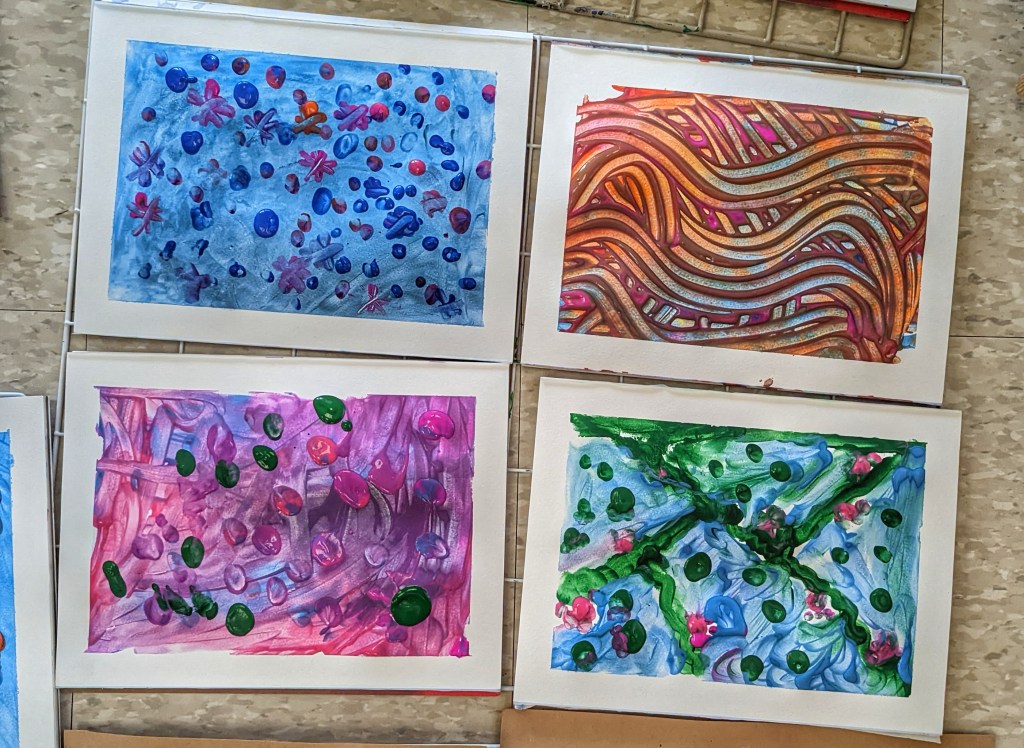
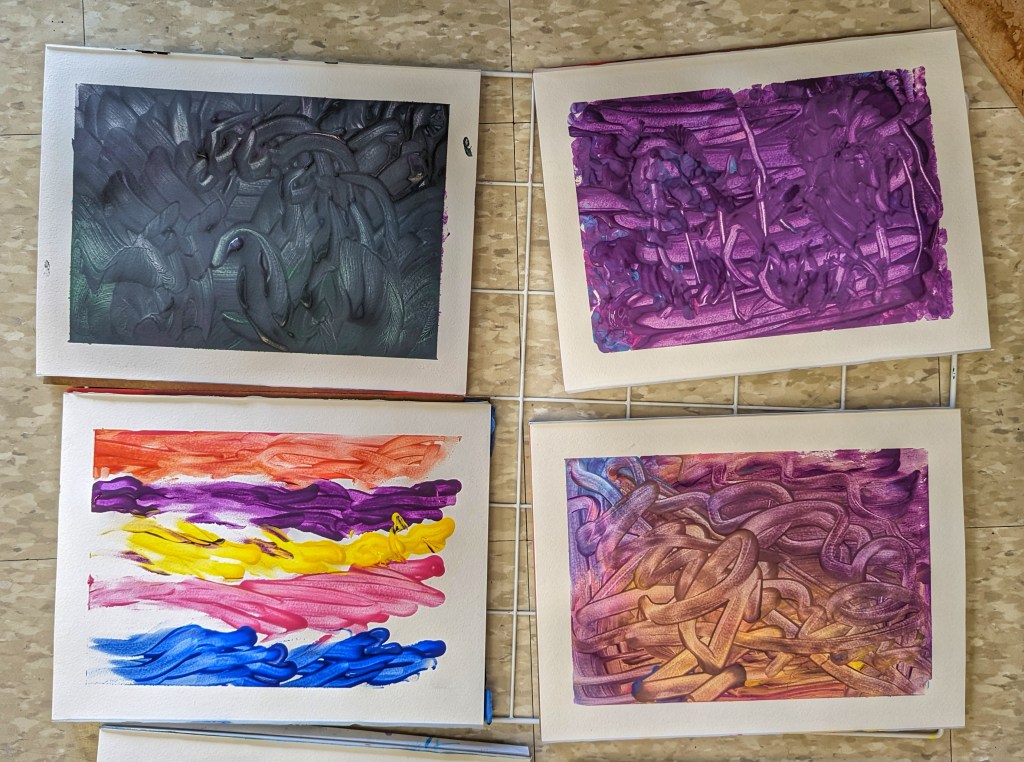
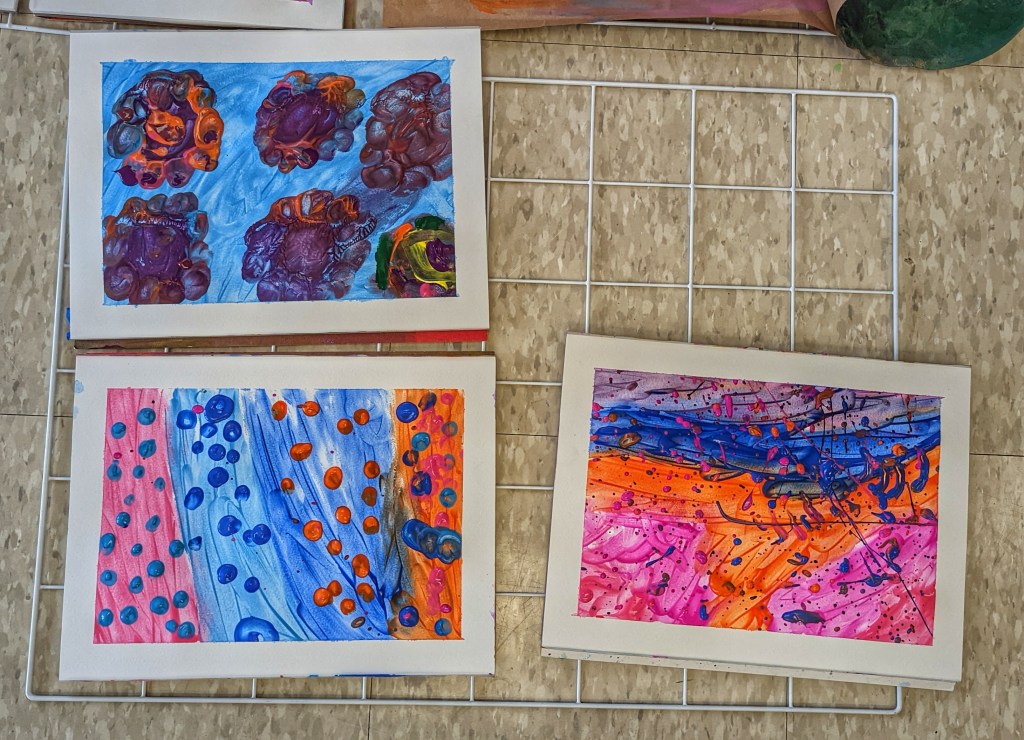
It was interesting to watch the various ways they chose to interact with the paint. Some worked with one color at a time. Others worked with a few at a time. Some worked with one finger. Others worked with both hands, covering the paper — and their hands — with color. On some pieces the colors were distinct, on others the colors melded into one.

I wandered around the room, stopping at each artist’s work to comment on what I noticed. I frequently said “Oh! That is lovely! What a great idea. I never thought of doing that!” I also asked “Are you finished?” Most of the time, the artists responded to my question with a definite “No.” I was committed to allowing this to be a moment when I taught for delight, and to respecting the fact that this was their piece of art and delight, not mine, so each time I responded, “Okay.”

Sometimes that’s a difficult place for us to stand as educators. But, it truly doesn’t matter if I think it’s beautiful. It matters that the artist thinks it’s beautiful, and it matters that I respect that. The only time I intervened was if I thought the paint was so thick that it might crack off the page, or if artist’s hands were dripping wet after washing and were likely to destroy their paper or process.

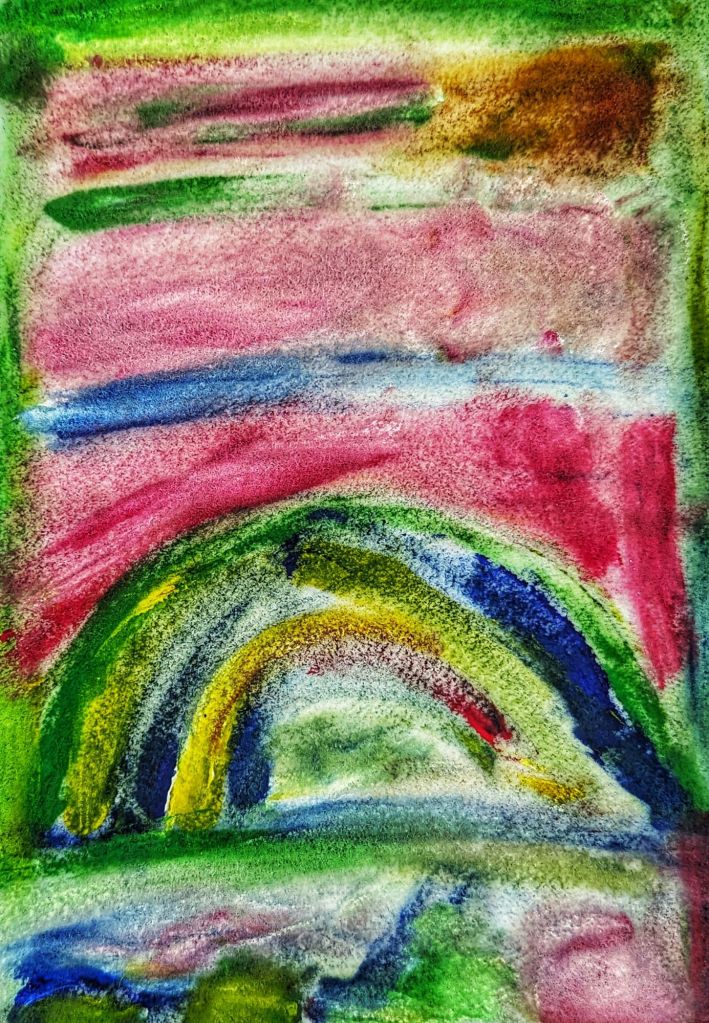
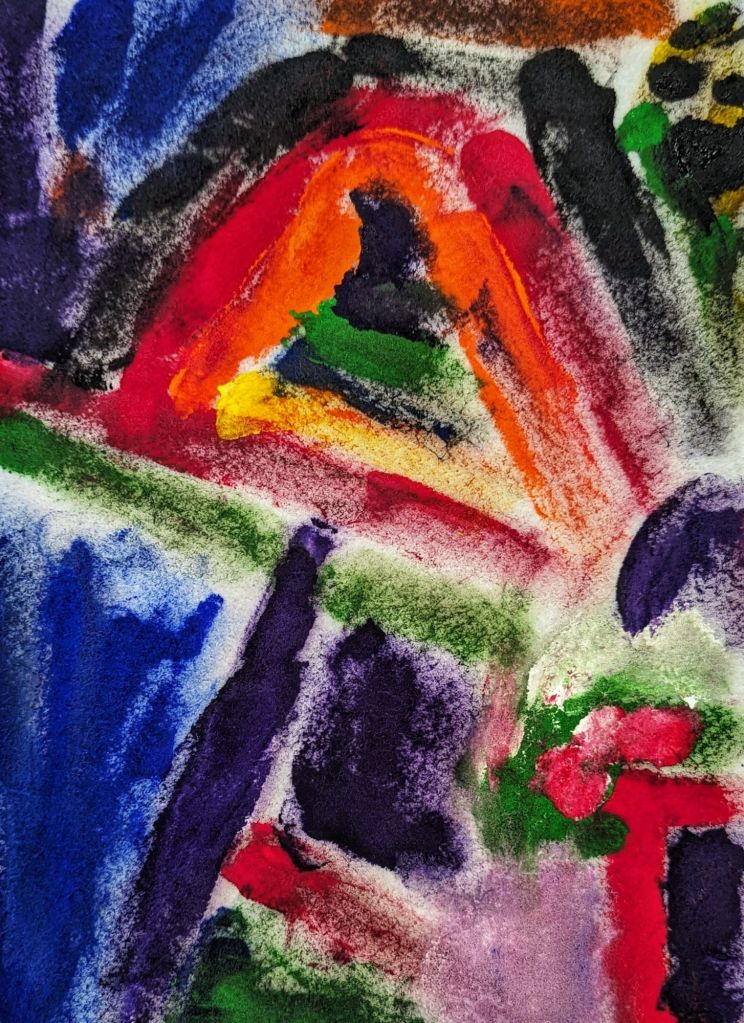
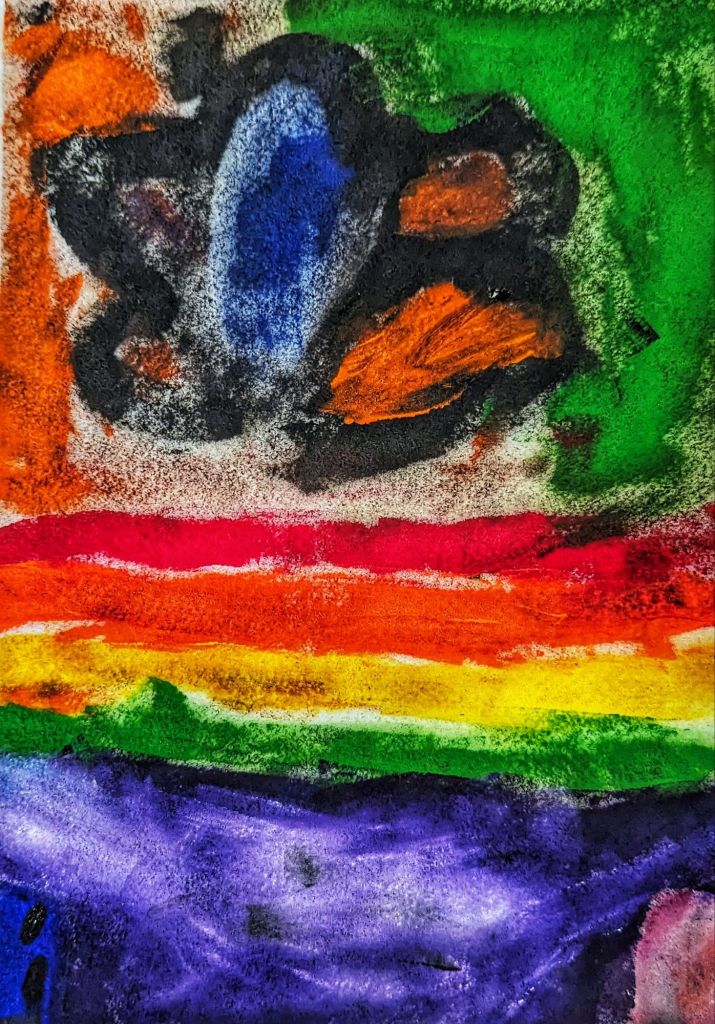
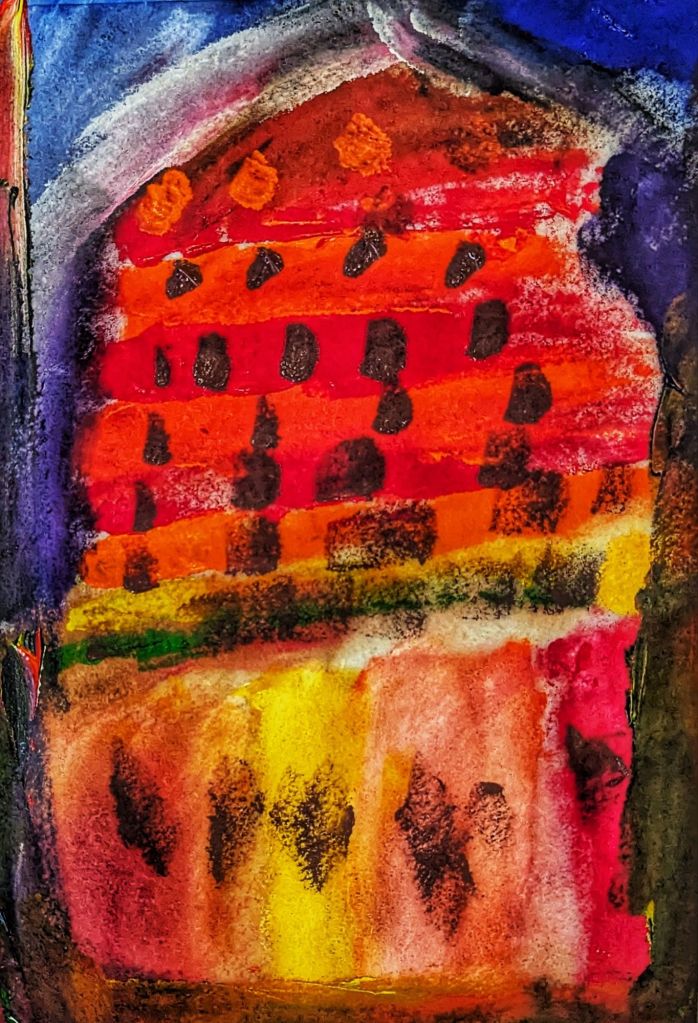
The results — in both process and product — were remarkably varied and beautiful.

The delight they experienced helped them to be more invested in the process. Being invested in the process helped them stay on task. Seeing, experiencing, and supporting their delight helped me to breathe a bit more, which allowed for there to be increased relaxation and ease in our learning space. All in all, it was lovely, and served to reinforce my believe that teaching for delight is essential.

Look, Wonder, and Ponder Possibilities

This week my Kindergarten inspirational artist was Ashley Bryan. What a remarkably talented artist. He’s a painter, a storyteller, a writer, and a collage artist — to name just a few of his artistic pursuits. Any one of those might lend itself to an art project. But, which one would work for my students, with the supplies they have, in the time we have? And, which one could I successfully model for them remotely?

I spent days researching Ashley. I studied his art, listened to him speak, and read articles about him. And then I did it all again. I was quite struck by two things he said:

I make flowers of all my mistakes.

and

In Kindergarten we made our first books … little one of a kind, limited editions. Bringing them home was the greatest reward.

That was the my first aha, We could be inspired by Ashley’s flowers, and his recollection — in his 90’s — of the joy he had at creating his own books in Kindergarten. My artists’ finished flower art pieces would become the covers for their own one of a kind, limited edition journals.

When I shared that with my artists, one asked “But what are we going to put in it.” I shrugged my shoulders and said “I’m not sure. It’s your journal. You’re the artist. What are you going to put it in?” She persisted, “But what can we put in it?” I persisted, too. “You’re the artist, you can put whatever you want in it.” Murmurs filled the room and wafted towards me across our remote connection. I smiled as I watched them begin to plan what would fill their journals.

But, I get ahead of myself.

I had the flower journal idea, but I wasn’t sure how I could help my artists emulate the loose style I perceived in Ashley’s flowers. Back I went to examining his work and words. I contemplated lots of possibilities, but each one felt less than exciting, and didn’t quite measure up to what I was hoping to achieve.

Then I saw Ashley’s lithograph and stained glass window work. That was it! Both of those included black lines and shapes. This would allow my artists to use their black markers to create the loose flowers. They could then use watercolor paint to add the color. I chose to focus on the stained glass creations because they included the color found in Ashley’s paintings.

The process and product of my Kindergarten artists was joy-filled, courageous, and filled with sharing of ideas. As an educator, I was super satisfied. As an artist, my creative thinking, and artist work continued.

I always make a demo piece, and then work on my own art as my Kindergarten artists work on theirs. This was my demo piece.

I liked it. But as I looked at it, I wondered what else I might do to it? How might I take it further? Was there something I might do to take it beyond a Kindergarten project? And of course, the ever present question “What if I mess it up?” It always makes me laugh out loud when I hear myself wonder that. It keeps me humble, and reminds me how brave my K artists are each time they take up their tools and get to work.

I got my white paint pen and began adding marks. I thought the detail would be what I needed to add some sort of pop. I was wrong. I got more pens and added more colors and marks. It got better, but then it seemed to have lost its original connection to Ashley Bryan as the flowers and black lines became less pronounced. Much like when I prepared to teach my lesson, I took a break. Each time I passed my art, I gave it a look — many looks, from many different angles. I contemplated many what ifs, and, maybes.

Finally a possibility made enough sense so as to become a plan. I decided to paint all the negative space with titanium white.

I am totally digging the result of my creative thinking, and artistic doing.

i created a second piece so I could paint with my artists during our second class. I was inspired by their drawings — some had intense amounts of detail, others had butterflies, birds, and lady bugs. The plethora of flowers and nature set off the white of the framed word in a great way. I loved it as a black and white piece.

Then I added paint with with Kindergarten artists.

It’s nice, and it was admired by all, but I’m not loving it. Perhaps it’s the starkness of the word frame compared to the color. Perhaps the color has muddied the detail of the background. I’m not exactly sure.

For now I look, wonder, and ponder possibilities. But soon, I paint.

Painting Today

There will be painting today!

I got these beauties in the mail a few days ago, but they had to sit in quarantine before I opened them, so for all intents and purposes, I got them today!

I staged the photo as I did because it pleased me aesthetically, but also because it hints at a message. The brush is supported by hope and courage. The combination of the three make the image complete, and somehow — in my heart today — increases the possibility of my being open to the many miracles that are gifted to me each moment.

That brush is fantabulous. I cannot wait to see how much water and paint it is able to soak up, and how it moves across the page.

Yes, there will be painting today.

Perhaps on my porch, or — gasp — dare I hope, at the edge of a stream on a walk? Mask and glasses on, but heart blissfully open to the blessings that will surely come my way. And, if tears come, it will be alright. They will mingle with the watercolors bringing unexpected beauty.

Tell Me More

I recently did a free-paint art project with my students. The only requirement was to paint something on the paper using the paint colors they had mixed during our color mixing activity. They love to paint, and being able to use colors they created intensified their enjoyment.

I moved around the room snapping photos, chatting with the girls, and putting finished works on the drying rack. On one of my passes I captured this.

jojo1

I was intrigued by the horizontal lines. I loved the structure and the contrast between the flowers organic shape and the horizontal lines.

After a bit of time I returned to this same artist. She was focused. She didn’t raise her head but continued to look and add, look and add.

Her work was so different than when I last saw it. I was intrigued. I loved it even more now then before. I wasn’t sure what was behind the flower, but I liked. I snapped a photo, and told her how cool I thought it was.

jojo2

She stopped painting, gave it one more look. and then with a gigantic smile and complete clarity, she looked up and said.  “It’s a flower growing in a library.”

Me: “Oh, wow … it is!!! That’s fantabulous!”

I snapped another photo, and continued the controlled chaos that art clean up sometimes is.

Afterwards I realize I missed an opportunity. I missed an opportunity to take a breath and a moment to let her tell me more.

Did she have that idea from the beginning?

Did it just happen?

Did her work remind her of a library?

Does she have a library with a flower in it?

So many questions. So many opportunities for connection, affirmation, wonder, relationship, joy, learning.

For some time, I fretted about not giving her that time.

Now I see it as a lesson and an opportunity for me to learn and grow as an educator and human being. And, I breathe easy remembering her focus, intensity, experience and smile. She was content.

My Watercolor Process

I’ve spent a good bit of time watercoloring these past few weeks.  Today, I decided to share my process with you.

Now to be clear, I’m not suggesting you adopt my process in its entirety. Just saying you might learn something from it!

  1. Take a 3 hour watercolor class.
  2. Learn some cool things.
  3. Fall in love all over again with watercolors.
  4. Head out for a hike and some plein air painting.
  5. Forget I am a beginner.
  6. Fail to remind myself — “”Bad art happens to good artists!”
  7. Experience angst — lots of angst.
  8. Nearly fall out of love with watercolors.
  9. Resist throwing everything in the river.
  10. Drive 5 hours.
  11. Sleep 8 hours.
  12. Go to church.
  13. Breathe.
  14. Eat.
  15. Nap.
  16. Do things that have nothing to do with watercolors.
  17. Catch sight of an unfinished painting.
  18. Give in to the allure, and bring the paints out of hiding.
  19. Paint with more wonder, and less judgement.
  20. Experience the joy of process and product again.


20180826_174229-01


We Are All Beginners

I had grand plans, this summer. I would create art, progress on the ukulele, nap, travel, read, learn, and refresh my body, mind, and spirit. I haven’t done nearly as much of any of those things as I might have liked, but I have done some, and it’s been wonderful!

Lately, I’ve developed a love for watercolors. I’m no pro, but I enjoy dabbling. I think my love affair started when, on a rainy day, unable to hike, I wandered into a local bookstore in search of a literary diversion. Instead, of a good book, I discovered a wall of art supplies — real, professional grade art supplies. Paint, paper, watercolors, pencils, pens, rulers, paint brushes, and more! No lie, for a moment, my knees went weak! I adore creating art, and all the tools and supplies connected to it. It brings me great joy to simply touch beautiful art tools and materials. I left the store with a simple watercolor travel kit, and a watercolor paper block. I was hooked.

The other day I discovered these beauties. 37635898_10217065659493192_6164546794509303808_o

If it were appropriate to describe watercolor as delicious, these would be the ones! Of course, perhaps there are other, more expensive, more professional ones that are even more delicious, but for me, I was satisfied.

I enjoyed looking at, and admiring them for a few days. Then, as luck would have it, I found this wonderful artist online — Watercolor Wednesdays. She has some fabulous videos on youtube.

I watched a few, and was impressed by her process and product, as well as the spirit she brought to the table. I decided to break out my supplies and give it a go. Here are my products from today.

20180813_132556-01

Nice, right? Not perfect by any means, but I think I am beginning to understand more of the essence of watercolors. By that I mean, I am beginning to understand a bit more about how they work, and what they are meant to do, as well as how I might work with them.

It was a fascinating experience to take a breath and jump in. Don’t get me wrong, it was mildly daunting. But, it was fun!

In one of the first lessons I watched, she said she doesn’t worry about the end result.  “Really?” I thought. “You aren’t concerned about the end result?!!!” I decided to set aside my skepticism, embrace her point of view, and not worry about the product. Instead, I would just paint. Removing my focus and feelings from the final product, I was more able to be in the moment. Existing more fully in each moment as it happened, I was more able to experiment, observe, notice, learn, and do.

It was fun, but not particularly easy. It’s tough sometimes, to allow myself to be a beginner. As a beginner, I’m vulnerable. I must embrace my foibles as well as my less than perfect products. I have to be brave, and not fret about what others may think about me, my process, or my product. Perhaps most difficult, I must not be hard on myself as I experience all of the difficulty of learning something new. If I can manage to do all that, or at least some of it, I am more able to enter into the joy of discovery, and the exquisite, child-like joy of one who is discovering something new and fantabulous!

As I sat and looked at my finished paintings, I had an epiphany!

This is what I ask my students to do — every moment of every school day. Try new things. Embrace being a beginner. Be brave. Celebrate your successes, no matter how small. Don’t worry what others think. Don’t fret. Be kind to yourself. Keep trying. Be in the moment. Experience the joy!

Wow, right?!

It makes me think differently about the work educators and students do every day. It’s profound. Learning to read, doing math, writing stories, interacting with each other. It’s all like my experience with the watercolors. We are often beginners, and that can be intimidating. But it is also powerful. There is joy and incredible potential in being a beginner. Perhaps even more joy and potential than in being an expert.

I have a lot to think about!

I want to take this epiphany and let it help me grow as an educator and lead learner in my learning space. For now, I am going to think about how I might give my girls more time and opportunities to experience the joy and potential of being a beginner. I want to think how I might shine the light more brightly on the ways I learn, struggle, try, persevere, find joy in little things, and embrace me as me.  And, I want to find time for them to be in the moment — able to explore and try, without fretting about the product. Hopefully this will enable them to more fully understand and experience the essence of whatever it is they are exploring.

I’m excited to see where this light will lead me — and you!

Comments, thoughts, and stories of your own journey are always welcome!

Dr. Seuss Creative Fun

Wacky Wednesday, by Dr. Seuss, inspired our creative fun today.  — Shoes on the wall, on the ceiling and under the bed. Worms chasing birds. Hoses, while split, still watering the lawn. — My students giggled, and eagerly shared each wacky thing they noticed.

They didn’t want to stop, but I told them “We must! I want you to have plenty of time to have your own wacky Wednesday fun!”

They were not immediately convinced. But, I assured them we would keep the book in our library, and they could read it as much as they wanted. Finally, they relented and moved to the chairs I had prepared.

I reminded them of our time together in yoga, when I invite them to take off their shoes and socks. “Now,” I said, “I’m not going to invite you to take off your shoes and socks. I’m going to tell you to take them off. We cannot do our wacky Wednesday creative fun unless you take them off.” Giggles and talking increased as they hurried to their cubbies and back again — with feet bared!

Paper was taped to the floor in front of each chair. Plastic egg cartons filled with paint, rested on paper towels. I encouraged them to guess what we might be doing.

“We’re going to paint with our feet!” … “Yes,” I said, “but how?”

“We’ll stick our feet in the paint!” … “Good guess, but no. We’re actually going to use a paint brush.”

“We’ll paint our feet and put them on the paper!” …”OH! Great idea, but no.”

“We’ll paint our toe nails!” … “That would be fun, but not today.”

They continued guessing, each building on the next. They were doing a lovely job thinking divergently. They showed some fluency, flexibility, and elaboration – each idea building upon the ones that came before, informed by my responses.

Finally, nearly jumping out of her chair, R. said “I know! We’re going to hold the paintbrush in our toes!!!!!” …. “YES!”

Laughter and conversation erupted in the room – making it nearly impossible for me to speak and be heard. I encouraged their enthusiasm, but asked them to do try to stay quiet until we began. They contained themselves, as best as they could, and after some brief instruction and encouragement, they began.

Some jumped in with both feet — pun-intended, lol — and used their toes to grip their pencil, and write their name.

feet writing

When M. finished writing she said, “That was hard. And it doesn’t look very good. It’s messy.” … “No way!” I replied. “That’s fantastic! You did that with your toes! How awesome is that?”

Was it as good as she could do with her fingers? No. But did that matter? Was that the right criterion to use to evaluate it? No! Her process and product  were remarkable. She gripped the pencil with her toes. Figured out how to create each letter in her name, and wrote them in a rather straight line! Perhaps most importantly, she showed great initiative, courage, and grit, and I wanted to acknowledge that for her.

Everyone joined in the fun — even me. My students were enthusiastic and joy-filled painters — quite willing to try, and try again.

feet painting

I was surprised by my reaction to the experience. It was hard! Hard to hold the paintbrush. Hard to figure out how to dip it in the paint. Hard to guide it on the paper. Just hard!

I did it, but I didn’t enter into the experience like they did. I think their were multiple reasons why. Each is worthy of my thought, consideration and remembering as I continue to work with my students, and for my own growth as a creative and an educator.

Here are some of the things I noticed:

  1. My support of my students — in word and presence — is powerful.
  2. Time to practice and play with the tools and process before beginning is important.
  3. Embracing positive thoughts about ourselves as artists and learners is essential.
  4. Adopting the joy, freedom and openness of a beginner’s mind is helpful.

My students often return the favor and support me with their word and presence. Today I didn’t have the opportunity to allow them to support me. I also didn’t have the time to practice and experiment before beginning. But perhaps most interesting to me, unlike my students, I didn’t immediately embrace positive thoughts about myself or my process, and I didn’t adopt the the joy, freedom and openness of the beginner’s mind.

I can learn so much from my students. They are truly fantabulous!