When 2+2 does not equal 4

We had Back to School Night at our school this week. As I shared who I was with the parents, I began talking about creativity and creative thinking. I told them creativity, and creative thinking, are not just about art! Creativity, and creative thinking, are about noticing, seeing possibility, taking risks, making mistakes, trying new things and thinking new thoughts. They’re about learning. They’re about taking what you know and using that knowledge to go beyond. They’re about playing and communicating. They’re about life!

I was so excited to be talking about creativity, my hopes for their children, and the possibilities for creativity in all venues, that I found myself saying, “Even math is a perfect venue for creative thinking. I read this article once, that talked about when 2+2 isn’t 4!” As it came out of my mouth, and I saw the looks of surprise on some of their faces, I recognized the need to clarify that I would, indeed, be teaching their children that 2+2 was 4! But, I would also be encouraging them to think like mathematicians, and, when appropriate, look for those times when 2 plus 2 was something other than 4.

I want their children to be able, even as kindergarteners, to take what they know and are learning, and transfer it to other situations. I want them to see the more.

Here is how it was lived in my classroom this week.

One of my students loves to get “math problems.” She seems to have an insatiable appetite for them! I wanted to honor and encourage her love for “doing math,” but I also wanted to go beyond the rote “doing of math” and engage her in mathematical thinking! I wanted to give her the opportunity to be challenged to notice things, tinker, get stumped, and keep trying.

Yes, even in Kindergarten this is possible, and appropriate.

So, after several problems with numbers and symbols, I started using pictures. First, I gave her pictures that indicated addition and subtraction. I didn’t tell her whether the problem was addition or subtraction, I let her figure it out. Once she discovered an answer, we talked about why she chose subtraction or addition, and how she got her answer. (By the way, her answers – listed on the page – are great answers, but not the only possible “correct” answers!)

add subtract

Then I asked her to complete patterns or provide the next item in a sequence. She had to think about some of them, and occasionally gave me a quizzical look. I resisted the urge to chuckle, and instead just encouraged her to think about it. Sometimes I realized I hadn’t given her enough information, or I had been ambiguous, so, I amended my instructions.

Each time she got it! I decided it was time to take a chance, and see what she did with more of an open-ended question.

I wrote:

10 equals

She looked at me, and then at the problem. She looked at me again, this time with a bit of annoyance.

“What is this?” she asked.

I responded, “Well, what does it say?”

“10 equals. But what do you mean?” she asked.

“Well, what does 10 equal?” I asked.

She again looked at me with a bit of annoyance, and a bit of confusion. I just pursed my lips, and raised my eyebrows. “You can do it. Think! What does 10 equal?”

She looked down, thought a bit, and finally wrote “10 = 10”

“Yup,” I said. “10 sure does equal 10. Can you think of anything else?”

She thought for a bit and said “6+4.”

“Yes!” I responded. “That does equal 10. What about this? Does 10 equal this?”

10 petals

She watched as I drew. Looked at me when I finished, then back at the drawing, and said, “Yes.”

To which I responded, “Why?”

“There are 10 petals.”

“Indeed!”

We did a few more problems together – sometimes I drew or wrote for her, sometimes she drew or wrote for me. Then, I took it a step further. I gave her this problem.
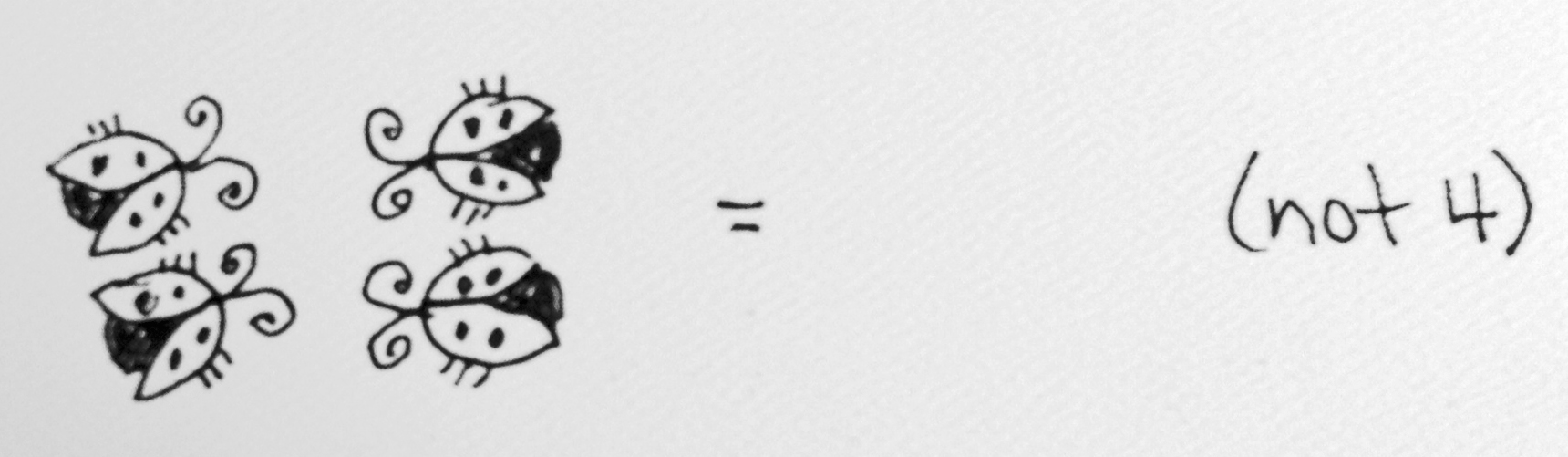
not 4

Using what she had learned from the car drawing – they were coming together –  she said, “It’s 4.” I said, “True, but what else is it? Do you see? I wrote ‘not 4’ I want you to think a bit. What is it, if it’s not 4?” She looked at me for a bit. I said, “Think. I want you to think. What else can it be? Thinking is good. You can do it!”

After a bit she came back to me and said, “It’s 16!”

“Oh! How is it 16?” I asked.

She showed me the 16 dots. “Indeed! That is 16.” Now it could just as easily have been 8 because of the antennae, or the wings. It could have been 24 because of the legs. It could have been a lot of things! The importance, (outside of the math facts) was the noticing, the thinking, the sharing of thinking, the questions, the explanations, the affirmation that thinking was good, and finally the confirmation that her thinking was sound.

It would, however, also have been ok if her thinking wasn’t sound, because it would have given us an opportunity to converse, rethink, and to come to another conclusion.

So, I ask you? When is 2+2 NOT 4?

Amazingly enough, there are many times! Think. Draw. Write. Be creative. Think in ways that might not be your first choice. Think in ways that seem to defy mathematical sense. But think! Oh, and be sure to play, and have fun.

If you come up with some ideas, please leave them in a comment. In a few days I’ll post a comment with some of my ideas when 2+2 is not 4!

Enjoy!


A Tree Grows in Kindergarten

I recently attended a workshop at Bank Street College in NYC. They have a tree growing in the middle of their lobby! A BIG TREE! If I remember correctly, it actually goes up to the second floor.

It was fabulous! I wanted one in my space. It would add to the classroom environment. It holds incredible possibilities for all sorts of learning and playing – science, history, literacy, math, art, morning meetings under the tree, and puppet shows in front of the tree. And, the students would love it.

I chuckled as I wondered how I might convince my school to architecturally recreate the kindergarten and library (above our room) to allow a tree to grow within the school building. Realizing that was not likely to happen, I set about thinking how else we might have “a tree grow in kindergarten.”

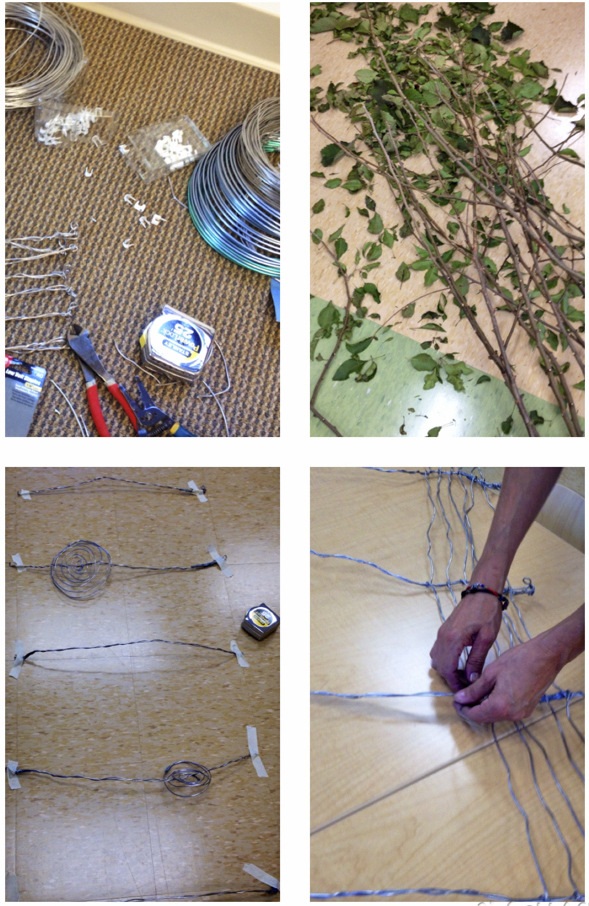
Ages ago, a friend gave me all sorts of wire to use as sculpting material. I still had a lot of the wire left, in a beautiful basket, on top of my cabinets, waiting. “Woo hoo” for keeping things that have creative potential, even when I can’t figure out how to use that potential.

That wire held the answer! If I couldn’t grow a tree, surely I could make one out of wire!

In my mind, I imagined a grand tree. A wire trunk with real tree branches  “growing” out of the wire trunk. It would be spectacular!

I built the tree in my mind several times – often changing the structure on a long car rides. Finally, I was ready to give it a go.

There was a lot of prep work the night before the build – find fishing wire, fight off mosquitos to get branches, take the leaves off the branches, gather tools (wire cutters, clippers, pliers, a hammer, pencils and a tape measure), load the car, and, perhaps most importantly, try not to forget anything.

The day of the build also held a lot of work – including tons of measuring and re-measuring, a failed try at anchoring (which, thankfully, led to a better engineered tree), an incredible amount of wire work, the realization I had to cover the pointy wire ends (yay for silver duct tape), and many other niggly details and tasks.

tree collage

The process was an interesting combination of frustration, invigoration, exhaustion, perseverance and psych. It was an exercise in patience as I pro-typed, failed, thought, re-thought, tried again, looked, looked from another angle and perspective, adjusted, tweaked and took untold number of relaxing breaths. In the end, my fingertips and back were screaming, but the tree was there, “growing in our kindergarten room.”

I will, no doubt, rebuild it again in my mind. I am already imagining new ways to connect and support the branches to allow for greater artistry and larger branches! But for now, a tree, made of wire, paper, actual tree branches, hard work, and imagination, grows in Kindergarten .

(A close up of the wire bark – complete with knots.)

tree2

 (The tree ready for our first day.)

tree1

I trust the tree will bring joy to those who experience it, and encourage them to be open to possibility, creativity, imagination, hard work,

I hope, now, and throughout their life, they will be inspired, and empowered, to create something new and fabulous — perhaps, something incredibly useful and valuable.


Bubbles Art, Science, Math and Language Arts!

The wider the range of possibilities we offer children, the more intense will be their motivations and the richer their experiences. We must widen the range of topics and goals, the types of situations we offer and their degree of structure, the kinds and combinations of resources and materials, and the possible interactions with things, peers, and adults. ~Loris Malaguzzi, Hundred Languages of Children

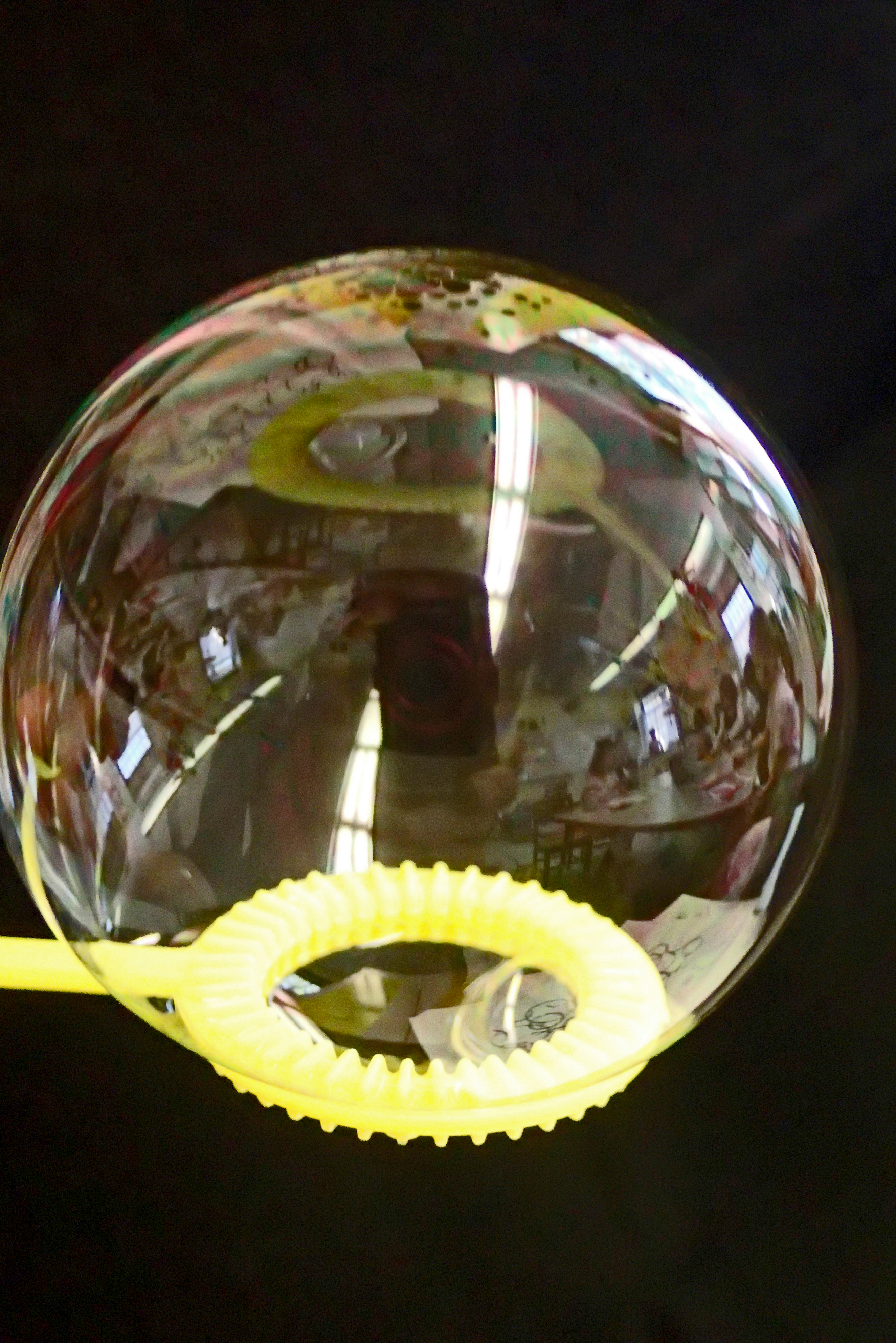
OLYMPUS DIGITAL CAMERA

Bubbles are fascinating and afforded us several challenging and fun ways to explore and experience science, art, math, and language arts. There was a plethora of things to notice, marvel at, wonder about, investigate and enjoy!

… The variety of sizes. The delicate and yet strong nature of soap film walls. The colors and reflections that are captured in the bubbles. The many things that can be used as a bubble wand. Do heart-shaped wands make heart-shaped bubbles? The ways we feel when we blow bubbles. Should we blow slowly or quickly? Does that make a difference? Can we fill the room with bubbles if we use a window fan? The joy and sorrow felt as bubbles pop. The way the wind takes the bubbles as they leave the wand. The way the bubble solution feels, and sometimes tastes, as the bubbles pop close to our lips. Can we create bubbles from things other than store-bought bubble solution? How could we create bubbles in art? What colors are bubbles? Which words best describe bubbles and our experience? 

Prior to starting I told the girls we would be scientists, authors, readers and artists, and that the process would take us several days. We experienced bubbles through our eyes, our ears, our brains and our bodies!

  • We did several read alouds.
  • I blew bubbles and the girls experienced them only with their eyes. What did the bubbles look like? How did they move?
  • They blew bubbles. Again, as scientists they tried to observe things about the bubbles, the process and each other.
  • We all blew bubbles, and just experienced the joy of bubbles – much laughing, movement and even some screaming!
  • We created bubble wands using various materials: pipe cleaners, plastic plant mesh, plastic water bottles, straws and string. We tested and observed each – Was it easy to make bubbles with them? Did they make big bubbles? Small bubbles? What shape were the bubbles? Did the bubbles mirror the shape of the wand?
  • After each experience the girls shared words and feelings, which I scribed onto a large piece of chart paper.
  • We ended up with three lists of words. We observed the lists: How many are in each? Which list has the most words? Which the fewest? Why? (We noticed that the words increased as we engaged more fully in each experience and grew in comfort with the process.) We used math strategies to add the lists together and come up with the grand total. We marveled at our abilities to describe our experiences. We used these lists to create our list poems.

OLYMPUS DIGITAL CAMERA

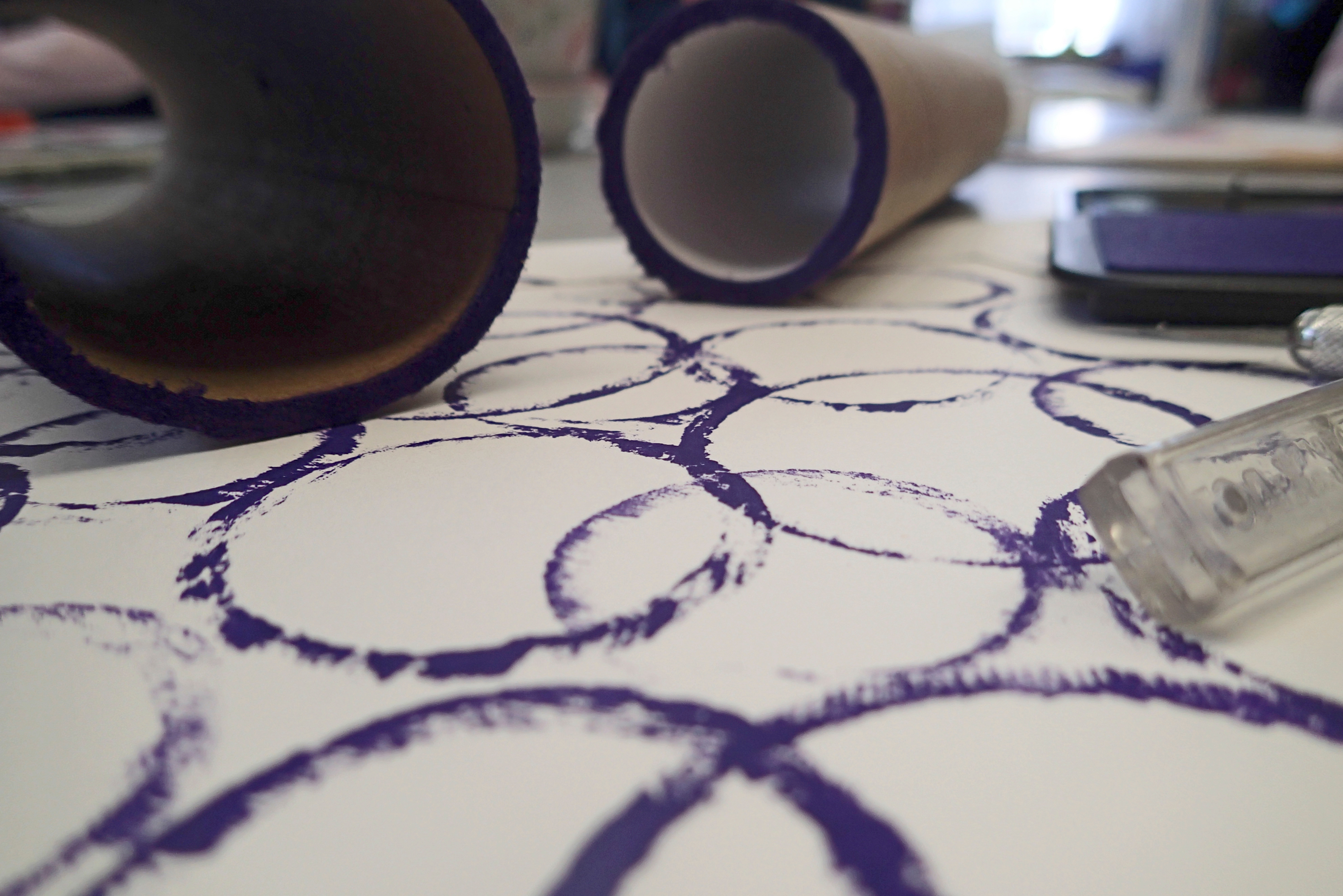
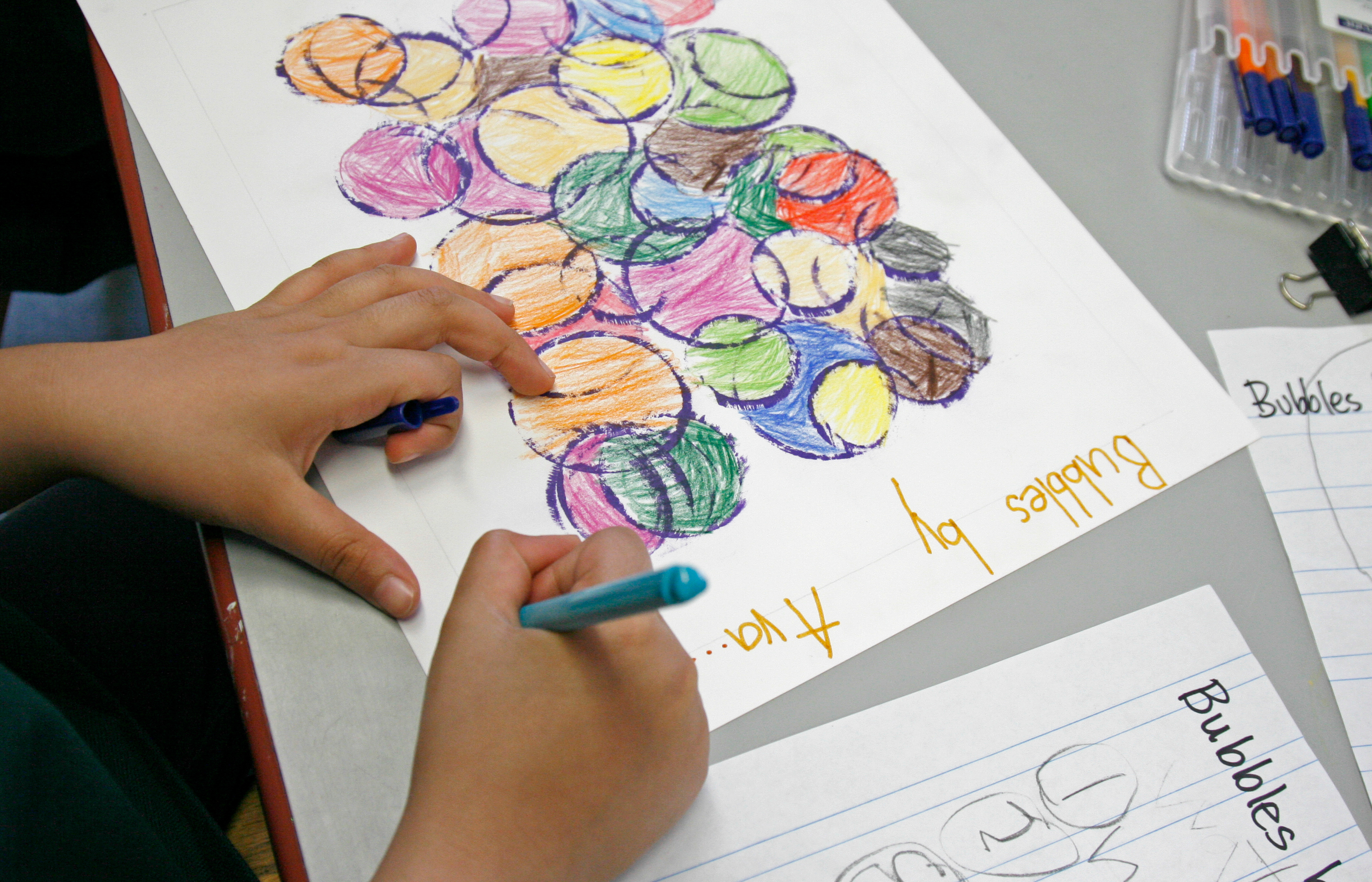
I brainstormed many ways to create a frame for the list poems and finally decided (for ease and aesthetic reasons) to cut a frame to place over the girls paper as they stamped. The frame allowed them to stamp freely while maintaining a clear border for their list poem. I held the frame in place, as the girls used the cardboard tubes and ink pads to create their bubbles.

I was amazed and impressed with the thoughtfulness with which they approached their work. Each girl had her own particular process, but each was purposeful in her choice of tubes (various diameters) and placement of bubbles. My only instructions were to be sure to press straight down so as to get a good print (and not to fret if it was less than perfect, as that added to the uniqueness of each piece) to consider overlapping the bubbles at least a bit, and to not be afraid to overlap the frame.

OLYMPUS DIGITAL CAMERA

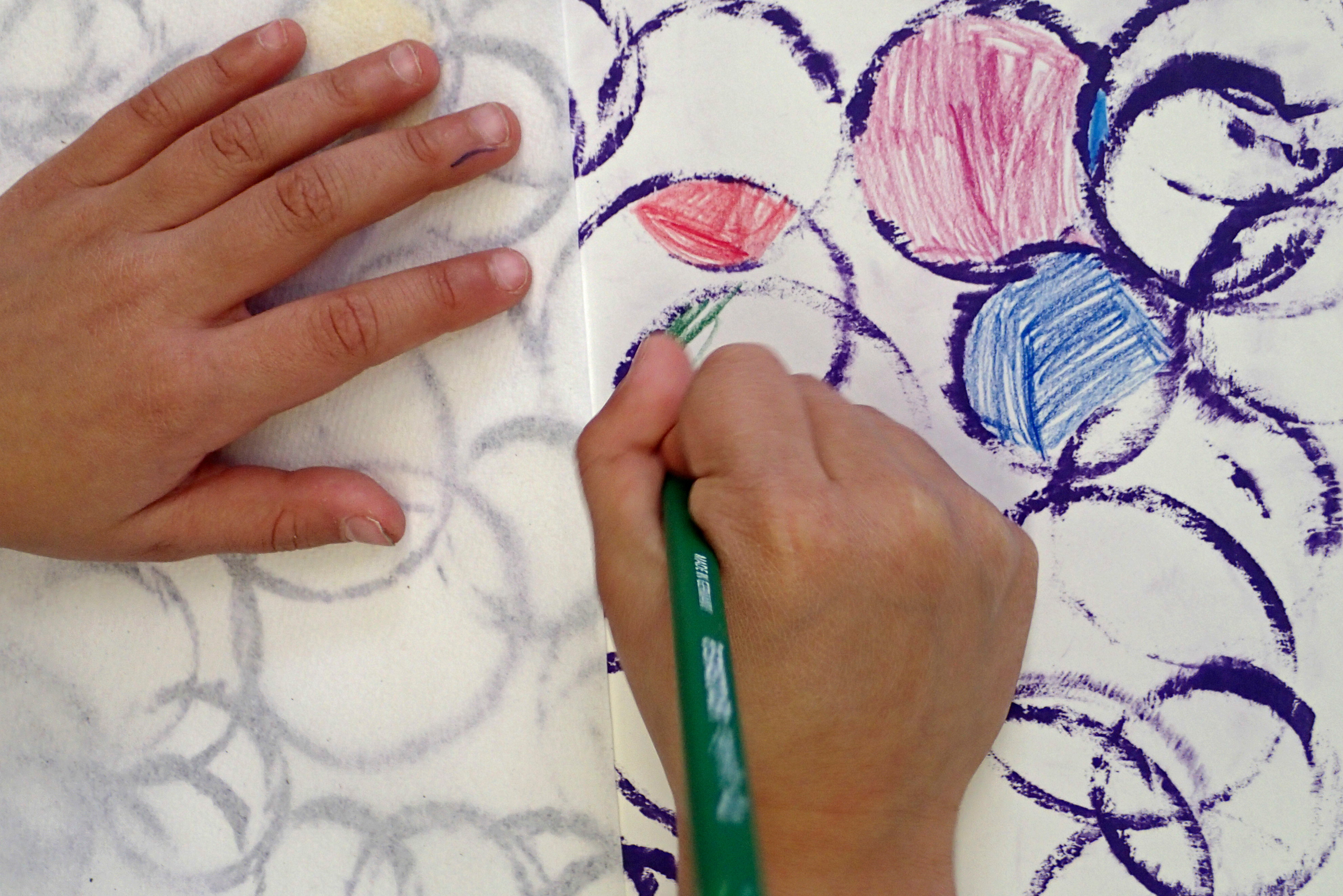
I brought in some artist quality pencils to share with the girls. I talked about why I liked the pencils – great colors, nice feel in my hand, beautiful movement across the paper – and why I chose to share them with the girls – they are artists too and I thought they would enjoy using them. I asked them to take care of the pencils as they were special to me. The girls were fantastic with the pencils! They carefully chose the colors, replaced them in rainbow order, only sharpened them as much as necessary, shared them with each other, and really seemed to empowered by using them. (We ended up using them in free choice as well as other projects.)

After the ink dried, the girls worked diligently to fill in each full shape (not the partial bubbles around the edges). We discovered that the ink, though dry, sometimes transferred around the paper, so we used a paper towel to minimize movement. Thankfully any transferred ink erased easily.

bubble words

Once finished with their art piece, the girls moved on to their list poems. The goal was to create a list poem and encircle the bubbles with the poem. (We read, observed and discussed poems from Falling Down the Page by Georgia Heard prior to this project, and emulated the freedom Georgia showed in placing words on the page.) Each girl began by choosing 12 words from the class lists and writing them in the frame of her paper. If needed, she chose more words.

When everyone was finished – and it took some girls many days to do so – we shared our poems and art pieces with each other. Finally, we displayed them on the hall bulletin board, with black and white photos of each of us blowing bubbles as the border.

RESOURCES: