The Intrigue of Leaves

Leaves hold an amazing amount of intrigue for my Kindergarten artists — and for me! I love collecting leaves as I hike, especially knowing I’m going to share them with my artists. I purposefully look for leaves that have a lovely color, an interesting shape, or an exaggerated size (large or small).

When I come in with my stash of leaves, I am always greeted with a plethora of questions and comments.

  • Ooooh! Where’d you get those?
  • They’re so BIG (or small).
  • What are you going to do with them ?
  • Can I touch them?
  • Can I have this one?

    More questions, comments, oohs and aahhs, and claiming of leaves, come as I explain, “We’re going to paint them.”

The intrigue gets to a fever pitch as I pull out our antique paper press.

The circle of Kindergartners tighten in around me and the press. Their curiosity is peaked, and they have more questions.

  • Ooooh! What’s that?
  • What are you going to do with that?
  • Why are you doing that?
  • Can I do it?

I tell them it’s a press, and we’re going to use it to press the leaves so that they will dry flat instead of curled and wrinkly. I explain a few safety issues, and let everyone take a turn loading leaves and paper towels, and cranking the press tight. The burning question becomes: “Can we paint them NOW?” I respond: “Nope, they need to stay in the press until tomorrow.”

“This is going to be an exercise in patience.” I say only to myself.

Finally tomorrow arrives. We open the press and extract the leaves. The Kindergartners are mesmerized by the intense flatness of each leaf. The gently sort through the leaves and choose their favorites.

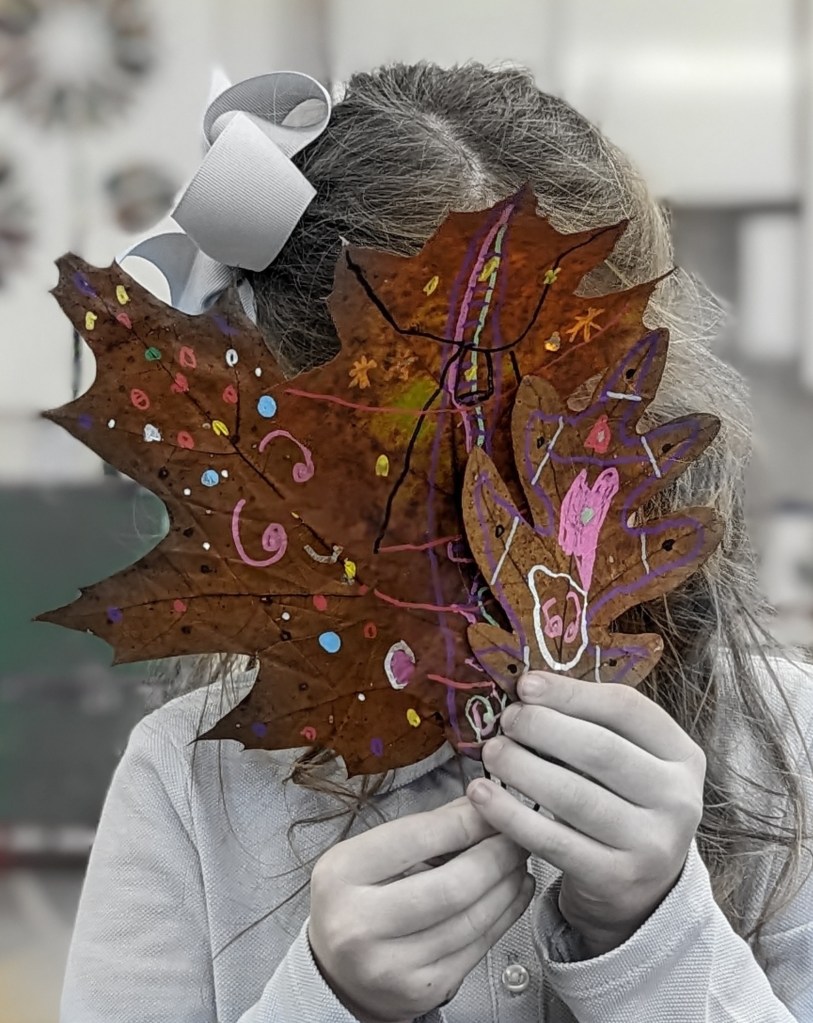
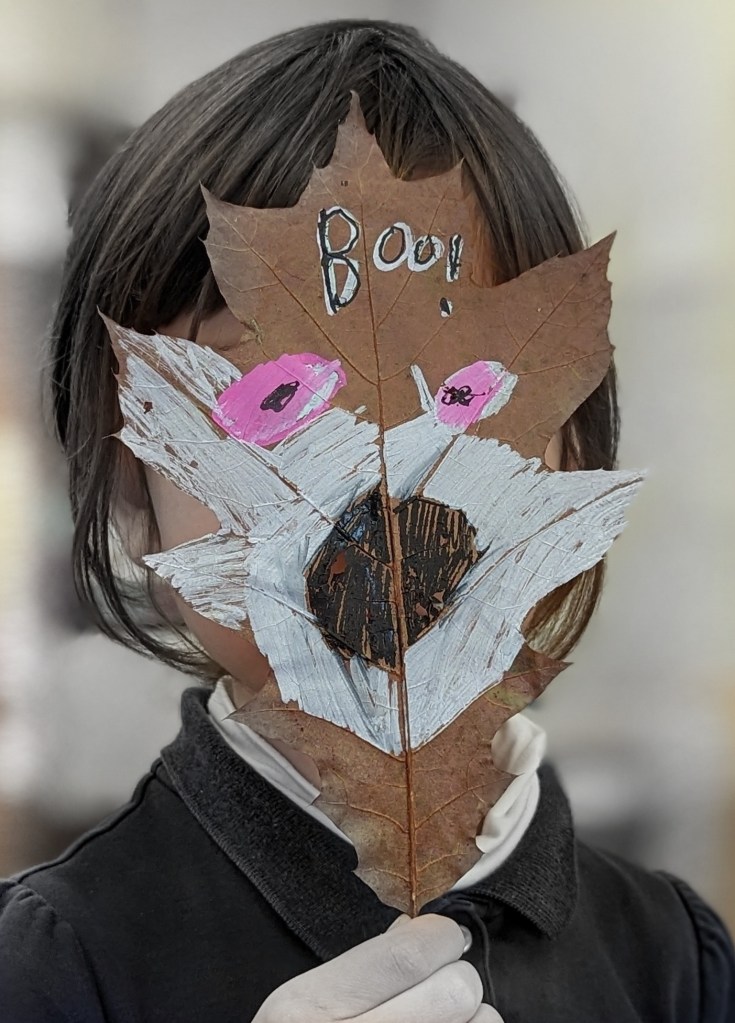
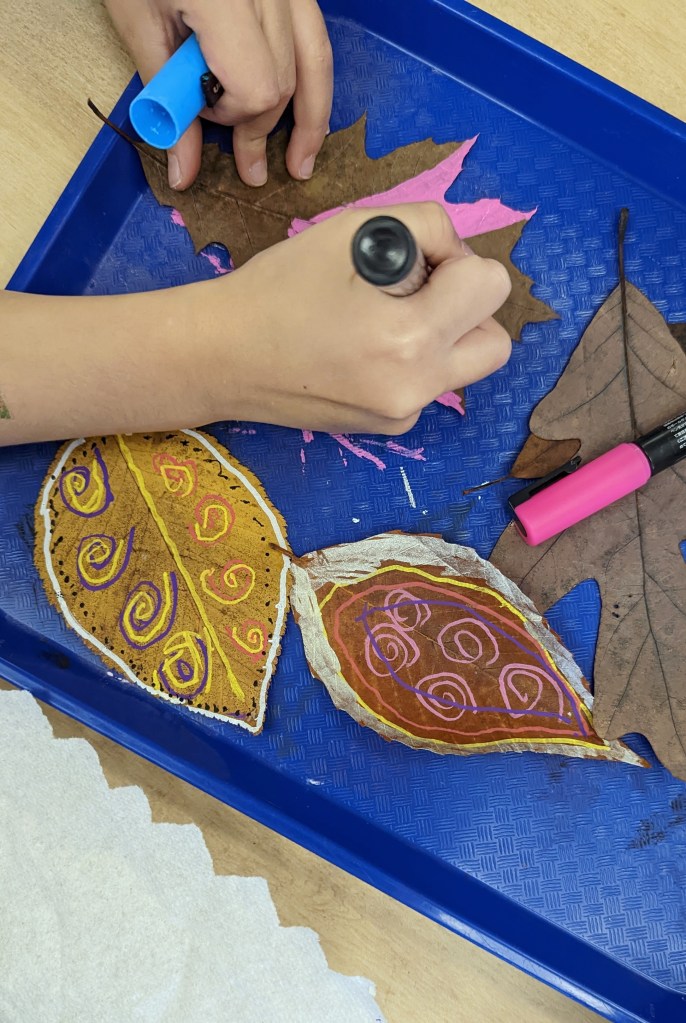
We paint the leaves using paint markers. The markers allow the artists to more easily add detail. I join them at the table with my own favorite leaf. Sometimes they are very talkative — admiring each others work. At other moments they are silent, eyes, mind, and hands intent on creating the perfect piece of leaf art. The structure of the leaf sometimes guides their design, at other times, they approach the leaf as more of a blank canvas. Always, the uniqueness of painting a leaf — versus a piece of paper — grabs their attention and interest.

I’m fascinated by the way photos — intentionally taken — remove the smallness of the Kindergartners. Instead their hands could the the hands of any aged artist. I love that.
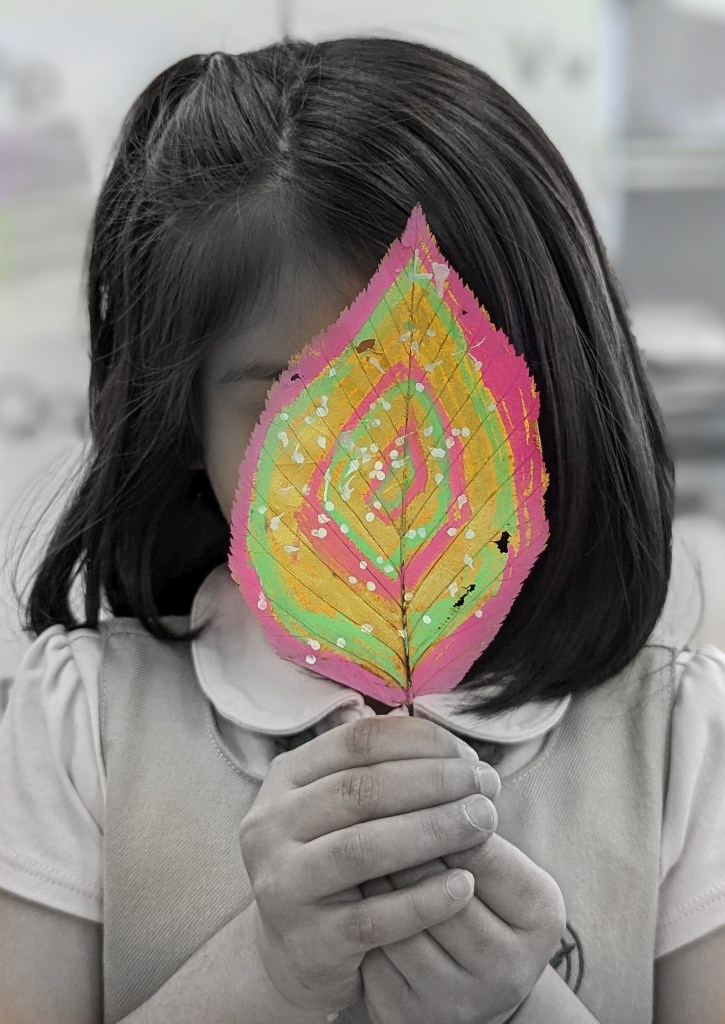
I decided to take photos that highlighted their leaf art. I processed the photos to remove the saturation and color from the background leaving their leaves as the stars, while still including a bit of information about each artist.
When you have leaves available to you, give this a try. It’s a fun activity that is filled with opportunity for exploration, learning, trying, collaborating, creating, and growing as artists and a community. Oh! And if you ever have the change to pick up an old paper press on the cheap –grab it! The possibilities in the classroom are endless.

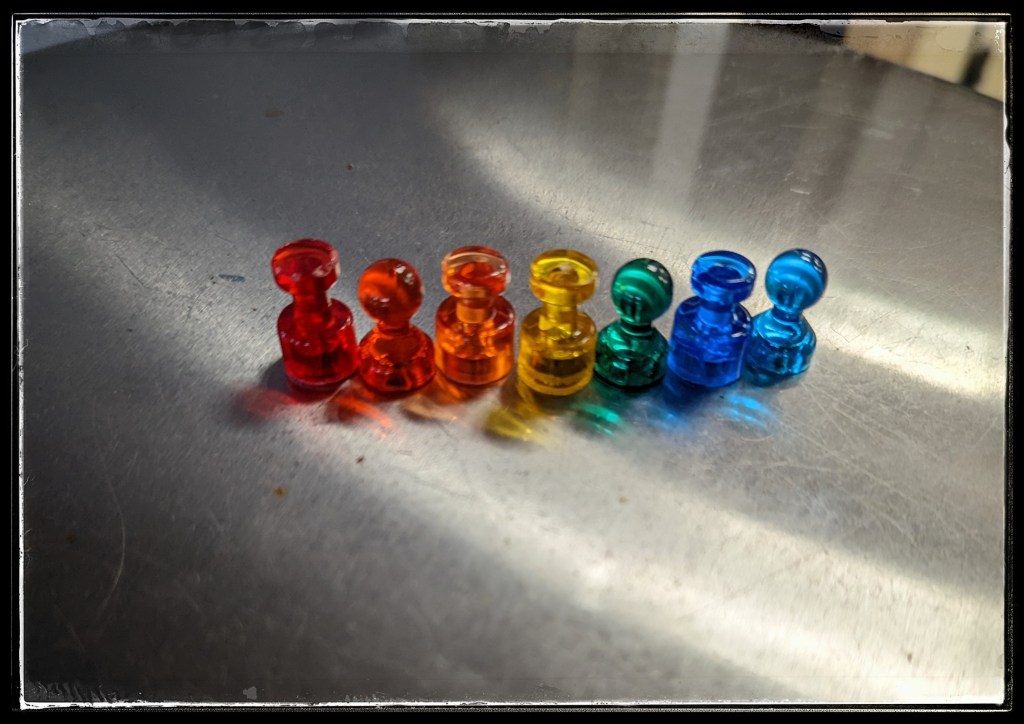
Magnets on the Trash Can

It’s a regular occurrence to find magnets on top of our classroom’s trash can. Sometimes they are arranged in rainbow order, sometimes they are grouped at various points on the lid. I often have to stop kind visitors who want to help by returning the magnets to the whiteboard.

“The Kindergartners put them there.” I comment. “When I need them, I take them, but for now, I let the Kindergartners store them on the trash can lid.”

Let me explain. The Kindergartners are exploring many things by having the magnets on the trash can lid rather than in their place on the whiteboard.

  • PHYSICS and ENGINEERING – How many magnets do you need to raise the lid without touching the lid or the foot pedal? Where is the best spot on the lid to put the magnets? What if you have a group that works and you separate the group into two smaller groups?
  • COLOR – What is the rainbow order? Where do the various shades fit in?
  • MAGNETIC POLES and PROPERTIES – Why don’t these two magnets stick together? Can I get the magnets to attract one another through my finger? Through all my fingers? What exactly are poles of a magnet?
  • COLLABORATION, SHARING, and PROBLEM SOLVING – “We need more magnets, Miss James!” they say. “That’s all we have right now. The others are holding up your math work.” A little while later, several Kindergartners are gathered around the whiteboard, gently moving magnets so that papers share the magnets thereby freeing some for their use!

I have no idea what new ideas and exploration may happen after winter break, but I’m excited to find out. I have other small magnetic bits, I may add them to the mix. We shall see.

Art and Faith

The three wisemen have begun their trek to the manger and Jesus. Today they stopped to rest in front of an art piece of mine.

Today, as the Kings stopped to rest, I too paused, and looked at them, and the art.

I imagined their journey in real life. They must have had to pause, breathe and remind themselves of the possibility their faith told them lay before them. They chose to begin the journey, and I suspect they might have needed to affirm their choice more than once as they walked together.

I imagine walking with them and pausing before this giant graffitied wall. We encourage each other with the words we see “Inhale peace, exhale tension. Trust. Pray.” Waking after a long day, and a not so long night’s rest, we eat, pray, and do some much needed stretching. As the sun rises, I don my sunglasses to shield my eyes from its brilliant rays. I love the idea of rising and burning like the sun, so I encourage myself, and my brother Kings to burn bright like the sun. We set off in search of the amazing possibility of a child King. Our faith creates hope, and our hope feeds our faith.

As I breathe and type these thoughts, I’m struck — again — by the power of art, word, reflection and imagination. I make a mental note to keep beauty and encouraging words near at hand, and to travel with companions willing to burn like the sun together, grateful for the happiness in each present moment we encounter.

Contemplating Color

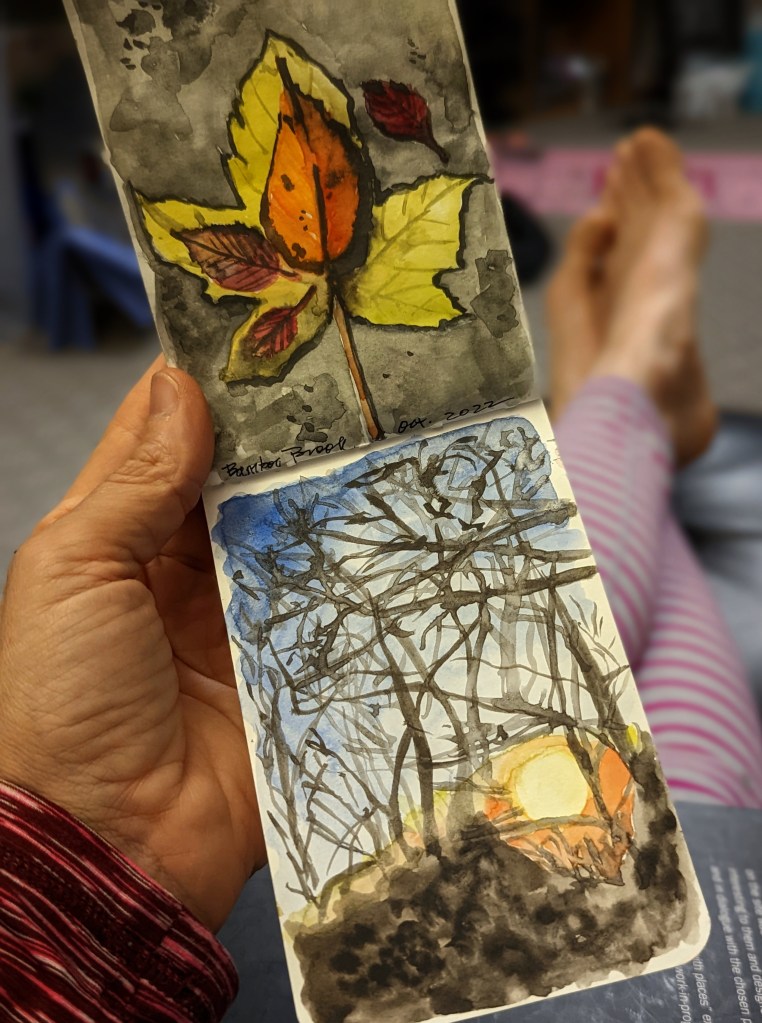
I’ve taken a few moments to paint this weekend — which has been wonderful. I did these while hiking. The leaves are from a couple weeks back. The sky was a quick ten minutes paint as the sun went down yesterday.

It’s interesting how different the sky watercolor looks now that it is dry, and being viewed with normal light instead of the setting sun light. The colors — even those I didn’t plan on being light — appear remarkably lighter now.

I’m pleased with the look for what it is and am going to resist any edits. However, I do want to remember just how much pigment is needed to have the watercolor dry a deeply saturated color. As I look at the leaves I’m recalling the amount of paint I loaded onto my brush to get those rich black shadows.

It’s so good to have pieces to look at and compare. It’s one of the things I like about my hiking watercolor journal.

This is a piece I started working on next to my Kindergartner artists. I used a combination of crayon and watercolor. It’s too bad I didn’t think to take a photo of the image before I added any color. It would be interesting to see how I react to it in comparison to the colored image and the black and white. I find both images satisfying. And, interestingly enough, I like the same parts in both images. It would seem that what I’m enjoying is the saturation as well as the actual color. I wouldn’t have guessed that before looking at them side by side. But, looking at them now, it makes perfect sense.

Ahhhh. Note to self. More painting, please.

Haiku Update

A while back I wrote about adopting a practice of writing a haiku poem each day, I haven’t written one poem a day. Some days I haven’t written any, and some days I’ve written more than one. I’m embracing my practice as it is so that I can find joy in it and continue.

I love the process of writing the poems. I’m not following all the rules of haiku, but I am maintaining the 5-7-5 beats for each poem or stanza in my poem. Finding words to fit the form is getting easier, but occasionally I still struggle to express myself in the form. At those times I head to thesaurus. Searching for a new word that has the needed number of syllables and the right meaning and feeling is enjoyable — I may even be enlarging my vocabulary!

As I write I’m working to be true to what I’m experiencing and noticing, but also to be positive and optimistic. I’m happy to report that I find great joy and encouragement as I reread the poems. I’m remind of happenings, pleasantly surprised by the rhythm, and encouraged by the meaning.

A few readers have asked me to share some of my poems and the poems my Kindergartners create. I haven’t introduced haiku to my Kindergartners yet. I think in the next few weeks, It might make sense to bring it into some of our work and thinking together. Once I do, I’ll share their work. For now, here are a few of mine — seven, actually, simply because I like the number.

RAIN (written in the depth of our drought)
What’s that? Is it rain?
Window thrown open, I melt
in the lusciousness of rain.


MORNING PAUSE
Wake, sit, breathe, and pray.
Mind and body run away.
Gently call them back

Hands on heart, I breathe.
Inhale, exhale, up and down.
Cultivating peace.

Repeat as needed.
Notice, accept, and breathe on.
Held in prayers and peace.


AMAZING THINGS
Believe it, it’s true.
Amazing things will happen.
Make room, lots of room.


MORNING
Drat the pencil’s dull
Shavings accidentally
Fall upon the floor


REPROGRAM
I am courageous
I am peaceful. I am loved.
I am safe and well.

Reprogram your brain.
Create new neural pathways.
We have the power.


PHEW, YAY!
Worked out yesterday
Feeling it today
Celebrate new strength


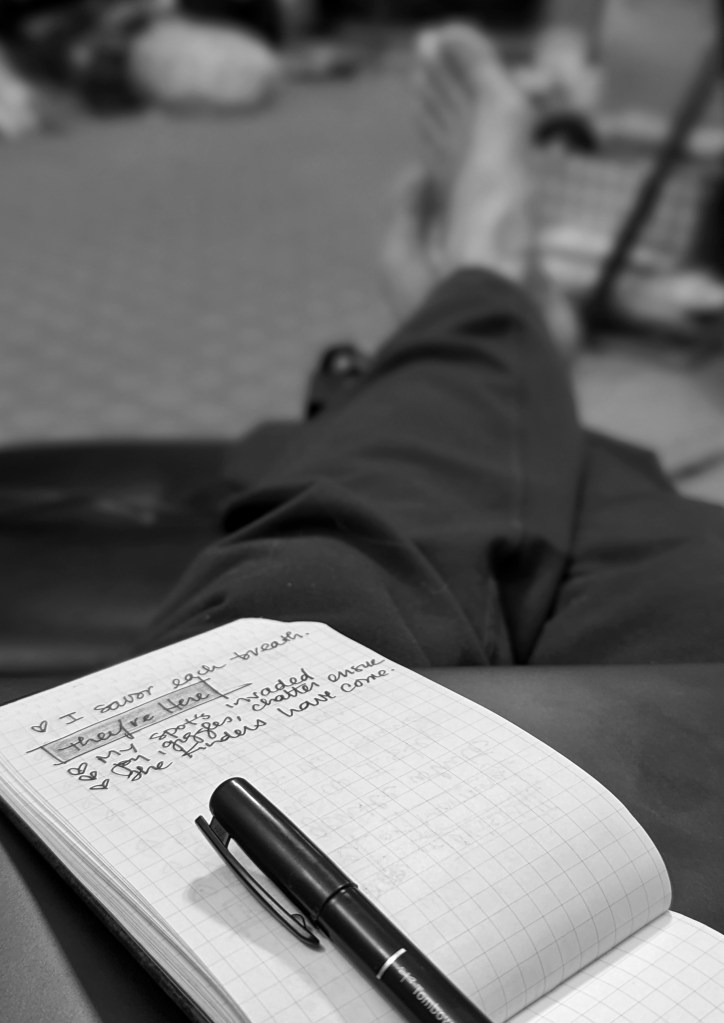
THEY’RE HERE
My spot’s invaded
by giggles, joy, and chatter,
My Kinders are here.


Write More, Not Less

It’s amazing how difficult it can be to write sometimes. It’s been feeling super tough to write as the summer comes to an end and the school year starts up again. I was shocked when I looked at my blog and realized I haven’t posted in over a month!

It’s not that I don’t have anything to say, instead, I often have too much to say. With so many thoughts swirling in my brain and competing to get to my fingers as I write or type, I end up getting a bit discombobulated. I wonder how to fit everything together. My brain becomes a bird distracted by all the shiny things around me and I end up running off after a new idea. I lose the train of thought that brought me to writing.

This morning I had an epiphany. Perhaps I’m not giving myself the opportunity to say what I have to say. I haven’t developed a practice that allows me to get my thoughts out of my brain and onto the page with any regularity. It reminds me of the feeling I have when I see a friend I haven’t seen in ages and I seem to lose the ability to finish sentences. Instead I speak in fragments as my thoughts trip over each other in their rush to leave my brain and be birthed into our time together.

I need to write more often. Might it be possible for me to establish a practice of daily reflection?

I feel myself begin to break into a sweat. How will I put one more thing into my day? Eeee GADS! Now you want to be a writer and write EVERY DAY!?!?!?!

Yes, I am having a moment of panic.

But, taking a deep breath, I remind myself I AM a writer. I have things to say. I have things I want and need to say. Not every writing needs to be profound. It just needs to capture whatever has captured me in that day or moment.

I like that. I like the connection to joy and beauty and awe. I think this practice will bear fruit in many ways in my life.

Now to let it happen.


And, in the spirit of having a plethora of ideas. I’m wondering where might I carve time out of our K day for me and my Kindergartners to take a moment and just write — as fellow writers!

A Daily Haiku Practice

I recently read about starting a daily haiku writing practice. I offer my gratitude to the person who suggested it because it’s a fab idea. And, since I cannot remember who they are or where I read it, I also offer my apologies. Hopefully they’re feeling a cosmic ripple of gratitude and happiness right now.

It seems many people have adopted a daily haiku practice for various amounts of time. I enjoyed this post by Daryl Chen and this TEDx talk by Zezan Tam. Their witnesses about their haiku writing practice were inspiring and encouraging, and removed any doubt about whether or not I should embark on this journey of a daily haiku.

I’m imagining a few moments of haiku play each day. Perhaps it will happen first thing, but I’m not going to force it. I chose a notebook small enough to carry with me so I’m free to find moments — wherever they may be in my day — that best serve joy, reflection, observation, word play, writing, peace, breath, and me.

I’m on my second year of my daily affirmation and art journaling, and want to continue that. I envision the haiku play as a complimentary practice. I’m hopeful the haiku will be a way to notice the good, and express gratitude. Zezan Tam said his haiku practice also helped him grow in courage and humility. I’ve been thinking a good bit about those two things as well. I’m excited to see how the haiku practice might help me be open to increased courage, learning, and growth.

I’ve done two haiku poems since my Daily Haiku poem. Lest you think my process as I play and write is a rather direct line from idea to poem, I share this image.

My process is, instead, quite circuitous — filled with pause and mental fermentation. This morning, I got up before the rest of my family, grabbed my notebook, pencil and pen, and headed downstairs. I put on some water for tea, and did a bit of stretching, breathing, and praying. As I moved, I felt my spine adjust and my muscles warm and soften. It was a moment I wanted to remember with gratitude, so I sat to write. I jotted some phrases — counting syllables as I went. No poem yet. I got up, cut vegetables and began to cook them. New possibilities came to me, so back to the notebook I went. I was up and down a few more times as I fashioned the mix of words, beats, rhythm, meaning, and feeling that made me say “Yeah, that’s it.”

After much writing, thinking, counting, and speaking. I settled on the haiku poem you see above. Funny, as I type it today, I’m not as pleased with the passive voice ending. So, here I share Day Begins #2.

Day Begins #2
In. Out. Up and down.
Body and breath move as one.
Peace and ease emerge.

I love this practice and play for me, but I also think it could be amazing for my Kindergartners as well. Earlier this summer, I read Shifting the Balance: 6 Ways to Bring the Science of Reading into a Balanced Literacy Classroom by Jan Burkins and Kari Yates. (A great book, by the way.) A haiku practice seems to fit right in with some of their ideas.

Just like me, my Kindergartners don’t have to write profound haiku poems — they just need to explore, play, and write. The 5-7-5 pattern gives them the opportunity to do a great deal of thinking, persevering and creating. Just imagine them playing with words! They will have ideas, count beats, think of new words and new ideas, rephrase, ask for help, give help, count again, and write!

As I thought of my Kindergartners playing with Haiku, I thought they might simply repeat words. They could use any words — as long as they follow the 5-7-5 pattern and enjoy the process. I came up with this as an example.

Dogs
dogs dogs dogs dogs dogs
barking barking barking woof
woof woof woof woof woof

Then I listened to Zezan Tam’s TEDx talk and laughed out loud. He shared this poem as he explained the basic pattern of the Japanese haiku poem.

Haiku
five, five, five, five, five
se-ven, se-ven, se-ven, se-
five, five, five, five five

How fantabulous is that? Perfect for Kindergartners!

What if they just use their names? The Kindergartners know and love their names. This might make it easier to find, count, and write the Haiku beats. How awesome to use your own name to practice phonemic awareness, orthographic mapping, and poetry. To help them out, I might make up three lines of Elkonin-like boxes — big enough to write in – following the 5-7-5 pattern.

My most recent thought?

“OH! We can have a classroom Haiku Board!!!!”

Me
Molly, Molly, Mol
James, James, James, James, James, James, James
Molly, Molly, Mol

Kindergarten Haiku
K poets unite!
Count and own your words and beats
Haiku soon you’ll share.


Some Haiku links:

Akita International Haiku Network

The Haiku Foundation

Examples of Traditional and Modern Haiku

Take It to the Streets

I love the PEM. It always has at least one exhibit that inspires me. I take photographs, get ideas for art with my Kindergartners, and gather lots of creative fodder.

This time, it was a solo visit, so I contemplated all the things I might do once I got there. For sure there would be photographing, noticing, thinking, wondering, and of course visiting the gift store. As an aside, it’s funny how I always visit museum gift stores even though I continue to be disappointed by their lack of connection with the museums, and their overall — in my humble opinion — lack of creativity.

I had been playing with the “don’t look away from what you’re drawing” sketching method in the morning. And, I had recently come upon this thought.

As I work at my drawings, day after day, what seemed unattainable before, is now gradually becoming possible.

Vincent Van Gogh

My mini watercolor journal sat next to the paper with my sketching. There’s so much that intrigues me with that method, and the loose sketching and painting school of thought. The PEM would surely have something I could sketch. There’s much I want to learn about the empty page, and its relationship to what I’m sketching.

Did I have the nerve to take it to the streets? Could I silence my own inner worrier? Could I put aside anything others might think of me or my work? Could I invite my inner artist to come out and play, and actually accept the invitation? Turns out, I can. But, I get ahead of myself.

I spoke to myself. “Maybe it’ll be fun. You like fun! Be like van Gogh and work on your drawings day after day. Just like for him, new things will gradually become possible.”

And then the kicker.

“How can you ask your Kindergartners to do something you’re unwilling to do?”

As I said that, I recalled my Kindergartners and all our affirmations, as well as my unwillingness to accept their reticence or resistance to trying something new or daunting. I took a deep breath in and out, and reminded myself of our affirmations: I have a big beautiful brain. I have an awesome heart. I can do hard things. I am brave. I am kind. I am a fantabulous artist. With another deep breath, I put my mini watercolor journal and permanent art marker in my bag, and set off for the museum.

You have to take some chances in order to grow.

Arriving at the PEM, I asked one of the museum staff what was the one exhibit to see if I were only going to see one. Without hesitation they suggested I check out the fashion exhibit. Here’s an arted-up photo of my first stop.

I spent time sketching here and at another part of the exhibit. In this one, I stood to the side, out of the way of any museum traffic. For my second sketching session I sat in the seats placed in the middle of the space. Sitting in the seats felt like a big win, and it felt good! I spoke the truth to myself. What anyone else thinks really doesn’t matter, and if they have questions or anything to say, I can explain what I’m doing.

This morning I found time to add watercolor to my sketches. As I did, I experienced worry about possibly messing it up. I chuckled and reminded myself it’s hard to mess something up that already is quite messy just by virtue of what it is. I realized my real worry was how I would manage having to see something I was unhappy with each time I opened my journal. Curiosity, love of making art, and the prospect of fun and learning won me over.

I sat on my couch with a cup of tea — careful not to dip my brush into the tea instead of the rinse cup — and painted. It was fun, and I like the result.

I thought about all sorts of detail I might add. My inner worrier, and my inner artist declined. One because she didn’t want to mess it up. The other because she thought it might not go with the otherwise loose look of the piece.

As I cooked my breakfast I thought, “Hmmm. Might I mask most of the image, leaving only the one figure that had a good bit of detail in the exhibit, and add some dots and detail with splatters of paint?” I grabbed some scrap paper out of the junk draw and did a really relaxed masking, followed by some splattering of paint.

I like how the splatters add detail without clashing too much with the sketching method.

There’s a lot reflect upon as a teacher.

  • It’s not always easy to go against your inner worrier, or accept an invitation to play — even when you’d really like to do so.
  • Breathing helps.
  • Affirmations help.
  • Van Gogh’s quote is true for much more than drawing.
  • It’s valuable to know you aren’t the only one feeling the way you are feeling.
  • It’s valuable to know that others have succeeded.
  • It’s good to have time to circle back — after you’ve had time to think — and work a bit more.
  • It’s important to have many opportunities to work and grow your art, understanding, and confidence.

I’m going to think about this — not just for art, but certainly for art. I’m excited to see what possibilities will make themselves known.

What a Difference a Day Makes

Sometimes, when things seem grey, or we can’t quite see as much as we’d like, we give into fear or stress. When we experience the lack of clarity, and the feelings that come with it, we often embrace it all as truth, and begin to tell ourselves a story filled with greyness, uncertainty, and melancholy.

The good news is we can do something else.

First, we can simply breathe, be, and notice. As we sit, or stand, with open hearts, minds, and eyes, we may notice that beauty, joy, or peace are present in this space that first seemed only grey and uncertain. As we can take another breath, we can acknowledge whatever is there. If we are open to the possibility, we might even express gratitude for what is.

The ocean view on a Monday.

We may not see a blessing in front of us. We may not feel at ease or peaceful. Sitting in the moment, breathing and being open and grateful may appear to be failing us. When that happens we can reassure ourselves, no matter how we feel, it’s helping. It’s science. It’s the way we are built.

Finally, we can remind ourselves that tomorrow is another day, and we’ll get there. We’ve done it before, and we’ll do it again. Tomorrow will come! And when it does, it will be different from today. Let us hold onto the hope that it will be filled with many good things.

Same ocean view, two days later.

Here’s to experiencing the beauty and gift in the grey, and soaking in the awesomeness of a new day filled with light, color, life, and joy.

Wonder and Awe in Nature and Watercolors

Have you ever captured wonder? Ever been (lovingly) slapped in the face with awe?

I have.

This day it was the wonder of this sky.

I’ve driven this dirt road many times. Sometimes I notice the dust and unevenness of the road. But today I was present to this. Or perhaps more accurately this was present to me — calling me to look, to see, to breathe, and to be open to the wonder of the ordinary. I snapped a picture in my mind, and with my camera.

My brother and I hiked, chatted, and pointed out various things to each other. I’m blessed to have him as my hiking partner. No matter how many leaves I notice, or how many times I say “Oh, look at that!” he never tells me “You know we just saw that last week.” or “You said the exact same thing 5 minutes ago.” He, too, is open to being in the moment, present to the wonder, joy, blessing, and amazingness of nature.

We walked and noticed new paths, and different vistas. And we sat. Exploration is super. Hiking is a joy. But sitting, sitting is absolutely necessary! It reminds me of Savasana in yoga. It’s a few moments, intentionally taken, to allow ourselves to experience who we are in the moment, to notice what our practice, our hike, our noticing, our awe, has produced in our bodies, minds, and spirits. It’s a time to rest.

We always find at least one lovely spot to sit. Sometimes we chat. Sometimes we photograph or paint. Sometimes we just rest in the awe of the present moment.

Ginny Graves wrote — in A Healthier Life (Real Simple Special Edition 10/21)

Positive emotions, like awe, love, and gratitude, suffuse your body with an uplifting sensation that can make you feel more at peace with yourself and at one with the world.

Mindfulness might help you train your brain to be less worried and more buoyant.

I love the idea and believe it to be true. Another day I’ll find the science to share with you. For now, I just share my experience.

My brother and I practice mindfulness as we hike. Sometimes it’s in mindful walking, sometimes it’s being present to the sights, sounds, and smells that surround us as we move. Other times it is the discovery of something we hadn’t yet seen. And always, it’s the sitting, and soaking in the space.

Look at all the shades of green. The plethora of plants. The amazing reflections in the water. This was a day for breathing and allowing the awe that I felt, and the almost magical bigness of the space and moment hold me. It’s funny to speak of it in that way. But that is the experience. It is being in the presence of something greater than me, of being surrounded by beauty. As I sit there I don’t know how to describe it other than being held, supported, with space to just breathe and be.

Another day at the same spot, I captured my wonder by looking deeply and using watercolor to capture a tiny bit of nature in my mini hiking journal. It’s funny because watercolor is something else that fills me with wonder and awe, and draws me deeply into a place of mindfulness. After painting I captured the moment to keep with me.

This is, for me, the image of an day well spent. Hiking shoes off. My feet in the green bed of clover at the bottom of the step on which I’m sitting. My view captured on the mini watercolor journal I carry with me. Looking at this image brings me back to that moment. I feel the joy I felt as I looked at all this in front of me. I see the brilliant green that stretches out in front of me, and I hear the water gurgling over the rocks. Amazing the wonder that can be held in an image, on the page, and in my heart and mind.

I couldn’t get out to hike the next day. Instead I brewed a big cup of matcha and sat in the quiet coolness of morning. I flipped through some photos from previous hikes. I took them with the intention of having watercoloring inspiration.

I decided to use this image of a small patch of flowers. The wildness of overlapping leaves, a plethora of different plants, and flowers popping out all over drew me. I liked the wildness — somehow it seemed like sweet cacophony of beauty. Is it possible for a cacophony to be sweet and beautiful?

As I sipped my tea, and zoomed in on the various areas of the photo, I was brought back to that moment in nature. I revisited the many different shades of green in the leaves, the darkness of the shadows and the soil, the textures, and the pops of color. I played with the paint and water mixtures, noticing how it moved on the page. As I did, I felt my breath and my spirit ease a bit. I painted and sipped tea in joy-filled silence.