Making Room for Creativity in Math

By the second half of the year, my girls understood addition is putting things together to get more. They understood subtraction is removing things to get less. They were able to use various strategies to solve problems I created. They enjoyed showing their mathematical prowess as they computed the numbers I gave them.

But, I wanted more for them. And, in a funny way I wanted more for me. They were always amazing and amusing me with their thinking and creativity in other pursuits – actually, we amazed and amused each other! I wanted to experience that with them in math as well. I wasn’t sure how to provoke this creativity, independence and amazement in math. But, believed it could (and should) happen.

After letting it “ferment” in my brain for a few days, I had an idea. What if I asked them to create  a real life addition problem? What about a real life subtraction problem? Oh my! What if I challenged them to create a real life math problem that involved subtraction AND addition? Now that would be something!

I asked them to think of an addition story. Not just two and two is four, but two of what and four of what. And perhaps most importantly why? Once they had their story, I asked them to record it in three ways: illustration, word and number. It was fascinating, and fun, to listen to them, talk with them, and watch them work.
IMG_2334 math add subtract

Next I had them create a “math mystery.” Their pictures were visible, but their word and number stories were hidden (under the flap). When they were ready, they partnered with a friend, shared their pictures and tried to guess each other’s word and number stories.

constructing math2

This helped them notice nuances that they missed, or didn’t need, when all the information was before them. For instance, is this 2 people joining 2 other people floating in a balloon (2+2 =4)? Or is it 2 people getting off the rock to go home, leaving 2 people on the rock (4-2 =2)?

Two very different scenarios, and depending on your interpretation, either could be true. When differences arose I encouraged the girls to talk with one another. “Ask each other questions. Tell each other what you think and why you think it. Explain your work. Add detail if you think it’s important. Help each other!” What an important and impressive process. Sometimes they agreed to disagree, secure in their explanations. Sometimes they amended their drawings, or noticed something they previously missed and amended their guess.

I think they amazed and amused each other. Certainly they amazed and amused me! Hopefully they began to see that math is useful, fun and all around them.

So, what did you guess the word and number stories were for the above picture?

This real life math problem is:

constructing math1(There were 4 people in the pool. 2 got out. How many are left? 4-2=2)

Of course! 🙂


Possibility Thinking Happens!

yogurt lady bugsI was delighted to receive this email from a parent of one of my kindergarteners:

Last night, M was finishing up 2 small containers of applesauce. She washed them out, put them on the counter, and said, “Save these. I’m turning them into ladybugs after school tomorrow.”

How awesome?!?!!!

What will this become? Clearly, the possibilities are endless.

Thinking, photographing, and conversing in the block center

Blocks are a fascinating medium. They provide endless opportunities for exploration, learning, growth and joy. While they have always been a part of our Kindergarten classroom, this year they are an integral part of our curriculum.

Blocks enable the girls to participate in all three domains of learning – cognitive, affective and physical/kinesthetic. The girls engage in mapping and spatial planning, collaborate with each other as they build, negotiate for space and use of blocks, and finally, when finished, conduct tours, as well as answer questions regarding their designs and buildings. The depth of thought and engagement is fantastic!

While building, the girls must think creatively and critically. What will they build? Where will they build? How will they create the various shapes and levels? What if the blocks they want are being used elsewhere, can they create that same block using other blocks? What if their structure is unstable and falls down, how can they re-engineer it for greater stability? Additionally, creative and critical thinking abounds as they furnish their buildings with accessories and special features, and as they create the community of persons who live in, or work in, their buildings.

My absolute favorite part of the process is documenting their work through photographs, and conversing with the girls regarding what I see.

It is incredible what I see, and don’t see, as I look through the camera. And it is fascinating and fabulous what I learn – about the girls, and their buildings – as I ask questions.

  • Can you tell me about your thinking?
  • What is this?
  • How does this work?
  • How did you make that? Is there any other way you could build that?
  • Tell me about this.
  • Hmmm. Could you create a way for …?
  • Why do you think …?
  • Oh wow! How did you decide to do that? How did you decide to do it that way?

Look …

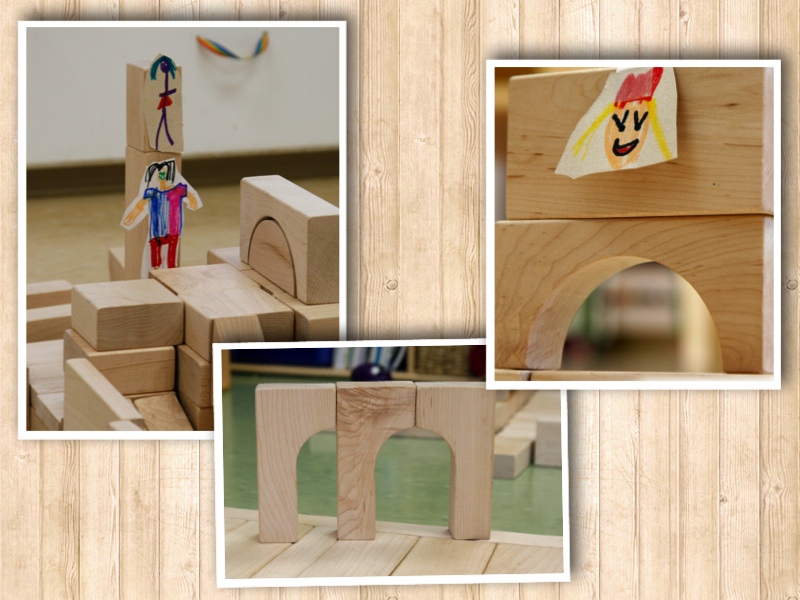
blocks for blog2

Do you notice the two people? The builder was hesitant to add people to her structure – although it had a multitude of spaces where people would congregate, play, and live. Finally after a bit of conversation, she added the larger figure. I admired the figure, listened to her explanation, and continued to photograph the other girls. When I looked back, I noticed she had added another person … on top of the first person’s head! I chuckled and said, “Is she standing on his head?” She looked at me as though I knew absolutely nothing and said “No, Miss James, he’s giving her a piggy back ride!” I responded, “OH MY GOSH! Of COURSE!!!! I get it now.” How else would we show that? She continued creating people – some standing on their heads, some on their feet, and stacked them 10 high on the original person’s head. Evidently, the circus was in town and the acrobats were staying at that apartment building!

Now, do you notice the face with blond hair and a crown? The girl added that to her castle when we were talking about adding people. Hmmm, I thought, I wonder what that is? So, I asked. “Hey, A. What is that? A ghost? A head with no body?” As with the other girl, she looked at me like I was a bit silly, chuckled and said, “No, Miss James, it’s the old queen.” I didn’t get it yet. “The old queen?” She continued her explanation, “Yes, a picture of the old queen, on the wall! Look here is one of the old king!” I laughed and said, “Oh! I love it! Pictures of the people who used to be here. Fantastic! Does someone live in the castle now? Will you be adding them to the castle?” She assured me that she would.

Finally, do you notice the doorway (archway) that appears to have two entrances? I loved it as a structure and architectural detail but I was intrigued to know what the girl was thinking when she created it. “M. would you tell me about this?” She launched into a detailed description – complete with a demonstration – regarding the planning, purpose and use of the doors. Evidently there are good and evil people in her realm – of varying sizes. The good people, big and small, can enter the castle using the appropriate opening. But, should an evil person approach the doorway, the single arch magically moves to block their entrance. And, I believe, should they have somehow made it past that safety measure, there was a trap door waiting for them upon entering!

Fabulous, isn’t it? Their ability to imagine is quite remarkable, eye-opening and entertaining. But, had I not engaged them in conversation with open ended questions, I would not have understood the depth of their thinking!

Squish-squash books in Kindergarten

The other day I taught my kindergarteners how to make a squish-squash book (Special thanks to Dar Hosta for the cool name! https://www.youtube.com/watch?v=Z88mmn_P1Gk).

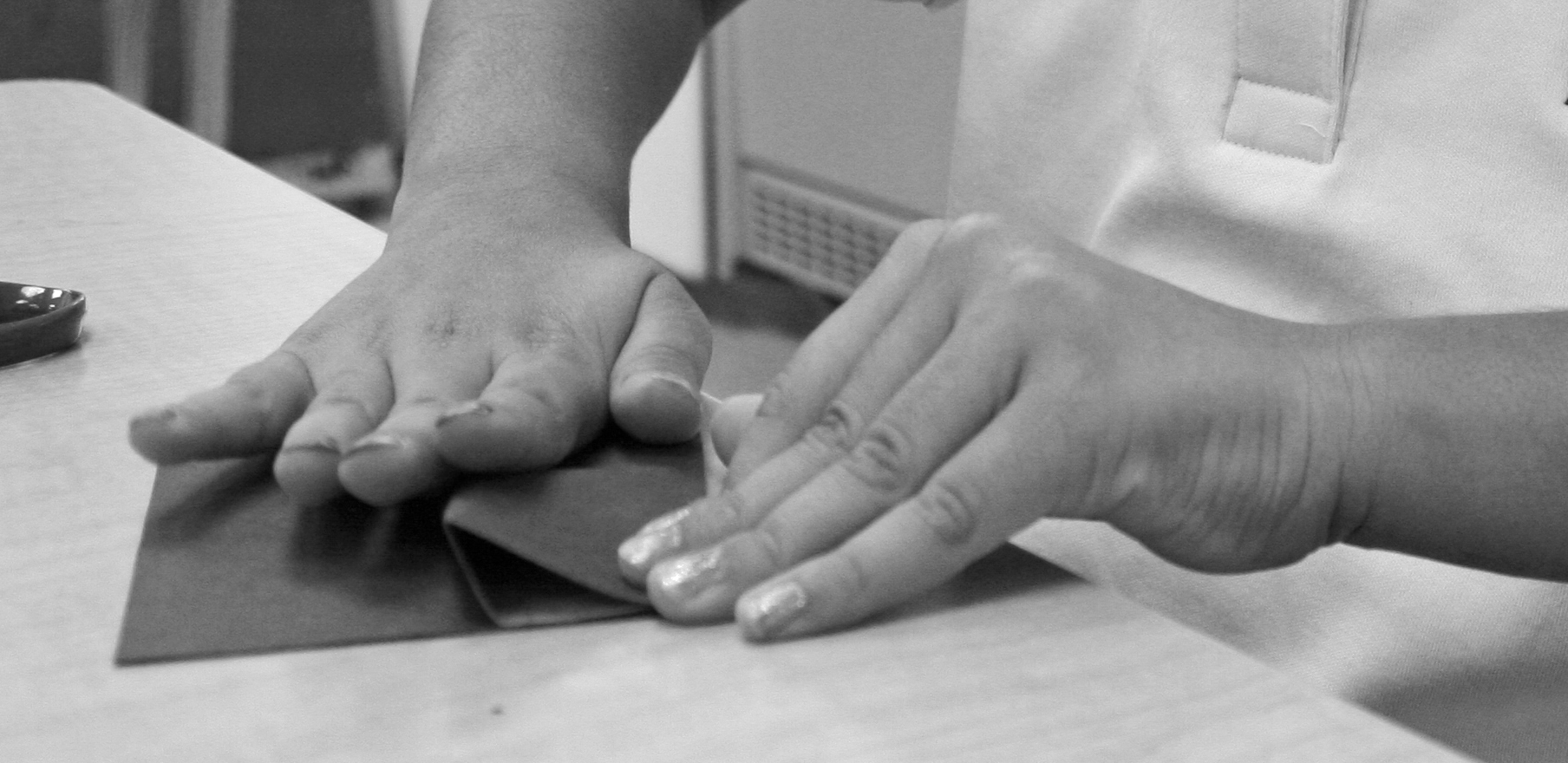
We worked together (teachers and students) each step of the way. Fold the paper the long way – don’t forget to match the corners, hold the edge tight and make a nice, hard crease. Open the paper. Fold it the short way. Now fold the top paper down to the middle fold. Flip it over like a pancake. Fold the other side down. Now you have an M or a W – depending how you hold it. Hold it so it looks like a W. Now cut the center of the W down to the fold at the bottom of the W. Grasp the top fold on each side of the cut – squish, squash!

squish squash fold

LOL yes, yes, it sounds rather complicated when you just read the words. Perhaps you are wondering – “How on earth did those kindergarteners do that?” Well, let me tell you, with a bit of direction, some encouragement, and a whole lot of respect for them, and their abilities, they did fantabulously!!! (Yes, fantabulously – better than fantastic, better than fabulous … fantabulous! How’s that for creative manipulation of the English language?! My students love the word, by the way.)

The most amazing thing was the response of the students. They were making books and talking with anyone who would listen! They were excited, empowered … giddy even! Some filled each page with illustrations. Some filled the pages with words. Others made many different sized squish-squash books, and gleefully taped them together!

squish squash

Why was this such a powerful experience for the students?

Was it the power they felt as they made their own book-form? Was it the freedom to do what they wanted? (Write, draw, make more books.) Was it the respect of the teachers for the students? Was it the authenticity of the activity? Was it the joy the teachers shared with the students? Was it the fantabulousness of the students themselves?

To be honest, I’m not sure I can pinpoint one thing that made this activity great. I think it was a combination of all of the above – and more – coming together in a beautiful, synergistic dance. And wow, was it great to experience. Fingers are crossed we will experience it over and over again throughout the year!

Munari’s Zoo

I discovered Bruno Munari while attending a conference for educators at the Eric Carle Museum in Massachusetts. Munari – an Italian artist, designer and inventor, and writer of children’s books, – is loved by Reggio educators. I use Munari’s Zoo and Munari’s Machines in the classroom with great results!

_MG_3596

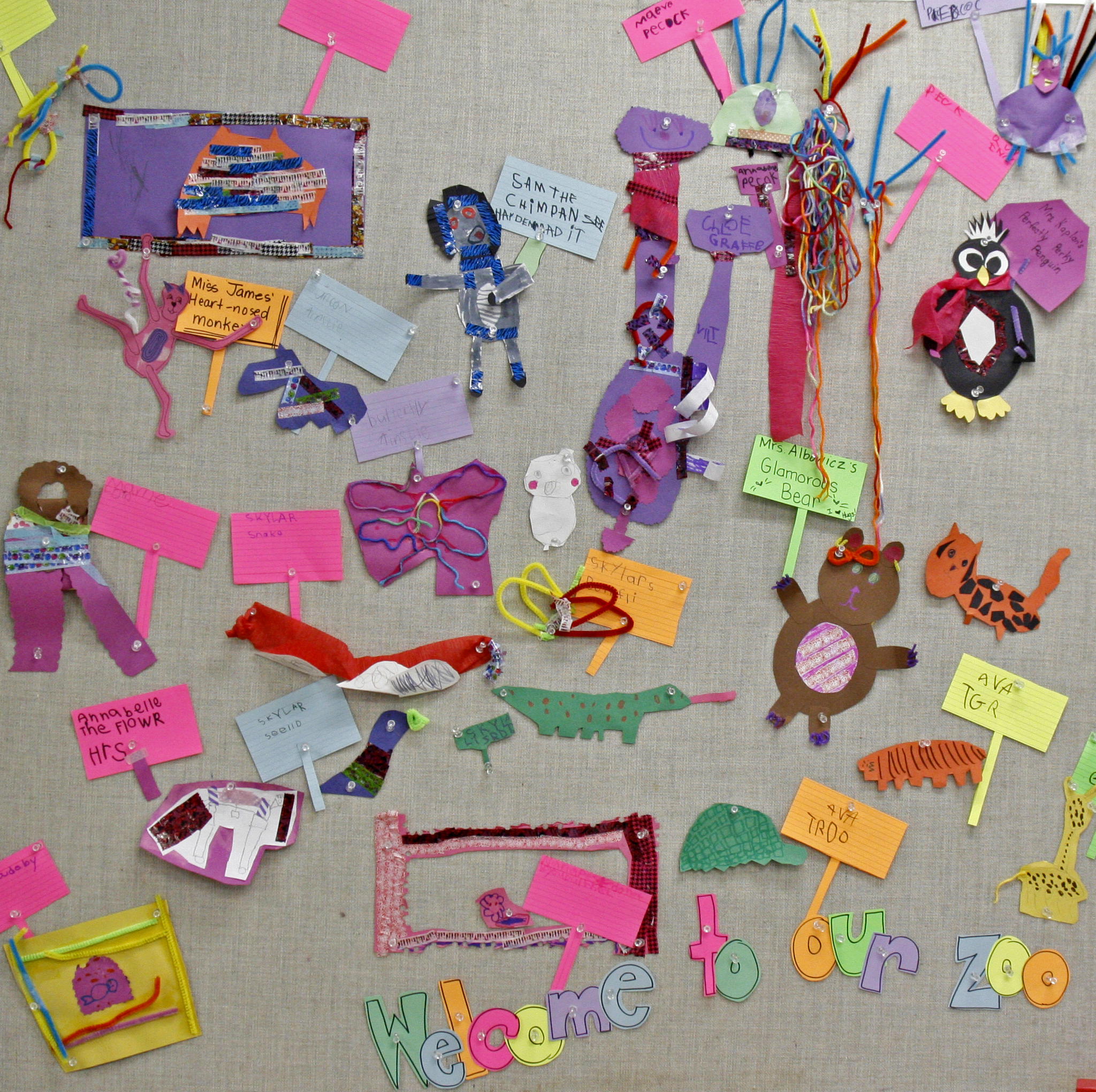
I enjoy using Munari’s Zoo at the beginning of the year. After a read aloud, we surround ourselves with paper, pencils, crayons, markers, scissors, tape, yarn, pipe cleaners, hole punches, and various other art supplies and tools – and set about making an animal to populate our classroom zoo (bulletin board).

Munari’s book starts with several amusing signs, so we all create a sign for our animal. This year the signs were mostly identifying our animal and the artist that created it. But, sometimes we add signs with instructions. This year there was one sign warning readers – “do not pull the lion’s tail!”

_MG_3604

It’s a fabulous exercise. The students are engaged – working hard without feeling strain or pressure. The spirit in the room is light and joyous. Conversations abound between the students, and between students and teachers. It’s a great way to get to know each other and to do some authentic assessments.

Are the students brave? Do they jump in, or hang back a bit? Do they have many ideas that they share and implement? Do they look to their friends or teachers for ideas? Do they need a little extra encouragement and love? Are they leaders – helping friends? How are their fine motor skills (holding pencil, scissor, manipulating tape, pipe cleaners, cutting, drawing)? Do they know the sounds letters make? Can they stretch out words? What do they hear as they stretch out the words? Do they have an efficient motor plan for their letters? Do they use upper case, lower case, or a combination of both?

The challenge involved is positive and self-regulated. The students are intrinsically motivated to create, and caught up in the excitement of seeing their work displayed, even the most timid writers stretch out words to make their sign. The open-ended nature of the assignment allows the children to self-differentiate. Some students make one animal, some make many. Some use materials they are familiar with, while others experiment with some of the less familiar materials. But, one way or another, everyone succeeds at the task.

This project is an easy, and safe way, to give the students control over their work and learning, and therefore increase their sense of agency, early in the school year. My instructions are simply to make an animal, and a sign to accompany it. They decide if the animal will be real or imaginary. They determine the form, color, and size of their animal. They choose the materials they will use to create it. They decide what their sign will say, and write it (with as little or as much help as they need). Finally, once done, they choose where to place their animal on the board as we create our class zoo.

And, very importantly, I do my best to limit my “interference” and simply listen, question and encourage. For instance, the animals at the top right are peacocks. One has to use their imagination and enter into the mind of the child – as best we can – to see how they are all wonderful representations of peacocks – although not ones we might have imagined. But, notice the color, the beginning structure, and the use of the yarn to represent all the color of the peacock feathers.

I even purposefully limit the amount of help I give them as they write. I try to help them hear the sounds in the words, and encourage them to represent each sound. But I resist my adult urge to “tell them” how to write it. By limiting my “help” I allow them to think, struggle, problem solve, experiment and come up with their own solutions. By doing so, we (they and I together) strengthen their skills, increase their ability to persevere, expand their vision of themselves and their abilities, and (hopefully) positively impact their future work and thought.


When 2+2 does not equal 4

We had Back to School Night at our school this week. As I shared who I was with the parents, I began talking about creativity and creative thinking. I told them creativity, and creative thinking, are not just about art! Creativity, and creative thinking, are about noticing, seeing possibility, taking risks, making mistakes, trying new things and thinking new thoughts. They’re about learning. They’re about taking what you know and using that knowledge to go beyond. They’re about playing and communicating. They’re about life!

I was so excited to be talking about creativity, my hopes for their children, and the possibilities for creativity in all venues, that I found myself saying, “Even math is a perfect venue for creative thinking. I read this article once, that talked about when 2+2 isn’t 4!” As it came out of my mouth, and I saw the looks of surprise on some of their faces, I recognized the need to clarify that I would, indeed, be teaching their children that 2+2 was 4! But, I would also be encouraging them to think like mathematicians, and, when appropriate, look for those times when 2 plus 2 was something other than 4.

I want their children to be able, even as kindergarteners, to take what they know and are learning, and transfer it to other situations. I want them to see the more.

Here is how it was lived in my classroom this week.

One of my students loves to get “math problems.” She seems to have an insatiable appetite for them! I wanted to honor and encourage her love for “doing math,” but I also wanted to go beyond the rote “doing of math” and engage her in mathematical thinking! I wanted to give her the opportunity to be challenged to notice things, tinker, get stumped, and keep trying.

Yes, even in Kindergarten this is possible, and appropriate.

So, after several problems with numbers and symbols, I started using pictures. First, I gave her pictures that indicated addition and subtraction. I didn’t tell her whether the problem was addition or subtraction, I let her figure it out. Once she discovered an answer, we talked about why she chose subtraction or addition, and how she got her answer. (By the way, her answers – listed on the page – are great answers, but not the only possible “correct” answers!)

add subtract

Then I asked her to complete patterns or provide the next item in a sequence. She had to think about some of them, and occasionally gave me a quizzical look. I resisted the urge to chuckle, and instead just encouraged her to think about it. Sometimes I realized I hadn’t given her enough information, or I had been ambiguous, so, I amended my instructions.

Each time she got it! I decided it was time to take a chance, and see what she did with more of an open-ended question.

I wrote:

10 equals

She looked at me, and then at the problem. She looked at me again, this time with a bit of annoyance.

“What is this?” she asked.

I responded, “Well, what does it say?”

“10 equals. But what do you mean?” she asked.

“Well, what does 10 equal?” I asked.

She again looked at me with a bit of annoyance, and a bit of confusion. I just pursed my lips, and raised my eyebrows. “You can do it. Think! What does 10 equal?”

She looked down, thought a bit, and finally wrote “10 = 10”

“Yup,” I said. “10 sure does equal 10. Can you think of anything else?”

She thought for a bit and said “6+4.”

“Yes!” I responded. “That does equal 10. What about this? Does 10 equal this?”

10 petals

She watched as I drew. Looked at me when I finished, then back at the drawing, and said, “Yes.”

To which I responded, “Why?”

“There are 10 petals.”

“Indeed!”

We did a few more problems together – sometimes I drew or wrote for her, sometimes she drew or wrote for me. Then, I took it a step further. I gave her this problem.

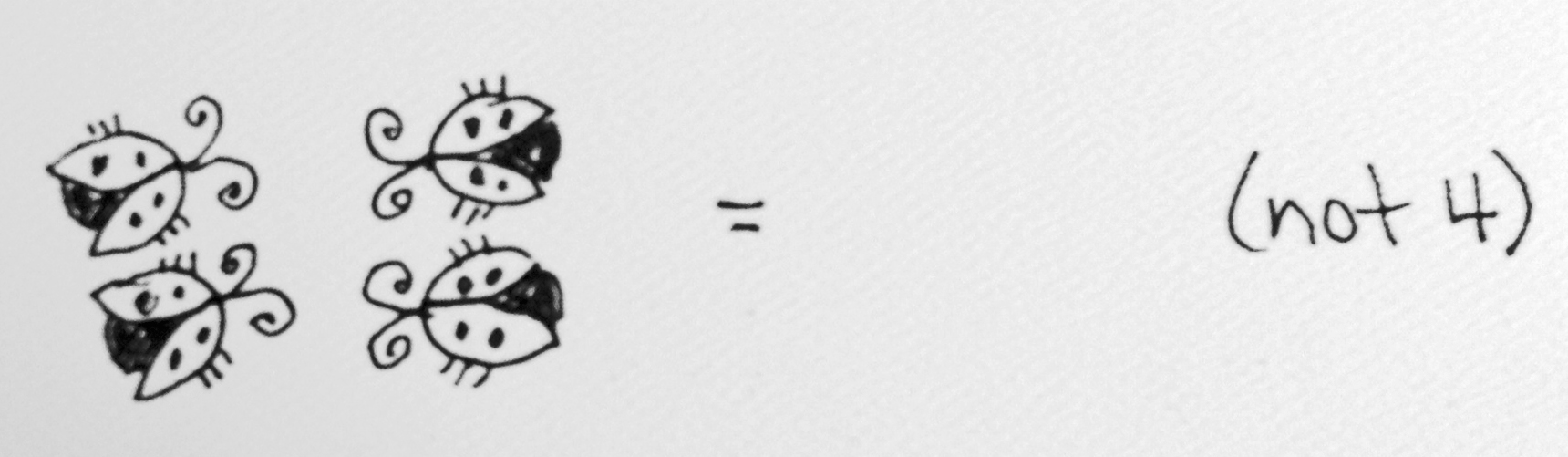
not 4

Using what she had learned from the car drawing – they were coming together –  she said, “It’s 4.” I said, “True, but what else is it? Do you see? I wrote ‘not 4’ I want you to think a bit. What is it, if it’s not 4?” She looked at me for a bit. I said, “Think. I want you to think. What else can it be? Thinking is good. You can do it!”

After a bit she came back to me and said, “It’s 16!”

“Oh! How is it 16?” I asked.

She showed me the 16 dots. “Indeed! That is 16.” Now it could just as easily have been 8 because of the antennae, or the wings. It could have been 24 because of the legs. It could have been a lot of things! The importance, (outside of the math facts) was the noticing, the thinking, the sharing of thinking, the questions, the explanations, the affirmation that thinking was good, and finally the confirmation that her thinking was sound.

It would, however, also have been ok if her thinking wasn’t sound, because it would have given us an opportunity to converse, rethink, and to come to another conclusion.

So, I ask you? When is 2+2 NOT 4?

Amazingly enough, there are many times! Think. Draw. Write. Be creative. Think in ways that might not be your first choice. Think in ways that seem to defy mathematical sense. But think! Oh, and be sure to play, and have fun.

If you come up with some ideas, please leave them in a comment. In a few days I’ll post a comment with some of my ideas when 2+2 is not 4!

Enjoy!


Yes, and … in the classroom

Back in July, I hipped you to Uri Alon’s awesome TED talk. (https://creativitylovingeducator.com/2014/07/05/in-the-cloud-with-uri-alon/) I said we’d talk once you watched the video. Well, hopefully you found the time (If not, go now!), because here we go!

So, yes, Uri Alon. How do we transfer his ideas into the classroom? Do his ideas have any merit in a classroom where we are laying a foundation of skills, facts and knowledge? Isn’t it important, and in fact necessary, that we as teachers teach our students what is correct? Wouldn’t we be doing a disservice to our students if we engaged in “Yes, and …” conversations? How is “Yes, and …” valuable in, for instance, a kindergarten classroom?

All great questions. I think it is a matter of balance – not “either or” but, “yes, and!” LOL!

As a teacher I understand the necessity of giving my students a broad base of knowledge and facts. It would be irresponsible of me to never correct a child, but it would be equally irresponsible if I never engage in “yes, and …” conversations with them.

“Yes, and …” conversations provide opportunities for profound things to happen for me, and for my students. Given a “yes, and …” response by me, my students are given permission and space to enter into a dialogue with me, their peers, themselves, and their work and thought.

They must engage in metacognition and  attempt to articulate their thinking. Why do they believe what they believe? How is it true?

By thinking about their thinking, and struggling to adequately express their thoughts, they will practice, and hopefully enhance, many essential skills:

  • metacognition
  • thinking about their thinking
  • critical thinking
  • creative thinking
  • articulating
  • emotional intelligence
  • negotiation
  • listening
  • analyzing
  • comparing
  • evaluating
  • experimenting
  • summarizing
  • valuing mistakes and learning from them, instead of running from them

They may discover their thinking was flawed at a certain point, and upon rethinking, may arrive at the correct answer with greater understanding and knowledge. Or, they may discover why their answer was correct, and grow in confidence and understanding.

Additionally, “Yes, and …” conversations benefit me as a teacher (and learner). By engaging in “yes, and …” conversations with my students I too enhance all the skills listed above. I may discover they are thinking along a path I never considered. I may discover that my instructions, or thinking, were flawed or ambiguous, or, simply different from theirs. Plus, I grow in my understanding of my students’ thinking. Focusing on the process, and the path they took to their answer/understanding, I am more able to encourage, affirm, and/or correct.

house

One year I asked my students to draw a picture of their family. One student came to me, excited to show me her picture. It was a lovely picture, but their were no people in it! I looked at her, and she looked at me. I was perplexed, so I asked her what she drew. “My house,” she replied. “Did I ask you to draw your house?” I asked. “Nope,” she replied. “You asked me to draw my family.” I looked at her with a smile, and a bit of a raised eyebrow and said “So, where’s your family.”

It seemed she hadn’t noticed any problem until I asked her about the whereabouts of her family. She leaned on the table – one hand on either side of her paper – studying her drawing intently. She looked, and thought. I waiting silently.

Finally she looked up, with a huge smile on her face – eyes glowing with the discovery she had just made. “THEY’RE IN THE HOUSE!!!!!” I couldn’t restrain myself, as the answer was so unexpected, and burst out laughing! “They’re in the house? What are they doing in there? Do you think you can draw them so we can see them?” She looked at the picture one more time, said yes, and began to draw faces in the windows.

That was an awesome example to me of a “Yes, and …” type of conversation benefiting both my student and me. She had to think about the task and her response. She had to problem solve. I had to trust her, wait, and re-evaluate my directions.

We both walked away with greater understanding and confidence in ourselves and each other. Fabulous!


RESOURCES:

The Art of Focused Conversation: 100 Ways to Access Group Wisdom in the Workplace, edited by R. Brian Stanfield,  http://www.amazon.com/The-Art-Focused-Conversation-Workplace/dp/0865714169

Relentless Creativity

MA cert

Over the last 2 1/2 years I pursued (and attained) an MA in Creative Thinking from the University of Central Lancashire. I focused on the classroom environment that might best support creativity and academic excellence. Occasionally I got a bit off track and wanted to stick a pencil in my eye (not really, lol, but you get my point), but, most of all it was a fascinating journey filled with discoveries, joy and inspiration!

I concentrated on three schools/approaches that endeavor to marry creativity and excellence – El Sistema, Reggio Emilia, and Oklahoma A+ Schools. If you haven’t read anything about them you really should! Or, just follow my blog as I’m sure to talk about them here!

I heard Tricia Tunstall (author of Changing Lives: Gustavo Dudamel, El Sistema and the transformative power of Music – a great book btw) speak at the NJAIS conference in 2012. She shared her experiences with El Sistema (a remarkable music program started by Jose Antonio Abreu). She said some great things, but the most profound idea – which I wrote in capital letters with numerous underlines – was RELENTLESS POSITIVITY! The El Sistema educators are relentlessly positive.

RELENTLESSLY POSITIVE! Wow. I adopted it as my mantra – relentless positivity.

When I decided to start a creativity blog, I struggled to find a title that adequately described who I am, and what I hope to achieve in my life and on this blog. I thought about relentless positivity and relentless creativity. Either would work for me because I see them as rather intertwined. Wanting to highlight creativity, I included relentless creativity in the title. I’m not sure it captures everything I’m imagining, but it’s a good start.

I am relentlessly creative. I love being creative, thinking about creativity, talking about creativity, encouraging creativity and experiencing creativity. And I mean creativity in all arenas – art, science, math, music, life, you name it – everything! Creativity is a way of thinking, learning and being, that has the potential to impact all academic disciplines and all aspects of life. Joy, knowledge, a great scarf, a new recipe, and life changing discoveries are just some of the treasures creativity offers us.

I may not always produce the most beautiful scarf, or craft the perfect recipe, or have the most profoundly creative thought, or make any life changing discoveries, but I will always be relentless in my pursuit of creativity in my life and in the lives of those around me.

Welcome to my blog! I hope you enjoy my thoughts, photographs, projects and posts, and I hope you join the conversation.

Have a wonderful day!

Molly