If you’re reading along with my posts, you know my recent life has been filled with caring for my dad. The stress and angst of his injury, complications, and days and nights in the hospital were pushing me to the edge. Then, my oncologist – after seeing my recent bloodwork – said, “You have got to take better care of yourself!” I nearly fell over the edge.
What’s a girl to do when she’s at the edge? Well if you’re me, you paint, write, or paint and write. I love playing with paint and words. I’m often surprised or stumped, and go through moments of deep thought and wondering, mess ups and revelations. Somehow the process brings me to a space of flow, peace, and joy.
Thinking about my process and experience, I did a bit of research to see what experts say about art assuaging angst, and aiding in health and wellbeing.
The Mayo Clinic — The intersection of art and health: How art can help promote well-being – Mayo Clinic Press
The arts also can be beneficial to your physical and mental health when you experience them — as an appreciator or creator.
The American Congress of Rehabilitation Medicine says making or even just seeing art can impact the brain. Whether it’s part of a creative arts therapy exercise, or something you experience in your everyday life, art can help:
*Imagine a more hopeful future.
*Increase serotonin levels.
*Increase blood flow to the part of the brain associated with pleasure.
*Foster new ways of thinking.
The Connection Between Art, Healing, and Public Health: A Review of Current Literature – PMC
Engagement with creative activities has the potential to contribute toward reducing stress and depression and can serve as a vehicle for alleviating the burden of chronic disease.
So, as I am want to do when it’s time to create, I pushed aside the many things that were in my way (in life and on my kitchen table). I surrounded myself in that small cleared space with acrylic paint, paper, an acrylic wedge, old hotel door cards (the poor woman’s answer to pallet knives), artist tape, and some hopeful enthusiasm and curiosity.
First I just sat in that tiny creative haven breathing, looking, thinking, and being. I was reminded of the invitation from our school’s art gallery curator to be part of our faculty and staff art show. In the midst of everything, the provocation of new art had sat forgotten in the back of my mind. Now, it came into my conscious mind as a beautiful opportunity.
Wonder joined my breath, looking, thinking and being. What might I do that would bring me joy, peace, and healing? Is it possible to do that, and create something I’d like to submit for the show? I decided to play and see what happened.
First I mindfully taped the edges of the paper. Then I added the paint.
At first it didn’t work as I hoped. I tried a few times to bend the paint and process to my will. Finally, I surrendered to the process and paint. Instead of trying to control it, I bent to its will, or, at the very least, cooperated with it. I began to see what was possible and beautiful, rather than what didn’t work. I switched to a more monochromatic palette and the results of my change in thought and color were surprisingly beautiful and satisfying. The things that had been so frustrating became the elements I most enjoyed.
Sitting with my paintings I knew I had to add words. Haiku is a form of poetry that soothes me and brings me beautiful, quiet joy. Something about the process of forming my thoughts, and then forming those thoughts into 5-7-5 lines, changing words to match the beats, and finding unexpected inspiration in the new words, brings me into an almost parallel world of stillness. Many words flow out of me onto an old envelope. I gather them up and the haiku begins to take shape. Then, as is my usual experience, I am unable to find the right sound and feeling. I struggle on for a bit. Then I rest my head in my hands, close my eyes, breathe, and wait with peaceful expectation. As I wait, my breath deepens, my headache eases, my angst lessens, and the words appear.
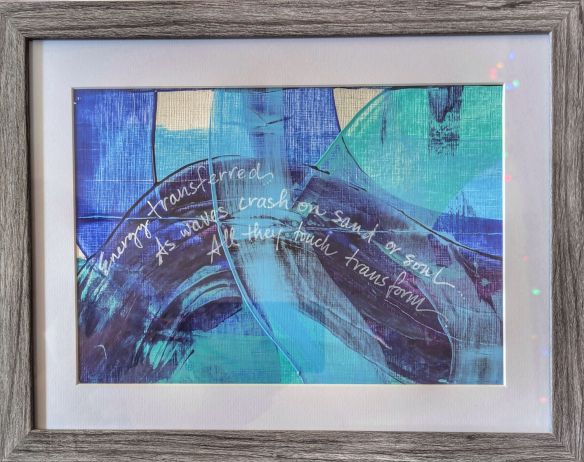
Waves
Energy transferred
As waves crash on sand or soul
All they touch transform
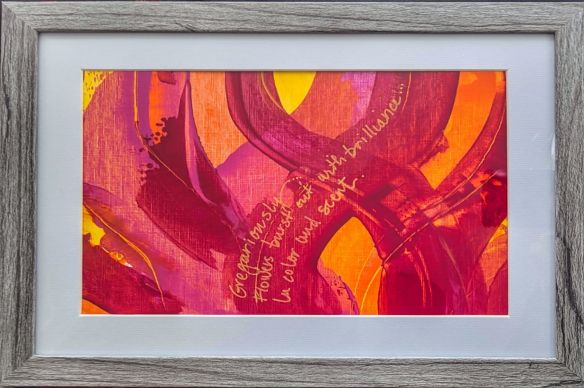
Flowers
Gregariously
Flowers burst out with brilliance
In color and scent
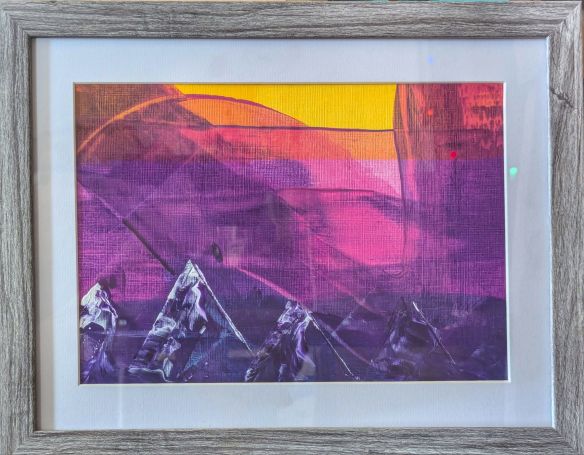
Sunset Over Snow-covered Mountains



 Life lived with relentless creativity