Letting My Learners Lead Me

We had the best social studies learning time today! It was spectacular. I know I always say I wish I had a videographer, but wow, I really wish I had one today. My girls were fantabulous — full of energy, passion, and awesomeness.

Let me explain.

We are part way through our super hero unit. We’ve explored fictional super heroes, and created our own personal fictional superhero. After numerous discussions, we decided there aren’t just fictional superheroes, there are also real superheroes! We generated a list of superheroes in our own lives. They included: police officers, firemen, firewomen, grandmothers who get up early every day to make us breakfast, sisters who help us cross the street, dogs who bark at bad guys, teachers who teach us, dads who give us medicine when we’re sick, and nannies who always play games with us.

Today’s topic was  how we can be, and are, superheroes. I planned on showing them Brad Montague’s (Kid President’s brother-in-law) video This is a Joyful Rebellion, and then work on Mirror Messages as a way to give them concrete examples of them being superheroes.

I told them we’d be watching a couple videos this week. I mentioned Kid President and his pep talk for superheroes. None of them had heard of him, so I pulled up a quick photo to show them. They were enamored with his image, the fact that he is a kid, and the idea of a pep talk. They all wanted to watch him TODAY! They were quite emphatic.

I thought for a moment. I wasn’t prepared for an activity for this video, but they were definitely into it, so I decided to give it a go, and see what happened. I asked them “So you want me to change my plans so we can watch this today?” They responded, enthusiastically, “Yes!” I paused, thought a moment and said “OK, let’s watch it, and then talk about it.

OH MY GOSH!!! They got so much out of the pep talk! Their observations, insights, and discussion were amazing.

One said: “But Miss James, we can’t be REAL superheroes!”

I took a breath, put my hands on my hips, thought for a moment, and said “What do you mean?”

She repeated herself: “We CAN’T be real superheroes, Miss James!” and added “We can’t fly.”

“OH!” I said, “You mean we can’t be like Superman?!”

“Yes!” she replied.

As I began to explain that Superman isn’t real, but is a movie and comic book character, another girl interrupted. She practically yelled …

“But they’re NOT REAL! They’re FAKE!”

“Yes!” I said (giving her a high five).

She continued “We’re real, and we can be REAL SUPERHEROES. We don’t need to be able to fly, or shoot lasers out of our hands”

“YEAH!” another said “And we don’t need to have laser eyes!”

“That’s true! We don’t have, or need, lasers hands or eyes!”

Now came the big question. “So if we don’t have laser hands or laser eyes, and we can’t fly, do we have super powers?”

Their eyes seemed locked on me as they struggled with that question. The room was completely silent.

Finally, one yelled, “YES! We do have super powers!”

“What?” I asked.

“We have heart power!”

“YES!! YOU DO!” I exclaimed in return.

I cheered them on as they continued. We have:

  • Big Beautiful Brain Power
  • Our Own Ideas
  • Making Power
  • Kindness Power
  • Niceness Power
  • Friendship Power
  • Art Power
  • Science Power
  • Math Power
  • Loyalty Power
  • Brave Power
  • Strong Power
  • Muscle Power
  • Generosity Power
  • Loyalty Power
  • Creativity Power
  • Honesty Power
  • Helping Power
  • Inventing Power
  • Gift Giving Power
  • Listening Power
  • Thinking Power
  • Word Power

“Wow!” I said “This is fantabulous! I think we have to make signs with our powers. Shall we use big or small sheets of paper?”

“BIG PAPER. Let’s use big paper!”

Of course we had to use big paper. What was I thinking? Their powers, their hearts, their minds, their spirits, DEMANDED big sheets of paper. What else could even come close to holding them?

We each got our favorite color 12×18 inch sheet and set to work writing and illustrating our powers.

After social studies, we had choice time. One of the girls asked if she could work on our 120 chart — we had begun constructing it during math. “Sure! How many numbers do you want?

“Two.” she said.

She took two and placed them in the chart. Then she took a handful. A moment later she said, “I want to finish the whole thing!”

“You go, girl! Use your math power!”

IMG_20180212_202342_processed

40 minutes later the chart was completed!

We sat and looked at it together. “Wow,” I said, as we high-fived. “That is so fantabulous! Thanks for using your math power to help us get this done.”

I’m sure social studies would have been good if we followed my plan to the letter. But, I’m also sure it wouldn’t have been this good. And I have no idea if this girl would have had the confidence in her power to finish this chart on her own. My decision to allow my students to lead me — to step into the unknown, trusting in them, me and us — made all the difference.

I’m so glad they asked to lead, and I’m super glad I said yes, and followed them.

Helping Students Reach Higher

As educators we often talk about wanting our students to:

  • reach
  • stretch
  • go as far as they can
  • achieve

We also work hard to provide:

  • instructions
  • help
  • scaffolding
  • tools
  • structure

My classroom word wall is quite fluid. Sometimes it has our names on it, other times it has words we may encounter in our various learning units. Once we return from winter break, and move towards spring break, I begin to give the world wall more and more to my students.

In reading they each write three words they want to add to our word wall. They must be words they know how to spell like they are written in a library book.

I’m careful to not say “Three words you know how to spell correctly.” When they use inventive spelling — which is appropriate and important in Kindergarten — the words they write are correct if they, and I, can read them. For instance eat might be written ete. Or, teacher might be encoded as teechr. These are examples of correct inventive spelling, because they follow phonetic rules, and accurately convey the sounds, words, and thoughts of the writer. I don’t want them to begin thinking that the way they write is incorrect, and only by memorizing words, or asking for help, are they able to spell, write, and share their ideas.

In Social Studies, my students think of three words related to our topic, that they’d like to add to our word wall. Often these are words that are difficult to spell like they are spelled in library books. My girls stretch them out as best they can, then we work together to make any needed changes. This gives me the opportunity to share rules, digraphs, blends, and crazy things about the English language (for instance, ir, ur, and er have the same sound!), as well as help my girls find their own errors in thinking, hearing and sounding out.

For instance, one girl wanted to write strong. She srog. We stretched the word out, tapping the sounds – to try and tease out that n sound. She added it. Then I asked her to read me her word again. She read strong. “Hmmm,” I said, “I read srong.” She looked at me with a puzzled look, and sounded it out while holding my gaze. Then she looked at what she wrote and sounded it out again. Finally, she laughed and said “Oh, t! I forgot a t.”

These moments are examples of my students reaching, stretching, and attaining, while I support and scaffold. Sometimes, though, the reaching, stretching, and scaffolding is much more literal.

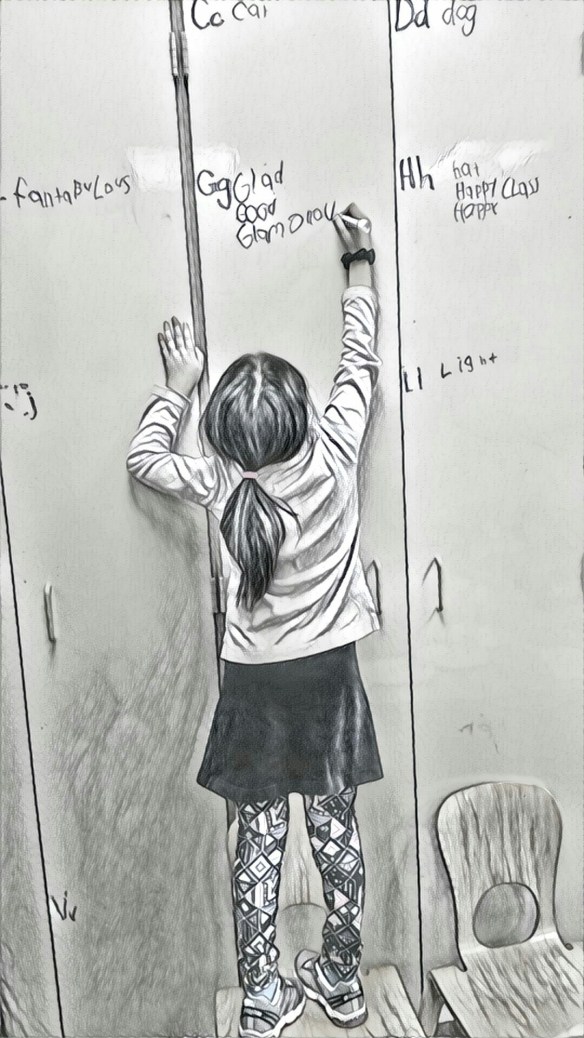
My students are confident in their own ability to find safe and effective ways to use things in our classroom to achieve their goals. So, they often create their own scaffold, and reach as high as they desire.

IMG_20180210_075908_processed

But, there are times the height they hope to attain is beyond their reach. That’s when I offer myself as a resource. I provide the scaffold they need to reach higher than they might on their own.

IMG_20180210_075948_processed

I really like that I am supporting them, rather than holding them. They get the chair. They have to be brave enough to step onto the scaffolding (me) and stand tall. Even though I am spotting them all the while it’s not always easy! Once on the scaffold, they have to breathe, trust, focus, reach higher. and write — undeterred by the distance they are from the floor!

For me, these are all moments of creativity.

  • Thinking outside the box.
  • Being open to possibility.
  • Inventing as we spell.
  • Not being deterred by what seems impossible considering the tools we have or do not have.
  • Risking.
  • Being brave.
  • Giving it a go.
  • Reflecting, adapting and rethinking.

And, let us not forget the equally important and essential parts of engaging in creative thinking and doing:

  • Experiencing joy.
  • Being struck by beauty and awesomeness.
  • Learning.

Grab A Moment

I’ve been thinking a lot about finding time in the day to “give” to my learners — time for them to make and invent, time to think creatively and critically, time to think about possibility, to experience joy, energy, challenge, freedom, and agency. It’s not so easy to find, but I just kept thinking and wondering.

I noticed I sometimes have small pockets of time in morning meeting. Not a lot of time for sure — maybe 5 minutes — but I thought I’d see what we could do in that time.

I searched around for LEGO bricks in the classroom, and found quite a few. I took out most of the pieces that suggested any thing in particular (trees, people, wheels). I hoped by doing that to have the creation be more open to possibility, and the imagination of each maker, and less led by the ideas of the LEGO makers. I found a basket that made it easy to send the bricks around our morning meeting circle, and eagerly anticipated our work together!

lego basket

By the way, we hadn’t used our LEGO bricks in some time, so they were in a need of a wash. I loaded them in a mesh bag, and washed them on the top shelf of my dishwasher on a cool setting. Worked great! Thanks to all the people who posted things online about ways to wash them.

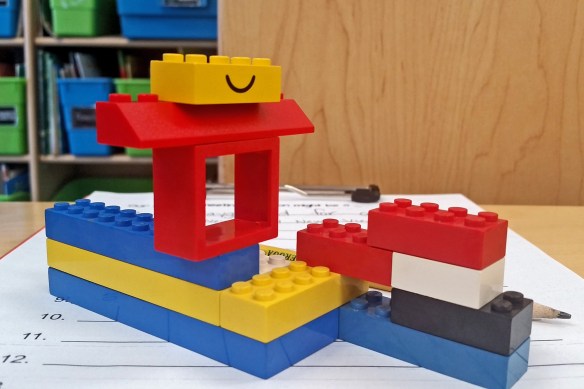
The first two times we gave it a try, we worked together to create one structure. We each picked a lego, and added it to the structure as we passed it around our morning meeting circle. Here’s our first creation.

inventing 2

Sometimes the girls were quiet, watching each other add their brick. Other times they kibitzed about where to put the brick, or shared with a neighbor what it might be.

When we finished creating the structure I placed it — with a pencil — next to a clipboard reading “Our morning meeting invention might be … ”

20180202_121455

Over the next few days, the girls continued to think about what the structure might be — not what it is, but what it might be — and when they had a moment, they added their ideas to our lists.

The girls loved creating together, and writing their ideas one the lists. In the process we all got to practice and grow in many ways. We

  • used our imagination.
  • thought creatively and critically.
  • were open to possibilities.
  • collaborated.
  • were flexible when our friends accidentally knocked a piece off, and replaced it in a different spot.
  • acted as individuals, and as a team.
  • practiced handwriting, and encoding our thoughts into words so others could read them.
  • were resourceful — figuring out how to create something with a small set of bricks.
  • worked on our communication skills — as we created, as we talked about the creations later on, and as we shared our ideas.
  • enjoyed each other and the process.

It may seem like there is no time in your day to allow your students to invent, create, make, think, dream, imagine, wonder, and enjoy. Don’t believe that. Be open and observant. When you notice a moment or two in your day, give it to your students, and yourself, as moments of possibility.

Often times this is my mantra: “Small moments. Small creations. Big impact.”

Give it a go. Grab the moment! Your students, and you, deserve it.


By the way … 

If you find a moment and do something, leave me a comment, I’d love to hear what you did, and how it went.

If you find a moment and have no idea what to do, ask a colleague, or leave me a comment. I’d be happy to brainstorm some ideas.

if you look at your schedule and say “Molly does NOT know what she is talking about. My day is packed, and there is NO WAY I can do one more thing!” leave me a comment. Maybe we can look at your day together and find some time.