The Power of Language

Lately I’ve been struck by the profound power of language.

Last night at a mindfulness session someone pointed out the difference between saying: “I am a worrier!” and “I am experiencing worry.”

Do you hear a difference? Do you feel one? They are very similar statements, but the small variations cause large differences in meaning and impact.

The first statement says something about me, and therefore about the possibility of my actions or thoughts. I AM a worrier. If I am a worrier, I have no choice. I worry. If, instead, I am experiencing worry, I have choices. I can notice the worry. I can observe it. I can choose to turn towards the worry and learn from it. I can choose to do something to alleviate it. Or, I can worry, lol.

The point is, the change in my language opens possibilities for me! It gives me options. It creates space to be, and to do.

I share the worry example because it helped me to understand my experience of another rather subtle change in language.

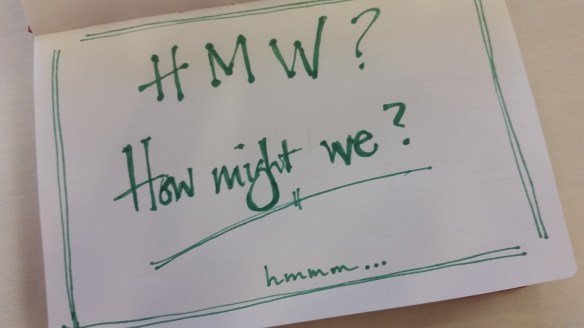
I’m writing an article on creativity and leadership. My editor suggested I change “How might we?” to “How can we?”

What do you think? Say the questions to yourself a few times. What do you experience when you read the questions? Do you notice a difference? Do you have pull or preference for on or the other?

I definitely experience the questions differently, and I have a clear preference!

I am experiencing — in my life and in my practice — that the power of “How might we?” far exceeds the power of “How can we?” Sounds a bit crazy, right? But, it’s not!

“How can we?” offers two options: we can, or, we can’t. That’s it. Too often, when given the choice of can, or can’t we choose can’t.

I can’t do that! I can’t walk a half marathon! I can’t solve that problem. I can’t write a story. I can’t do a multimedia presentation. I can’t pass this test.  I’m not able. There is no way. (sigh)

If we avoid the “I can’t!” quagmire. We may fall into the “I don’t know” trap because”How can we?” suggests we are looking for the correct way to do whatever we are doing. If the person being questioned is at all unsure, this often leads to the answer: “I don’t know.”

In both instances — “I can’t” and “I don’t know” — the problem remains unsolved understanding stagnates, learning is limited, and, perhaps, most tragically, the one questioned is now more convinced than ever that they really don’t know, and they really can’t .

20161102_100801

In contrast, “How might we?” is more flexible and less prescriptive. “How might we?” invites divergent thinking, allowing us to go wide with our answers. Even the uncertain can offer ideas because the “rightness” of the answer is not demanded.

Often the answers which fail, are more valuable than those that immediately succeed. They allow us — demand it actually — to reflect, examine, explore, talk, learn and try again. In this process many positive things happen. To name just a few:

  • Understanding (of ideas, materials, students, ourselves, others) deepens.
  • New strategies emerge.
  • Trust, confidence and relationships grow.
  • Thinking and ideas are valued.
  • New ideas are formed.

The power of simple changes in language is intriguing. I’m super excited by the possibilities of HMW questions, and am working on using them more often in my life, and in my practice.

Give them a try. If you do, I’d love to hear your reflections.

Memories of Clementines

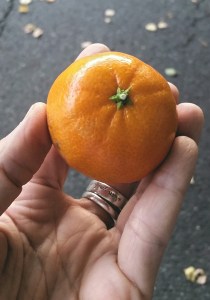
Driving to a late day meeting, I unzip my lovely new cooler bag, and fish around for this …

clementine-me

Before I even see it, I imagine peeling it, and think of where I might leave the peelings. In my mind’s eye (or is it nose? lol) I can already smell the beautiful, citrus fragrance. I can’t wait to experience it as it fills my car with lusciousness!

At that moment my mind returned to this fabulous little hand …

clementine-london

This hand belongs to one of my kindergarteners from last year. I loved the exchange we had, so I asked if I could photograph her hand with the peel in it. She looked quizzically at me when I asked, but agreed.

“I love your idea,” I explained, “and I want to write about it on my blog! I never thought of it as a possibility, and I want to share it with others.” She smiled a soft, small smile, and agreed.

Finally, I am sharing.

When she came to me her eyes were bright.

She said “Look, Miss James!”

I looked at her hand, and then back to her face for an explanation.

She responded, “I’m going to use it in our supermarket build!”

(We visit a supermarket, create field guides, and then re-create the market in our classroom with blocks and various other items.)

I reply, “You are? What will you do with it?”

She said, “I’m going to use it to add an orange smell to my paper oranges. You know, like a scratch and sniff!”

I burst out laughing, and with a huge smile say “WOW! That is fantabulous!!! What a great, creative idea! I never thought of that! Thanks for sharing your idea with me!”

Amazing, right? I wondered why she was showing me a clementine peel. It didn’t immediately come to mind that the small piece of peel could be used so creatively.

Often, my students ideas are large, sometimes even bigger than mine. I enjoy their exuberance, and their big ideas. And, I trust that my support, my openness and positivity, and my joy in their awesomeness, encourages them to adopt, trust and live their big ideas!

Courage, Challenge, Learning and Excellence

“Although my students are only five or six years old, I work hard to establish egalitarian, collaborative relationships with them. I am interested in their thoughts and always respond to their questions of “Can I tell you something?” with “Yes, please tell me something!” I value their stories as a way to get to know them, and I really listen to them as they share. I sit or kneel to speak with them so I am not so far above them, and I often sit on the floor with them when I teach them. This helps us develop a relationship of trust, and ultimately empowers courage, challenge, learning and excellence.” (Managing the Classroom for Creativity)

When I wrote that for the Creative Education Special Issue, I was thinking of the courage, challenge, learning, and excellence that my students develop and live in our classroom.

As I re-read the section now, I still believe my students benefit from our collegiality. But, I am fascinated by the realization of how much our relationship of collegiality and trust impacts me as well. It helps me to be courageous and more open to challenge, and it encourages and enables me to develop deeper learning, and greater excellence!

This became very clear to me the other day. I joined a kindergarten alum and her family (she just finished first grade) for an afternoon at Turtle Back Zoo. Part of our day included participating in the Treetop Adventure.  The course is about 15-20 feet in the air. Not too high unless you are afraid of heights – which I am!

My alum and I hit the course together. We chatted with each other as we waited for our turn on the various elements. We watched others and commented on things they did well, and the things they might do better. We talked about being a little afraid. I told her I was afraid of heights. She assured me it wasn’t that high!

We decided I would take the lead for the first half of the course. I cheered her on as she worked each piece of the course, and offered suggestions the few times she seemed a bit stuck.

The second half of the course, my alum went first. This section was a little higher and a little more challenging. Nothing terrible, but I was beginning to feel fatigued from my fear of heights and my effort to overcome it. I breathed in through my nose and out through my mouth – just like I tell my kindergarteners to do when they need to relax and get their bodies to know all is well. As I paused at one challenge — to take one of those calming, strengthening breaths, and decide how I would step — I heard the most awesome thing …

“You can do it, Miss James!!!”

It was my alum yelling to me, “You can do it, Miss James!!” 

How fantastic is that?!?!?

I’m not sure if she was completely confident in my ability to do it. I am sure she was completely confident in herself, and in our relationship.

Our relationship based on respect, trust, collegiality, and love, let her know it was appropriate for her to encourage me. And, our relationship assured her it would make a difference to me.

And it did! It helped me! Her egalitarian and collaborative relationship with me, empowered and enabled me to embrace “courage, challenge, learning and excellence!”

It wasn’t just that day. It happens in the classroom too.  But there, on the ropes course, it was very clear.

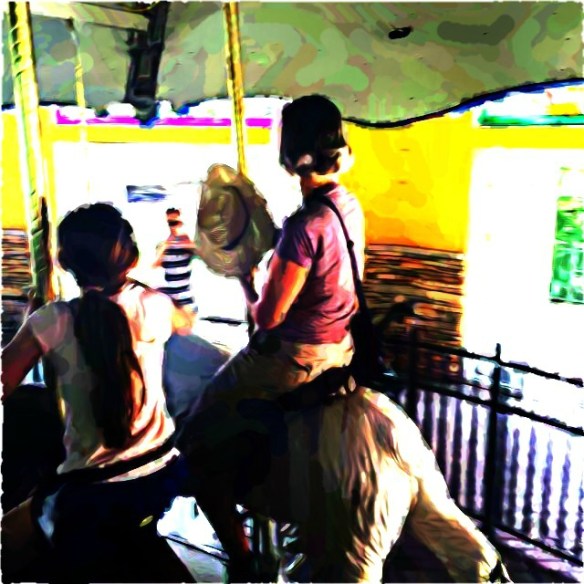
artistic skylar and me

Here we are, on the carousel together. I love the photo for the memory, and the symbolism.

May I always have a beautiful kindergartener, or kindergarten alum, by my side.


RESOURCES:

James, M. (2015) Managing the Classroom for Creativity. Creative Education, 6, 1032-1043. doi: 10.4236/ce.2015.610102.


Courageous Creativity

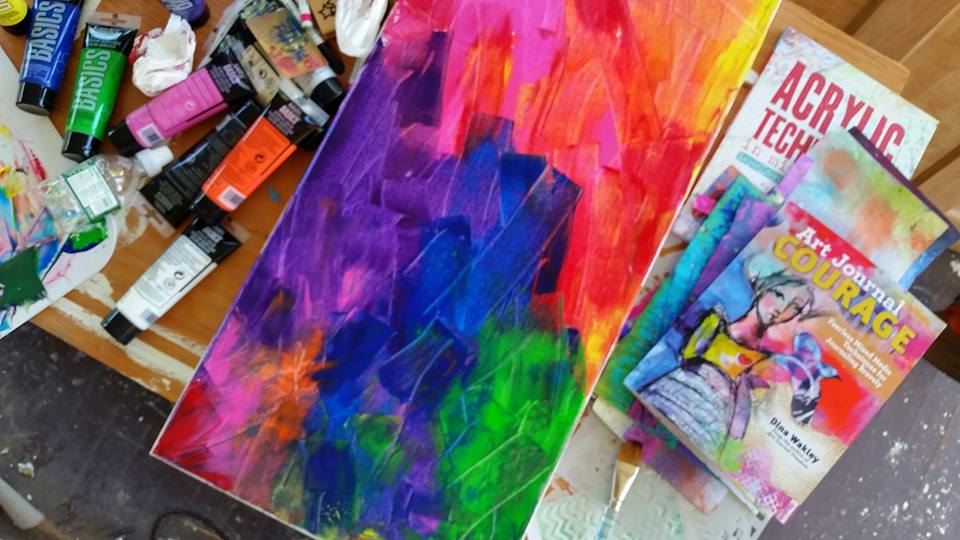
math canvas 1

Sometimes we have to show a little courage in order to encourage it in our students!

Our math coordinator felt, I think, a little left out of my Kindergarten classroom. It is a lovely space, rich in the opportunity to do math, but not so rich in the “in your face, obvious, look this is math” kind of way! I love math, yes, for real, I really do. So I thought “Let’s go all out!”

I pulled out two canvases. They were beautiful! Big, thick, pristine, white canvases. I was excited to make some sort of creative, statement piece. Something that was fabulous artistically and aesthetically, and actually said something about math.

You may recall, I’m sometimes a bit of a chicken when it comes to the big, blank, white page! And, let me remind you, this was not a only big, blank and white, it was a canvas, and not a cheap one at that. But I had no time for timidity! I had two days to create two canvases. Eeek!

I flipped through a couple mixed media art books, and came upon many ideas I thought I could use – putting paint on the canvas with an old credit or gift card, creating layers with stencils and cut paper – and perhaps most importantly, not being afraid of the process.

A deadline is not always helpful when you are being creative, but this time, it was incredibly helpful. I didn’t have time to entertain my fear of the blank page, or the possibility of destroying the canvas. I had to trust the process, the colors and me, and just do it! So I did.

It was super fun and super freeing. Hopefully it will inspire parents and students to wonder, investigate, think, share, strategize, question, problem solve, reason, make mistakes, try again and learn … even if they are feeling a bit trepidatious!

math canvas 2