We had our Field Day at my school yesterday. It was fantabulous and tiring! Thankfully it’s a half day for students. This allows faculty to do some of the many things on our plates.
After my students left, I took a moment to contemplate my next steps. Despite having a lot to do, I decided that it would be most beneficial for me to take a walk uptown, grab a bite to eat, and give myself the opportunity to find peace and refreshment.
As I walked, my joints and muscles ached a bit, and for a moment, I wondered if I chose well. I took a breath, reminded myself of the advantages of pausing and taking care of myself, and walked on.
Arriving at the restaurant I talked and laughed with the server, ordered, and went outside to find a pleasant place to sit. The table in front of the waterfall installation was free. I opened the umbrella by my table, sat down, kicked off my shoes, and began to breathe and relax. I chuckled at the small birds, enjoyed the cool breeze, took many deep breaths, and allowed my mind to find joy.
Before leaving school, I packed my haiku notebook and a pencil I enjoy using in my bag, knowing I don’t always enjoy eating alone at a restaurant. After sitting for some time, I felt the pull to write. I appreciate the structure of haiku. Its format encourages me to find new ways of saying things and allows me to write in short bursts.
Little Bird The bird drinks water escaping the waterfall Then tweets hungrily
Gladness In city center I pause by the waterfall Manmade and lovely.
Once you’re comfy, peel its gentle skin like you would a clementine … dig your thumb at the bottom of each juicy section and pop the piece out.
Kwame Alexander – How to Read a book
Kwame’s book is beautiful. The words are wonderful, and the images are stunning. This quote is one my Kindergartners and I come back to with great frequency. They have been thinking about scrumptious clementine pieces that are so juicy they burst when you bite them, sending clementine juice down your chin, and surrounding you with clementine fragrance.
The Kinders are crafting their own juicy sentences. They start with the driest of sentences, and tell only “Who, did what.” Then they use their imagination to say more about the who and the did what?
The juice, flavor, and fragrance of this one got me.
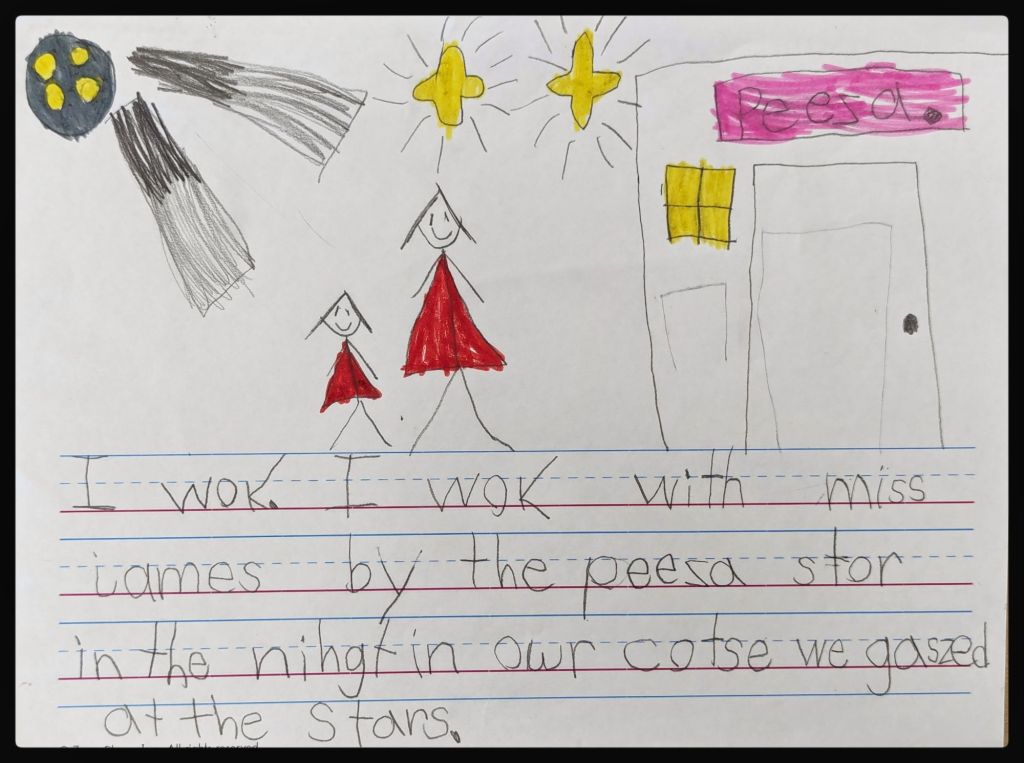
So much to love — her thinking, her writing, her ideas. We’re together, by the pizza store in our matching coats, gazing at the stars! It’s a great place to be.
A while back I wrote about adopting a practice of writing a haiku poem each day, I haven’t written one poem a day. Some days I haven’t written any, and some days I’ve written more than one. I’m embracing my practice as it is so that I can find joy in it and continue.
I love the process of writing the poems. I’m not following all the rules of haiku, but I am maintaining the 5-7-5 beats for each poem or stanza in my poem. Finding words to fit the form is getting easier, but occasionally I still struggle to express myself in the form. At those times I head to thesaurus. Searching for a new word that has the needed number of syllables and the right meaning and feeling is enjoyable — I may even be enlarging my vocabulary!
As I write I’m working to be true to what I’m experiencing and noticing, but also to be positive and optimistic. I’m happy to report that I find great joy and encouragement as I reread the poems. I’m remind of happenings, pleasantly surprised by the rhythm, and encouraged by the meaning.
A few readers have asked me to share some of my poems and the poems my Kindergartners create. I haven’t introduced haiku to my Kindergartners yet. I think in the next few weeks, It might make sense to bring it into some of our work and thinking together. Once I do, I’ll share their work. For now, here are a few of mine — seven, actually, simply because I like the number.
RAIN (written in the depth of our drought) What’s that? Is it rain? Window thrown open, I melt in the lusciousness of rain.
MORNING PAUSE Wake, sit, breathe, and pray. Mind and body run away. Gently call them back
Hands on heart, I breathe. Inhale, exhale, up and down. Cultivating peace.
Repeat as needed. Notice, accept, and breathe on. Held in prayers and peace.
AMAZING THINGS Believe it, it’s true. Amazing things will happen. Make room, lots of room.
MORNING Drat the pencil’s dull Shavings accidentally Fall upon the floor
REPROGRAM I am courageous I am peaceful. I am loved. I am safe and well.
Reprogram your brain. Create new neural pathways. We have the power.
PHEW, YAY! Worked out yesterday Feeling it today Celebrate new strength
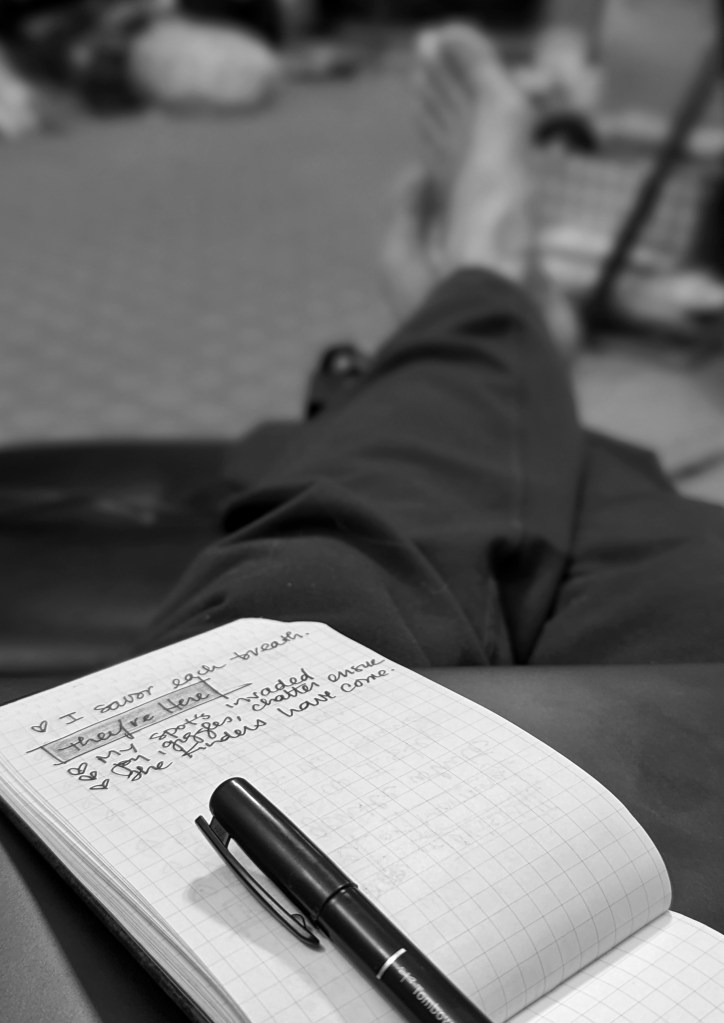
THEY’RE HERE My spot’s invaded by giggles, joy, and chatter, My Kinders are here.
I recently read about starting a daily haiku writing practice. I offer my gratitude to the person who suggested it because it’s a fab idea. And, since I cannot remember who they are or where I read it, I also offer my apologies. Hopefully they’re feeling a cosmic ripple of gratitude and happiness right now.
It seems many people have adopted a daily haiku practice for various amounts of time. I enjoyed this post by Daryl Chen and this TEDx talk by Zezan Tam. Their witnesses about their haiku writing practice were inspiring and encouraging, and removed any doubt about whether or not I should embark on this journey of a daily haiku.
I’m imagining a few moments of haiku play each day. Perhaps it will happen first thing, but I’m not going to force it. I chose a notebook small enough to carry with me so I’m free to find moments — wherever they may be in my day — that best serve joy, reflection, observation, word play, writing, peace, breath, and me.
I’m on my second year of my daily affirmation and art journaling, and want to continue that. I envision the haiku play as a complimentary practice. I’m hopeful the haiku will be a way to notice the good, and express gratitude. Zezan Tam said his haiku practice also helped him grow in courage and humility. I’ve been thinking a good bit about those two things as well. I’m excited to see how the haiku practice might help me be open to increased courage, learning, and growth.
I’ve done two haiku poems since my Daily Haiku poem. Lest you think my process as I play and write is a rather direct line from idea to poem, I share this image.
My process is, instead, quite circuitous — filled with pause and mental fermentation. This morning, I got up before the rest of my family, grabbed my notebook, pencil and pen, and headed downstairs. I put on some water for tea, and did a bit of stretching, breathing, and praying. As I moved, I felt my spine adjust and my muscles warm and soften. It was a moment I wanted to remember with gratitude, so I sat to write. I jotted some phrases — counting syllables as I went. No poem yet. I got up, cut vegetables and began to cook them. New possibilities came to me, so back to the notebook I went. I was up and down a few more times as I fashioned the mix of words, beats, rhythm, meaning, and feeling that made me say “Yeah, that’s it.”
After much writing, thinking, counting, and speaking. I settled on the haiku poem you see above. Funny, as I type it today, I’m not as pleased with the passive voice ending. So, here I share Day Begins #2.
Day Begins #2 In. Out. Up and down. Body and breath move as one. Peace and ease emerge.
I love this practice and play for me, but I also think it could be amazing for my Kindergartners as well. Earlier this summer, I read Shifting the Balance: 6 Ways to Bring the Science of Reading into a Balanced Literacy Classroom by Jan Burkins and Kari Yates. (A great book, by the way.) A haiku practice seems to fit right in with some of their ideas.
Just like me, my Kindergartners don’t have to write profound haiku poems — they just need to explore, play, and write. The 5-7-5 pattern gives them the opportunity to do a great deal of thinking, persevering and creating. Just imagine them playing with words! They will have ideas, count beats, think of new words and new ideas, rephrase, ask for help, give help, count again, and write!
As I thought of my Kindergartners playing with Haiku, I thought they might simply repeat words. They could use any words — as long as they follow the 5-7-5 pattern and enjoy the process. I came up with this as an example.
Then I listened to Zezan Tam’s TEDx talk and laughed out loud. He shared this poem as he explained the basic pattern of the Japanese haiku poem.
Haiku five, five, five, five, five se-ven, se-ven, se-ven, se- five, five, five, five five
How fantabulous is that? Perfect for Kindergartners!
What if they just use their names? The Kindergartners know and love their names. This might make it easier to find, count, and write the Haiku beats. How awesome to use your own name to practice phonemic awareness, orthographic mapping, and poetry. To help them out, I might make up three lines of Elkonin-like boxes — big enough to write in – following the 5-7-5 pattern.
My most recent thought?
“OH! We can have a classroom Haiku Board!!!!”
Me Molly, Molly, Mol James, James, James, James, James, James, James Molly, Molly, Mol
Kindergarten Haiku K poets unite! Count and own your words and beats Haiku soon you’ll share.
“Poetry is a type of literature, or artistic writing, that attempts to stir a reader’s imagination or emotions. The poet does this by carefully choosing and arranging language for its meaning, sound, and rhythm.”
I am a poet. I am a poet a meaning maker a lover of language
I am in awe of the profound power of the tiniest words strung together
I am amazed at the pleasure I experience by crafting these simple poems. It is the meaning making that most enthralls and feeds me.
I’m struck by the realization that all my writing is about making meaning. It makes no difference if it is a poem, a note, an observation about a child in my classroom, or an entry in my journal. I work — so I’ve discovered — with the heart and soul of a poet, always looking for the beautiful and powerful meaning in every moment.
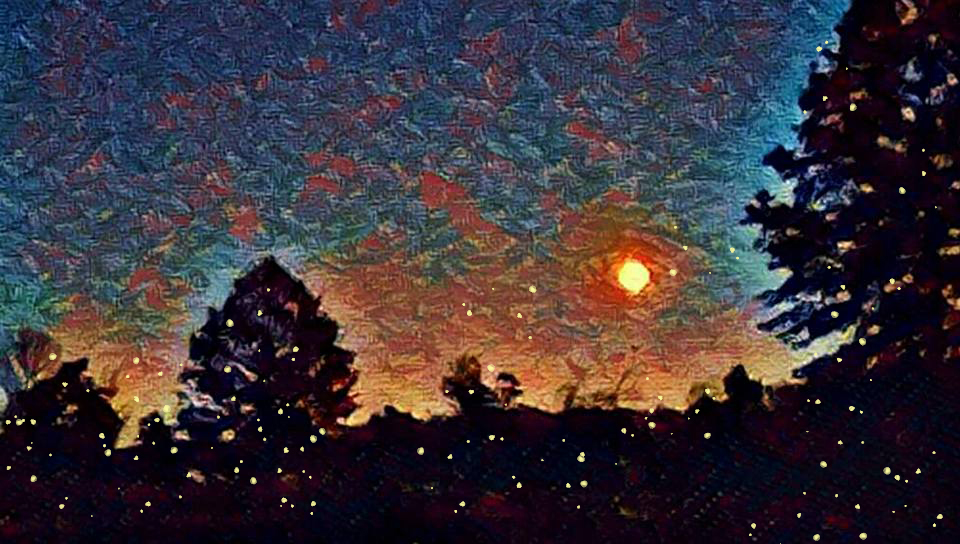
Poets, I’ve learned, sometimes notice and acknowledge meaning, and at other times we assign it — creating symbols in our own personal mythology. Part of my mythology involves fireflies. I love them. They always remind me of pleasant nights from my childhood, in my backyard, surrounded it seemed, by the dancing lights of the fireflies.
I was reminded of this the other day. My brother and I were on a late day hike, and as dusk fell, we walked past a field flush with fireflies. I was immediately transported back to those peaceful, awe and joy filled evenings of my youth. We stopped for a moment, and I put out my hand to once again trap one of those beautiful creatures. Amazingly, I got one on my first try.
When I returned home, I decided to speak the meaning of that moment, and the simple firefly, into existence and remembrance.
Fireflies and Messages
Flashes twinkle on and off in the darkness,
As I stand the darkness appears less dark
Is that shadow the flight of a firefly?
Perhaps …
In anticipatory hope my hand glides through the lightened darkness
In a moment of intuition I gently close my hand hoping to seize that flash of light
Slowly I open my fingers and gaze within a firefly walks across my palm
We look at each other with recognition he has let himself be caught
Flashes twinkle, on and off in the palm of my hand
Light lit message delivered he lifts his wings and is gone ~M. James July 5, 2020
As you probably already know, I’m doing cancer treatment right now. It’s a difficult process during a difficult time for us as human beings. So, it’s not easy, in fact it’s pretty tough. But is it doable? Yes. And not as bad as it could be? Yes.
There really is so much good in this world — beautiful people, edifying messages, helpful caring behavior, and many wonderful things. But sometimes it’s hard to maintain my focus on them because the difficult, negative, concerning, and fearful stuff is so ridiculously loud.
So, what do I do? Among other things, I turn to possibility thinking, and creative thinking and doing. Lately my creative doing has been writing — in particular poetry and the stories I tell myself.
It’s amazing really, how deeply my thoughts and stories impact my emotional, mental, and physical wellbeing. Do the words I choose, and the stories I tell, actually change my situation? Hmmm … that’s a tough question because they answer is no, and yes. Or perhaps to quote John Daly from the old What’s My Line show, “We’ll give you a qualified yes.”
What I mean is, even with all the positivity I can muster, even with all the real, beautiful, true things I notice and tell myself, there is currently still Covid, still unrest, and still cancer. However, and it’s a big however, the words I speak, and the stories I tell – to myself and others – make a difference. They make a difference in how I see things. They make a difference in how I react to things. And, they make a difference in how my body, mind, and spirit are able to manage the battles they are fighting.
I still remember working with my brother on his Strength Training for Fencers book. He wanted me to being able to power clean half my body weight. After laughing, I embraced the task. Much like now, it wasn’t easy. But, the ease of the task, and my experience of the weight on the bar, changed depending on what I said as I approached the task. When I approached it with an inner conversation of “yikes this is a lot of weight” I experienced it as such. When I coached myself through it differently “You’ve got this, it’s not that heavy” I had a completely different experience. As amazing, or unbelievable, as it may sound, the weight of the bar appeared to be less, and the task was easier, when I told myself it would be.
Our bodies and minds are incredible creations. They hear what we say, and act accordingly. There’s a doctor who suggests our brain is our second immune system. She suggests it isn’t our immune system that gives up first, but our brain. Our brain decides it’s hopeless and says, “We can’t do this.” Our immune system hearing it, says “Oh, we can’t do this? Ok.” and lays down its arms in defeat.
With all that in mind, I turned to the power of story — in particular written story through poetry. I found an online poetry workshop — or perhaps it found me — that has been perfect for my purpose.
Our first task was awe. Notice the things around us and be in awe of them — the big and the small, the extraordinary and the very ordinary. Our second task was making meaning. Find the things in our lives that mean something to us, remind us of something or someone, speak the truth to us, and then look even deeper, and articulate that meaning for ourselves and others.
Here are my poems. I used a photograph for the first poem’s illustration to show the detail and reality of my words. I sketched the illustration for the second poem — taking artistic liberty — so I could enhance the meaning. The orange pill really is quite tiny – not even 1/2 an inch long. It doesn’t say cancer crusher on it in real life – but wouldn’t it be fabulous if it did? And the plate is not covered with roses. But the story — the meaning — is about the shower of roses and blessing, and the power infused into that tiny orange cancer crushing pill.
I hope you enjoy the stories I tell. Perhaps even more so, I hope you are inspired and encouraged to write and tell your story. There really is power in the written word. Take the risk and write. You don’t have to share it with anyone but yourself. Perhaps you will, but either way, the power is there. It’s changing things with every letter written, and every word and sentence formed.
I Am in Awe of My Silver Icon by M. James, June 30, 2020
I am in Awe of My Silver Icon
I am in awe of my silver icon created by hands that love the Lord delivered by hands that love me
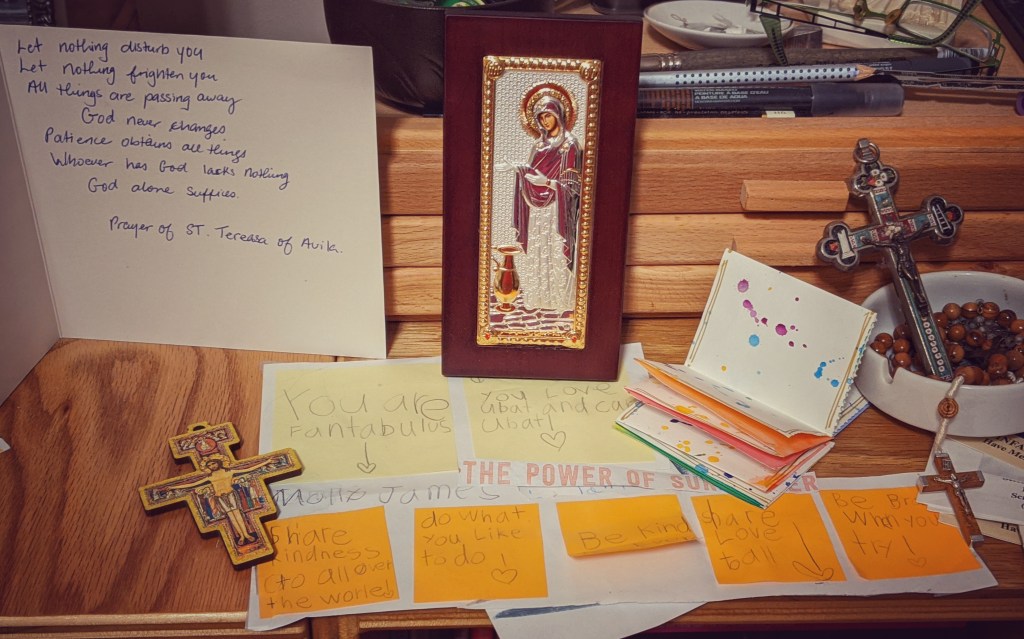
She stands surrounded by affirmations prayers and blank pages waiting to be filled
She is Queen Protectress and Amplifier of goodness and connection through time with great love to me ~M. James, June 30, 2020
Gather and Speak by M. James July 2, 2020
Gather and Speak
Pink roses adorn the sides of my cup reminding me I’m not alone
Therese is letting fall a shower of roses from heaven itself
Her loving hands send graces as we gather at the altar and speak saints angels and me
A small orange pill rests in my hands I ask that it may be blessed
May its power be increased by the prayers love and presence gathered here
I set the pill reverently upon the pink rimmed plate
Then I speak to my beautiful body the house of my sacred spirit
Do not fear do not resist be brave
Embrace and welcome this little orange pill with joyful hope
Accept it as a gift and magnify its efficacy with your courageous participation ~M. James, July 2, 2020
Be in awe of everything. I love that! Be in awe of everything.
Be in awe of the amazing sky.
But also be in awe of the fork you use. Be in awe of the beautiful red tomato. Be in awe of the green tomato tops that dance like stars after they’ve dropped their weighty fruit. Be in awe of the cutting board, the kitchen counter, the floor, the house, the air, your breath, your very self. Be in awe of everything.
Being open to awe, inspiration, and wonder changes things. It transforms the way I think, what I notice, how I feel, how I interact with things and people, perhaps even how they interact with me.
I didn’t come up with the idea. I’m taking a poetry course with Jacquiline Suskine over at One Commune. Be in awe of everything is her title for Day 1. I haven’t listened to the talk yet. I will tomorrow.
For now I just want to sit, breathe, and be in awe.
Words are amazing things. They are beautiful alone and when strung together. I love the way plethora feels as I say it. When I string it together with possibilities, it encourages me to open my mind to a plethora of possibilities! I eagerly await a myriad of miracles. I am fierce — fantabulously fierce.
Words allow us to express our thoughts, feelings, understanding, and wonderings. That in and of itself makes words wonderful. But, beyond that, I find that words, used well, allow me to discover and give joy, reinforce or alter my feelings, and create new spaces for breath, life, and ease.
Poetry is not my usual creative jam. I’m intrigued by it. I enjoy the rhythm, and the way words are used to form incredible images. But, I don’t often indulge.
However, for some reason, a few years ago I started a poetry journal. I played and experimented. I pieced together words that encouraged life, joy, peace, breathing, and possibility.
I found that journal the other day, and was amazed at how much I need the words I wrote 8 years ago. Perhaps I will experiment again — there are many blank pages — but for now, I will simply share a few poems with you.
Two Magnet Poems:
Life is.
Laughter is essential.
Tears are inevitable.
Life is good.
Possibility surrounds me.
I see possibilities.
They whisper to me.
"We can happen soon."
Transforming Fear:
From every acorn regrowth.
Face everything and relax.
Flying eagles are radiant.
Fantabulous, easy, and remarkable.
Fun even amidst rainstorms.
Funky earrings are rockin'!
Fantastic embraces are relished.
Enjoy Every Moment
Let's ...
sing with the bluebirds
breathe between kisses
laugh in the sunshine
smell every flower
make many wishes
dance beneath the moon.
Let's ...
enjoy every moment.
A bit of alliteration — I love alliteration, I’m not sure why, but I find it so satisfying.
Super soft sunshine
pours perfect pretty patterns
in incredible intricacies
making mere movements
become beautiful bits
of
amazing abstract art
upon
otherwise ordinary
simple surfaces.
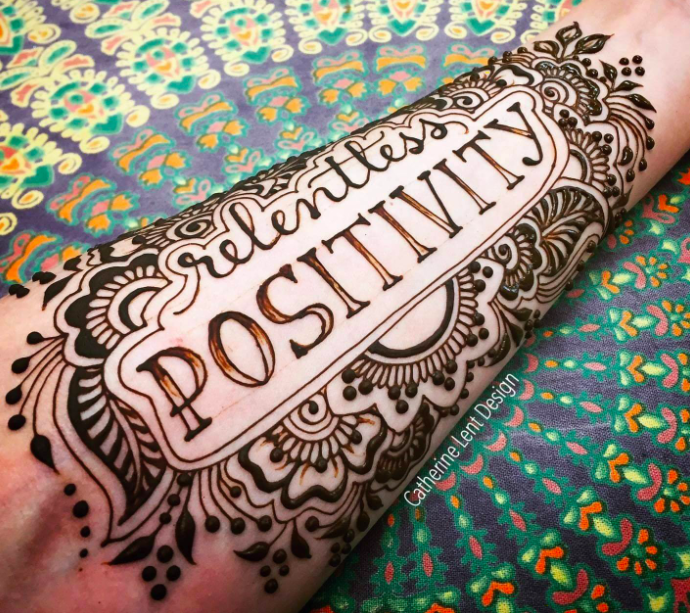
And then there are words, written on my body, in smooth, beautiful henna. These words mingle with my spirit, my actions — with my very self — and become a living poem.
Perhaps that will be my new poetry experiment – life, me, and relentless positivity.
My first Kindergartners are now 10th graders. Hard to believe, but true.
Recently, I had the pleasure of seeing one of them participate in the NJ Poetry Out Loud finals. She recited three poems. Each was filled with pauses, inflection, breath, emotion, and gestures, which drew me more deeply into the words and meaning of the poems.
My favorite was Undivided Attention by Taylor Mali. It’s a fun, and thought-provoking poem for an educator. An added sweetness was that I was introduced to it by my alumna!
If you’re unfamiliar with the poem, take a moment to go read it now. Especially if you’re an educator, read it — right now.
I’ll wait.
The whole thing is glorious. But, if you ask me, the most striking part is:
So please.
Let me teach like a Steinway, spinning slowly in April air, so almost-‐falling, so hinderingly dangling from the neck of the movers’ crane. So on the edge of losing everything.
As I listened to my alumna recite the poem, I imagined the educator asking permission of her administrators, coordinators, and colleagues to allow her teach in this fashion. As I listened, I heard her imploring others to share her vision.
Later that day I read the poem to myself, and then aloud to others. I heard it differently. I’m not completely sure why.
Perhaps I heard it differently because it was my own voice that spoke the words. Or, perhaps it was because Mali’s words had been floating in my brain since the morning, somehow becoming my own.
“Let me teach like the Steinway …so almost-‐falling, so hinderingly dangling … let me teach like the new snow, falling.”
The word I heard, with soft, encouraging, invitation was me. It felt like a quiet manifesto.
Much like the piano movers I need to move my personal Steinways. My Steinways are lessons, ideas, inspiration, motivation, classroom culture, design experiences, creativity, and much more. Similar to the movers in the poem, occasionally, my eye-popping, jaw-dropping, risky, awesomeness has to hang out the window. Scary, but also a huge blessing, because, hanging out the window, others can see it, engage with it, and be excited by it.
First snow, falling, is nothing new, and yet each time it falls it feels new. The snow beckons all who notice it to come and look with long interested looks. It reworks the view out the window. It offers the opportunity for play, and the necessity of work. And, when examined closely, it reveals the marvels of each unique flake. That is a profound way to teach.
Yes. Let me teach like that Steinway — big, brave, bold, and fantabulous. Let me teach like snow falling — offering play and work, changing views, and surprisingly breathtaking wonders.
Never let it be said that creativity is purposeless! If you have ever thought that, or begin to think or say it now, bite your tongue! lol
Creativity has many joyous, important, and profound purposes in our lives and world. Not the least of which is the ability to express ourselves, sort through our thoughts and feelings, and emerge, a bit stronger, with more understanding, and possibly, a nice piece of creative work.
I have cancer. A rare form with a ridiculously long name — Waldenstrom Macroglobulinemia (WM). It’s a type of non-Hodgkin lymphoma. I used to joke that once I learned how to spell it, I should be granted a cure! lol
But, though I can spell it, I still have it. I’m doing great, but from time to time, I am a bit overwhelmed sharing my body with WM. And, sometimes even more overwhelming than sharing my body with it, is sharing my mind and spirit it.
A couple days ago, I had the idea to write a poem – in the hopes that it would help me pull my thoughts and emotions back from the edge, into a place of greater strength, joy, and positivity — really just a place that is more me.
For truly, I am strong, fierce, powerful, joy-filled, positive, awesome, and full of life! I am a warrior. My life is full of possibility.
Impossible?
Is anything undeniably impossible?
My spirit rebels at the suggestion that good things might be impossible.
Possibility surrounds me, and gives my soul joyous pause.
Of course, fear and doubt mingle in, at times rising to the top, obscuring joy and hope.
So much is unsure.
Success is not guaranteed, and solutions are not yet seen, found, created, done, or lived.
I breathe deep breaths, and fortify myself with these thoughts:
Be brave and stubborn. Believe all is possible.
Live as though success is inevitable, and your actions and thoughts encourage its coming.
Expect, and eagerly embrace, the awesomeness and miracles that surround, and are, you!














 Life lived with relentless creativity