Courage, Challenge, Learning and Excellence

“Although my students are only five or six years old, I work hard to establish egalitarian, collaborative relationships with them. I am interested in their thoughts and always respond to their questions of “Can I tell you something?” with “Yes, please tell me something!” I value their stories as a way to get to know them, and I really listen to them as they share. I sit or kneel to speak with them so I am not so far above them, and I often sit on the floor with them when I teach them. This helps us develop a relationship of trust, and ultimately empowers courage, challenge, learning and excellence.” (Managing the Classroom for Creativity)

When I wrote that for the Creative Education Special Issue, I was thinking of the courage, challenge, learning, and excellence that my students develop and live in our classroom.

As I re-read the section now, I still believe my students benefit from our collegiality. But, I am fascinated by the realization of how much our relationship of collegiality and trust impacts me as well. It helps me to be courageous and more open to challenge, and it encourages and enables me to develop deeper learning, and greater excellence!

This became very clear to me the other day. I joined a kindergarten alum and her family (she just finished first grade) for an afternoon at Turtle Back Zoo. Part of our day included participating in the Treetop Adventure.  The course is about 15-20 feet in the air. Not too high unless you are afraid of heights – which I am!

My alum and I hit the course together. We chatted with each other as we waited for our turn on the various elements. We watched others and commented on things they did well, and the things they might do better. We talked about being a little afraid. I told her I was afraid of heights. She assured me it wasn’t that high!

We decided I would take the lead for the first half of the course. I cheered her on as she worked each piece of the course, and offered suggestions the few times she seemed a bit stuck.

The second half of the course, my alum went first. This section was a little higher and a little more challenging. Nothing terrible, but I was beginning to feel fatigued from my fear of heights and my effort to overcome it. I breathed in through my nose and out through my mouth – just like I tell my kindergarteners to do when they need to relax and get their bodies to know all is well. As I paused at one challenge — to take one of those calming, strengthening breaths, and decide how I would step — I heard the most awesome thing …

“You can do it, Miss James!!!”

It was my alum yelling to me, “You can do it, Miss James!!” 

How fantastic is that?!?!?

I’m not sure if she was completely confident in my ability to do it. I am sure she was completely confident in herself, and in our relationship.

Our relationship based on respect, trust, collegiality, and love, let her know it was appropriate for her to encourage me. And, our relationship assured her it would make a difference to me.

And it did! It helped me! Her egalitarian and collaborative relationship with me, empowered and enabled me to embrace “courage, challenge, learning and excellence!”

It wasn’t just that day. It happens in the classroom too.  But there, on the ropes course, it was very clear.
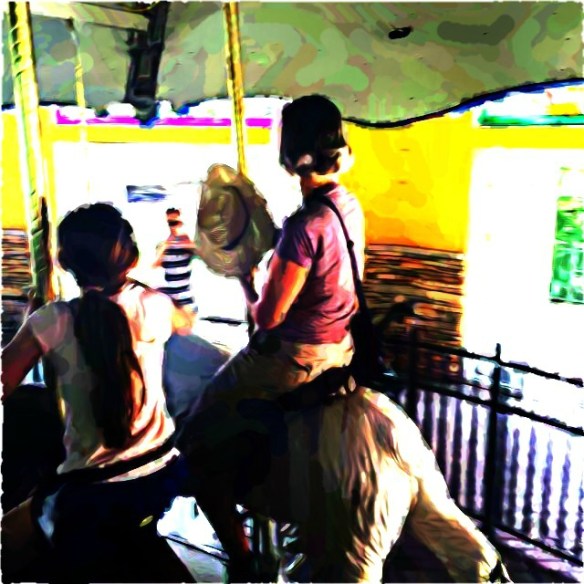
artistic skylar and me

Here we are, on the carousel together. I love the photo for the memory, and the symbolism.

May I always have a beautiful kindergartener, or kindergarten alum, by my side.


RESOURCES:

James, M. (2015) Managing the Classroom for Creativity. Creative Education, 6, 1032-1043. doi: 10.4236/ce.2015.610102.


Reflections on Making Room for Creativity in Math

math blog

Tons of things happened when I made room for creativity in math. My students and I:

  • thought
  • shared our thinking
  • struggled with moments of confusion, not knowing, and even small failures
  • laughed at ourselves, and laughed with each other
  • challenged one another’s thinking, explanations, illustrations, words, and math
  • encouraged one another to keep at it and not give up
  • were creative – in our ideas for the math story, in our illustrations, and in our explanations
  • transferred our math knowledge to our real life, and our real life to our math work and thought
  • persuaded others regarding our thoughts and conclusions
  • worked to understand each other’s point of view
  • did a lot of math
  • drew some great illustrations
  • enjoyed seeing our ideas in print

But, what surprised me the most was the depth of understanding this exercise afforded me!

My girls all have a basic understanding of addition and subtraction, and they all employ various strategies to solve simple number sentences. Some have a greater comfort than others manipulating numbers, and actively seek the opportunity to share their adding/subtracting prowess. While I was excited to experience the thought and creativity of all my girls, I was particularly interested in what these girls would do with the challenge. I imagined their math skills would allow them to revel in the thinking, and come up with great, inventive ideas. I never imagined what happened for a few of them.

They could not complete the task!They came up with many number sentences and easily solved them. But, they struggled to find a way to connect their number sentences to real life. They seemed perplexed as to why anyone would do that, and honestly, seemed to feel a bit betrayed by me for asking them to do so! We worked through it together, and they were able to, joyfully, produce work that made sense to them and their friends.

It was fascinating! This wide open exercise that combined life, art, math, writing, thinking and communicating, allowed my girls to show – in a new and insightful way – what they did, and did not, understand. It was an amazing assessment opportunity – of their learning, and my teaching!


The Cloud … in the Classroom

“The cloud stands guard at the boundary between the known and the unknown, because in order to discover something truly new, at least one of your basic assumptions has to change, and that means that in science, we do something quite heroic. Each day, we try to bring ourselves to the boundary between the known and the unknown and face the cloud.” Uri Alon

When I first listened to Uri’s TED talk, I immediately related as a researcher. I had experienced the misery of the cloud, the benefit of support in my cloud-induced-angst, and finally the joy, relief and wonder of new ideas and conclusions. But, then I wondered, where is the cloud in my life as an educator? Where is the cloud in the classroom?

I listened to his talk again, jotted notes from the transcript, and let the question ferment in my brain as I drove, walked, showered and slept … and, I had a revelation. The cloud is in the classroom every day because the cloud IS education! Let me modify his statement.

“The cloud stands guard at the boundary between the known and the unknown, because in order to discover something truly new, at least one of your basic assumptions has to change, and that means that in education, students and teachers do something quite heroic. Each day, we try to bring ourselves to the boundary between the known and the unknown and face the cloud.” Uri Alon rephrased by Molly James

Think about it! Isn’t that what education is all about? Discovering new things? Learning new skills? Challenging assumptions? Understanding things in new and deeper ways?  Bringing ourselves and our students to the boundary between the known and the unknown and facing the cloud … together.

I don’t know about you, but I think that is SPECTACULAR!!! All of a sudden students are elevated to a new level. They are protagonists in their own learning. They are brave, heroic explorers confronting their own clouds and emerging victorious with new insights, understanding and skills.

Wow.