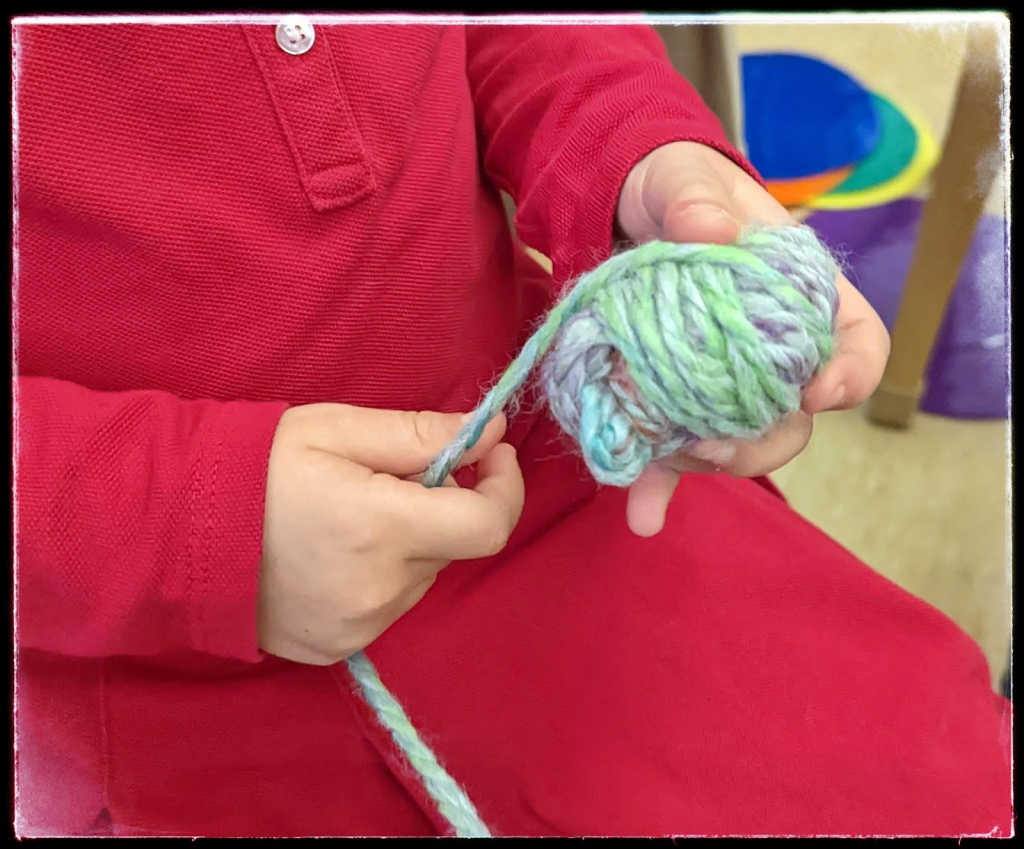
My learners love to finger-knit. It’s a never-ending source of joy, creativity, flow, and peace. When we begin, I show them two methods of finger-knitting, and then they choose their favorite way to continue. Amazingly, every year, after working with my two methods for a bit, my learners develop their own iteration of finger-knitting and teach it to me. Soon, they take over my job of teaching others how to finger-knit, make the beginning slip-knot, and wind yarn balls.
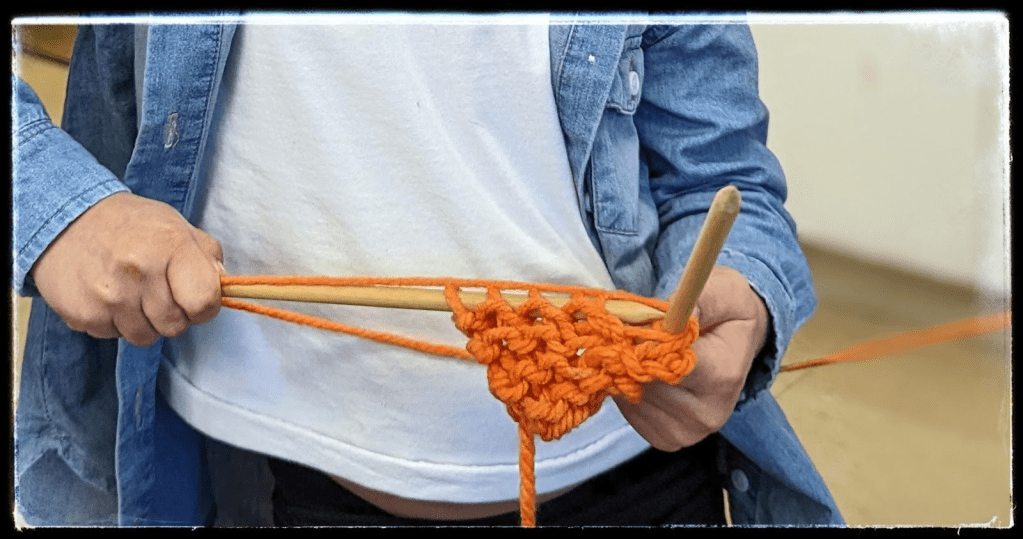
Soon after they learn to finger-knit, they are curious about the knitting needles I have in the classroom. They begin to ask questions: Can you knit with sticks, Miss James? Did you knit that on sticks? What else can you knit on sticks? Their curiosity turns to wonder and awe as they discover I know how to knit with sticks and have made many things. One by one, they ask me to teach them to knit with sticks.
They wait patiently – or not so patiently – for time and sticks, so that they can be the next knitter. At one point, five of them had work on the sticks, and I was commissioned to make more sticks so that they could all knit.
Whether they knit with fingers or sticks, the process is one of grit and growth. First, I show them, often helping them move their hands, fingers, or sticks. Frequently, they make mistakes. Sometimes they forget a step. Other times, their knitting falls off their fingers or sticks, and they accidentally pull it all apart. We breathe through our angest, and rehearse the movements and the words that describe those movements: Make a loop. Put it on your finger. Wrap the yarn around your finger in front of that loop. Don’t make it too tight! Now pull the loop over that piece of yarn. Once that’s done, pull these two ends. Finally, we celebrate and encourage: You got it! Now do it all again – over and over until you’re done.
After working with me, they work on their own – sometimes in close proximity to me, sometimes with a group of other knitters. They frequently check in, asking, “Is this right? Can I take it off now? Can you fix this, Miss James?” As their competence and confidence grow, they begin to say, “Can you teach me how to do it so I can do it by myself?” If, when helping, I miss their aha moment, they say, “Miss James. I can do it. Would you let me do it?” My response is always, “Yes, of course!” More often than not, the exact same words begin to greet me in reading, writing, and math. “Can you teach me how to do it so I can do it by myself?”
Finger-knitting is a shared experience of creating, taking chances, trying, problem-solving, teaching, learning, using tools, and creating a valuable and genuine product. It’s a lot like being a writer!
If you aren’t a knitter (finger or sticks), there are many wonderful resources online to teach you. However, it may be better for you to consider the ways you create and make in your own life. What creative love do you have that you can share with your learners? When you do it, do you have to take chances, try again, problem-solve, learn, use tools? Do you create a valuable and genuine product? Then it’s a lot like being a writer, perhaps we can consider it pre-writing skills since we are growing the mindsets and habits of a writer. Weaving, cooking, collage, mark-making, origami, calligraphy, or embroidery may be your jam; use them. Your excitement, joy, peace, and curiosity will spark the same in your learners and motivate them to give it a go.
As you and your learners engage in the creative process, you will learn about yourself, your learners, and the process. I am always amazed at how much I learn about something I have done forever, as I listen to and watch my learners. Sometimes, as we work, we work in silence, absorbed in the struggle of learning or the peace of flow. But often, we employ one of HGSE’s Project Zero’s Core Thinking Routines. We notice, think, and wonder, and share our thoughts with one another. This thinking routine allows us to verbalize what we are doing with our hands, share the new things we notice about the yarn and how it works, think about and share our thinking, create new iterations, notice similarities and differences, get suggestions from others, talk through our struggles, and celebrate our successes.
As we knit together, I noticed how often we use the phrases – first, then, next, after that, and finally. I realized this shared passion was a way to make the concept of beginning-middle-end-thinking concrete for my young learners. If we could notice the concept of beginning, middle, and end in our repeated experience of finger-knitting, perhaps we could translate that into the use of beginning, middle, and end in writing.
I set a task for my learners the next morning. During Investigate and Explore time, they were to finger-knit. My instructions and explanation were intentional and specific. “Everyone must finger-knit so you have it fresh in your big, beautiful brains for writing. As you knit, use our Notice-Think-Wonder thinking routine. You can use it by yourself or with friends. I particularly want you to think about how you are knitting. What steps are you taking? Do you always do things the same way? Notice. Think. Wonder.”
Finally, writing time arrived, and my learners peppered me with questions. “What are we doing with finger-knitting, Miss James? How is finger-knitting writing? What are we doing? Can we finger-knit again now?” As they settled in, I explained that we were going to teach others how to finger knit by explaining what we do first, then, next, after that, and finally. A plethora of hands raised, as ideas tumbled out of their mouths. I asked them to breathe and hold their excitement while I finished my explanation.
“First, I want you to work with a partner. Talk about your process. Notice what is the same and different. Think about what is possible. Do you both start and end the same way? Are you middle steps exactly the same? Do you explain them in the same way? Why or why not? Use our learning question What makes you say that? to discover what your partner is thinking. Show your partner what your words mean by finger-knitting for them. Use your art sketchbook to draw pictures. This might help you try things out and will give you a guide as you write.
Then, write and illustrate your process – your finger knitting steps – so others can learn to finger knit. Please remember to use the words first, next, then, after that, and finally. After that, share your work with your partner. Finally, when you are satisfied with your process and product, come share it with me.
Everyone – even my writers who struggle – was successful. Everyone – in word, action, and illustration shared a possible finger-knitting process iteration using beginning-middle-end-thinking. It’s only a first step, but it’s an important step in their life and growth as writers.
(Translation: First, you take it out of the finger-knitting basket. Then I do a loop and I start finger-knitting. Then I talked a friend to help me.)
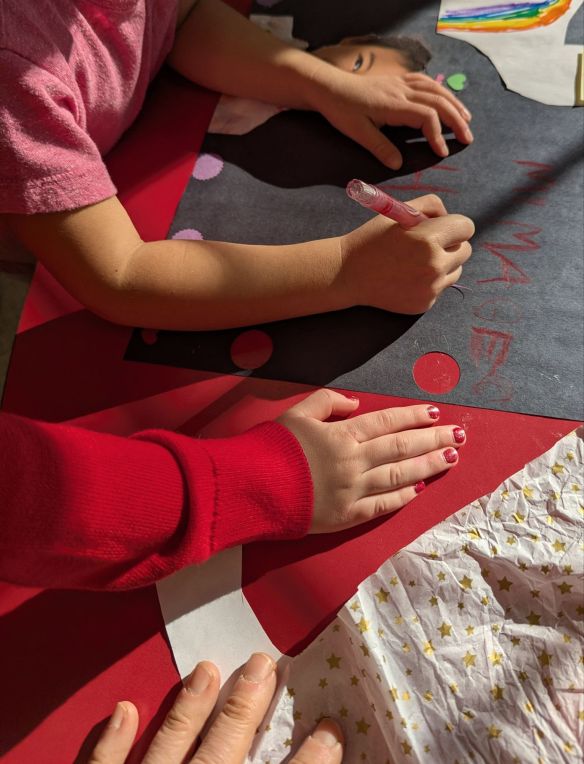
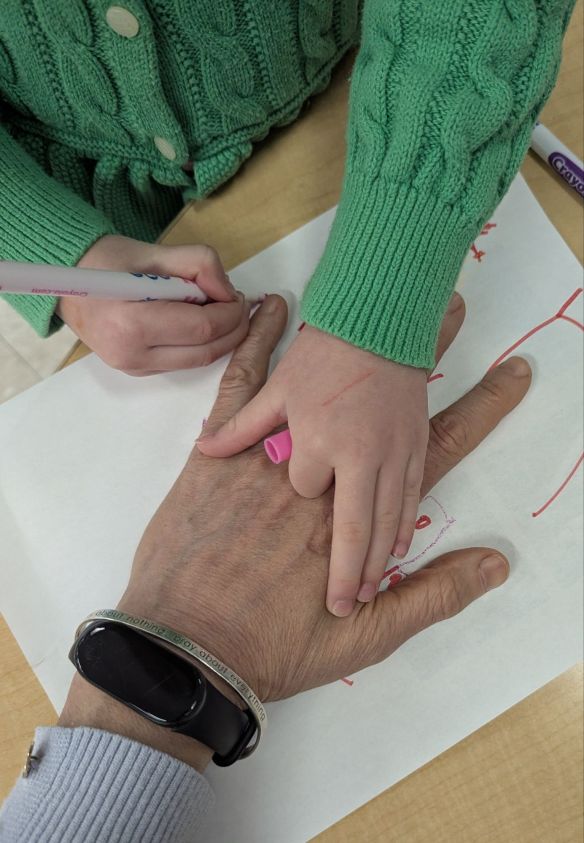
These images are of my Kinders over the past few years. This year I’m teaching pre-Kindergarten. Just like my Kinders, they love to learn how to do things, and then do them — even when they’re hard things. And goodness gracious, they love to make things. I’m excited to teach them how to finger-knit, and to be their scribe as we construct first, then, after that, and finally finger-knitting plans.
Merriam-Webster’s sixth definition of setup is “the manner in which the elements or components of a machine, apparatus, or system are arranged, designed, or assembled.”
I love to remind myself of this definition while I’m going about my classroom setup. I am designing a system in which I, and my students, colleagues, and parents, will work, create, play, and learn. If I’m any example, creating a classroom system requires a lot of thought, reflection, iteration, sweat, and muscle!
As I worked, thought, and sweated, I reminded myself of the truth about myself and my students. We are “rich in potential, strong, powerful, competent” (Loris Malaguzzi quoted in The Hundred Languages of Children, 2nd addition, p. 275). I also thought back to my MA research where I considered the environment that might best support creativity and academic excellence.
I read so many thought provoking things as I researched for my MA. I synthesized them in an article in Creative Education. If I were writing my dissertation, or the article now, I think I might title it Managing the Classroom for Creative and Cognitive Excellence. I want my classroom setup to support creative excellence, and cognitive excellence. To do that, it has to include and support the 6 elements of Teresa Amabile’s KEYS I adapted for classroom management in Managing the Classroom for Creativity:
Freedom which enables and and encourages ownership, motivation, and engagement of all the learners.
Positive challenge which helps everyone know the tasks/skills they engage in are important and valuable.
Supervisory Encouragement which values work and thought, and encourages inquiry and exploration.
Work group support which encourages the generation and exchange of new ideas.
Easy access to sufficient resources.
Organizational Support of our shared vision and an infrastructure that enables and empowers everyone in my learning space.
I’ve finished my initial classroom set up, and am super happy with the result. There is more work to be done, but I’m ready for my learners to join me in the space.
In addition to including the 6 elements listed above, I worked on including more visibility this year. I was mindful of balancing beauty and utility. I wanted our work, vision, thought, prototypes, iterations and our creative and cognitive “mess” to be visible. It adds a richness to the space — telling our story while increasing curiosity, inquiry, wonder, learning, understanding, creativity and excellence!
Here are a few photos with my reflections.
Last year our maker projects where stored in a classroom cabinet. This year, some awesome maintenance people ripped out the cabinet, and I replaced it with this open shelving unit. The wall behind and beside it is covered with a large art piece my students made last year. (How awesome is that?!!!) The use of that artwork, the trays for student work, and the words on the front of the shelving unit let everyone know these things are valued and supported.
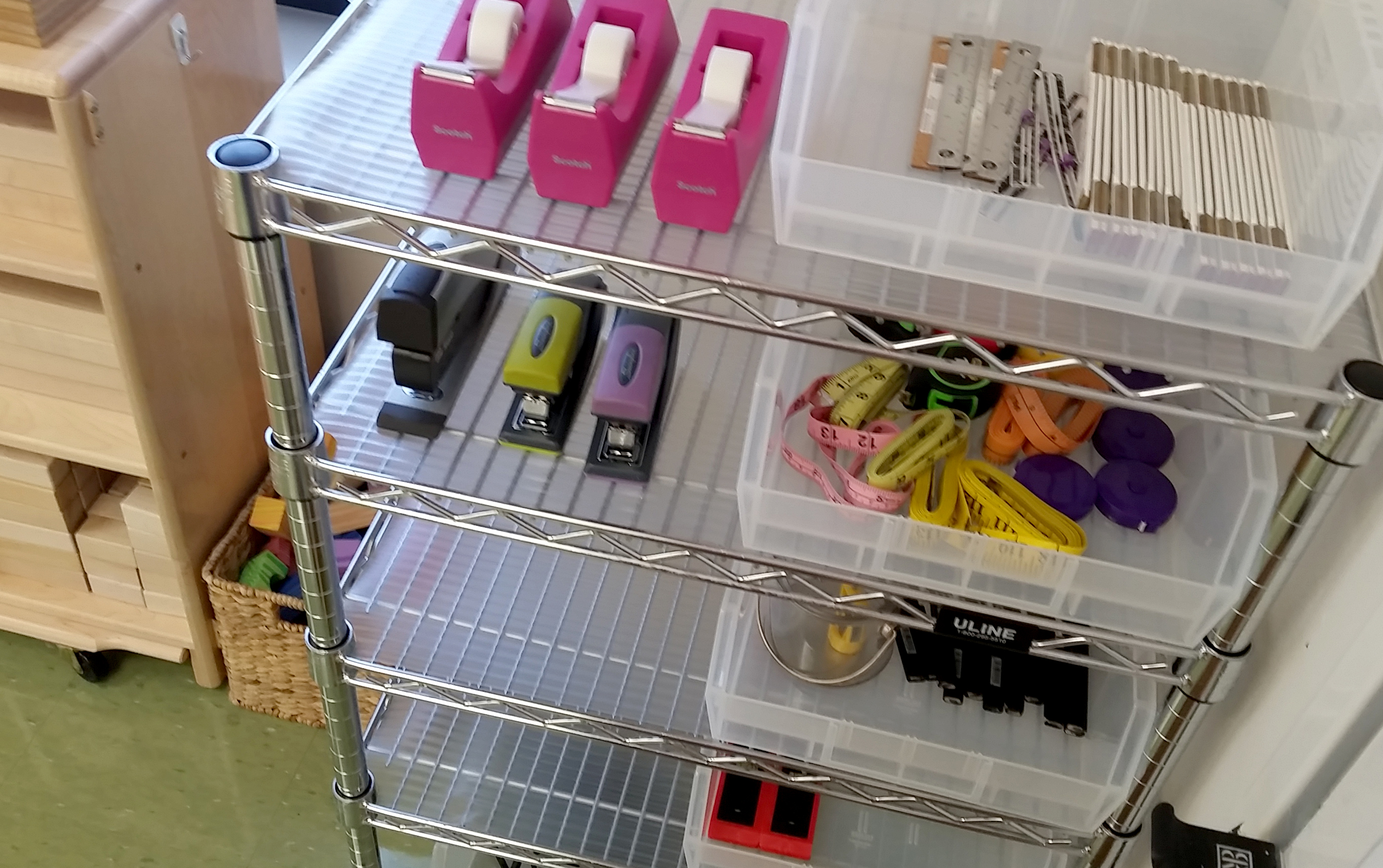
A second smaller shelving unit — on the coolest, gigantic wheels — keeps our tools neat and easily accessible. There’s opportunity for remarkable exploration and learning through the use of these tools.
The maker trolley has always been a part of the makerspace, but this year I am repurposing the back to hold more materials, and storing our large item bins in the open. I am hopeful this will increase use and understanding.
The two classroom easels provide opportunities for creative art experiences outside the regular art curriculum. The second is actually a double easel – fabulous for conversation and inspiration! I love leaving the dried paint on the easels. It adds an element of beauty and history to the space, and allows for freedom as one paints.
I’m thinking about the resources I have that might enable me to store paper beneath the easels — enabling the artists to be autonomous in their work. I have some ideas I’m going to try this week.
I love the connection between my learners’ art experience and mine (the watercolors are my work). I also like the suggestion of a connection between painting, shapes, blocks and building.
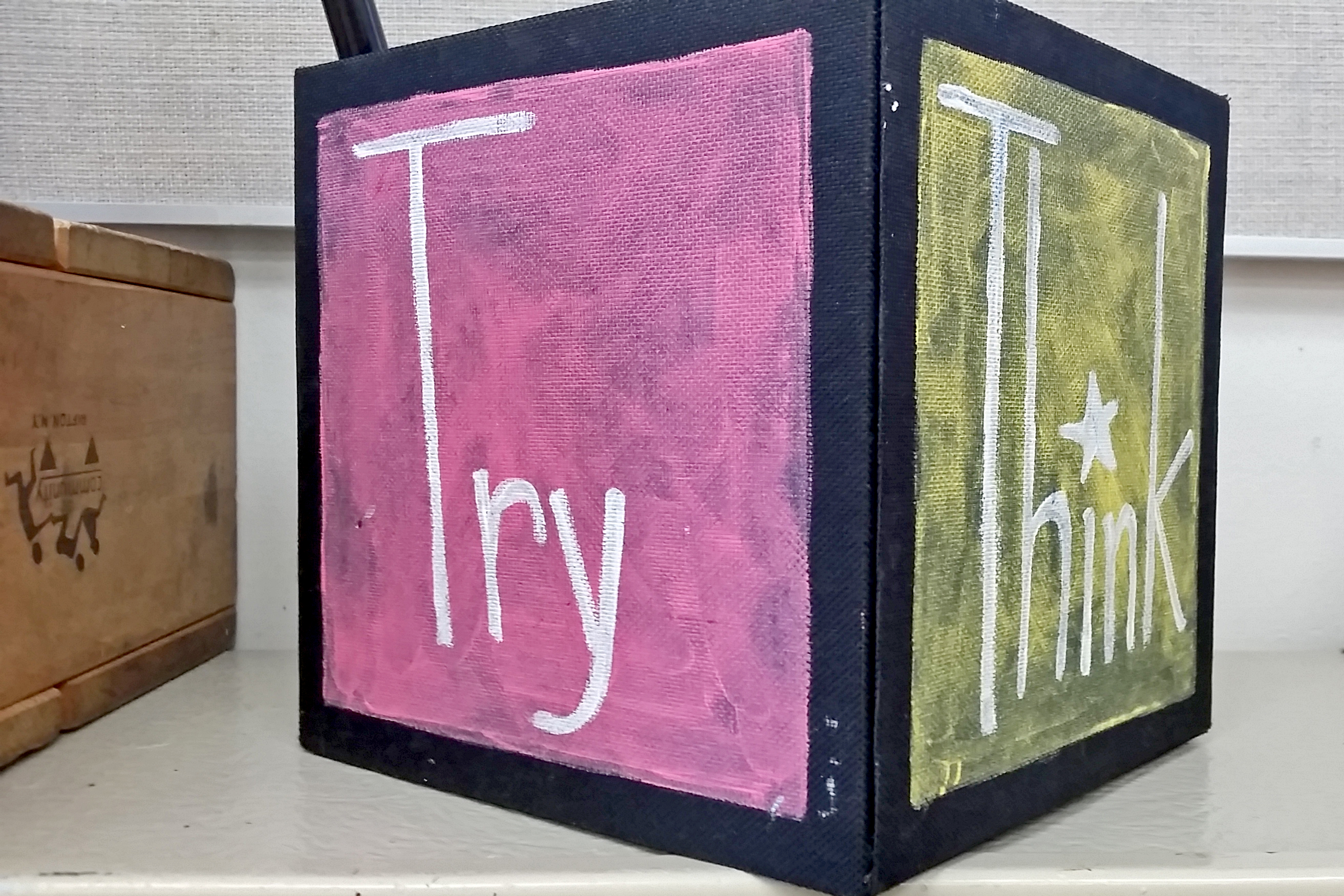
Print is plentiful and purposeful in my learning space. I want my students to read the room and learn. I want them to become more skilled at letter recognition and use, and to be inspired — to see, read, absorb, and live, what is important.
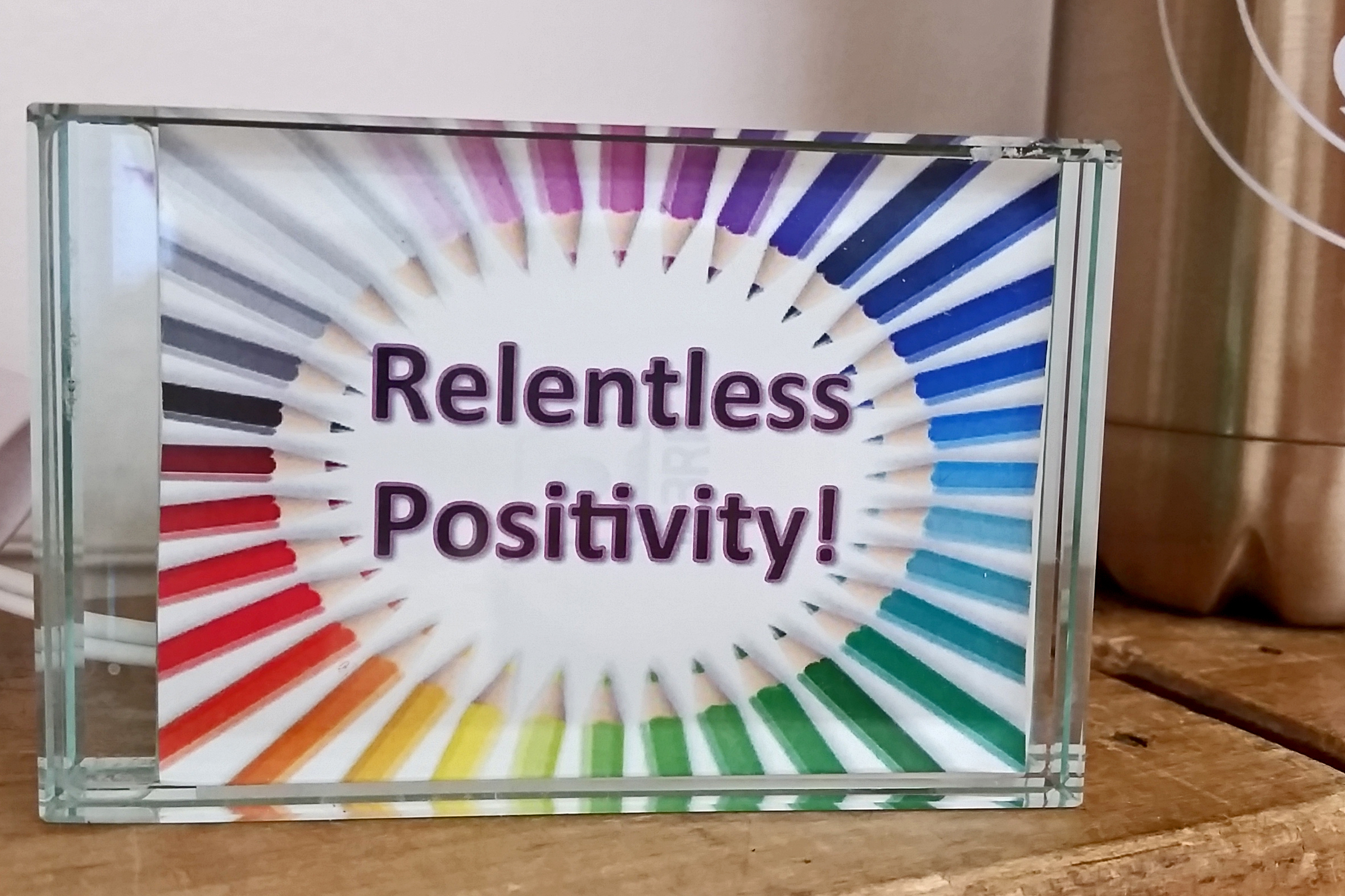
I love all the little print treasures in my space, so it’s nearly impossible to choose a favorite. However, I am enjoying this one quite a bit! I wonder what it will evoke or awaken in those who see it. For me it stirs up joy, possibility, positivity, and continuing even when obstacles arise.
And this, partially hidden gem, out of the way of traffic, is a message from me, to me. “Be a superhero every day. The kids and the world deserve it!”
All the best to all my fellow educators. Arm yourself with another Malaguzzi truth “Nothing without joy!” and have a fantabulous year!
NOTE:
Whenever I write, I think of all the remarkable people I’ve read, talked with, and researched . I think about adding tons of links to each post. Instead, I offer my deep gratitude to all those who informed my research and learning, and remind my readers there is a great bibliography at the end of my Creative Education article.
Wacky Wednesday, by Dr. Seuss, inspired our creative fun today. — Shoes on the wall, on the ceiling and under the bed. Worms chasing birds. Hoses, while split, still watering the lawn. — My students giggled, and eagerly shared each wacky thing they noticed.
They didn’t want to stop, but I told them “We must! I want you to have plenty of time to have your own wacky Wednesday fun!”
They were not immediately convinced. But, I assured them we would keep the book in our library, and they could read it as much as they wanted. Finally, they relented and moved to the chairs I had prepared.
I reminded them of our time together in yoga, when I invite them to take off their shoes and socks. “Now,” I said, “I’m not going to invite you to take off your shoes and socks. I’m going to tell you to take them off. We cannot do our wacky Wednesday creative fun unless you take them off.” Giggles and talking increased as they hurried to their cubbies and back again — with feet bared!
Paper was taped to the floor in front of each chair. Plastic egg cartons filled with paint, rested on paper towels. I encouraged them to guess what we might be doing.
“We’re going to paint with our feet!” … “Yes,” I said, “but how?”
“We’ll stick our feet in the paint!” … “Good guess, but no. We’re actually going to use a paint brush.”
“We’ll paint our feet and put them on the paper!” …”OH! Great idea, but no.”
“We’ll paint our toe nails!” … “That would be fun, but not today.”
They continued guessing, each building on the next. They were doing a lovely job thinking divergently. They showed some fluency, flexibility, and elaboration – each idea building upon the ones that came before, informed by my responses.
Finally, nearly jumping out of her chair, R. said “I know! We’re going to hold the paintbrush in our toes!!!!!” …. “YES!”
Laughter and conversation erupted in the room – making it nearly impossible for me to speak and be heard. I encouraged their enthusiasm, but asked them to do try to stay quiet until we began. They contained themselves, as best as they could, and after some brief instruction and encouragement, they began.
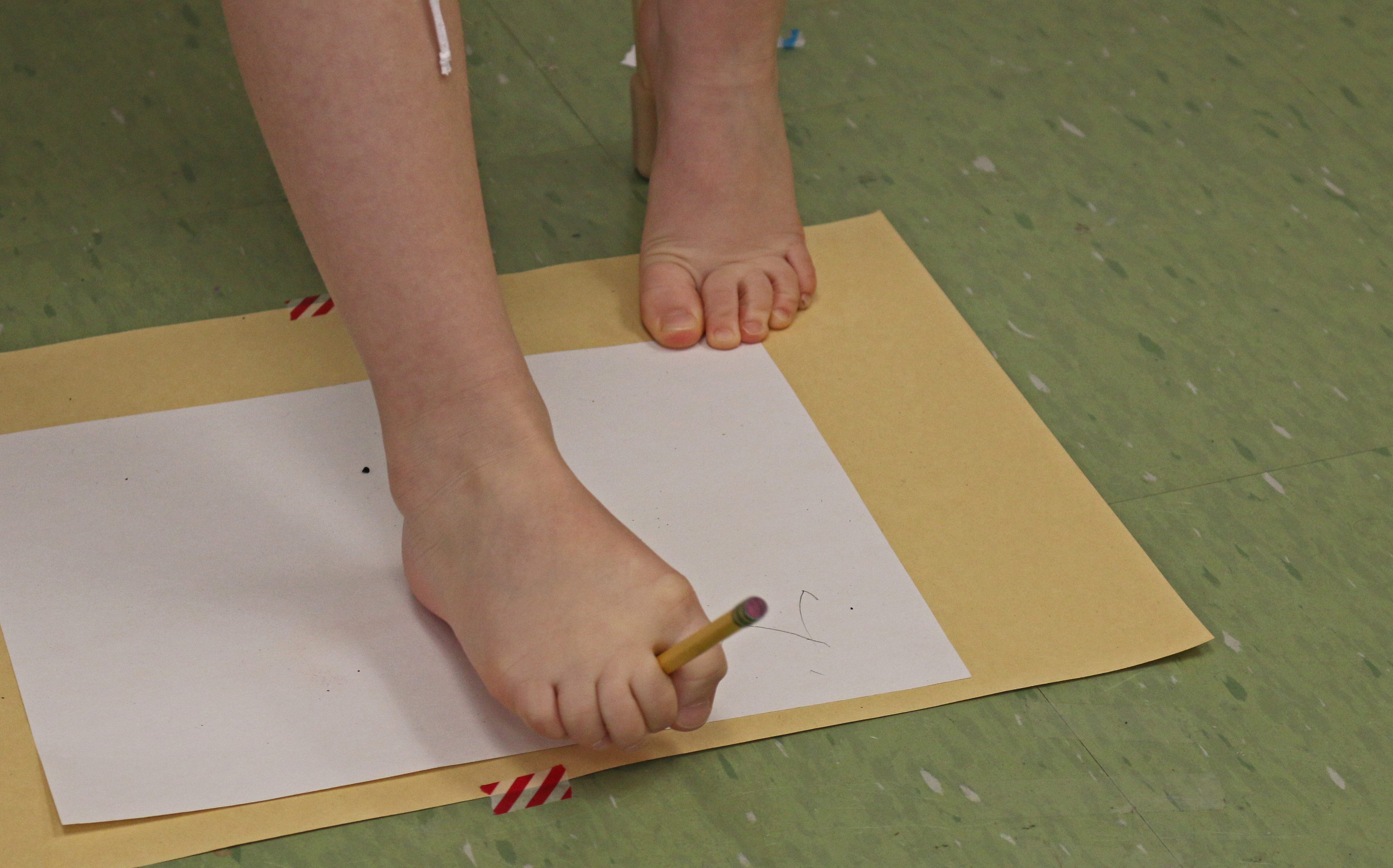
Some jumped in with both feet — pun-intended, lol — and used their toes to grip their pencil, and write their name.
When M. finished writing she said, “That was hard. And it doesn’t look very good. It’s messy.” … “No way!” I replied. “That’s fantastic! You did that with your toes! How awesome is that?”
Was it as good as she could do with her fingers? No. But did that matter? Was that the right criterion to use to evaluate it? No! Her process and product were remarkable. She gripped the pencil with her toes. Figured out how to create each letter in her name, and wrote them in a rather straight line! Perhaps most importantly, she showed great initiative, courage, and grit, and I wanted to acknowledge that for her.
Everyone joined in the fun — even me. My students were enthusiastic and joy-filled painters — quite willing to try, and try again.
I was surprised by my reaction to the experience. It was hard! Hard to hold the paintbrush. Hard to figure out how to dip it in the paint. Hard to guide it on the paper. Just hard!
I did it, but I didn’t enter into the experience like they did. I think their were multiple reasons why. Each is worthy of my thought, consideration and remembering as I continue to work with my students, and for my own growth as a creative and an educator.
Here are some of the things I noticed:
My support of my students — in word and presence — is powerful.
Time to practice and play with the tools and process before beginning is important.
Embracing positive thoughts about ourselves as artists and learners is essential.
Adopting the joy, freedom and openness of a beginner’s mind is helpful.
My students often return the favor and support me with their word and presence. Today I didn’t have the opportunity to allow them to support me. I also didn’t have the time to practice and experiment before beginning. But perhaps most interesting to me, unlike my students, I didn’t immediately embrace positive thoughts about myself or my process, and I didn’t adopt the the joy, freedom and openness of the beginner’s mind.
I can learn so much from my students. They are truly fantabulous!












 Life lived with relentless creativity