What Do You Think about Pre-K? Do You Love It?

We had a birthday celebration today in pre-K, and as the kids were enjoying the birthday treats, the birthday girl’s grandmother asked how I liked pre-K compared to Kindergarten. (I started teaching pre-K this year after 18 years in Kindergarten.) What a great question!

How do I like pre-K compared to Kindergarten? There is so much to love about Pre-K — so much possibility, so much joy, so much fantabulousness. There was a lot to love about Kindergarten too. It’s a gift to hold on to all of that awesomeness, and now have new opportunities, new teammates, new learners, new relationships, and new fantastic parents in pre-K.

So, what do I think about pre-K?

Oh my gosh I love the kids. They are brave, curious, joyful humans. They love to laugh, try things (sometimes with a bit of encouragement or a willingness to be with them). They are wide open to wonder, and awe. And they are always learning, making, and sharing.

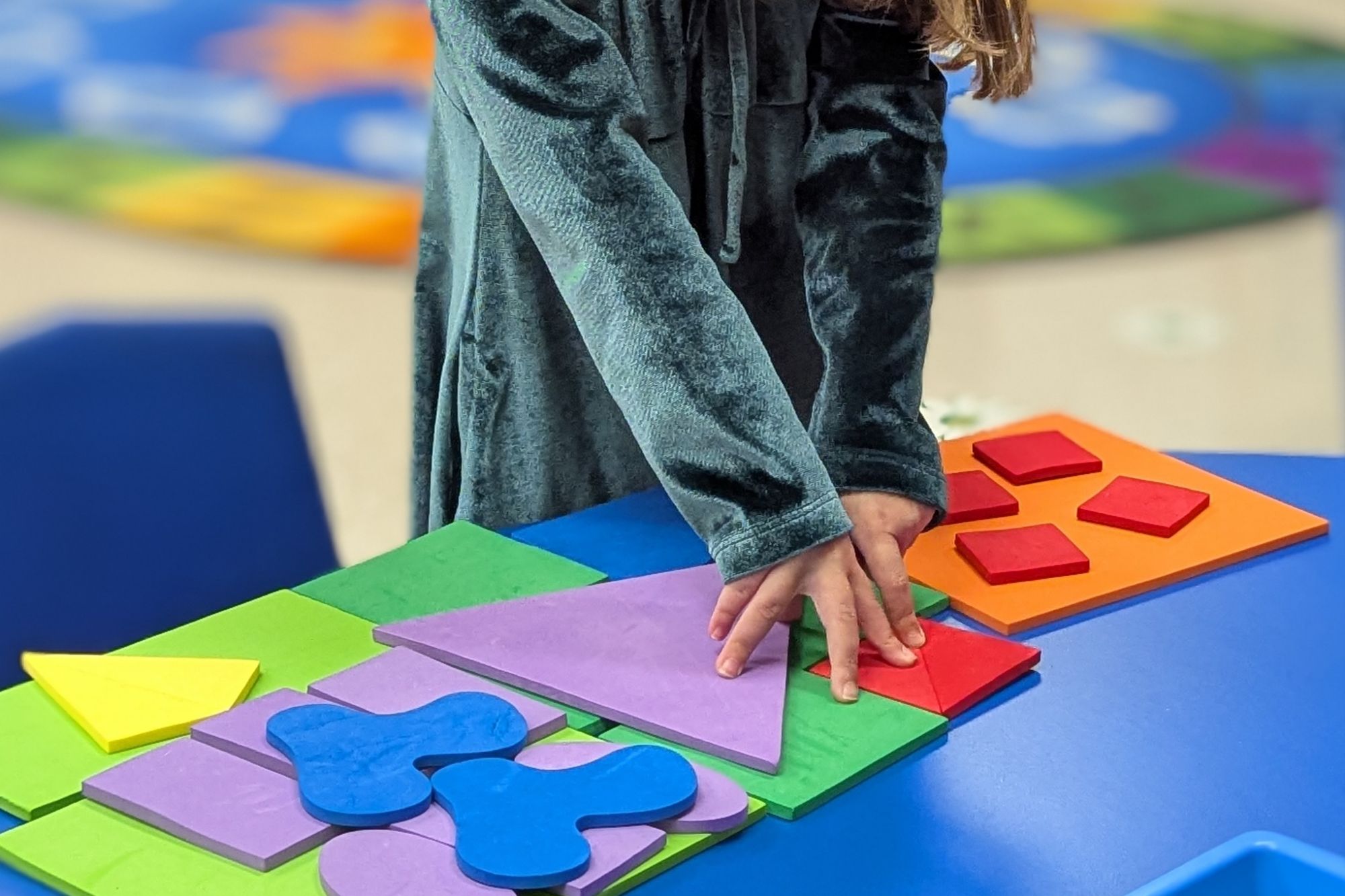
Today one of them asked if I’d come with her to our math center and make things with shapes. (Yes, please!) At one point, I asked her what she was doing. She had been giving me a running commentary, but had stopped. She replied, “I’m making it better. … See?!” Another friend joined in with equal enthusiasm.

The other day, we took an “Oh WOW! Walk” outside. The super scientists looked for things that tickled their fancy through one of their five senses. They collected these things to share with one another. One mighty pre-Ker showed me her stash as she tried to decide what to take home and what to leave in our science trolley. She had several rocks. One in particular seemed to be a treasure.

Me: “Can you tell me about that rock?”
C: “Oh! This rock has a belly button!”
Me: “Come on!!! A belly button??!! Get out!”
C” “Look!”
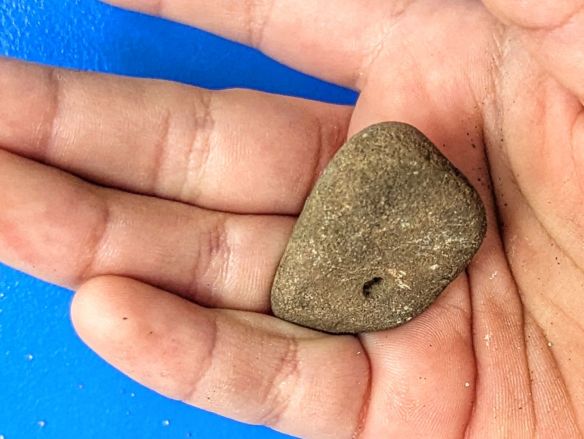
I laughed out loud! She was right. It was a rock with a belly button! It may sound silly to you. But, think about her thinking. She noticed similarities between this rock and a belly and belly button. She was able to use her imagination to put those noticings together. She found joy in her musings, and was courageous enough to share it with another. These are the skills, and habits of mind that are used when we problem solve and create things as yet unknown. Once again it is not the simple cuteness of the young, it is the beginnings of profound critical and creative thinking.

Another thing I’m grateful for in pre-K is time. I’m super grateful for, and really enjoy, the extra time there is to simply be in pre-Kindergarten. This gives us the opportunity to talk, share, develop relationships, play, explore, create. and learn. Today one of the girls was missing her mom. At the end of the day, she came over to me and told me. I asked her if there were anything I might do to help her. She said no, and just quietly stood next to me, her face devoid of joy. Then, she began to button the buttons on my denim jacket. She didn’t ask if she could do it, she just began to button them. Her sadness turned to determination and joy as she checked and buttoned each button — even rolling down my sleeves to button the cuffs. It was as if she felt and embodied the care and love of her mother, as she took care of me by buttoning my buttons.

Oh, and then there’s car line. When I first started teaching, we did Kindergarten car line in the morning and after school. It was something I loved because it allowed me to get to know the parents a bit, and interact with them and their children together. We stopped doing it in Kindergarten a few years ago, and it was something I’ve always missed. Well, in Pre-K we get to do it again. I’m happy to be back interacting with parents each time I have the opportunity to do carline.

And, oh my gosh, Jr. Pre-Kers! They are a joy to get to know. Since I’m in Pre-K, I get to help take the JP-Kers out of the cars, and sometimes see them before and after school. We’re working on learning each other’s names, and as they remember mine, they joyfully call, “Ms. James! I know your name!” I love the joy, the connection, and the feelings of accomplishment – for them and me.

So, to answer that Grandmother’s question as clearly as I can. Do I miss Kindergarten? I do. But, do I love PK? Yes, I do! Are the kids fantabulous? Yes, they are! Are the parents marvelous? Yup, they sure are! Are my teammates amazing? Indeed! Are the possibilities awesome and limitless? Yes! So, I breathe on, learn, grow, love, be me, and enjoy it all.

Learners and Writers Blossom Through Creative Passion, Process, and Product

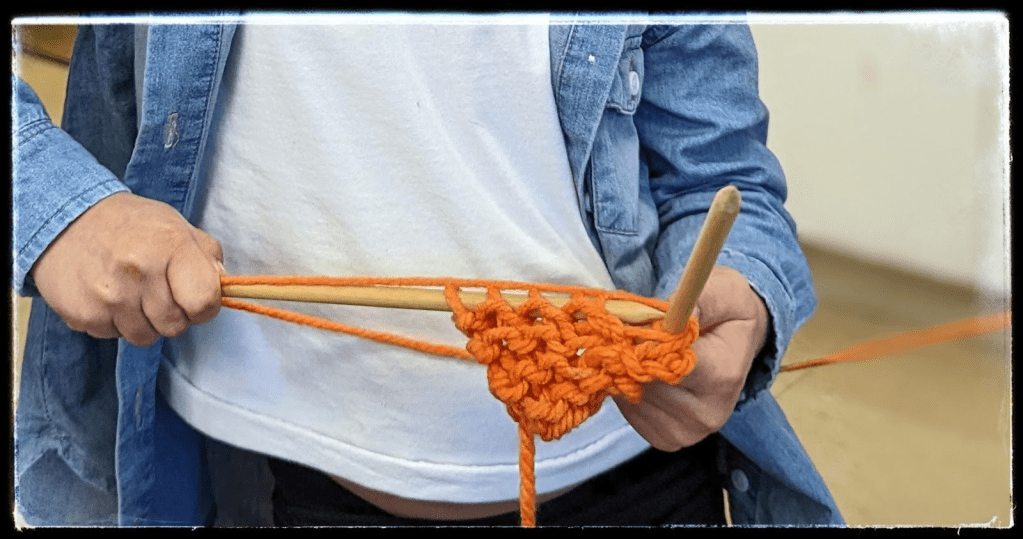
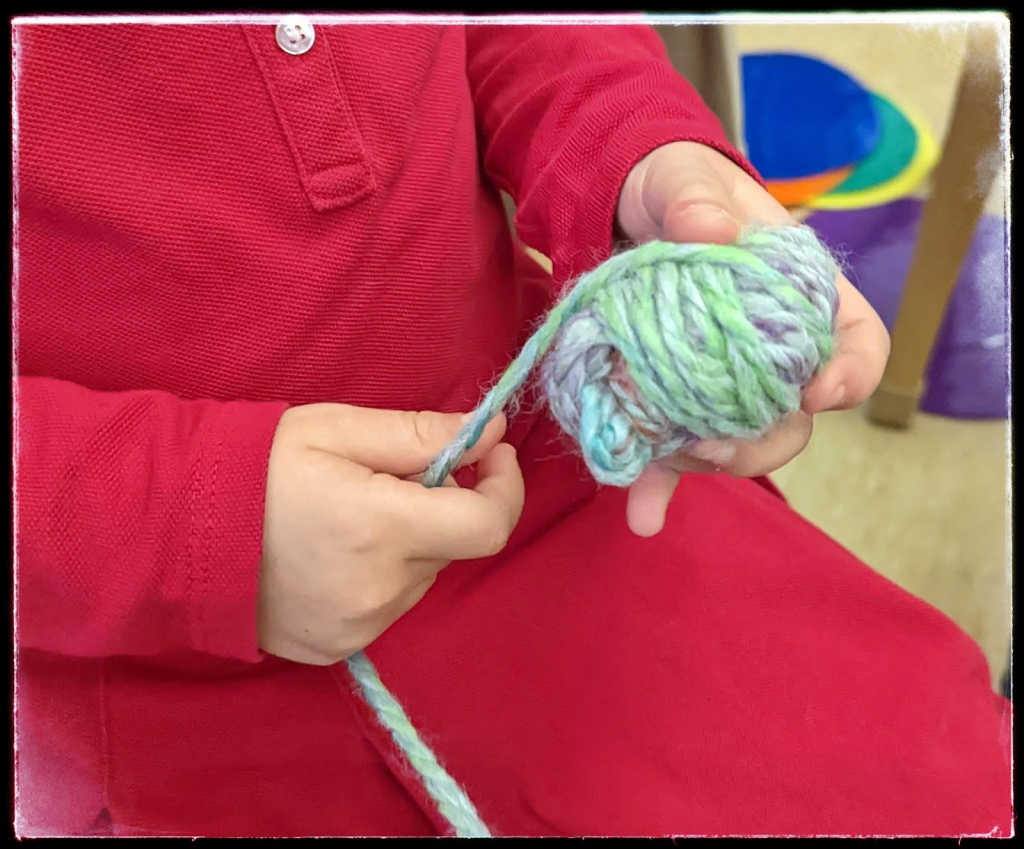
My learners love to finger-knit. It’s a never-ending source of joy, creativity, flow, and peace. When we begin, I show them two methods of finger-knitting, and then they choose their favorite way to continue. Amazingly, every year, after working with my two methods for a bit, my learners develop their own iteration of finger-knitting and teach it to me. Soon, they take over my job of teaching others how to finger-knit, make the beginning slip-knot, and wind yarn balls. 

Soon after they learn to finger-knit, they are curious about the knitting needles I have in the classroom. They begin to ask questions: Can you knit with sticks, Miss James? Did you knit that on sticks? What else can you knit on sticks? Their curiosity turns to wonder and awe as they discover I know how to knit with sticks and have made many things. One by one, they ask me to teach them to knit with sticks. 

They wait patiently – or not so patiently – for time and sticks, so that they can be the next knitter. At one point, five of them had work on the sticks, and I was commissioned to make more sticks so that they could all knit. 

Whether they knit with fingers or sticks, the process is one of grit and growth. First, I show them, often helping them move their hands, fingers, or sticks. Frequently, they make mistakes. Sometimes they forget a step. Other times, their knitting falls off their fingers or sticks, and they accidentally pull it all apart. We breathe through our angest, and rehearse the movements and the words that describe those movements: Make a loop. Put it on your finger. Wrap the yarn around your finger in front of that loop. Don’t make it too tight! Now pull the loop over that piece of yarn. Once that’s done, pull these two ends. Finally, we celebrate and encourage: You got it! Now do it all again – over and over until you’re done.

After working with me, they work on their own – sometimes in close proximity to me, sometimes with a group of other knitters. They frequently check in, asking, “Is this right? Can I take it off now? Can you fix this, Miss James?” As their competence and confidence grow, they begin to say, “Can you teach me how to do it so I can do it by myself?” If, when helping, I miss their aha moment, they say, “Miss James. I can do it. Would you let me do it?” My response is always, “Yes, of course!” More often than not, the exact same words begin to greet me in reading, writing, and math. “Can you teach me how to do it so I can do it by myself?” 

Finger-knitting is a shared experience of creating, taking chances, trying, problem-solving, teaching, learning, using tools, and creating a valuable and genuine product. It’s a lot like being a writer!

If you aren’t a knitter (finger or sticks), there are many wonderful resources online to teach you. However, it may be better for you to consider the ways you create and make in your own life. What creative love do you have that you can share with your learners? When you do it, do you have to take chances, try again, problem-solve, learn, use tools? Do you create a valuable and genuine product? Then it’s a lot like being a writer, perhaps we can consider it pre-writing skills since we are growing the mindsets and habits of a writer. Weaving, cooking, collage, mark-making, origami, calligraphy, or embroidery may be your jam; use them. Your excitement, joy, peace, and curiosity will spark the same in your learners and motivate them to give it a go. 

As you and your learners engage in the creative process, you will learn about yourself, your learners, and the process. I am always amazed at how much I learn about something I have done forever, as I listen to and watch my learners. Sometimes, as we work, we work in silence, absorbed in the struggle of learning or the peace of flow. But often, we employ one of HGSE’s Project Zero’s Core Thinking Routines. We notice, think, and wonder, and share our thoughts with one another. This thinking routine allows us to verbalize what we are doing with our hands, share the new things we notice about the yarn and how it works, think about and share our thinking, create new iterations, notice similarities and differences, get suggestions from others, talk through our struggles, and celebrate our successes. 

As we knit together, I noticed how often we use the phrases – first, then, next, after that, and finally. I realized this shared passion was a way to make the concept of beginning-middle-end-thinking concrete for my young learners. If we could notice the concept of beginning, middle, and end in our repeated experience of finger-knitting, perhaps we could translate that into the use of beginning, middle, and end in writing.

I set a task for my learners the next morning. During Investigate and Explore time, they were to finger-knit. My instructions and explanation were intentional and specific. “Everyone must finger-knit so you have it fresh in your big, beautiful brains for writing. As you knit, use our Notice-Think-Wonder thinking routine. You can use it by yourself or with friends. I particularly want you to think about how you are knitting. What steps are you taking? Do you always do things the same way? Notice. Think. Wonder.” 

Finally, writing time arrived, and my learners peppered me with questions. “What are we doing with finger-knitting, Miss James? How is finger-knitting writing? What are we doing? Can we finger-knit again now?” As they settled in, I explained that we were going to teach others how to finger knit by explaining what we do first, then, next, after that, and finally. A plethora of hands raised, as ideas tumbled out of their mouths. I asked them to breathe and hold their excitement while I finished my explanation. 

“First, I want you to work with a partner. Talk about your process. Notice what is the same and different. Think about what is possible. Do you both start and end the same way? Are you middle steps exactly the same? Do you explain them in the same way? Why or why not? Use our learning question What makes you say that? to discover what your partner is thinking. Show your partner what your words mean by finger-knitting for them. Use your art sketchbook to draw pictures. This might help you try things out and will give you a guide as you write.

Then, write and illustrate your process – your finger knitting steps – so others can learn to finger knit. Please remember to use the words first, next, then, after that, and finally. After that, share your work with your partner. Finally, when you are satisfied with your process and product, come share it with me. 

Everyone – even my writers who struggle – was successful. Everyone – in word, action, and illustration shared a possible finger-knitting process iteration using beginning-middle-end-thinking. It’s only a first step, but it’s an important step in their life and growth as writers. 

(Translation: First, you take it out of the finger-knitting basket. Then I do a loop and I start finger-knitting. Then I talked a friend to help me.)

These images are of my Kinders over the past few years. This year I’m teaching pre-Kindergarten. Just like my Kinders, they love to learn how to do things, and then do them — even when they’re hard things. And goodness gracious, they love to make things. I’m excited to teach them how to finger-knit, and to be their scribe as we construct first, then, after that, and finally finger-knitting plans.

Celebrating Little Moments: A Kinder’s Art of Noticing

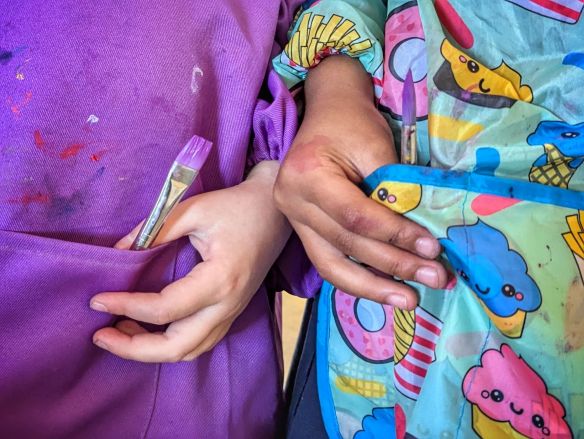
The other day two of my Kindergarten artists were moving excitedly to a new spot in our learning space — paint brushes in hand. Paint brushes that were dripping with lovely purple watercolor paint.

Me: “Careful with the paint brushes. Maybe you can leave the here while you go there.”

Them: “Ok.”

They didn’t drop them off with me. Instead, a few moments later, as I wondered where they and their paint filled brushes were, I heard squeals of delight as the two of them hurried back to me.

Them: “POCKETS! Miss James, we have POCKETS!”

Me: (laughing out loud) “Indeed you do. What a great way to use them!”

Little things. Are there really any little things? Or is it simply the way we look at them.

Pockets — when I don’t need them or notice them — become small insignificant things. But when noticed, found, needed, and used, they become wonderous things to celebrate.

I’ve been wanting to bring more joy, positivity and hope into my life these days. I think this is an answer — notice and celebrate the little things.

Oh! How fantabulous is this?!?! I’ve also been looking for ways to encourage my Kinders to reflect and write. Perhaps a little-things-noticing ritual with a lovely handmade little-things-noticing journal is the answer! Art, writing, and mindfulness all wrapped up in one. This can be a beautiful ritual that allows us to slow down, take a moment, notice, celebrate, and keep track of the lovely little things. I think I can find a bit of time in the morning and afternoon for us to note one little — wonderful — thing.

Fingers crossed I’ll keep you posted.

Here’s a few of mine for right now:

  • sunshine
  • naps
  • sprouts growing
  • birds chirping
  • my flute
  • greeted by name by a kind soul
  • conversations with old friends
  • delicious green tea
  • my inhale-exhale mug
  • a blog post

I wonder how the Kinders will experience this ritual of reflection and writing. I will have to think how I might structure it — the journal, the time, the selling — to help them experience it’s power.

My experience? I found that seeing one thing brought another, and another to mind. Occasionally I felt a bit of reticence — thinking other might find my ritual silly, I think. But, as I brushed that away, I found more things to note.

Let us all learn from my Kindergartners. Let’s notice, celebrate and share the little moments — even when we think others might think us silly.

I’ll go first … “A nap! I got a nap!”

A Haiku Walk

I blogged about my daily haiku practice when I first started. I love the practice. I was very faithful from July through December. Then I was knee deep in teaching, coaching, and some family health issues, and my practice was set aside. The other day I found my haiku journal, and stowed it in my bag, hopeful that I’d find a moment to begin again. Days passed, and my journal remained safely tucked in my bag. I didn’t write, but each time I saw the book I thought of my Kindergartners.

My morning meeting manager composes our morning message each day. It seemed the perfect place to begin their haiku writing practice. Each one would then write five haiku poems — one a day during their week long job.

The process and products were delightful. The Kindergarten poets stared at the computer screen, thinking. They looked up thoughtfully and counted silently on their fingers. They tested sentences, and they wrote morning message haikus.

As they crafted their sentences, I practiced patience. I resisted the urge to free them from their struggle. Instead, I gave them time and space. My silence assured them I knew they could do it.

I breathed through every thought that encouraged me to watch the clock and rush them through their task. I reminded myself: “They can do it. The struggle is important. Their thoughts are valuable. Learning is happening. Breathe and wait. Wait and breathe. Accept these moments as gifts.”

Here are some of their messages. I love that the poems are infused with kindness, and affirmations. And their word play — mathy and mathists — bring me joy.

We are amazing.

We are artists and mathists.

 I love the playground.


Miss James is awesome. 

Everyone is so awesome.

Everyone is friends.


Friends are very kind.

Friends are very, very, kind.

We are very kind.


We are mathy girls.

We are mighty mathy girls.

Math is fantastic!


We are super nice.

We’re the best Kindergartners

We are always kind!


We are amazing.

We have big beautiful brains.

We are wonderful.


We are wonderful.

Everyone is amazing.

We love each other.


We are amazing.

We have big beautiful brains.

We have awesome hearts.


I loved everything about this, so I kept my eyes and mind open to other haiku possibilities. As the the days turned into beautiful spring days, I told the poets that we would be taking time during our reading block to take a haiku walk. They asked many questions: What is a haiku walk? What will we do? Can we go places we’ve never gone before? When are we going? Can we go more than once? Will we actually write haiku? I answered all their questions, and we planned our walk for the next day. Then, the weather turned cold, gray, and wet. Each day they asked if today were the day we would walk. Each day I said “Not today. It’s too wet and cold.” I knew we could walk and write when it was wet and cold, but I also imagined that better weather would lead to more joy, more writing, more willingness to engage.

Finally, on Friday, spring burst forth again. The sun was bright, and the temperature was warm enough to head out without coats. The perfect day had arrived. When I told them we were going on our haiku walk, they cheered and shouted “We’re going on our haiku walk!!!” You would have thought I told them I had candy and puppies for everyone!

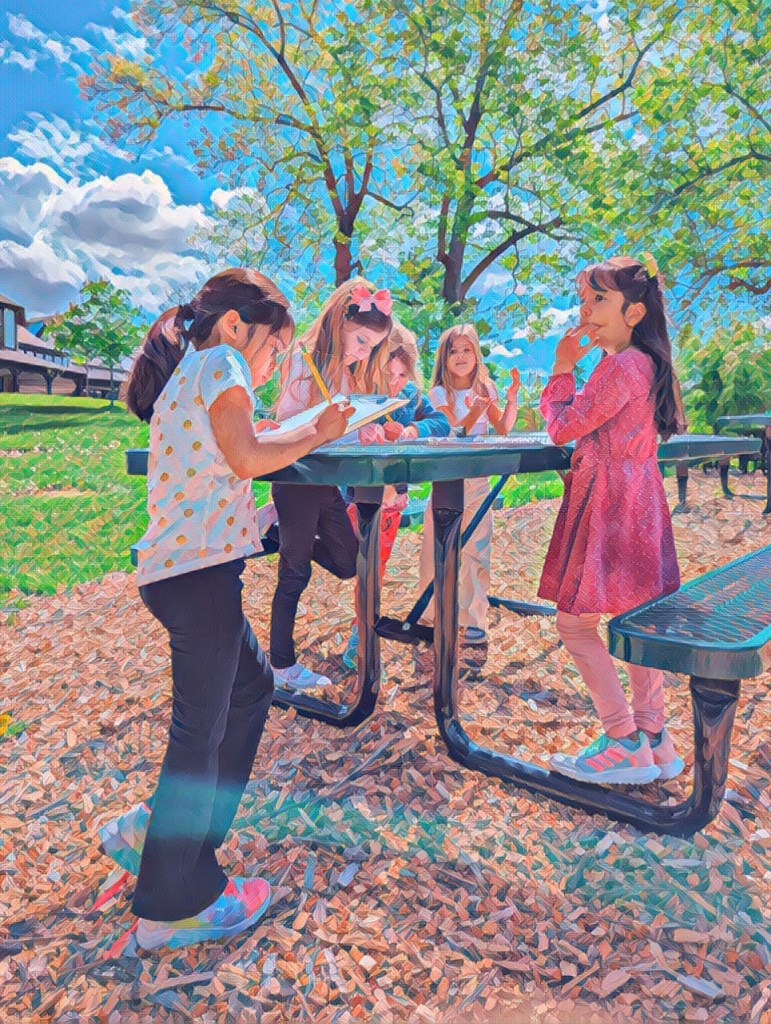
We chose a spot to gather. It was large enough for them to run free, explore, and be inspired, and also small enough for us to see each other wherever they roamed. Clipboards in hand, they wandered, stopped, wrote, chatted, and sometimes abandoned the clipboards to simply run with joyous freedom.

Here are a few of their poems.

The statue is down.

Flowers are everywhere.

This flower’s pretty


The flowers are here. 

I see sticks and logs right here. 

I see the flowers.


The bees like flowers.

The flowers are everywhere.

The flowers are here.


Trees are beautiful.

The sky’s very beautiful.

We are beautiful.


There’s lots of flowers.

There is wood chips by us, too.

The trees are so long.


The statue is gray.

It looks so cool and funny.

It looks amazing.


I see trees and rocks.

I see beautiful flowers.

I see trees and grass.


I see the benches.

I see the gate and the grass.

I see signs and rocks.


As I watched, encouraged, and enjoyed the beautiful day, I joined my Kindergartners, and documented the moment in haiku.

Haikus are forming.

Fingers count syllables, then

pausing, they run free.

Laughter swirls round them.

Feet sound in quick staccatos.

Returning, they write.

Magic enfolds us.

Haiku poets all, living

and writing haiku.

These Kindergartners are mighty, capable, and filled with amazingness. It’s good to remember this, and to treat them as the humans I know they are — fantabulous, trustworthy, free, joyful, and poets of haiku.

What’s the Goal?

And just like that, she’s done.

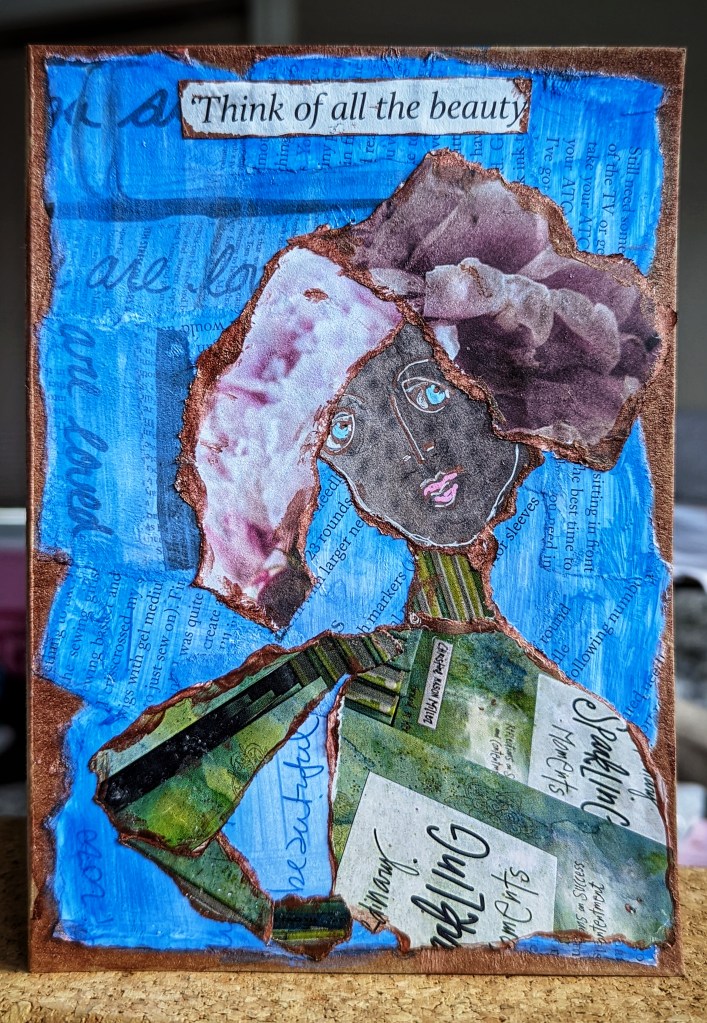
As I finished putting her together, I thought, “She looks pretty good, not perfect, but pretty good.” Since my inner critic was in a talkative mood, I engaged. “True, but is perfection the goal?” I wasn’t being sassy. I was genuinely inquiring. We were both quiet for a bit.

Then I noticed the words “think of all the beauty.” I didn’t specifically pick them to be part of this piece. They fell out of my box as I was choosing other things. But, I noticed them. And, I let them speak to me. Once they spoke, I knew they were the answer, and I knew I had to figure out a way to include them in this piece.

That’s the goal. Think of all the beauty — in art, in life, in ourselves and others. Think of all the beauty.

Learn, be, create, enjoy, and think of all the beauty. Notice it. Acknowledge it. Accept it. Celebrate it. And, preach it.

So, my art and I sit here and preach on. Think of all the beauty.

Share Your Gratitude

We are never more than one grateful thought away from peace of heart.
Brother David Steindl-Rast

It’s been a long few days with my Kindergartners. It seems like I was constantly having to bring them back, constantly having to ask for their attention, constantly having to scold them in some way. Now, to be fair, it wasn’t actually constantly. There were many moments of marvel, joy, laughter, love, and all around fantabulousness. Those beautiful moments far outnumbered the frustrating angst filled ones. And yet, those moments that were less than I hoped for, those moments when I was less than I hoped to be, weighed heavy on me. I struggled to figure out what I might do, and how to get both them, and me, back on track.

With that on my mind and heart, I headed to my coaching gig. As I entered, I ran into a friend. “Hey!” I said, smiling under my mask. Seeing me she said, “I’m sorry, I just have to …” as she reached in and gave me a hug. I laughed out loud as we embraced before hurrying off to be with my HS athletes.

At the end of the night I popped over to say goodbye and my friend handed me a bag and a lovely vase of flowers. “What’s this?” I asked. “Just a little something to say thank you.” she replied. I thanked her, and gave her a tight squeeze as we got her daughter to take a quick photo. Then, we were both on our way.

My way included having to wait with some athletes whose parents hadn’t yet arrived. I was tired and none to happy to have to wait. But wait I did, and as I waited I opened the bag, read the card, and looked at the gift. In the card, my friend detailed the first time she met met me. She was late to pick up her daughter and I waited, outside, with her daughter. I made sure she got into the car alright, and pleasantly said hello before heading off for the night. She told me how much that relatively small act meant to her. The note, the flowers, and the gift — You make a difference. That’s all. — touched my heart and mind. They were the one grateful thought that allowed me to see the truth, take a breath, and find some peace.

How amazing, right? Her gratitude for my waiting with her daughter came at the moment when I was miffed at having to wait, in my exhausted state, with someone else’s daughter. Her acknowledgement, affirmation, and gratitude for the difference I make in the lives of others — with the smallest of acts — was the one grateful thought I needed. Her gratitude, shared with me, helped me to see the truth, helped me to take a breath, helped me to be present — present to truth, to opportunity, to joy, to peace. As I took a breath, I turned to the athlete still waiting. Instead of expressing any impatience, I simply chose to enter the moment with another human being. The peace and joy were much nicer than the angst.

Later that night, I realized I had received another grateful thought at the very beginning of the day. If you notice in the photo, there’s a bit of a yarn chain nestled in front of the flowers. That was a gift from one of my Kindergartners. I taught them how to finger knit a couple weeks ago. First thing in the morning, Jay came into our learning space, and came to me, as she does every morning, to greet me. It’s a routine I treasure. Today she held the finger knitting up for me to see. I told her it was beautiful. She said, “I made it for you!” I responded, “Thank you so much!” as I placed it on my neck.

That finger knitting chain stayed on my neck all day. I forgot about it until I got home and looked in the mirror. Seeing it, I realized my sweet Kindergartner had shared a grateful thought with me at the very beginning of our day. I love that her grateful thought had rested close to my heart all day. As I placed it by the other gifts for a photograph I again took a breath, embraced the truth, and experienced peace and joy.

Never underestimate the power of gratitude. Never hesitate to express it. Your gratitude — for yourself, your life, and towards others — may be the one thought of gratitude needed to find peace and joy.

I Am An Artist

There is such power and joy in being able embrace oneself as an artist. An artist able to:

  • be inspired by other artists
  • use that inspiration to create your own art
  • inspire others
  • make creative and artistic decisions
  • carry out your plan or
  • enjoy the freedom of artistic and creative play and experimentation
  • speak your truth through your art
  • embrace your artist-self by choosing your own name (Hundertwasser)
  • share your understanding and vision by naming your artwork (Thomas)

The power and joy explodes, I think, when you can do all these things as a young child.

Last week my Kindergarten artists explored the work and life of Alma Thomas. She began her career as a representational artist, and later in her artist journey embraced abstract art. Amazingly, at the age of 80 in the early 1970’s she became the first African American woman to have a solo exhibit at the Whitney Museum in NYC.

The kindergarten artists loved Alma’s use of color, and enjoyed trying to guess what she named each of her paintings. They worked hard — first in their sketch books and then on the final watercolor paper — to recreate with crayons, the marks Alma made with acrylic paint. By the way, in case you’ve never tried it, it takes a lot of dedication to fill a 9X12 piece of paper with marks the size of your thumb.

As my artists worked in the classroom, I worked alongside them in my home studio. Like them I made my own crayon marks, and then added layers of watercolor wash. My work was often interrupted by “Hey Ms. James. This is …..,” as they slid their work under the document camera so we could marvel and talk together.

Encouraging them to include all the elements we noticed in Alma’s work, yet at the same time allowing them to make their own artistic and creative decisions and plans, is a delicate line to walk. I often wonder how close their work has to look to our inspirational artist’s work.

As I’ve worked with them this year, I’ve become more convinced that there are four non-negotiables. My fantabulous artists must:

  • include the elements of the original piece that we notice and spoke about together
  • be free to use their big beautiful brains and awesome hearts to decide how to incorporate the elements into their art
  • be allowed, encouraged, and enabled to find joy in their process and product
  • come to know themselves as artists

So, I work on pointing out what I see — what I see that reflects the elements we discussed, the things I notice are missing, and the many things I wonder about. I do my best to guide my artists to walk that delicate line of agency and requirements with me. Sometimes I set them free to make the decision as an artist, sometimes I request they put the artwork down for a bit and then look at it again to see if they are still happy with it, other times we find a compromise that allows them to have freedom while still following the guidelines.

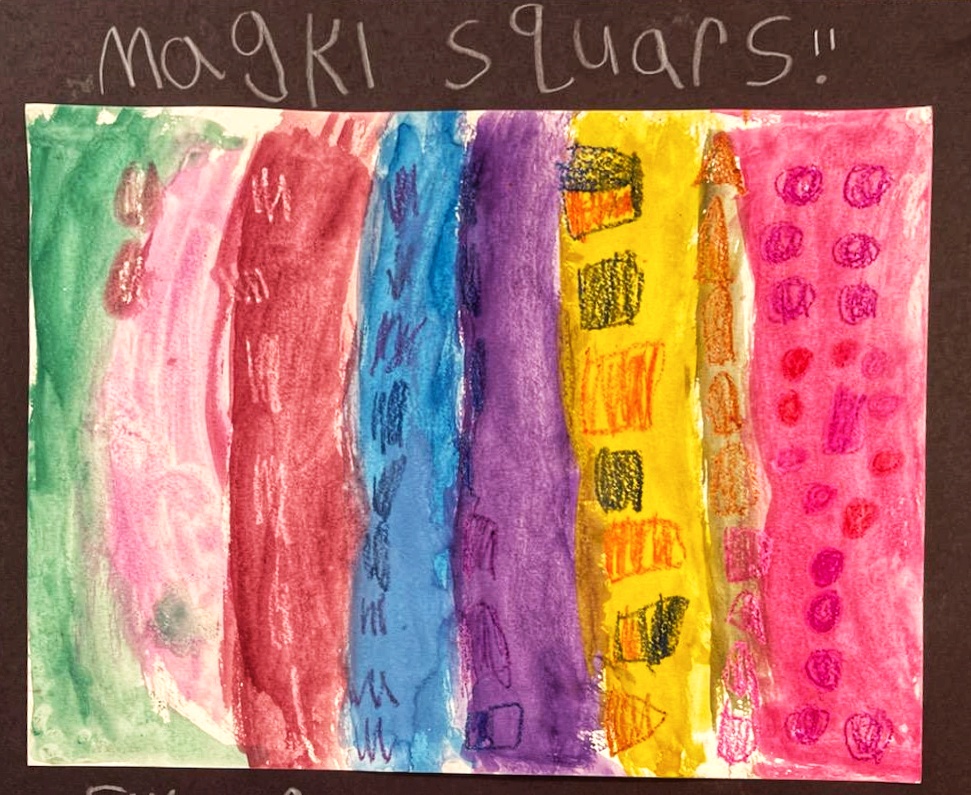
Here are some of our Alma Thomas inspired works of art. I’m always interested to see how they interpret the current artist’s work, and how they incorporate some of the other artists we’ve explored previously. I’m amazed and edified by their title choices. The titles add to the power of the piece. They speak to the audience to share the artist’s thoughts and understanding, and speak to the artists themselves to affirm who they are.

The Master of Sjhapes
Magical Squares
Tornadoes Howling
A Meteor Shower
The Inspired Painting
Artist’s Lines

When I read their titles my heart is full. These Kindergarten artists are perceptive, thoughtful, confident, and invested in sharing what is in their minds and hearts. Everyday I do my best to affirm them “Indeed my young artist sisters, you are masters. You are inspired and inspiring artists. Don’t every believe anything less.”

World Changing Ideas

I shared the book What Do You Do With An Idea with my Kindergartners. Sometimes it’s hard to see them when I’m teaching remotely — especially when I’m sharing my screen. I was a little disappointed in my lesson, wondering if I had been able to spark ideas, and share the amazingly fantabulous idea that we ALL — no matter what — can have beautiful, world changing ideas.

After the lesson I shared 3 videos with my students — how to make a squish-squash book, an accordion fold book, and a silly fold book. I asked that each student make at least one book, put her ideas in it, and then share her book and ideas by video on SeeSaw.

I’ve been looking at the responses and leaving comments, and wow, I’m so happy. They are sharing their ideas, reading what they wrote, explaining their illustrations, and talking about things they wonder about from the book we read together.

Here are some of their ideas:

flying unicorns
making a tree to climb when she becomes seventeen
ice cream everywhere
writing a book about her favorite stuffy
sending her ideas to the clouds for them to get stronger
looking at the clouds to see what they look like
not holding onto her ideas but sharing them with others
making a car that goes wherever you tell it
reading more books,
being a superhero and discovering how to fly
stating what she knows, doesn’t know, and wonders,
helping others and saying “No problem!”
creating a cardboard igloo over the summer
making a robot that can help her and others

It might be easy to discount their ideas as childish, sweet, or silly — after all, flying unicorns and superheroes? How is it possible that these ideas are world changing?

Perhaps, for just a moment, imagine those same ideas from the perspective of a scientist, designer, or researcher. I’ll consider just a few but they ALL are equally full of potential.

Flying unicorns can easily become a cure for cancer or other devastating diseases. Much like flying unicorns, a cure seems far off. Imagine if the scientists didn’t engage in their fantastical dreams. Imagine if they didn’t try to attain them. Imagine if they had people around them saying “That’s a sweet idea. Too bad it can’t be done. There are no such things as flying unicorns or cures.”

Ice cream everywhere is a problem of ingredients, process, temperature, distribution, and end users. It’s reminiscent of a remarkable story of creative design thinking shared by Tom Kelley and David Kelley. The Embrace Infant Warmer helps save the lives of premature babies. Similarly to my student’s desire for ice cream everywhere, the warmer was the solution to a problem of ingredients, process, temperature, distribution and end users.

The idea of making a tree to climb when she reaches the age of 17 sounds a bit unusual to our adult ears, but it’s really quite spectacular. Don’t just hope there will be a tree to climb. Work to make it happen. Work to bring your ideas and dreams to life.

I’ve got some ideas and thoughts of how I might improve my next remote read aloud. I’m excited to try them and continue to grow my relationship with my students. But, I’m no longer worried that the idea of having ideas was lost or lessened by the remoteness.

I miss sitting next to them, creating, talking, and sharing. And yet, being able to watch their recordings is powerful. Watching and listening is a gift. It’s great to be able to have a recording of each student as she formulates her thoughts and chooses what to share, and it’s quite fantabulous to have the opportunity to reflect and respond to each one.

I’m hopeful they feel the power and joy of our remote conversation. And, my fingers are crossed that my enthusiasm and ideas about their ideas change the world for them just a bit. They really are fantabulous, and their ideas are game changers!

Matisse and Me

I’m teaching art with my Kindergartners and that always has me reflecting on my own process, emotions, and thoughts as a creative.

I’ve been painting when I hike for a few years now, but this year, I began working in a watercolor journal. All the paintings — no matter my opinion of them — are there. I’m always kind of surprised by the courage involved to put pen or paint brush to paper — especially when it is in a bound book, or done without pencil sketching first. I wondered it if I were the only one to feel that. Surely not, I thought.

Looking for affirmation for my feelings I set about finding articles linking courage and creativity. As I looked I stumbled upon this quote by Henri Matisse “Creativity takes courage.” Ah, even the master felt it!

And then, as I read more, I nearly fell out of my chair. Matisse — the man whose pencil drawings of the Madonna enthralled me at the Museo d’Arte e Spiritualita in Brescia, and whose Cut Outs took my breath away at the MOMA — said this:

“It has bothered me all my life that I do not paint like everybody else.”

Wow.

When I read that, I was amazed and encouraged. If Matisse could be bothered that he didn’t paint like everybody else, why would I be surprised that I feel that way? If Matisse said it, and yet went on to embrace his work — grow, change, re-invent himself when he saw fit — then I could, too.

It’s remarkable how freeing it is to know Matisse was bothered that he didn’t paint like everybody else. Somehow that gave me a great sense of freedom. Just paint, draw, do your thing. Notice, think, wonder, and make creative and artistic decisions. Your thing is yours, it’s beautiful, it’s creative, it’s artistic — but most of all, it’s yours.

What if Matisse had stopped doing his own thing and tried to be like everybody else. Yikes! That would have been awful. So I encourage myself — I am in amazing artistic and creative company, and if a master like Matisse could just say “Hey this brings me joy, and expresses what I see and feel” then so can I.

So I paint on. I draw on. Seeing my work, and the work of others for what it is — us.

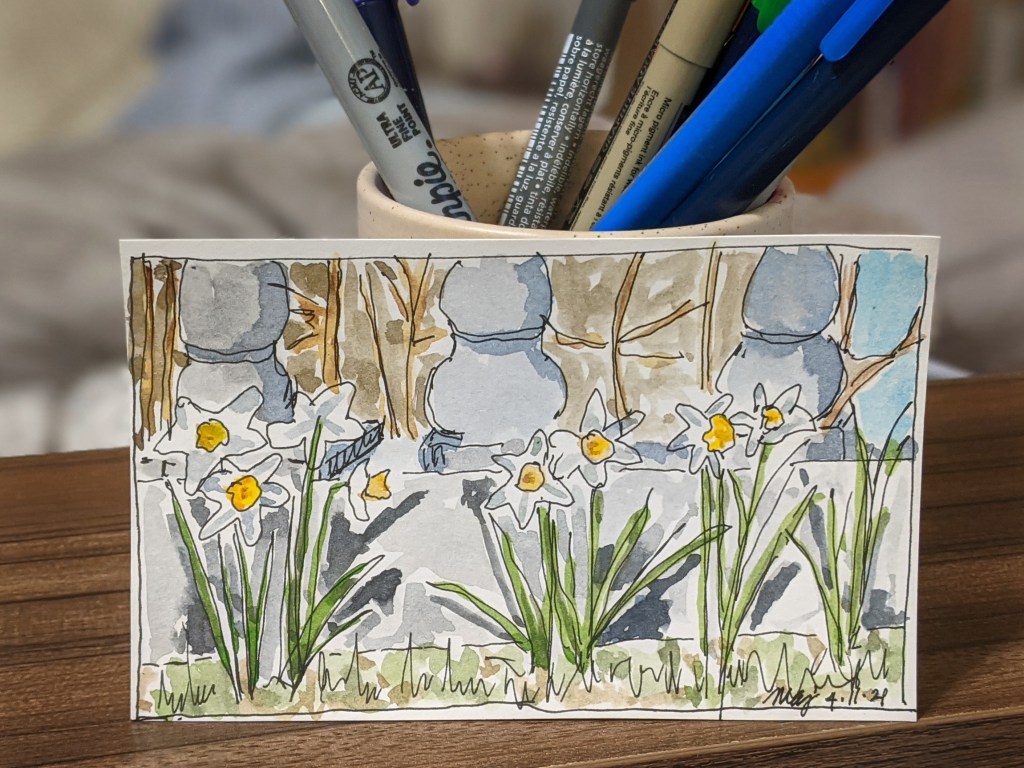
I photographed daffodils on a recent walk. Wanting to make some art I grabbed a small piece of watercolor and got to work. Is it perfect? No. Is it good? Yes. Did it bring me joy? Yes. Does it bring me joy now as I look at it? Yes. Is it me? Yes. Is it my style? Yes. What more can I ask for?

For now it sits on my desk to remind myself of the joy and awesomeness that is creative and artistic me — the joy and awesomeness of creating from who we are, where we are, with all we are.

When I work with my Kindergartners I want them to have this freedom — the freedom to know they can make great artistic and creative decisions, the freedom to find joy in their process and product even if it looks different than others, the courage to create with confidence in their own fantabulousness.

From Matisse, to me, to them. Who knows where it will go from there?

A Little Something

A few weeks ago I got a message from a former colleague.

Hey wonderful woman. Would you mind sending me your address? I have a little something to send you.

I chuckled at her beautifully affirming greeting, and sent my address without delay. I felt the delight of a child who knows a little something is in the works.

The package arrived the other day. It was a good size, but extremely light, and made no noise as I moved it into a space for quarantining. I wondered what it might be, and with all the patience I could muster, I waited for its quarantine to end,

Yesterday was the day. Eyes wide, I opened the box. As I folded back the flaps, a smile burst forth on my face, and I laughed out loud.

It was a veritable flock of paper cranes!

That flock is the perfect little something!

I often make paper cranes to share with friends, or leave for others to find. And here they were — with all the hope, joy, love, and wishes I try to infuse into mine — flying back to me. It was fantabulous to pull them out of the box.

My kids made the paper cranes — a symbol of healing — for you. You are always in my prayers.

Wow!

If you’ve ever wondered if kindness matters, wonder no more. It does. These cranes. Notes and thoughtful gifts from Kindergarten alums and their families. Zoom call check ins. Showing a friend how to use her sewing machine via zoom. Praying for and with one another. Listening, laughing, crying together. Chatting on the porch (over 6 feet away) bundled up with masks and a heater. Affirmations sent through WhatsApp. Appreciating one another. Breathing before reacting. Saying thank you. Sharing positive news stories. Walking slower or faster to keep up with your walking partner. Kindness matters! It all matters.

The cranes fly peacefully next to my chair. They accompany me with their wishes and whispers of health, happiness, resiliency, wisdom, beauty, strength, hope, gratitude, and kindness. When I see them out of the corner of my eye, they draw my gaze. Looking at them I wonder about the folding session. Often I reach out and touch them — enjoying the rustling of their paper wings and the shiny bead holding them together.

One more time. Kindness matters. Go be kind.