If you’re reading along with my posts, you know my recent life has been filled with caring for my dad. The stress and angst of his injury, complications, and days and nights in the hospital were pushing me to the edge. Then, my oncologist – after seeing my recent bloodwork – said, “You have got to take better care of yourself!” I nearly fell over the edge.
What’s a girl to do when she’s at the edge? Well if you’re me, you paint, write, or paint and write. I love playing with paint and words. I’m often surprised or stumped, and go through moments of deep thought and wondering, mess ups and revelations. Somehow the process brings me to a space of flow, peace, and joy.
Thinking about my process and experience, I did a bit of research to see what experts say about art assuaging angst, and aiding in health and wellbeing.
The arts also can be beneficial to your physical and mental health when you experience them — as an appreciator or creator. The American Congress of Rehabilitation Medicine says making or even just seeing art can impact the brain. Whether it’s part of a creative arts therapy exercise, or something you experience in your everyday life, art can help: *Imagine a more hopeful future. *Increase serotonin levels. *Increase blood flow to the part of the brain associated with pleasure. *Foster new ways of thinking.
Engagement with creative activities has the potential to contribute toward reducing stress and depression and can serve as a vehicle for alleviating the burden of chronic disease.
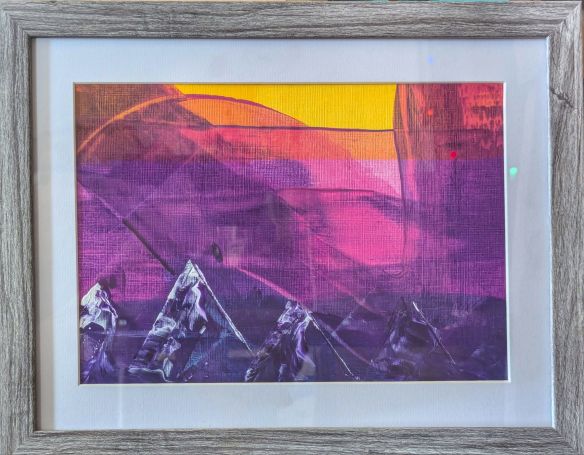
So, as I am want to do when it’s time to create, I pushed aside the many things that were in my way (in life and on my kitchen table). I surrounded myself in that small cleared space with acrylic paint, paper, an acrylic wedge, old hotel door cards (the poor woman’s answer to pallet knives), artist tape, and some hopeful enthusiasm and curiosity.
First I just sat in that tiny creative haven breathing, looking, thinking, and being. I was reminded of the invitation from our school’s art gallery curator to be part of our faculty and staff art show. In the midst of everything, the provocation of new art had sat forgotten in the back of my mind. Now, it came into my conscious mind as a beautiful opportunity.
Wonder joined my breath, looking, thinking and being. What might I do that would bring me joy, peace, and healing? Is it possible to do that, and create something I’d like to submit for the show? I decided to play and see what happened.
First I mindfully taped the edges of the paper. Then I added the paint.
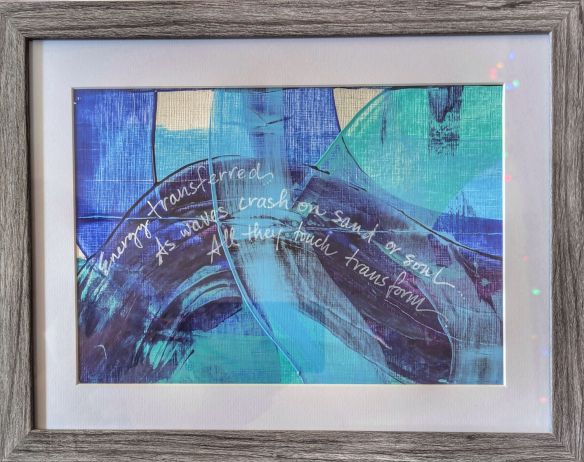
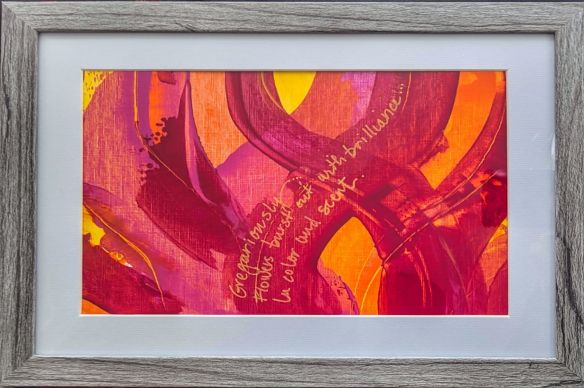
At first it didn’t work as I hoped. I tried a few times to bend the paint and process to my will. Finally, I surrendered to the process and paint. Instead of trying to control it, I bent to its will, or, at the very least, cooperated with it. I began to see what was possible and beautiful, rather than what didn’t work. I switched to a more monochromatic palette and the results of my change in thought and color were surprisingly beautiful and satisfying. The things that had been so frustrating became the elements I most enjoyed.
Sitting with my paintings I knew I had to add words. Haiku is a form of poetry that soothes me and brings me beautiful, quiet joy. Something about the process of forming my thoughts, and then forming those thoughts into 5-7-5 lines, changing words to match the beats, and finding unexpected inspiration in the new words, brings me into an almost parallel world of stillness. Many words flow out of me onto an old envelope. I gather them up and the haiku begins to take shape. Then, as is my usual experience, I am unable to find the right sound and feeling. I struggle on for a bit. Then I rest my head in my hands, close my eyes, breathe, and wait with peaceful expectation. As I wait, my breath deepens, my headache eases, my angst lessens, and the words appear.
Waves Energy transferred As waves crash on sand or soul All they touch transform
Flowers Gregariously Flowers burst out with brilliance In color and scent
My brother and I are caregivers for our parents. Its a blessing in many ways, and, at the same time it’s often incredibly difficult.
These have been some of the difficult times. My 90 year old father fell on Christmas day. He broke his femur and needed a partial hip replacement. So many stressors — pain, fear, the unknown, and fatigue — to name a few.
I had hoped to ease some of my daily angst by creating a large meditative art piece over winter break, but now I find myself in the hospital with no space to paint a 24 x 24 inch canvas — could you imagine? – as my dear father (and mother) suffer.
Unable to do what I planned, I am making art with what I have in my bag. My very large art creating has turned into some of the smallest bits of creating I’ve done in quite some time.
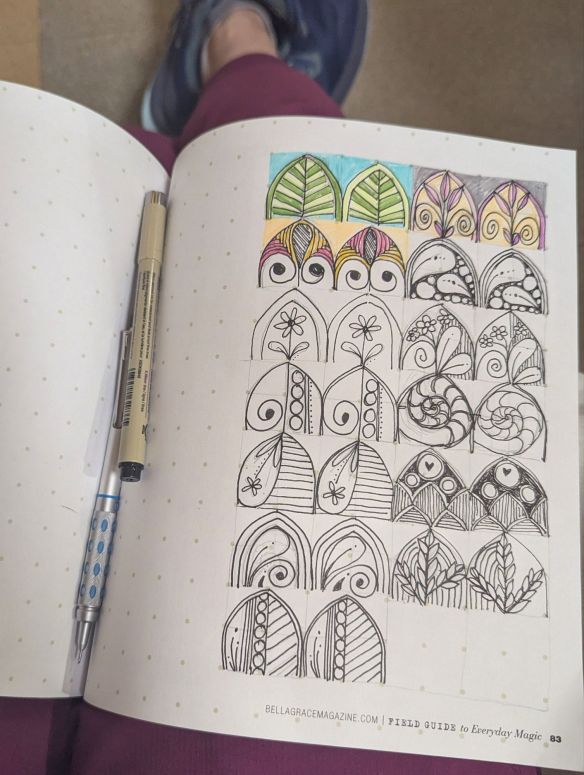
I threw the Bella Grace Field Guide to Everyday Magic in my bag with some pencils and pens as I ran out the door to meet the ambulance and my dad at the hospital. I’m so glad I did. It’s not a drawing journal, but that’s how I’m using it. I think the fact that it wasn’t made for drawing has made it an even better experience for me because it encourages me to think and play. My moments of play, focus, contemplation and creative thinking and doing have been a remarkably beautiful balm for my spirit, mind, body and soul!
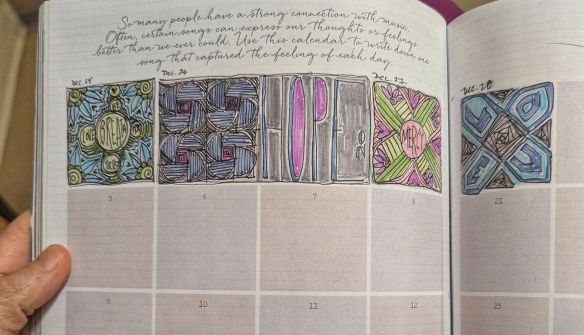
Instead of songs — designs and words:
A space for my thoughts … In drawing form. I made two of each to practice. The first done with pencil then pen, the second just with pen.
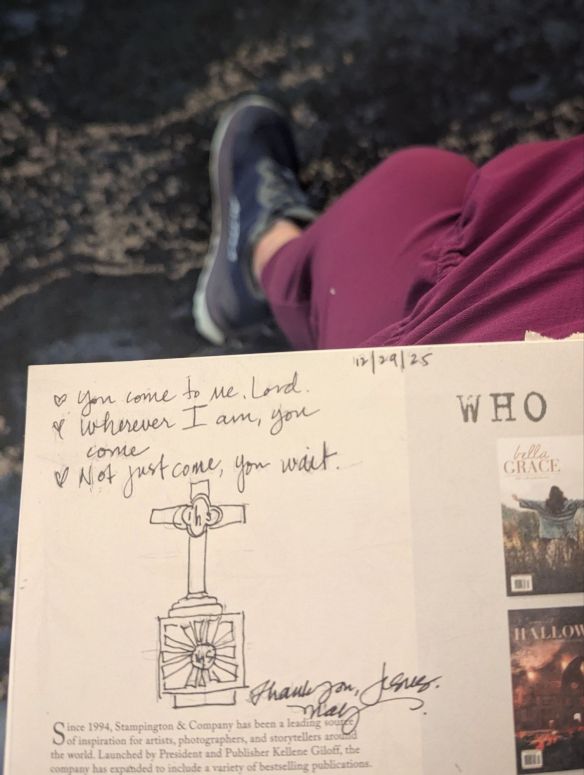
This was done on a space meant for nothing but space. I wanted so much to capture a feeling and thoughts I had as I visited the chapel. As the haiku was written, and the image drawn, my breath deepened and tears flowed.
CREATIVITY Creativity What would I do without you? Surely I’d be less.
We had our Field Day at my school yesterday. It was fantabulous and tiring! Thankfully it’s a half day for students. This allows faculty to do some of the many things on our plates.
After my students left, I took a moment to contemplate my next steps. Despite having a lot to do, I decided that it would be most beneficial for me to take a walk uptown, grab a bite to eat, and give myself the opportunity to find peace and refreshment.
As I walked, my joints and muscles ached a bit, and for a moment, I wondered if I chose well. I took a breath, reminded myself of the advantages of pausing and taking care of myself, and walked on.
Arriving at the restaurant I talked and laughed with the server, ordered, and went outside to find a pleasant place to sit. The table in front of the waterfall installation was free. I opened the umbrella by my table, sat down, kicked off my shoes, and began to breathe and relax. I chuckled at the small birds, enjoyed the cool breeze, took many deep breaths, and allowed my mind to find joy.
Before leaving school, I packed my haiku notebook and a pencil I enjoy using in my bag, knowing I don’t always enjoy eating alone at a restaurant. After sitting for some time, I felt the pull to write. I appreciate the structure of haiku. Its format encourages me to find new ways of saying things and allows me to write in short bursts.
Little Bird The bird drinks water escaping the waterfall Then tweets hungrily
Gladness In city center I pause by the waterfall Manmade and lovely.
I blogged about my daily haiku practice when I first started. I love the practice. I was very faithful from July through December. Then I was knee deep in teaching, coaching, and some family health issues, and my practice was set aside. The other day I found my haiku journal, and stowed it in my bag, hopeful that I’d find a moment to begin again. Days passed, and my journal remained safely tucked in my bag. I didn’t write, but each time I saw the book I thought of my Kindergartners.
My morning meeting manager composes our morning message each day. It seemed the perfect place to begin their haiku writing practice. Each one would then write five haiku poems — one a day during their week long job.
The process and products were delightful. The Kindergarten poets stared at the computer screen, thinking. They looked up thoughtfully and counted silently on their fingers. They tested sentences, and they wrote morning message haikus.
As they crafted their sentences, I practiced patience. I resisted the urge to free them from their struggle. Instead, I gave them time and space. My silence assured them I knew they could do it.
I breathed through every thought that encouraged me to watch the clock and rush them through their task. I reminded myself: “They can do it. The struggle is important. Their thoughts are valuable. Learning is happening. Breathe and wait. Wait and breathe. Accept these moments as gifts.”
Here are some of their messages. I love that the poems are infused with kindness, and affirmations. And their word play — mathy and mathists — bring me joy.
We are amazing.
We are artists and mathists.
I love the playground.
Miss James is awesome.
Everyone is so awesome.
Everyone is friends.
Friends are very kind.
Friends are very, very, kind.
We are very kind.
We are mathy girls.
We are mighty mathy girls.
Math is fantastic!
We are super nice.
We’re the best Kindergartners
We are always kind!
We are amazing.
We have big beautiful brains.
We are wonderful.
We are wonderful.
Everyone is amazing.
We love each other.
We are amazing.
We have big beautiful brains.
We have awesome hearts.
I loved everything about this, so I kept my eyes and mind open to other haiku possibilities. As the the days turned into beautiful spring days, I told the poets that we would be taking time during our reading block to take a haiku walk. They asked many questions: What is a haiku walk? What will we do? Can we go places we’ve never gone before? When are we going? Can we go more than once? Will we actually write haiku? I answered all their questions, and we planned our walk for the next day. Then, the weather turned cold, gray, and wet. Each day they asked if today were the day we would walk. Each day I said “Not today. It’s too wet and cold.” I knew we could walk and write when it was wet and cold, but I also imagined that better weather would lead to more joy, more writing, more willingness to engage.
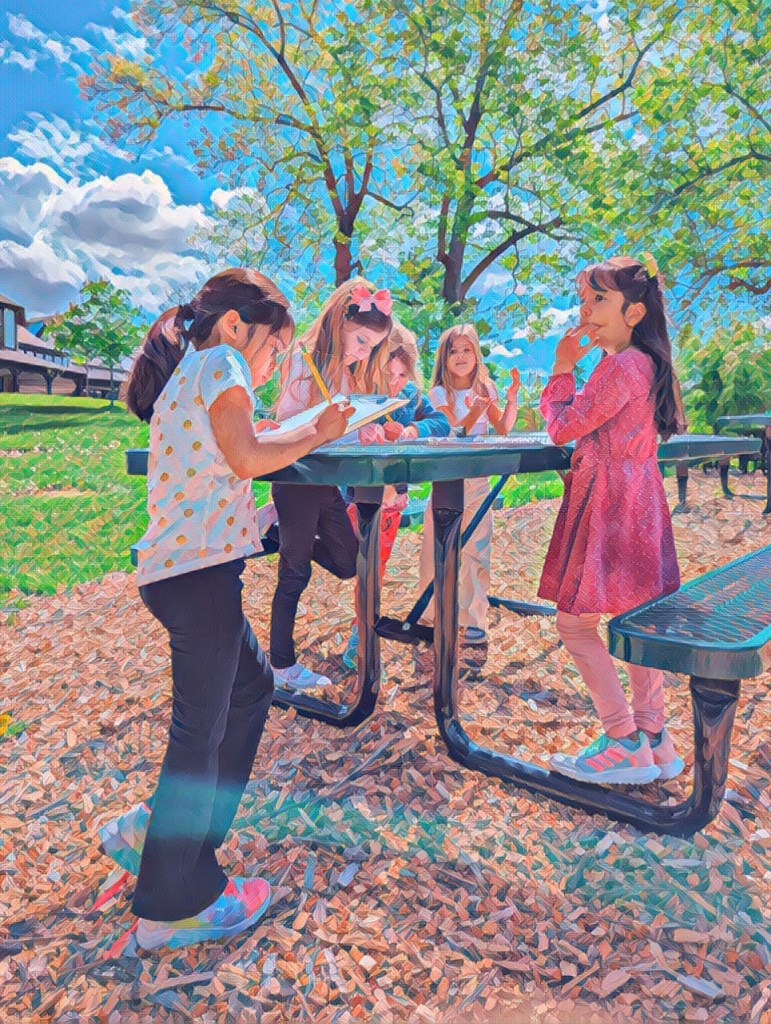
Finally, on Friday, spring burst forth again. The sun was bright, and the temperature was warm enough to head out without coats. The perfect day had arrived. When I told them we were going on our haiku walk, they cheered and shouted “We’re going on our haiku walk!!!” You would have thought I told them I had candy and puppies for everyone!
We chose a spot to gather. It was large enough for them to run free, explore, and be inspired, and also small enough for us to see each other wherever they roamed. Clipboards in hand, they wandered, stopped, wrote, chatted, and sometimes abandoned the clipboards to simply run with joyous freedom.
Here are a few of their poems.
The statue is down.
Flowers are everywhere.
This flower’s pretty
The flowers are here.
I see sticks and logs right here.
I see the flowers.
The bees like flowers.
The flowers are everywhere.
The flowers are here.
Trees are beautiful.
The sky’s very beautiful.
We are beautiful.
There’s lots of flowers.
There is wood chips by us, too.
The trees are so long.
The statue is gray.
It looks so cool and funny.
It looks amazing.
I see trees and rocks.
I see beautiful flowers.
I see trees and grass.
I see the benches.
I see the gate and the grass.
I see signs and rocks.
As I watched, encouraged, and enjoyed the beautiful day, I joined my Kindergartners, and documented the moment in haiku.
Haikus are forming.
Fingers count syllables, then
pausing, they run free.
Laughter swirls round them.
Feet sound in quick staccatos.
Returning, they write.
Magic enfolds us.
Haiku poets all, living
and writing haiku.
These Kindergartners are mighty, capable, and filled with amazingness. It’s good to remember this, and to treat them as the humans I know they are — fantabulous, trustworthy, free, joyful, and poets of haiku.
A while back I wrote about adopting a practice of writing a haiku poem each day, I haven’t written one poem a day. Some days I haven’t written any, and some days I’ve written more than one. I’m embracing my practice as it is so that I can find joy in it and continue.
I love the process of writing the poems. I’m not following all the rules of haiku, but I am maintaining the 5-7-5 beats for each poem or stanza in my poem. Finding words to fit the form is getting easier, but occasionally I still struggle to express myself in the form. At those times I head to thesaurus. Searching for a new word that has the needed number of syllables and the right meaning and feeling is enjoyable — I may even be enlarging my vocabulary!
As I write I’m working to be true to what I’m experiencing and noticing, but also to be positive and optimistic. I’m happy to report that I find great joy and encouragement as I reread the poems. I’m remind of happenings, pleasantly surprised by the rhythm, and encouraged by the meaning.
A few readers have asked me to share some of my poems and the poems my Kindergartners create. I haven’t introduced haiku to my Kindergartners yet. I think in the next few weeks, It might make sense to bring it into some of our work and thinking together. Once I do, I’ll share their work. For now, here are a few of mine — seven, actually, simply because I like the number.
RAIN (written in the depth of our drought) What’s that? Is it rain? Window thrown open, I melt in the lusciousness of rain.
MORNING PAUSE Wake, sit, breathe, and pray. Mind and body run away. Gently call them back
Hands on heart, I breathe. Inhale, exhale, up and down. Cultivating peace.
Repeat as needed. Notice, accept, and breathe on. Held in prayers and peace.
AMAZING THINGS Believe it, it’s true. Amazing things will happen. Make room, lots of room.
MORNING Drat the pencil’s dull Shavings accidentally Fall upon the floor
REPROGRAM I am courageous I am peaceful. I am loved. I am safe and well.
Reprogram your brain. Create new neural pathways. We have the power.
PHEW, YAY! Worked out yesterday Feeling it today Celebrate new strength
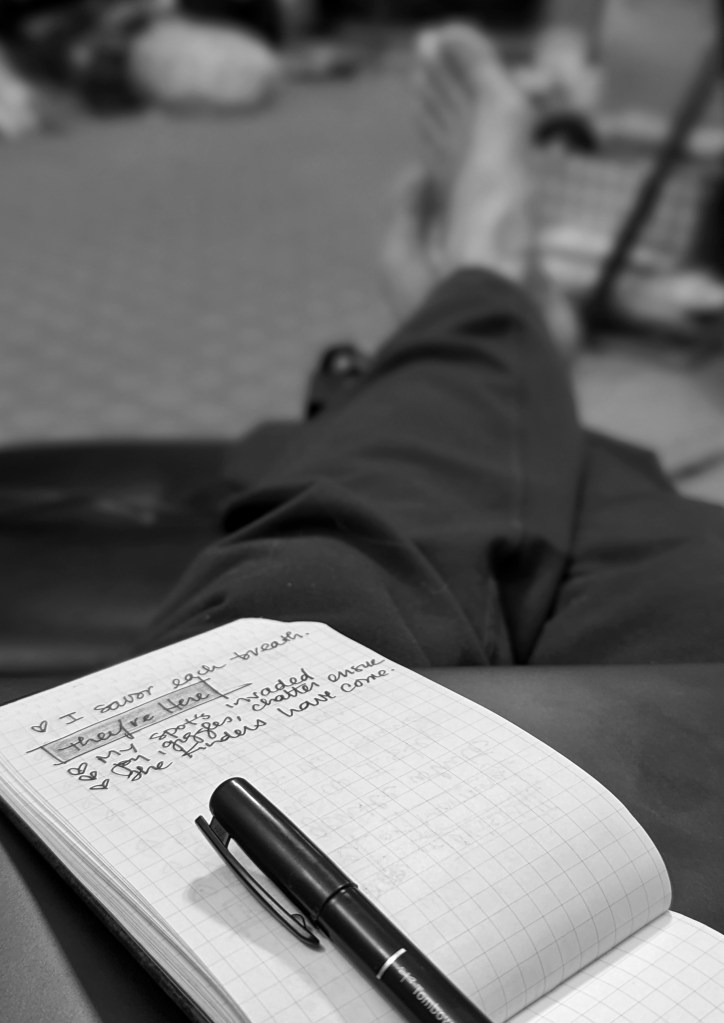
THEY’RE HERE My spot’s invaded by giggles, joy, and chatter, My Kinders are here.
I recently read about starting a daily haiku writing practice. I offer my gratitude to the person who suggested it because it’s a fab idea. And, since I cannot remember who they are or where I read it, I also offer my apologies. Hopefully they’re feeling a cosmic ripple of gratitude and happiness right now.
It seems many people have adopted a daily haiku practice for various amounts of time. I enjoyed this post by Daryl Chen and this TEDx talk by Zezan Tam. Their witnesses about their haiku writing practice were inspiring and encouraging, and removed any doubt about whether or not I should embark on this journey of a daily haiku.
I’m imagining a few moments of haiku play each day. Perhaps it will happen first thing, but I’m not going to force it. I chose a notebook small enough to carry with me so I’m free to find moments — wherever they may be in my day — that best serve joy, reflection, observation, word play, writing, peace, breath, and me.
I’m on my second year of my daily affirmation and art journaling, and want to continue that. I envision the haiku play as a complimentary practice. I’m hopeful the haiku will be a way to notice the good, and express gratitude. Zezan Tam said his haiku practice also helped him grow in courage and humility. I’ve been thinking a good bit about those two things as well. I’m excited to see how the haiku practice might help me be open to increased courage, learning, and growth.
I’ve done two haiku poems since my Daily Haiku poem. Lest you think my process as I play and write is a rather direct line from idea to poem, I share this image.
My process is, instead, quite circuitous — filled with pause and mental fermentation. This morning, I got up before the rest of my family, grabbed my notebook, pencil and pen, and headed downstairs. I put on some water for tea, and did a bit of stretching, breathing, and praying. As I moved, I felt my spine adjust and my muscles warm and soften. It was a moment I wanted to remember with gratitude, so I sat to write. I jotted some phrases — counting syllables as I went. No poem yet. I got up, cut vegetables and began to cook them. New possibilities came to me, so back to the notebook I went. I was up and down a few more times as I fashioned the mix of words, beats, rhythm, meaning, and feeling that made me say “Yeah, that’s it.”
After much writing, thinking, counting, and speaking. I settled on the haiku poem you see above. Funny, as I type it today, I’m not as pleased with the passive voice ending. So, here I share Day Begins #2.
Day Begins #2 In. Out. Up and down. Body and breath move as one. Peace and ease emerge.
I love this practice and play for me, but I also think it could be amazing for my Kindergartners as well. Earlier this summer, I read Shifting the Balance: 6 Ways to Bring the Science of Reading into a Balanced Literacy Classroom by Jan Burkins and Kari Yates. (A great book, by the way.) A haiku practice seems to fit right in with some of their ideas.
Just like me, my Kindergartners don’t have to write profound haiku poems — they just need to explore, play, and write. The 5-7-5 pattern gives them the opportunity to do a great deal of thinking, persevering and creating. Just imagine them playing with words! They will have ideas, count beats, think of new words and new ideas, rephrase, ask for help, give help, count again, and write!
As I thought of my Kindergartners playing with Haiku, I thought they might simply repeat words. They could use any words — as long as they follow the 5-7-5 pattern and enjoy the process. I came up with this as an example.
Then I listened to Zezan Tam’s TEDx talk and laughed out loud. He shared this poem as he explained the basic pattern of the Japanese haiku poem.
Haiku five, five, five, five, five se-ven, se-ven, se-ven, se- five, five, five, five five
How fantabulous is that? Perfect for Kindergartners!
What if they just use their names? The Kindergartners know and love their names. This might make it easier to find, count, and write the Haiku beats. How awesome to use your own name to practice phonemic awareness, orthographic mapping, and poetry. To help them out, I might make up three lines of Elkonin-like boxes — big enough to write in – following the 5-7-5 pattern.
My most recent thought?
“OH! We can have a classroom Haiku Board!!!!”
Me Molly, Molly, Mol James, James, James, James, James, James, James Molly, Molly, Mol
Kindergarten Haiku K poets unite! Count and own your words and beats Haiku soon you’ll share.










 Life lived with relentless creativity