
Intent-based Leadership in Kindergarten

My brother just hipped me to the concept of Intent-based leadership. He sees value in adding it to our coaching practice. It sounds promising so I’ve started watching the plethora videos he suggested. As I watch I have to say I agree with him, and I’m thinking — “Wow! This isn’t just a good idea for our fencing team, this would be great to share with my Kindergartners!”

Leadership, responsibility, intent, learning, in Kindergarten
(created the photo art with goart.fotor.com)

Intent-based leadership looks like another awesome way for my Kindergartners to grow in their CASEL 5, as well as, academic excellence and joy. It will encourage my students to think about what they know, what they don’t know yet, what they’re doing, why they’re doing it, and what and how they’re learning. My hunch is it’s going to be a powerful tool in the classroom.

Intent-based leadership was developed by L. David Marquet, while a Captain in the US Navy as a Commander of the nuclear submarine Santa Fe. Two quotes on his website hooked me! (I’ve adapted them for the classroom.)

Imagine a school (work place) where everyone engages and contributes their full intellectual capacity. A school (place) where people are healthier and happier because they have more control over their work – a school (place) where everyone is a leader.

Teaching (Leadership) is communicating to students, colleagues, and parents (people) their worth and potential so clearly that they are inspired to see it in themselves.

How fantabulous is that? I’m still exploring and pondering, and there are a gazillion good ideas to consider, but here are five of my “OH!” and “AHA!” moments regarding using intent-based leadership in the classroom

#1 There isn’t one source of power, information, and leadership on the nuclear sub or in our classroom. Students and teachers share in the responsibility of learning and growing a fantabulous classroom community.

Do I have a lot of information as the teacher? Yes. Do I bear a large portion of the responsibility? Yes. Do I have a considerable amount of power? Yes.

However, do I have all the information as the teacher? No. Do I have all the responsibility? No. Do I have all the power? No. My students also have a considerable amount of information, responsibility, and power.

My Kindergartners are knowledgeable about many things — they understand what they love, what motivates them, what they think they know, what they think they don’t know, what they actually know and don’t know, what’s going on with them and their friends, what’s going on at home, and so much more.

Ask any of my students if they have any responsibilities in our classroom. Each will say yes. They have class jobs. They are responsible for how they behave, what they say, what they do or don’t do. It sometimes takes them a bit to realize just how responsible they are. Here’s a common conversation.

Student: “My mom forgot to put my folder in my bag, Miss James.”
Me: “Your mom forgot to put your folder in your bag?
Student: :Yes.”
Me: “Whose folder is it?”
Student: “Mine.”
Me: “Who forgot to pack it.”
Student “My mom.”
Repeat until ….
Me: “Who forgot to pack your folder?”
Student: “Me?”
Me: (with a big smile) “Yup! Hope you remember tomorrow!”
The folder always makes it in the next day.

My students are strong, rich, and powerful. Some understand that and use it well. Others don’t realize the power they have. Still others know they have power, but don’t always use it in the best way. I’m eager to help them recognize, embrace, and use their power well. The fantabulous humans in my Kindergarten and I are going to have a remarkable leadership journey together this year!

Our classroom community will flourish when we all co-exist as bearers of knowledge, responsible classroom citizens, and powerful leaders. As we step into our leadership opportunities, listen to one another, reflect upon what we hear, and value one another’s ideas, my Kindergartners will begin to blossom. They will experience and understand themselves as valuable and essential partners in our classroom community and in their learning journey.

If David is correct — and all the data suggests he is — this will reduce tension in the classroom while increasing productivity and happiness.

#2 It’s valuable to know what you intend to do, why you intend to do it, and how you intend to do it.
There are times my students need to do what I tell them to do. But there are other times when they are able to choose between various options. It would be amazing for them to be able to choose based on what is most valuable and helpful to themselves and their learning.

For instance, in reading they might listen to reading, read to someone, work on writing, or do some word work activity. How do they choose what to do? Do they simply follow a schedule I set up for them? If so, then they intend to follow directions. There is value in following directions that is true, but there are also times when it would be good for me to allow them to decide what they intend to do.

For instance perhaps they intend to — share a favorite book with a friend, or listen to reading so as to learn about snakes, or do word-work so they can learn their sight words and thereby grow as a reader. How awesome is that? They understand why they are doing what they are doing, and are working with intrinsic motivation.

I want them to know that even if they haven’t received specific directions from a teacher, they can still do wonderfully productive and fantabulous things. I want them to be confident in their ability to think, reflect, and make good decisions. And, I want them to actually make those good decisions.

This will require a good deal of trust on my part. I will need to trust myself, my students, and the process. And, I will have to be willing to take it one step at a time.

I know I will need do a good bit of frontloading, modeling, and scaffolding. We will have to build relationships, trust, and skill. There will be many discussions: What are we doing? Why are we doing it? What did we experience? What do we want to experience? What did we learn? How did we learn it? When might we do that again? Is there anything that might work better?

The process feels incredibly daunting, and, at the same time, amazingly powerful and exciting.

#3 Student: “I intend to …” Me “What am I thinking right now?”

When my students tell me what they are motivated to do, and what they intend to do, it will be important for me to engage in conversation with them. Sometimes it might be — tell me more. Sometimes it might be “What am I thinking right now?” These questions allow my students to take ownership of themselves and what they intend, while at the same time having the benefit of my thoughts, experiences, and sense of things.

Some of the things I’m thinking might be:
Is it safe? Convince me that it’s safe.
Is it productive? Convince me that it’s productive.
Is it the right thing to do? Convince me that it’s the right thing to do.
Is it kind? Convince me that it’s kind.

This type of exchange is a learning experience for my students and myself. I get to learn what they’re thinking, and why they’re thinking it. I discover areas that aren’t clear to them and that might benefit from greater explanation or experience. They get to think through the process, consider their actions, and remember the purpose of the particular learning moment.

Again, I’m struck by the enormity of the process. And yet, if my goal is to begin to help my students become their best, most brilliant selves, I must take the chance. If I hope to help create not just students who can do what I ask them to do, but humans who can make good decisions and impact themselves and others in powerful ways, then it’s time to give it a go.

#4 We are all leaders and all followers

This isn’t about anarchy. We are all leaders, and all followers. We cannot just choose to intend to do something that is against the guiding principles of the organization. We choose to be part of the organization — in my case, my students’ parents choose to have their children be part of our classroom community. After making that commitment there are certain ways we must comply. For instance we must do our best, be kind, and treat each other with respect. There are other ways we can exercise our leadership and creativity. It’s always about learning and growing and being our best possible selves as individuals and a community.

#5 You can do it, *Molly (*Insert your name here.)

In one of the leadership nudges, David suggests we use our name when encouraging ourselves. Instead of “I can do it.” I would say “Molly, you can do it.” At first it feels a bit silly, but after trying it, I like it. David posits that using the third person way of speaking to ourselves puts us in a bit of a less emotionally charged space. I experience it as though a kind friend is giving me the encouragement. I’m definitely going to suggest it to my Kindergartners. I think it will be valuable, and be worth a few chuckles.


So, there you have it. I intend to embark on the profound journey of intent based leadership with my Kindergartners this year. And, I intend to have a fantabulous year together. Wish me luck!


Here’s a bonus nugget so you can get a feel for intent-based leadership from David himself. The three name rule. I’m thinking about how to incorporate it into our classroom community.

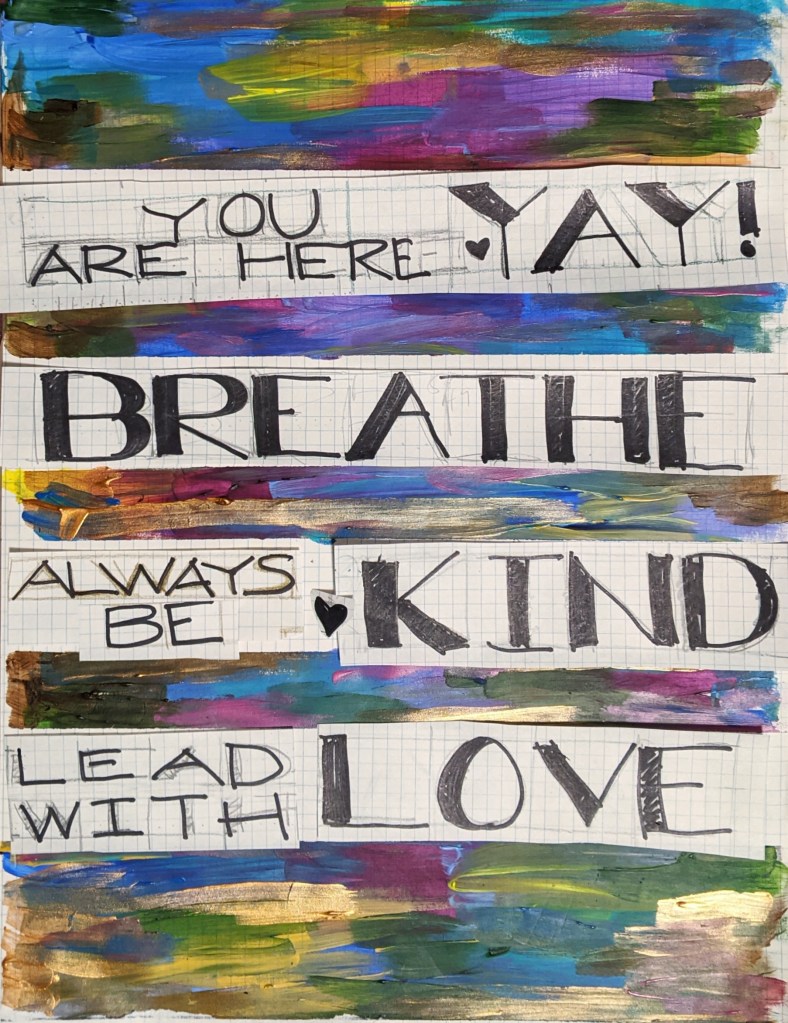
SEL and Setting Intentions In Kindergarten

Social and emotional learning (SEL) is an essential part of living and learning. The Collaborative for Academic, Social, and Emotional Learning (CASEL) has 5 core SEL competencies, called the CASEL 5 – self-awareness, self-management, social awareness, relationship skills, and responsible decision making.

According to CASEL, the social emotional learning that happens as we develop and use these 5 core competencies “is the process through which all young people and adults acquire and apply the knowledge, skills, and attitudes to develop healthy identities, manage emotions and achieve personal and collective goals, feel and show empathy for others, establish and maintain supportive relationships, and make responsible and caring decisions.”

I don’t know about you, but I think that list of outcomes is spectacular! I read it and say, “Oh, yeah. I want that!” And, I don’t just want that for myself. I want it for my family, my students, and gosh, for the world.

I’m always looking for ways to enhance the SEL in my classroom. My question is always how to most effectively and efficiently give my students agency over their own SEL. I think I’ve found an answer in intention setting.

We talked a lot about setting intentions in our B4C training. We considered: How do I want to show up? What do I want to notice? What emotion do I want to cultivate?

Sometimes our instructors would invite us to join them in a particular intention. At other times they would encourage us to take a moment, and then set our own intention for our practice, or our time together. As I set intentions, I noticed myself using the CASEL competencies.

Self-awareness and self-management: What am I feeling/thinking? What did I hope to feel/think? What do I need? What might help me reach my goal?

Social awareness: Who is around me? How might I influence them, and them me? How do I want to show up in relationship to them? How might I grow?

Relationship skills: How might I show up as a leader, speaker, listener, and/or collaborator?

Responsible decision making: Might I increase my curiosity, courage or kindness? What is my role? Might I think more critically, more creatively? What is happening today? How does all of this impact my decision of how I might show up?

My best intention setting happens when I am present to myself, others, and the moment. I’m able to breathe, notice, think, and choose an intention that actually helps me to become the person I want/need to be in that moment in time. Sounds too good to be true, doesn’t it? But, I tell you it’s true. Our minds are incredibly powerful, and our thoughts, emotions, mental images, and inner talk actually shape our brains, our experiences and our very selves. There’s tons of research out there if you’re interested. Here’s one article from Stanford News on the ability of our minds to shape our reality.

I definitely want to share the practice of setting intentions with my Kindergartners.

I imagine the power my Kindergartners will experience as they decide how they want to show up — kind, brave, happy, curious. I am sure there will be lots of modeling, lots of inviting them to join me in an intention, and lots of conversations about our intentions. We will have opportunities to share our intentions. We’ll wonder and talk about how it might look for us to live our intentions to be kind, or to be a good friend, or to be brave. At other moments we’ll check in with ourselves and each other to recall our intentions, reset them, or simply celebrate remembering that we set an intention. We might explore what happens if we set an intention and then forget it, or don’t actually do what we intend. It’s all part of our SEL and growth as our best selves.

I’m super excited to begin this work with my Kindergarten colleagues. My intention is to honor them as capable human beings, and give them tools they can use now and in the future. I’m hopeful this supported agency and growth in the CASEL 5 will empower them to be more self aware, more mindful, and more in charge of themselves and our classroom community.

I believe in the goodness and ability of my Kindergartners, and I believe in the power of this process. I know that there may be times I will need to intervene, so I will of course, remain in the mix. But, my plan is to remain more as a lead learner and model, rather than an arbitrator of all things necessary. I’m confident we will experience a positive difference in our classroom community – socially, emotionally, and academically.

Oh.my.gosh!

My fingers stand poised above the keyboard, waiting for directions from my brain. For many moments, nothing comes. It’s not that my brain has nothing to say. It’s almost as though it has too much to say. So I wait.

Perhaps it will help to say it again. OH.MY.GOSH! Yes, somehow saying it again has helped.

So. This happened just a few days ago.

I graduated the 200 Hour Training Intensive with Breathe for Change!

I am a certified SEL facilitator and (200 hour) yoga teacher.

OH.MY.GOSH!

How amazing is that?

It’s very amazing — not just because I graduated, but because I learned, I did, I experienced, I grew, and I glowed. It’s amazing and fantabulous how much I did of each of those things. Here’s a bit of what I gleaned and want to remember for my life and my teaching practice.

BE AN UNAPOLOGETIC HUMAN CRUISING ALONG WITH AND TO GRACE
Be kind. Be your best self. Show up knowing that there is grace and goodness in each moment. Apologize for being unkind, don’t apologize for being human. Did something touch you and you were overjoyed? Live it. Were you overwhelmed — enough for tears to flow? Experience it. Being alive is a huge gift. Honor who you are, and be open to greater transformation and grace. 

Wouldn’t this be an amazing lesson for our students? I imagine things like: Don’t apologize when you make a mistake or don’t understand something. Notice it, accept it, learn from it, use it, but don’t apologize. Celebrate the struggle. Celebrate being willing to say “I don’t get it.” Celebrate the learning. And also perhaps, start noticing the things for which we should apologize and the new ways we want to show up.

THERE IS POWER IN MY BREATH, BODY, MIND, AND BEING
It’s amazing how powerful simple things like noticing my breath, and accepting it can be. As I practiced mindfulness with my breath, I noticed myself becoming more aware and mindful in other ways. Just yesterday I was outside and thought, “Have those flowers always been there like that?!?!” It was as though I saw them anew. It was wild.

As I experienced the power of the mindfulness practices, I kept thinking — “Oh.my.gosh. I want to share this with my students! How amazing and empowering would it be for them to experience and embrace the power they carry around with them every moment of the day!”

SHOW UP – MAKE MAGIC
Show up as your best self in each moment. Even if it’s difficult — and it’s often difficult.

Isn’t that a great message to share with others? “Yes, showing up is hard. I get it. Sometimes it’s hard for me, too. It doesn’t mean you’re not good enough, or you’re doing something wrong. It just means some things are difficult.”

I’m thinking of my Kindergartners as they walk into school the first day. It’s a gigantic struggle for some of them. Sometimes it’s a struggle for their parents, too. I wonder how it might feel to have somehow say “Yup, it’s hard, no doubt about it. But guess what. You did the hardest part! You’re amazing, and fantabulous, and super brave. You showed up. You came in. I’m so glad you did. I can’t WAIT to see what kind of magic we create together today, and every day!”

CREATE A PROCESS AND SELL IT
I laughed as I decided on the heading for this section. Sell it sounds so anti-mindfulness and yoga, and yet, I still like it.

Sell it! Help others buy into the process. Use language that conveys the beauty and power of the process. Allow your emotions to express more than your words might express on their own.

The B4C trainers said things like, “I can’t wait to share this incredible process with you.” or “This is my favorite form of meditation. I’m so excited for you to try it.” Their excitement and conviction, made a difference. It heightened our interest level, and encouraged us to about take risks and give it a go.

I’m always doing my best to use my language, emotions, and behavior to rock the peace, positivity, and possibility vibes in my learning space. Intentionally and regularly selling the process and product of learning is a perfect addition to my teaching practice.

I really like the idea of being clear about my excitement and enjoyment of whatever I’m presenting. This also means I need to be assess my process and product. In order to share my excitement, I actually have to be excited. If I’m not excited, why am I teaching it the way I am? And, if I am excited by it, then, yes, share the love!

I CAN CREATE AND HOLD SPACE – LET ME MAKE IT GOOD SPACE
The B4C training was an incredible 6 weeks of creating and holding space for ourselves and each other. The affirmation, joy, and love were palpable and powerful. From the first welcome “Hello fabulous educators!” to the graduation goodbye — “”You matter! We love you!” B4C spoke to us about how they saw us. They spoke to us about who we are. They spoke to us about how they want us to see ourselves. Amazing isn’t it?

Teaching is about so much more than the information I’m sharing or the activities we’re doing. It’s even more than the thinking and creating. Teaching is about helping others to see and know themselves as the amazing humans they already are, and the even more amazing humans they are becoming.

Imagine starting your very first class — or each one of your classes — with this statement, “Hello fantabulous learners. I’m so glad you’re here. I can’t wait to share this incredible thing with you!” Now imagine ending it with “Wow! Look at all you’ve done, and learned! I’m going to open some space for you. I’d love to hear how you feel, and what you think …”

Talk about transformational!


So, yes! OH.MY.GOSH! The B4C Wellness, SEL, and Yoga Teaching Training is amazing. I’m so glad I took the risk and did it. It’s been transformational.

If your interest is at all piqued give them a look. Here’s a link to their digital 200 hour Wellness, SEL and Yoga Teacher Training information and application — no pressure, no commitment, just an opportunity to talk about the program and see if it makes sense for you.

And, whether or not you choose to become part of Breath For Change, remember you make a difference every moment of every day — for yourself and others! Keep being remarkable.