What Do You Think about Pre-K? Do You Love It?

We had a birthday celebration today in pre-K, and as the kids were enjoying the birthday treats, the birthday girl’s grandmother asked how I liked pre-K compared to Kindergarten. (I started teaching pre-K this year after 18 years in Kindergarten.) What a great question!

How do I like pre-K compared to Kindergarten? There is so much to love about Pre-K — so much possibility, so much joy, so much fantabulousness. There was a lot to love about Kindergarten too. It’s a gift to hold on to all of that awesomeness, and now have new opportunities, new teammates, new learners, new relationships, and new fantastic parents in pre-K.

So, what do I think about pre-K?

Oh my gosh I love the kids. They are brave, curious, joyful humans. They love to laugh, try things (sometimes with a bit of encouragement or a willingness to be with them). They are wide open to wonder, and awe. And they are always learning, making, and sharing.

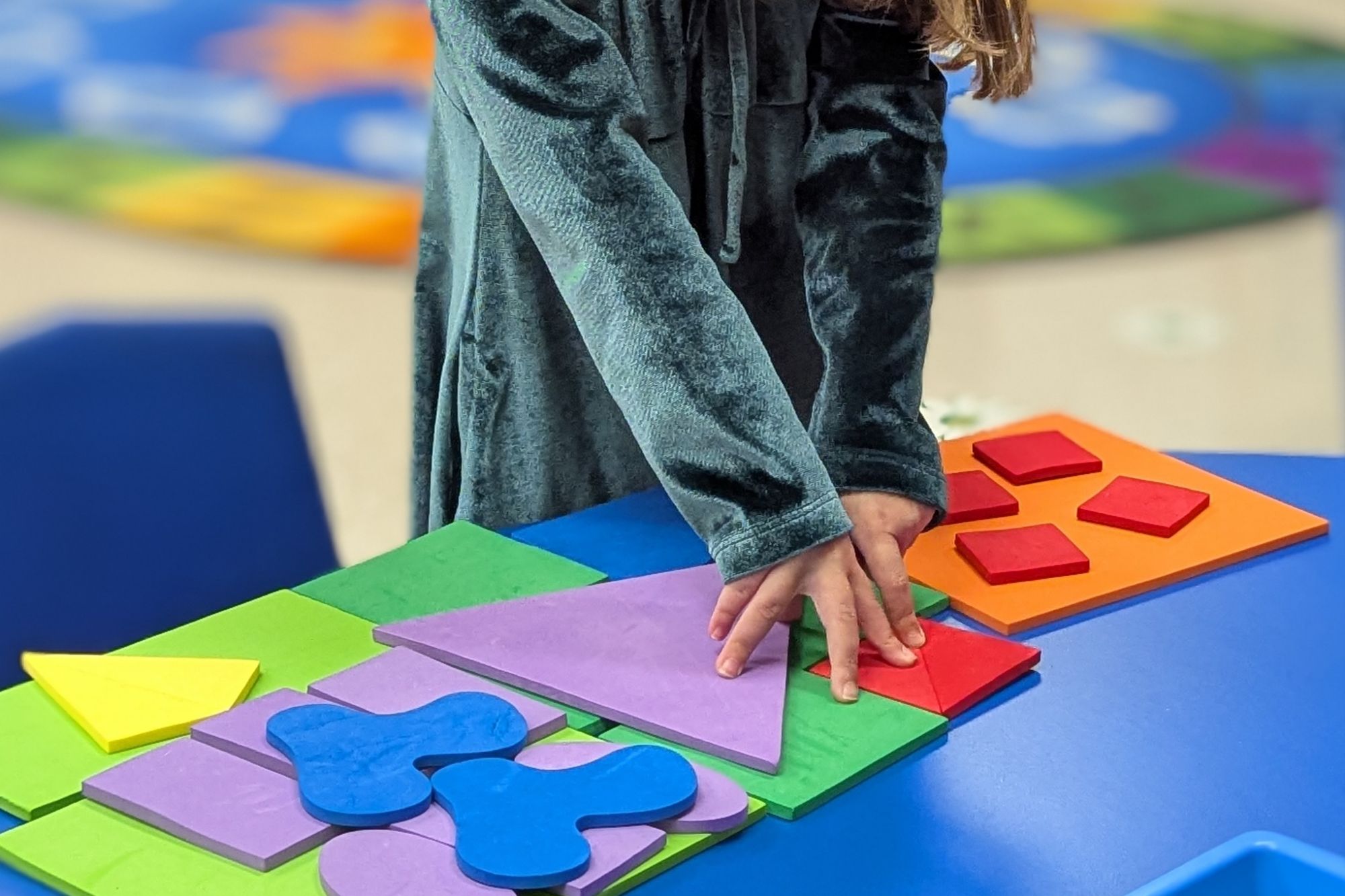
Today one of them asked if I’d come with her to our math center and make things with shapes. (Yes, please!) At one point, I asked her what she was doing. She had been giving me a running commentary, but had stopped. She replied, “I’m making it better. … See?!” Another friend joined in with equal enthusiasm.

The other day, we took an “Oh WOW! Walk” outside. The super scientists looked for things that tickled their fancy through one of their five senses. They collected these things to share with one another. One mighty pre-Ker showed me her stash as she tried to decide what to take home and what to leave in our science trolley. She had several rocks. One in particular seemed to be a treasure.

Me: “Can you tell me about that rock?”
C: “Oh! This rock has a belly button!”
Me: “Come on!!! A belly button??!! Get out!”
C” “Look!”
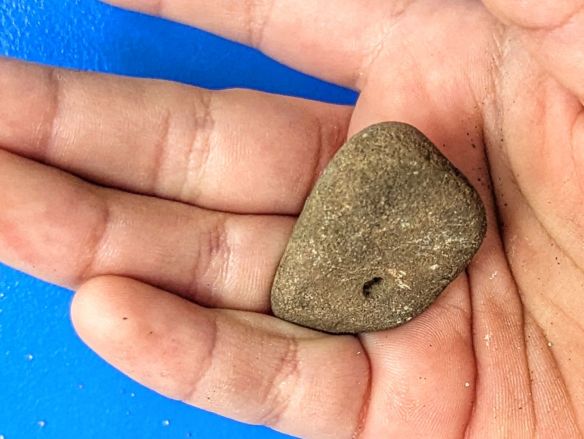
I laughed out loud! She was right. It was a rock with a belly button! It may sound silly to you. But, think about her thinking. She noticed similarities between this rock and a belly and belly button. She was able to use her imagination to put those noticings together. She found joy in her musings, and was courageous enough to share it with another. These are the skills, and habits of mind that are used when we problem solve and create things as yet unknown. Once again it is not the simple cuteness of the young, it is the beginnings of profound critical and creative thinking.

Another thing I’m grateful for in pre-K is time. I’m super grateful for, and really enjoy, the extra time there is to simply be in pre-Kindergarten. This gives us the opportunity to talk, share, develop relationships, play, explore, create. and learn. Today one of the girls was missing her mom. At the end of the day, she came over to me and told me. I asked her if there were anything I might do to help her. She said no, and just quietly stood next to me, her face devoid of joy. Then, she began to button the buttons on my denim jacket. She didn’t ask if she could do it, she just began to button them. Her sadness turned to determination and joy as she checked and buttoned each button — even rolling down my sleeves to button the cuffs. It was as if she felt and embodied the care and love of her mother, as she took care of me by buttoning my buttons.

Oh, and then there’s car line. When I first started teaching, we did Kindergarten car line in the morning and after school. It was something I loved because it allowed me to get to know the parents a bit, and interact with them and their children together. We stopped doing it in Kindergarten a few years ago, and it was something I’ve always missed. Well, in Pre-K we get to do it again. I’m happy to be back interacting with parents each time I have the opportunity to do carline.

And, oh my gosh, Jr. Pre-Kers! They are a joy to get to know. Since I’m in Pre-K, I get to help take the JP-Kers out of the cars, and sometimes see them before and after school. We’re working on learning each other’s names, and as they remember mine, they joyfully call, “Ms. James! I know your name!” I love the joy, the connection, and the feelings of accomplishment – for them and me.

So, to answer that Grandmother’s question as clearly as I can. Do I miss Kindergarten? I do. But, do I love PK? Yes, I do! Are the kids fantabulous? Yes, they are! Are the parents marvelous? Yup, they sure are! Are my teammates amazing? Indeed! Are the possibilities awesome and limitless? Yes! So, I breathe on, learn, grow, love, be me, and enjoy it all.

The Power of Relationships in Learning

Relationships are powerful and essential components of learning.

I’m not the only one who knows this is true. Many educators — from Vgotsky, to Frances and David Hawkins, Harvard Graduate School of Education, and Reggio Emilia (and RE inspired educators) — speak of the importance of relationships for learning, understanding, creating, and thinking.

Inspired by Reggio Emilia I value relationships between parent, teacher, learner, and the environment. – and do my best to cultivate them. And, not just my relationship with each of them, but their relationships with each other. Through these connections, learners develop relationships with:materials, thoughts and ideas – their own and others, themselves, play, other learners, and the importance and value of struggle.

I’m always reminded of relationships as the school year ends and my summer begins. My relationship with time, energy, rest, exploration, play, creativity and my own physicality are blessed with opportunity and possibility. And of course, my relationships with my current learners and parents transition and change.

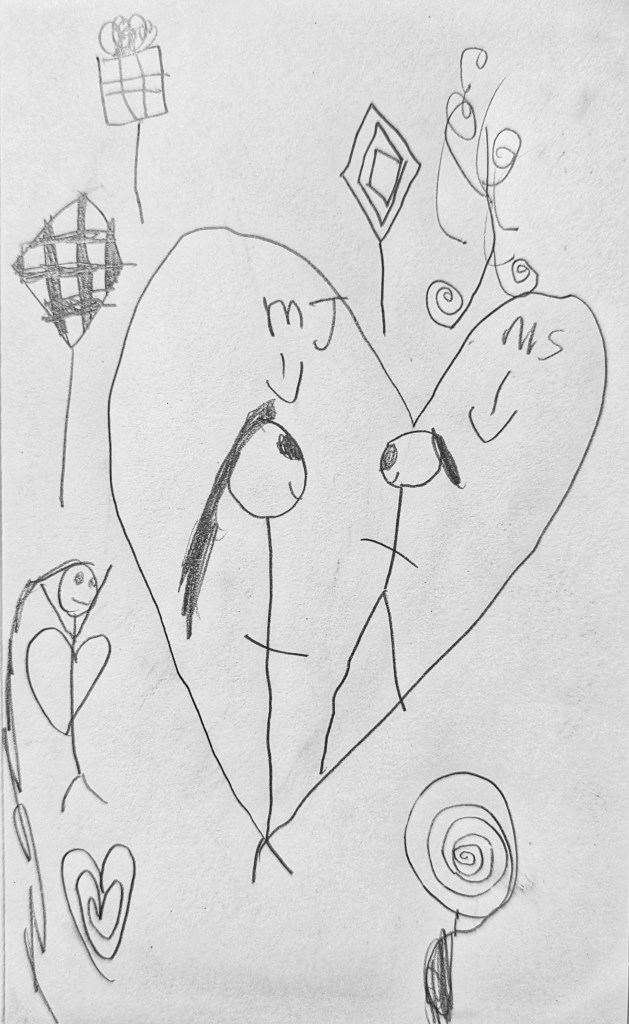
I never cease to be amazed (and edified) as I experience the power, essentiality, and inspiration of these relationships from learners new and old. I never take for granted the gift it is to bump into a former student, or receive a note in my mailbox. Here are a few that touched and reminded me of the power of these relationships.

An 11th grader saw me moving things around in the classroom. It’s a normal part of my end of year routine — but not a normal one for her.

11th grader: “What are you doing, Miss James?”
Me: “I’m moving some of my things out of the classroom.”

A look of confusion, then shock and horror, crossed her face. She asked a string of questions in rapid fire: “Are you leaving, Miss James? You’re not leaving are you? You can’t leave! What will the Kindergartners do? What would we do? You can’t leave!”

I took a breath, as I looked into those loving and panicked eyes of hers, and said, “Nope. I’m not leaving. Just moving some of my things.”

She looked at me as though trying to decide if I had told her the truth. Then she took a breath and said, “Oh, good. We need you.”

Then a 7th grader left me an amazing letter in my mailbox telling me about how I — and the way I teach Kindergarten — has continued to impact her life and learning. “Even though it’s been a while since Kindergarten, I still remember how your creativity, kindness, and positive energy made learning so much fun. You helped build the foundation that inspired me to grow, explore and believe in my myself. I’ll always be grateful for the start you gave me.”

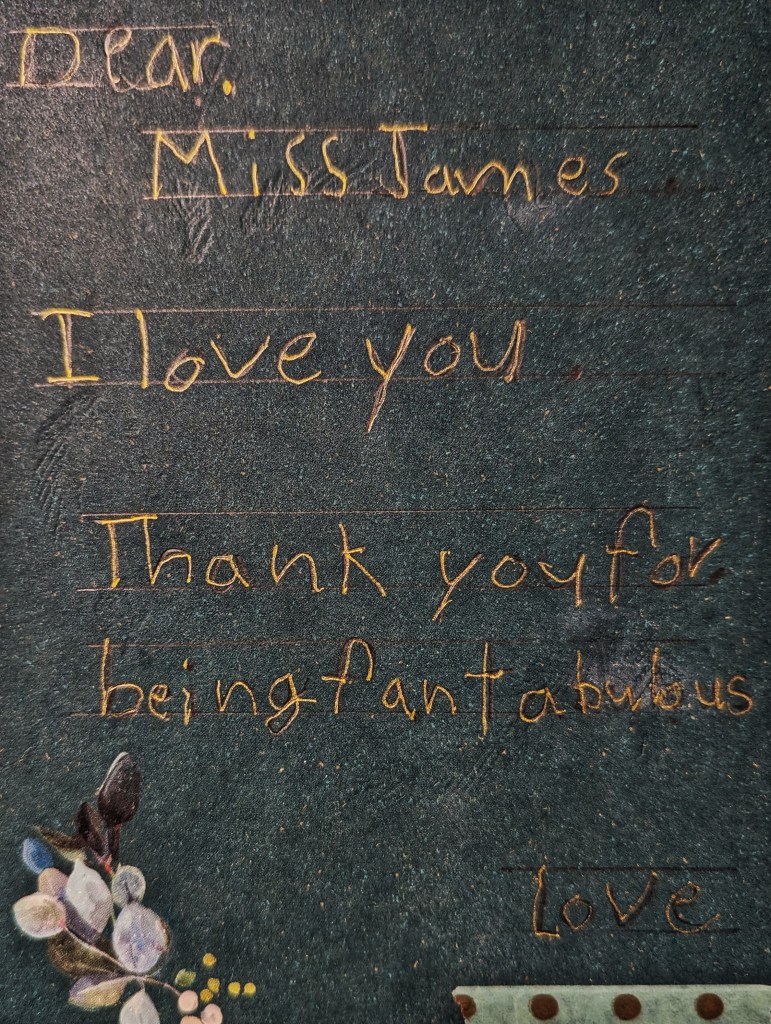
And then there’s my sweet Kindergartners. One mom emailed me to share her daughter had been asking when she might have a playdate with me! And then, I a letter in the mail from another KJer proclaimed “Miss James. I love you. I loved being in KJ. Thank you for a great year. You are the best teacher.”

I know they don’t have a lot to go on when they proclaim me the best teacher. I understand it means they have experienced goodness, kindness, and acceptance in me. It means they have experienced and know that I am their (to quote Rita Pierson’s TED talk) “champion, an adult who will never give up on them, who understands the power of connection, and insists that they become the best that they can possibly be.”

Never underestimate the power of love, joy, relationships, understanding, acceptance, and dogged determination that we should all be the best we can be.

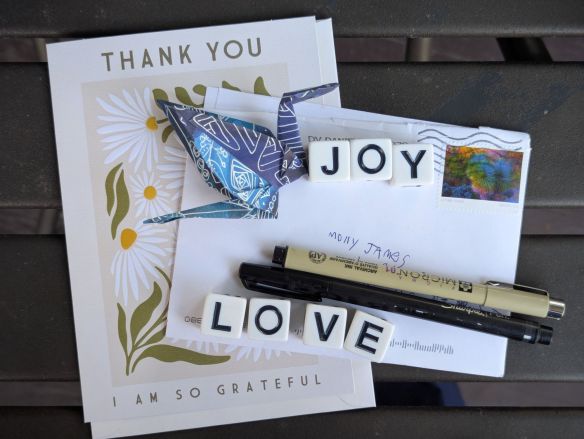
And (if you’ve read my previous post) never be afraid to share the joy of your art — cause we are all artists — with others. The crane’s flying soon!

You Love Us

The day before winter break I was surrounded by students as we talked about our upcoming performance and I opened various cards and gifts. One of my Kindergartners looked at me and asked “Miss James, why does everyone say you’re the best?” All eyes turned to me as they awaited my response. Genuinely curious I responded “Hmmm … why do you think people say that?”

There was some chatter amongst themselves and then they turned to me and said “Because you love us.”

I responded “Yeah, I do love you. Do you think that makes me the best?”

They responded “Yes.” 

It’s an answer that gets to the heart of the matter. I do many things. I am always thinking, changing, making, trying new things, talking, explaining, laughing, teaching, learning, guiding, and being with them. But at the center of it all is love. I love them.

What the educator does in teaching is to make it possible for the students to become themselves.

Paolo Fiere (https://civiceducator.org/paulo-freire-quotes/)

I trust my love makes it possible for my students to become themselves — their best truest selves. Yes, of course my diligence, my fantabulousness, my work, my thought, makes it possible, but mostly it’s my love. All that other stuff grows in strength, brilliance, and awesomeness because of love.

Funny, I thought this would be a quick post about the power of love in the classroom. But, as I wrote I was reminded of a conversation I had years ago with someone in the educational field who discounted the idea of love. They declared it was only a word and would fail at some point. I was aghast. Love only a word??? Love would fail! Never. Might I fail, yes. Might I be less than loving? Of course. But when I say I love you, I mean it in all the power it can hold. Love isn’t a sentiment. It’s a way of being. It’s a choice.

Anyway, that recollection urged me to look for a way to put into words what I mean when I say I love my students.

Andrea Bonier PhD wrote about healthy relationships in Psychology Today. When I read her article, I thought about my students, my love for them, and theirs for me. Here are her 11 elements of a healthy relationship (and one of mine). Perhaps they don’t contain the fullness of what my love for my students is, but, they are a concrete way to see the love I have for my students.

  • Trust – I operate from a place of trust. I trust in their word and their abilities. I live in a way that enables them to trust me. I encourage them to trust themselves and each other.
  • Communication with openness and honesty – We communicate a lot — sharing our feelings, our ideas, our wondering, our apologies, our needs and wants. I do my best to model the best form of communication — honest, respectful, and powerful.
  • Patience – Phew. Every relationship requires patience. Relationships in a classroom often seem to require more. I do my best, but when I fail, I apologize and try to do better. My students do the same.
  • Empathy, healthy conflict resolution, and individual boundaries – I’m always trying to increase our Emotional Intelligence. Are we self aware? Are we socially aware? What are we feeling? What might they be feeling? Have we talked with each other? Have we really listened to what is being said? What did I hear? How might I behave because of what I’ve heard and know.
  • Affection and Interest – Love is action, but there is also feeling, emotion, and affection — even in the classroom. Learning to navigate that is a huge part of loving well. And interest — oh my yes, we all want to share about ourselves. We want others to be curious, interested, even amazed. I always operate from the position that nothing they do or are can be relegated to the “Oh that’s so cute.” category. There’s always more — it’s hard work, it’s imaginative, it’s creative, it’s fantabulous, it’s worthy of my time and attention.
  • Flexibility – Whenever it’s possible I am flexible and give choice and wiggle room. For me it goes back to trust, empathy, and affection.
  • Appreciation and if I might add valuing – I appreciate and value my students and let them know. I appreciate and value their hard work, their humor, their thoughts, their courage, their love, their willingness to try, and much more.
  • Room for Growth – Gosh yes, this is a huge part of love. We always have to give others the room to grow and change. We are not who we were yesterday, or for that matter even a moment ago. Allow for growth and when appropriate, communicate about it.
  • Reciprocity – There are many opportunities for reciprocity in our learning space. Learning from one another, doing for and with one another, supporting one another. These are not just roles that I fill. I encourage my students to teach me, to show me, and I let them know that I’ve been inspired or learned from them. I accept their help with grace and gratitude, even when I know I can do things faster and or better than they can. I check in with them often, and I relish the moments they check in on me.

Build On With My Parent Questionnaire

Recently I posted about the postcards I sent to my Kindergartners. It was the first block I set to establish our classroom culture and community, and the first step in building relationships with the families and learners in my class. Wednesday, I set the next block.

To be fair, I’ve been thinking about, researching, and creating this block for quite some time. It’s my parent questionnaire. I considered what I wanted to know about my learners, their parents, and their families. I spent a considerable amount of time drafting the questions. I wanted to begin sharing our classroom culture and some of my pedagogy: the importance of relationships, communication, and positive, affirming language, as well as the power and primacy of the voice of the learner no matter how young.

I’m super grateful for the plethora of educators and educational institutions that posted their parent questionnaires online. They were each valuable to read. It was interesting to read, not only the words, but the tone, and the message that was implied, or perhaps that I inferred, from the way the questions were worded.

After several drafts, I finally had my parent questionnaire set for this school year. My families are connected to our school electronically, so I chose to use a google form rather than a hard copy form.

In a spirit of gratitude to the others who shared their questionnaires online, here is mine. My voice and style may not work for you. Your voice is the one you want to share with your learning community. None-the-less, I hope imy questionnaire helps you create your parent questionnaire in a way that establishes relationships, sets your classroom culture, and helps you have the best year possible with your new students and families.

Hello fantabuous parents! I have the pleasure of having your children in Kindergarten James this year. YAY!

I’m excited and honored to partner with you on your child’s amazing learning journey in Kindergarten. I know we have all year to get to know one another, but I’d love if you would take a few moments to answer the following questions. My hope is to get to know you, your child, and your family — just a bit — even before you step into our learning space.

When you have a moment, please fill out this parent questionnaire. Hopefully it will be painless, and perhaps even enjoyable! I’m looking forward to reading your answers, and learning a bit about you and yours, prior to the start of Kindergarten. I’d be grateful if you completed the form by August 31. Thanks in advance.

Have a wonderful day!


Getting to know you. You are an important part of our classroom community!

  1. Your email.
  2. Your name(s) as you prefer to be called.
  3. What are you looking forward to with your child in Kindergarten?
  4. Would you be interested in sharing skills, traditions, or customs with our class this year? If so, what might you like to share?
  5. What are your hopes and dreams for your daughter this school year?

Getting to know your child. Good relationships begin by getting to know each other. We’ll grow our relationship each day, and this will help us get started.

  1. What is your child’s full name (first, middle, last)?
  2. What does your child prefer to be called?
  3. What are your child’s strengths?
  4. What would you love your child to get better at?
  5. What fears does your child have? (big or small)
  6. What is the most important thing I should know about your child?
  7. Ask your child: What are you really excited by, or interested in?
  8. Ask your child: What do you want Miss James to know?

Getting to know your family. Our families are super important — at home and in the classroom.

  1. Who else lives with you (siblings, grandparents, pets, etc.)?
  2. What, if any, holidays or traditions are important to your family?
  3. In which language(s) are you and your child comfortable conversing?

Anything else? Here’s your chance. What else would you like to tell or ask me?

  1. What haven’t I asked, that you’d like to tell me?
  2. What questions do you have for me?

MAJames 8/2023

Why Teach?

Oh my gosh the list is long.

But, as I sit here, surrounded by sweet cards, notes, paper bracelets, assorted treasures, and art, I’m reminded of the most important reasons — perhaps the only reasons — I teach.

Love
Relationships
Changing lives — theirs, mine, and hopefully, the world


By the way, at first I wondered why I was in a box. Then I realized, that’s how they saw me, and how they know me. At first my heart broke just a little, then I remembered my MA study. That’s how I always saw Karl, and it was no problem. He taught me tons, made me laugh, encouraged me, and helped me be the best me I could be — all through the magic of technology. Just like me and my students this year.


I agree, my fantabulous Kindergartners, I can’t wait to see you “in prsin”, either! But first, enjoy your summer.

Possibility and Fantabulousness in Quarantine

The other day a colleague shared a link about how to force a copy to be made of a google doc, sheet, slide, or drawing, when you attempt to download it. What a great idea! Now no one has to remember to make a copy, or risk changing your original by mistake.

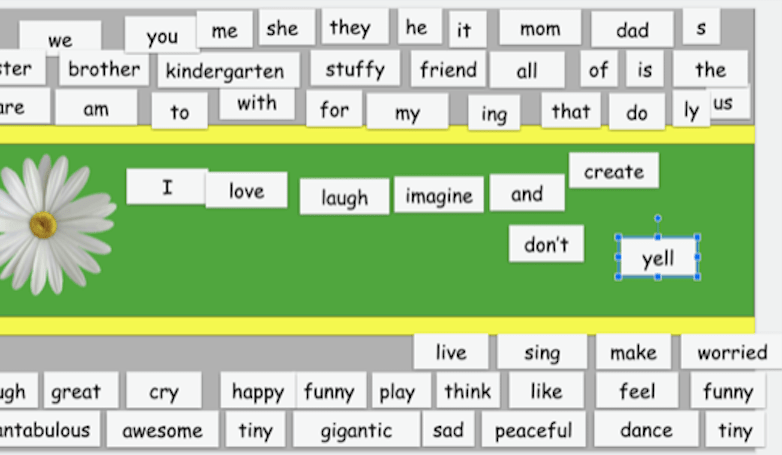
While I was on the Shake Up Learning site learning how to do that, I clicked on a few other things I found interesting. My absolute favorite was her magnetic poetry board that featured small white rectangles with black lettered words, waiting to be placed on a retro mint green refrigerator! Oh my GOSH!!! So good.

After playing for a bit, I noticed she had a free mini course about how to make the magnetic boards. I wasted no time clicking on that link.

I listened, played, and created a magnetic board for my Kindergartners. It was lovely, but a bit too complicated. Back to the drawing board I went.

Finally I decided I’d create a board that had space to create sentences in the middle, while holding the words on the top and bottom of the slide. This would allow the Kindergartners to create the sentences by clicking and dragging.

I shared it as an optional assignment.

…………………………………………………………………………………………………………………………………

When you are finished with your other projects, please consider teaming with me as an Official Tester of Our Kindergarten Virtual Magnetic Words Board.

I can’t come put magnets on your refrig, so I had to do it on the computer. I learned some new skills, and used them to make word “magnets” as well as a place for you to create sentences, poems, lists, or other things we haven’t yet imagined, on your computer.

This is the first time I’ve tried this, so I’m not sure how it will work for you on your device, or how much you will enjoy it. But I’d really like to know.

If you’re ready to be brave, resilient, I can do it Kindergartners, click here. Make a copy, and see what you can do. Try it for a few days. I’ll be waiting for your thoughts, and your sentences.

…………………………………………………………………………………………………………………………………

I was sure they would except the challenge. But, I had no idea what I’d get in return. I waited, with hopeful anticipation.

Slowly their responses began filling my email inbox. They were great! Each one showed me the spirit, resilience, and all around awesomeness of the student who did the work.

Their sentences speak volumes about who they are, how they see themselves, and what they are experiencing and thinking. I gotta say, they filled my heart with joy! Take a look at a few:

Yes, yes indeed, I do feel all the love!

Fantabulous, right? I included a few words in their word bank that were a little less than positive – yell, cry, worries. I added them to honor and validate the reality that we might want to yell, cry, or be worried. They didn’t choose them — except to suggest — after a long line of things they do — love, laugh, imagine, and create — they don’t yell. That actually made me laugh out loud.

Curious to consider, but true none-the-less, this fantabulousness happened because of the quarantine.

Because we’re home and not together in our school, I needed to rethink how to do what I would normally do in our classroom. How could I give them open ended opportunities to create with words? How could I allow them to share themselves and their ideas? How could I do some formative assessment?

Living during this pandemic I have a bit more time, and am experiencing a good deal more stress. So what could I do? I could try to follow my passion to learn and create. So when this opportunity to learn and get caught up in the flow of creativity came my way, I eagerly embraced it.

I think this fantabulousness also happened because of all the work we put in together pre-quarantine. Not just the work to develop skills, but the work to develop relationships.

Everything about our time together — even now — is about relationships. Relationships with arms, hearts, and big beautiful brains, wide open to embrace each other and all we bring to one another.

We say good morning, inquire how the other is, look each other in the eye, and share our thoughts ideas and feelings. We laugh, and sometimes we cry. Our relationship is based on trust, love, openness to possibility, wonder, willingness to risk, and mutual respect.

For sure, that relationship allowed me to take a risk, do something new, and ask my students and their parents to join me in my experiment. Undoubtedly it gave them courage and freedom as well.

We remain apart, but at the same time together — together in all our fantabulousness!