
My learners love to finger-knit. It’s a never-ending source of joy, creativity, flow, and peace. When we begin, I show them two methods of finger-knitting, and then they choose their favorite way to continue. Amazingly, every year, after working with my two methods for a bit, my learners develop their own iteration of finger-knitting and teach it to me. Soon, they take over my job of teaching others how to finger-knit, make the beginning slip-knot, and wind yarn balls.
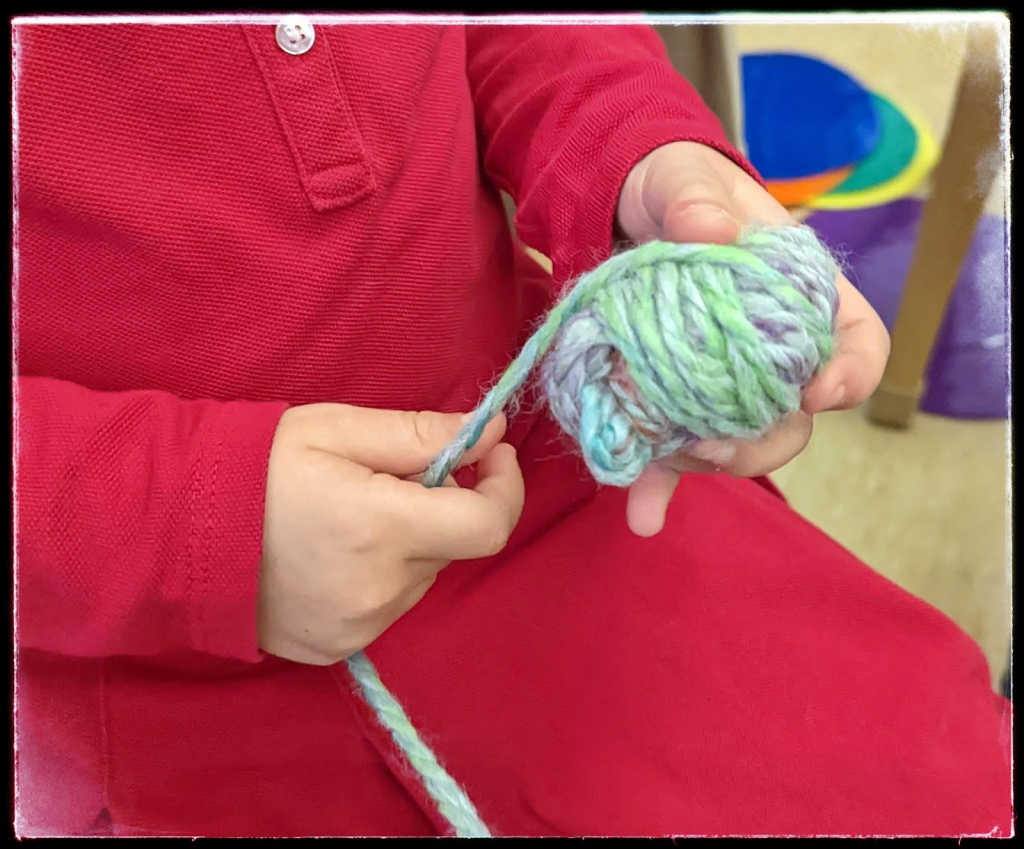

Soon after they learn to finger-knit, they are curious about the knitting needles I have in the classroom. They begin to ask questions: Can you knit with sticks, Miss James? Did you knit that on sticks? What else can you knit on sticks? Their curiosity turns to wonder and awe as they discover I know how to knit with sticks and have made many things. One by one, they ask me to teach them to knit with sticks.
They wait patiently – or not so patiently – for time and sticks, so that they can be the next knitter. At one point, five of them had work on the sticks, and I was commissioned to make more sticks so that they could all knit.
Whether they knit with fingers or sticks, the process is one of grit and growth. First, I show them, often helping them move their hands, fingers, or sticks. Frequently, they make mistakes. Sometimes they forget a step. Other times, their knitting falls off their fingers or sticks, and they accidentally pull it all apart. We breathe through our angest, and rehearse the movements and the words that describe those movements: Make a loop. Put it on your finger. Wrap the yarn around your finger in front of that loop. Don’t make it too tight! Now pull the loop over that piece of yarn. Once that’s done, pull these two ends. Finally, we celebrate and encourage: You got it! Now do it all again – over and over until you’re done.
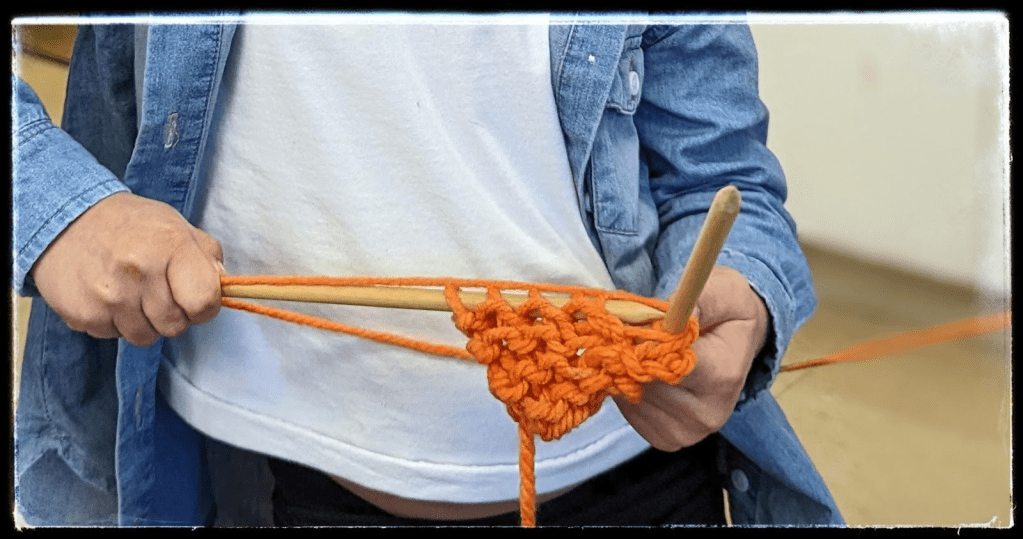
After working with me, they work on their own – sometimes in close proximity to me, sometimes with a group of other knitters. They frequently check in, asking, “Is this right? Can I take it off now? Can you fix this, Miss James?” As their competence and confidence grow, they begin to say, “Can you teach me how to do it so I can do it by myself?” If, when helping, I miss their aha moment, they say, “Miss James. I can do it. Would you let me do it?” My response is always, “Yes, of course!” More often than not, the exact same words begin to greet me in reading, writing, and math. “Can you teach me how to do it so I can do it by myself?”
Finger-knitting is a shared experience of creating, taking chances, trying, problem-solving, teaching, learning, using tools, and creating a valuable and genuine product. It’s a lot like being a writer!
If you aren’t a knitter (finger or sticks), there are many wonderful resources online to teach you. However, it may be better for you to consider the ways you create and make in your own life. What creative love do you have that you can share with your learners? When you do it, do you have to take chances, try again, problem-solve, learn, use tools? Do you create a valuable and genuine product? Then it’s a lot like being a writer, perhaps we can consider it pre-writing skills since we are growing the mindsets and habits of a writer. Weaving, cooking, collage, mark-making, origami, calligraphy, or embroidery may be your jam; use them. Your excitement, joy, peace, and curiosity will spark the same in your learners and motivate them to give it a go.
As you and your learners engage in the creative process, you will learn about yourself, your learners, and the process. I am always amazed at how much I learn about something I have done forever, as I listen to and watch my learners. Sometimes, as we work, we work in silence, absorbed in the struggle of learning or the peace of flow. But often, we employ one of HGSE’s Project Zero’s Core Thinking Routines. We notice, think, and wonder, and share our thoughts with one another. This thinking routine allows us to verbalize what we are doing with our hands, share the new things we notice about the yarn and how it works, think about and share our thinking, create new iterations, notice similarities and differences, get suggestions from others, talk through our struggles, and celebrate our successes.
As we knit together, I noticed how often we use the phrases – first, then, next, after that, and finally. I realized this shared passion was a way to make the concept of beginning-middle-end-thinking concrete for my young learners. If we could notice the concept of beginning, middle, and end in our repeated experience of finger-knitting, perhaps we could translate that into the use of beginning, middle, and end in writing.

I set a task for my learners the next morning. During Investigate and Explore time, they were to finger-knit. My instructions and explanation were intentional and specific. “Everyone must finger-knit so you have it fresh in your big, beautiful brains for writing. As you knit, use our Notice-Think-Wonder thinking routine. You can use it by yourself or with friends. I particularly want you to think about how you are knitting. What steps are you taking? Do you always do things the same way? Notice. Think. Wonder.”
Finally, writing time arrived, and my learners peppered me with questions. “What are we doing with finger-knitting, Miss James? How is finger-knitting writing? What are we doing? Can we finger-knit again now?” As they settled in, I explained that we were going to teach others how to finger knit by explaining what we do first, then, next, after that, and finally. A plethora of hands raised, as ideas tumbled out of their mouths. I asked them to breathe and hold their excitement while I finished my explanation.
“First, I want you to work with a partner. Talk about your process. Notice what is the same and different. Think about what is possible. Do you both start and end the same way? Are you middle steps exactly the same? Do you explain them in the same way? Why or why not? Use our learning question What makes you say that? to discover what your partner is thinking. Show your partner what your words mean by finger-knitting for them. Use your art sketchbook to draw pictures. This might help you try things out and will give you a guide as you write.

Then, write and illustrate your process – your finger knitting steps – so others can learn to finger knit. Please remember to use the words first, next, then, after that, and finally. After that, share your work with your partner. Finally, when you are satisfied with your process and product, come share it with me.
Everyone – even my writers who struggle – was successful. Everyone – in word, action, and illustration shared a possible finger-knitting process iteration using beginning-middle-end-thinking. It’s only a first step, but it’s an important step in their life and growth as writers.

(Translation: First, you take it out of the finger-knitting basket. Then I do a loop and I start finger-knitting. Then I talked a friend to help me.)
These images are of my Kinders over the past few years. This year I’m teaching pre-Kindergarten. Just like my Kinders, they love to learn how to do things, and then do them — even when they’re hard things. And goodness gracious, they love to make things. I’m excited to teach them how to finger-knit, and to be their scribe as we construct first, then, after that, and finally finger-knitting plans.

 Life lived with relentless creativity