Teaching IS Design Thinking

Teaching — of every kind — is all about design thinking. Teaching remotely while your Kindergarten students are in school? That’s a whole other level of design thinking!

Much like when I teach in person, I’m currently doing whole class, half class, and small group teaching. I’ve been teaching number sense lessons during math in small groups. Depending on how you look at it, it’s been:
a lesson in patience
… an example of how remarkable these Kindergartners are
or

the perfect illustration that design thinking is an essential element of teaching.

Take this week as an example. I wanted the mathematicians to join me in some math talks. They love to notice and share. So, it seemed like a great idea.

I populated a slide deck with some photos that allowed for all sorts of noticing. There’s tons of great photos online – just search for images for math talks. Or, make your own. You can group the items to encourage seeing in certain ways, or leave it completely free and see what they notice on their own.
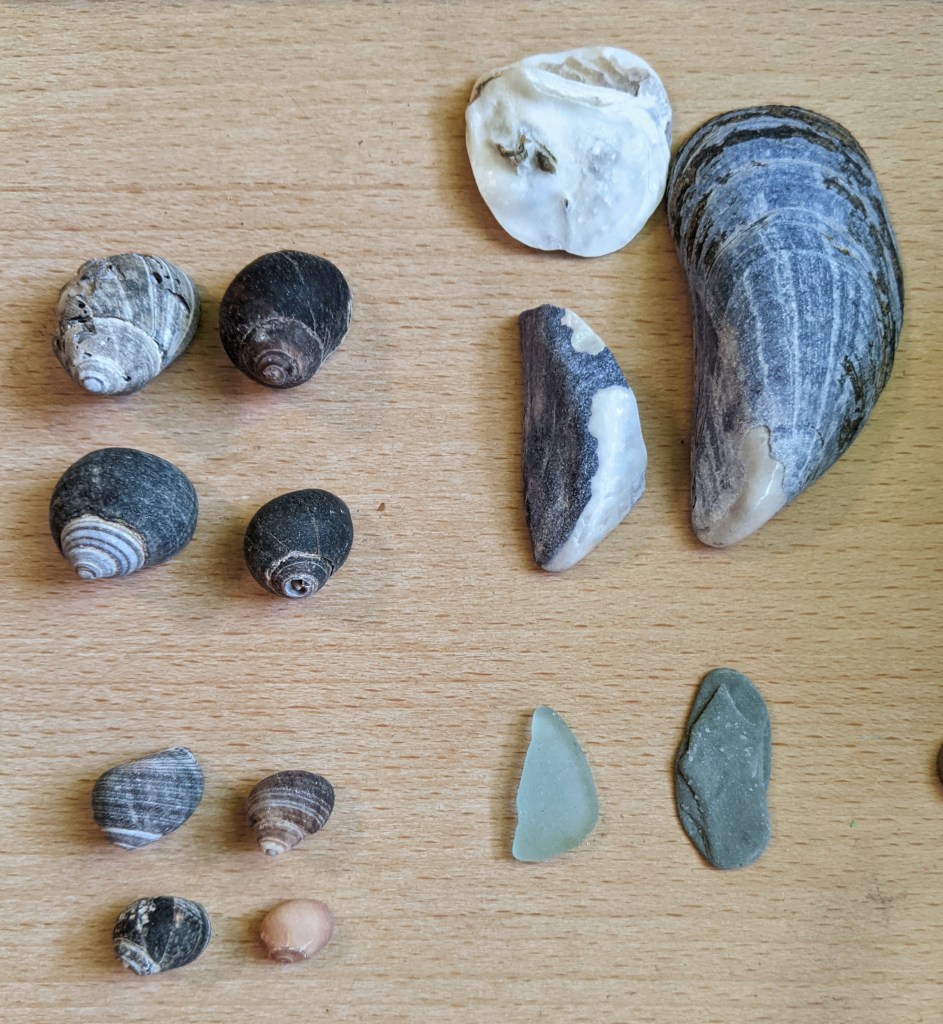
I spent some time reflecting on the photos myself so I’d be prepared to join the conversation. My plan was to leave things very open. I hoped for something like this.
… “I see shells and stones.”
… “I see 4 small shells and 4 bigger shells.”
… “Hey that’s 8 shells all together.” 
… “I see a cup with a tea bag in it.”
… “I see a circle on the top of the mug and one on top of the glass. That’s 2 circles all together”

We noticed things. We did math. But, phew, it didn’t go as I hoped.

Other than math, here’s what happened.
… My Kindergarten mathematicians were all over the place. (Note to self: it’s the last full week of school and their energy and excitement is, understandably, remarkably high.)
… The technology didn’t work so well. Mathematicians were getting kicked off zoom. They couldn’t hear me, or I couldn’t hear them.
… The other mathematicians and teachers in the room seemed quite loud to us on Zoom.
… My patience, self awareness, and self regulation was quite low.
… And, my quest for open ended discussion turned out to be a little too open ended.

So, I gathered my observations, thought about what my mathematicians and I, needed, re-considered the task and goals, and designed June Kindergarten Math Talk Iteration #2.

Day 2, iteration #2: Included:
…. Fingers crossed for better wifi connection.
… More patience from me.
… More self awareness and self regulation for me.
… More breathing for me and my mathematicians.
… A request to colleagues to monitor the classroom volume level.
… A new prompt – What MATH do you see?

We noticed things. We did math. And, things went a bit better.

The tech worked better. The class was quieter. I was calmer and happier — so were the Kindergarten mathematicians. But, they remained a bit distracted by the very technology that allows us to meet together. They adore writing on the screen and wanted to do it more — and it was tough to be patient and take turns. They love changing their names, and found it difficult to focus on math instead of surreptitiously changing their screen names.

Once again, I gathered my observations, reflected, pondered, and created the June Kindergarten Math Talk Iteration #3 — unless, of course, you count the many tiny changes I did on the fly. If you do, then consider this iteration #453.

Day 3, iteration #3 (#453) included:
… Mathematicians come to group with whiteboard and marker.
… I give mathematicians 2 minutes in the beginning of our session to change their names. Four of us are now Miss James!
… Same question – What math do you see?
… Mathematicians take turns choosing a photo to examine.
… Mathematician who chooses the photo, share her findings by writing on the screen.
…. I stop share so other mathematicians can share their findings on their whiteboards.
… Repeat for each mathematician.

We noticed things. We did math. We had fun. I didn’t have to do much classroom management. 

I don’t have a day 4 or 5, but my mind is already iterating. I’m taking what worked, combining it in new ways, and being inspired to make changes that allow for remediation as well as enrichment.
… Choose an image. Each mathematician finds and circles a particular quantity (2 eyes, 1 nose, … etc). We all then use our whiteboards and various strategies to determine how many we have all together. Then we share how we figured it out.
… Same as above but I get to remove a quantity., or ask what is one more or one less. My mathematicians figure out the answer and share how they figured it out.
… We choose a quantity and each mathematician shares a way they see it in the photo.
… We all use the chat feature (I disable private chat) and they each write the quantity they see into … the chat box, but we don’t share it until we count to three, or to 10 by 2s, or to 20 by 5s.

Empathize. Define the problem. Ideate. Prototype. Test. Repeat/Iterate. It’s what we do as teachers. I love the d.school design thinking bootleg deck. It keeps me thinking, and reminds me of the remarkably deep design thinking I engage in as I teach.

I Crossed My Fingers and Hoped for No Crying

I’ve been having my Kindergarten artists work in a sketchbook before they tackle the blank page of their final piece. I want them to get used to the artist practice of sketching without fretting, and without erasing. I want them to have the freedom to try all sorts of things without the concern that sometimes comes when they are creating their final piece.

They’ve been doing so much good work. They are filling the pages of their sketchbooks with a plethora of fantabulous experiments. Their faces beam as they show me their work, tell me if they love it or have more to add, and give me virtual high fives (which become high one hundreds) through the classroom D10.

This week I decided to try something new. No sketching. No exploration. No pencils. Just a sharpie, our big beautiful brains, awesome hearts, courage, and creativity! At least two colleagues chuckled and said “You are a brave woman!” I responded, “Nah! They can do it. I know they can. I’m going to tell them that!” I paused, and laughed, and then added, “And then, I’m going to cross my fingers, and hope for no crying!”

When art rolled around last week, I did just that. I started sharing that I have a sketchpad and often do sketches before I paint. But, other times I just use watercolor or pen and ink directly in my journal. As I spoke, I shared some pages from my hiking art journal. “That’s what we’re going to try today – no sketching, just being free and working directly onto our watercolor paper.” No one said a word, and since I’m on the D10 I can’t always read their facial expressions. I kept going forward. “You can do it. You’re amazing artists with big beautiful brains, awesome hearts, and lots of courage and creativity. … Are you ready?” Shouts of “Yes!” were music to my ears. With a huge smile on my face I said. “Awesome. Let’s get started.”

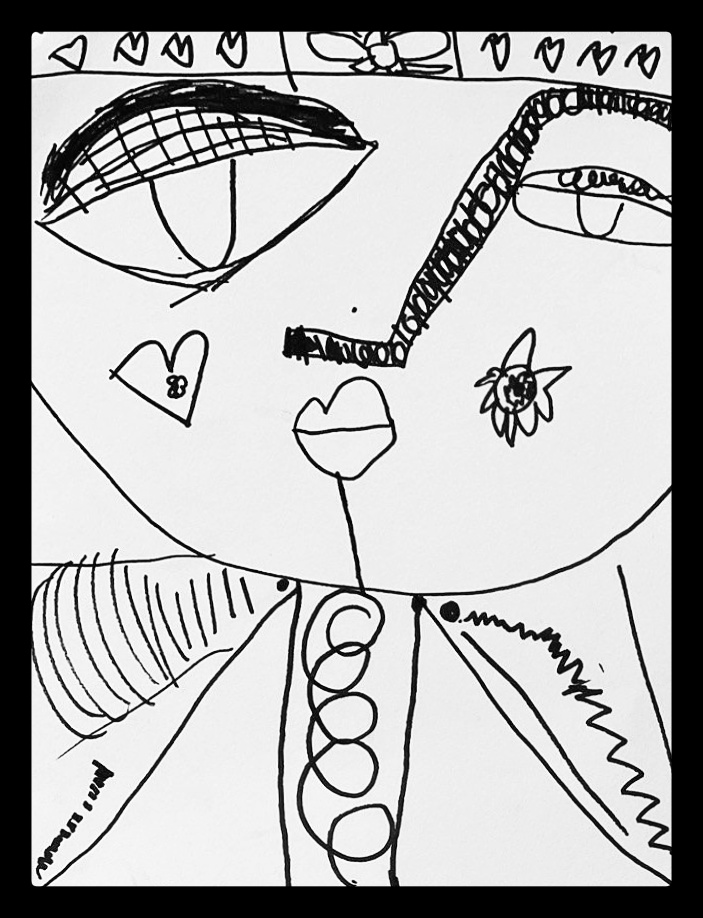
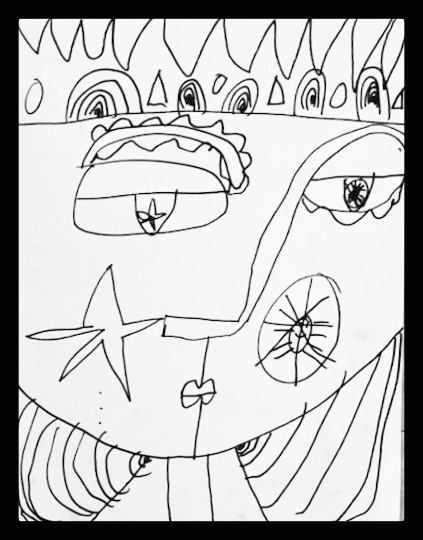
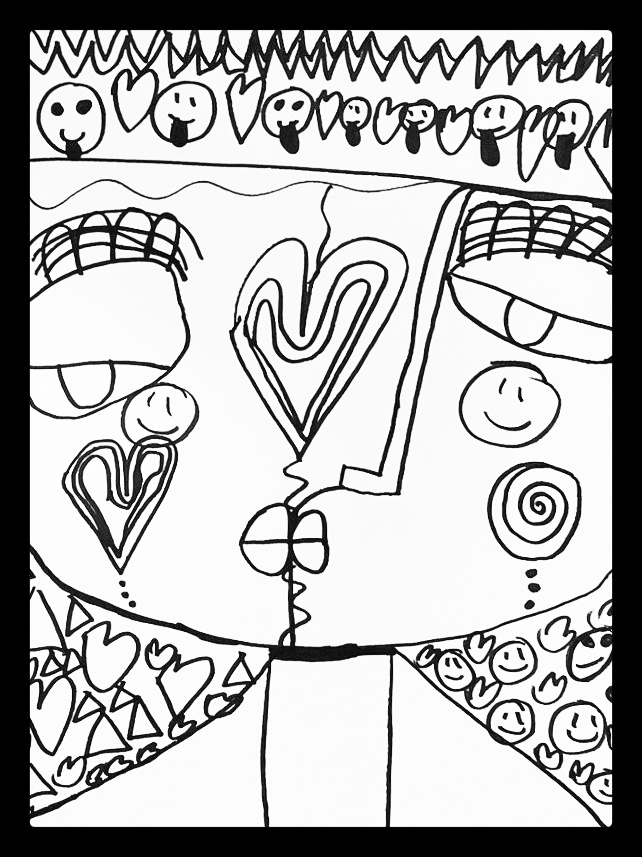
I led them through a few steps to create the shape of the face — complete with the asymmetry, unusual scale, and a crown we noticed in Sandra Silberzweig’s original piece. I encouraged them to follow along, but to also make decisions as the artist of their piece. Once we had finished the outline, I set them free to add details. I suggested they take time to look, and think as they drew.

The learning space was quiet as they created. I worked, and waited, with all my fingers crossed.

I am overjoyed to report that there was no crying! There was only excitement, enthusiasm, joy, and awesome art making.

Look! (There’s more, but I figured I’d just share a few.)

These young artists aren’t artists because I think they are. They’re artists because THEY think they are. They’re artists because they’re noticing, thinking, wondering, trying, making decisions, and creating their own art. They’ve embraced themselves as competent artists, and creative thinkers who can have ideas, think creatively, take risks, solve problems, and make great art. They are artists, they know it, and they’re loving it! So am I.

That confidence, and ability to think, and take a risk– without tears — doesn’t just show itself during art. It pops up often, and each time it’s a joy to experience. Most recently it was wonderfully evident in a homework assignment I gave them to record a video on flipgird,.

If you’re a teacher and you’ve never tried flipgrid, give it a go. It’s a great platform for you and your students to share ideas, comment on the ideas of others, be inspired, and help one another problem solve. When they record, my students practice oral literacy skills in a friendly pressure free arena. I smile each time I decide to redo my video and get the “You got this! Try again” message. A bonus is that flipgrid provides us with playful opportunities to add boarders, stickers, writing, and other fun ephemera to our videos and screenshots.

Pre-covid we did a lot of block building. When we build with blocks we play and learn. We think creatively, critically, and spatially — and we grow in our ability to do so. The somewhat transient nature of block building allows for lots of ideas, quick iterations, struggling, failing, succeeding, problem solving, learning, and sharing — all while having fun.

When Covid hit I looked for ways to to engage and grow my students imagination, creativity, courage, spatial muscles, grit and resilience through building. I wanted a building option that was compact, portable, open ended, and relatively inexpensive. I finally decided on Plus-plus blocks.

Now that I’m back — but remote — my challenge was how to share all of the greatness of our time together in the Kindergarten Makerspace making all sorts of cool block builds when we weren’t in the same physical space. I decided to give flipgrid a try.

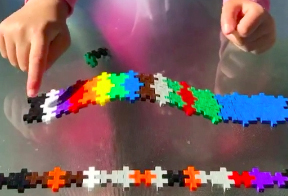
I created a flipgrid homework assignment. I encouraged my students to play with their blocks, create things, and then record a video showing what they made, what they learned, and what they still haven’t figured out. I posted my own video in response to the assignment sharing some of my struggles and asking for their help.

Flipgrid Plusplus Blocks Assignment

The things they made were fantabulous.

Here are a few:
A baking bird – brown and white for brown and white sugar.
A statue – which when you add the baking bird to the statue now has moveable arms.
Two cars and a garage.
A rainbow bridge, a sidewalk, and a bracelet.
Saturn, Jupiter, the sun, and Momo and his magic wand.
An adjustable ring, a flag, a plane that transforms into an eagle.
A cookie and apple who become friends.
Flower and all the characters needed for the story of her escape.
A girl named Anastasia

But, what really struck me was the builders themselves. I saw those same awesome artists simply working in a different medium. They shared their ideas bravely. They offered suggestions. They asked and answered questions. They explained their thinking. And, they interacted with their blocks in ways I never imagined — crafting stories and making connections.

One of them said this: “I love these blocks. You can make anything you want with these. You can just get creative and make whatever you want, and make your own dreamland.These blocks are just wonderful.” She had a beautiful, satisfied smile on her face she talked and shared her creation.

As I watched the videos — leaning in to see things more closely, chuckling at their stories, overwhelmed by their awesomeness — I was reminded of an idea of Loris Malaguzzi – Children are strong, rich in potential, powerful, and capable.

Yes, yes! Strong, rich, powerful, and capable. It’s important that we know and believe this truth about children. And, it’s essential that we reflect this belief to them. Our best selves, and our greatest sharing and learning, happens within relationships of respect, awe, and love.

They are artists. Yes. They are builders. Yes. They are awesome and fantabulous. Absolutely. But mostly they are themselves, and they are strong, rich, powerful, and totally capable. I’m so grateful I get to know them, teach them, and learn from them.

Brave One

My Kindergarten artists’ journals are finished and fantabulous. One, however, tugged on my heart and begged to be shared.

I love the art. But what took my breath away were her words:

Brave
(her name)
Love

Once my breath returned, I texted a friend the photo and this message ” Oh my gosh! My day is made. My work is done. My heart is full.”

Of course, my work continues, but wow, for today it is done. This young one knows and loves herself as brave. Simply fantabulous.

Look, Wonder, and Ponder Possibilities

This week my Kindergarten inspirational artist was Ashley Bryan. What a remarkably talented artist. He’s a painter, a storyteller, a writer, and a collage artist — to name just a few of his artistic pursuits. Any one of those might lend itself to an art project. But, which one would work for my students, with the supplies they have, in the time we have? And, which one could I successfully model for them remotely?

I spent days researching Ashley. I studied his art, listened to him speak, and read articles about him. And then I did it all again. I was quite struck by two things he said:

I make flowers of all my mistakes.

and

In Kindergarten we made our first books … little one of a kind, limited editions. Bringing them home was the greatest reward.

That was the my first aha, We could be inspired by Ashley’s flowers, and his recollection — in his 90’s — of the joy he had at creating his own books in Kindergarten. My artists’ finished flower art pieces would become the covers for their own one of a kind, limited edition journals.

When I shared that with my artists, one asked “But what are we going to put in it.” I shrugged my shoulders and said “I’m not sure. It’s your journal. You’re the artist. What are you going to put it in?” She persisted, “But what can we put in it?” I persisted, too. “You’re the artist, you can put whatever you want in it.” Murmurs filled the room and wafted towards me across our remote connection. I smiled as I watched them begin to plan what would fill their journals.

But, I get ahead of myself.

I had the flower journal idea, but I wasn’t sure how I could help my artists emulate the loose style I perceived in Ashley’s flowers. Back I went to examining his work and words. I contemplated lots of possibilities, but each one felt less than exciting, and didn’t quite measure up to what I was hoping to achieve.

Then I saw Ashley’s lithograph and stained glass window work. That was it! Both of those included black lines and shapes. This would allow my artists to use their black markers to create the loose flowers. They could then use watercolor paint to add the color. I chose to focus on the stained glass creations because they included the color found in Ashley’s paintings.

The process and product of my Kindergarten artists was joy-filled, courageous, and filled with sharing of ideas. As an educator, I was super satisfied. As an artist, my creative thinking, and artist work continued.

I always make a demo piece, and then work on my own art as my Kindergarten artists work on theirs. This was my demo piece.

I liked it. But as I looked at it, I wondered what else I might do to it? How might I take it further? Was there something I might do to take it beyond a Kindergarten project? And of course, the ever present question “What if I mess it up?” It always makes me laugh out loud when I hear myself wonder that. It keeps me humble, and reminds me how brave my K artists are each time they take up their tools and get to work.

I got my white paint pen and began adding marks. I thought the detail would be what I needed to add some sort of pop. I was wrong. I got more pens and added more colors and marks. It got better, but then it seemed to have lost its original connection to Ashley Bryan as the flowers and black lines became less pronounced. Much like when I prepared to teach my lesson, I took a break. Each time I passed my art, I gave it a look — many looks, from many different angles. I contemplated many what ifs, and, maybes.

Finally a possibility made enough sense so as to become a plan. I decided to paint all the negative space with titanium white.

I am totally digging the result of my creative thinking, and artistic doing.

i created a second piece so I could paint with my artists during our second class. I was inspired by their drawings — some had intense amounts of detail, others had butterflies, birds, and lady bugs. The plethora of flowers and nature set off the white of the framed word in a great way. I loved it as a black and white piece.

Then I added paint with with Kindergarten artists.

It’s nice, and it was admired by all, but I’m not loving it. Perhaps it’s the starkness of the word frame compared to the color. Perhaps the color has muddied the detail of the background. I’m not exactly sure.

For now I look, wonder, and ponder possibilities. But soon, I paint.

I Am An Artist

There is such power and joy in being able embrace oneself as an artist. An artist able to:

  • be inspired by other artists
  • use that inspiration to create your own art
  • inspire others
  • make creative and artistic decisions
  • carry out your plan or
  • enjoy the freedom of artistic and creative play and experimentation
  • speak your truth through your art
  • embrace your artist-self by choosing your own name (Hundertwasser)
  • share your understanding and vision by naming your artwork (Thomas)

The power and joy explodes, I think, when you can do all these things as a young child.

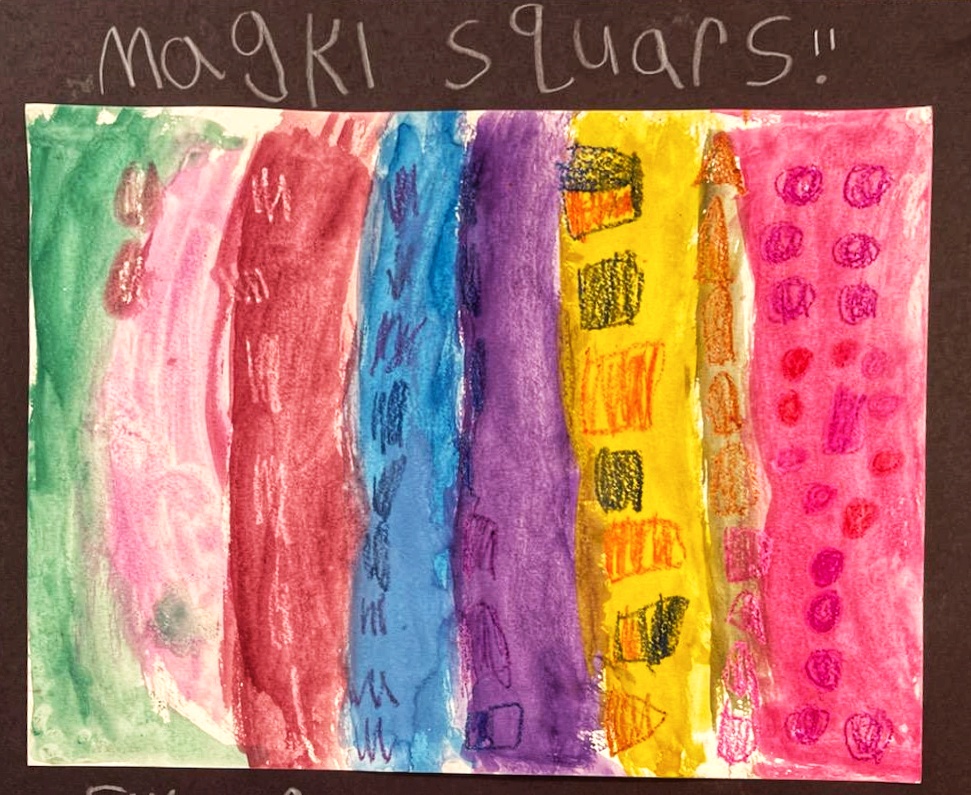
Last week my Kindergarten artists explored the work and life of Alma Thomas. She began her career as a representational artist, and later in her artist journey embraced abstract art. Amazingly, at the age of 80 in the early 1970’s she became the first African American woman to have a solo exhibit at the Whitney Museum in NYC.

The kindergarten artists loved Alma’s use of color, and enjoyed trying to guess what she named each of her paintings. They worked hard — first in their sketch books and then on the final watercolor paper — to recreate with crayons, the marks Alma made with acrylic paint. By the way, in case you’ve never tried it, it takes a lot of dedication to fill a 9X12 piece of paper with marks the size of your thumb.

As my artists worked in the classroom, I worked alongside them in my home studio. Like them I made my own crayon marks, and then added layers of watercolor wash. My work was often interrupted by “Hey Ms. James. This is …..,” as they slid their work under the document camera so we could marvel and talk together.

Encouraging them to include all the elements we noticed in Alma’s work, yet at the same time allowing them to make their own artistic and creative decisions and plans, is a delicate line to walk. I often wonder how close their work has to look to our inspirational artist’s work.

As I’ve worked with them this year, I’ve become more convinced that there are four non-negotiables. My fantabulous artists must:

  • include the elements of the original piece that we notice and spoke about together
  • be free to use their big beautiful brains and awesome hearts to decide how to incorporate the elements into their art
  • be allowed, encouraged, and enabled to find joy in their process and product
  • come to know themselves as artists

So, I work on pointing out what I see — what I see that reflects the elements we discussed, the things I notice are missing, and the many things I wonder about. I do my best to guide my artists to walk that delicate line of agency and requirements with me. Sometimes I set them free to make the decision as an artist, sometimes I request they put the artwork down for a bit and then look at it again to see if they are still happy with it, other times we find a compromise that allows them to have freedom while still following the guidelines.

Here are some of our Alma Thomas inspired works of art. I’m always interested to see how they interpret the current artist’s work, and how they incorporate some of the other artists we’ve explored previously. I’m amazed and edified by their title choices. The titles add to the power of the piece. They speak to the audience to share the artist’s thoughts and understanding, and speak to the artists themselves to affirm who they are.

The Master of Sjhapes
Magical Squares
Tornadoes Howling
A Meteor Shower
The Inspired Painting
Artist’s Lines

When I read their titles my heart is full. These Kindergarten artists are perceptive, thoughtful, confident, and invested in sharing what is in their minds and hearts. Everyday I do my best to affirm them “Indeed my young artist sisters, you are masters. You are inspired and inspiring artists. Don’t every believe anything less.”

World Changing Ideas

I shared the book What Do You Do With An Idea with my Kindergartners. Sometimes it’s hard to see them when I’m teaching remotely — especially when I’m sharing my screen. I was a little disappointed in my lesson, wondering if I had been able to spark ideas, and share the amazingly fantabulous idea that we ALL — no matter what — can have beautiful, world changing ideas.

After the lesson I shared 3 videos with my students — how to make a squish-squash book, an accordion fold book, and a silly fold book. I asked that each student make at least one book, put her ideas in it, and then share her book and ideas by video on SeeSaw.

I’ve been looking at the responses and leaving comments, and wow, I’m so happy. They are sharing their ideas, reading what they wrote, explaining their illustrations, and talking about things they wonder about from the book we read together.

Here are some of their ideas:

flying unicorns
making a tree to climb when she becomes seventeen
ice cream everywhere
writing a book about her favorite stuffy
sending her ideas to the clouds for them to get stronger
looking at the clouds to see what they look like
not holding onto her ideas but sharing them with others
making a car that goes wherever you tell it
reading more books,
being a superhero and discovering how to fly
stating what she knows, doesn’t know, and wonders,
helping others and saying “No problem!”
creating a cardboard igloo over the summer
making a robot that can help her and others

It might be easy to discount their ideas as childish, sweet, or silly — after all, flying unicorns and superheroes? How is it possible that these ideas are world changing?

Perhaps, for just a moment, imagine those same ideas from the perspective of a scientist, designer, or researcher. I’ll consider just a few but they ALL are equally full of potential.

Flying unicorns can easily become a cure for cancer or other devastating diseases. Much like flying unicorns, a cure seems far off. Imagine if the scientists didn’t engage in their fantastical dreams. Imagine if they didn’t try to attain them. Imagine if they had people around them saying “That’s a sweet idea. Too bad it can’t be done. There are no such things as flying unicorns or cures.”

Ice cream everywhere is a problem of ingredients, process, temperature, distribution, and end users. It’s reminiscent of a remarkable story of creative design thinking shared by Tom Kelley and David Kelley. The Embrace Infant Warmer helps save the lives of premature babies. Similarly to my student’s desire for ice cream everywhere, the warmer was the solution to a problem of ingredients, process, temperature, distribution and end users.

The idea of making a tree to climb when she reaches the age of 17 sounds a bit unusual to our adult ears, but it’s really quite spectacular. Don’t just hope there will be a tree to climb. Work to make it happen. Work to bring your ideas and dreams to life.

I’ve got some ideas and thoughts of how I might improve my next remote read aloud. I’m excited to try them and continue to grow my relationship with my students. But, I’m no longer worried that the idea of having ideas was lost or lessened by the remoteness.

I miss sitting next to them, creating, talking, and sharing. And yet, being able to watch their recordings is powerful. Watching and listening is a gift. It’s great to be able to have a recording of each student as she formulates her thoughts and chooses what to share, and it’s quite fantabulous to have the opportunity to reflect and respond to each one.

I’m hopeful they feel the power and joy of our remote conversation. And, my fingers are crossed that my enthusiasm and ideas about their ideas change the world for them just a bit. They really are fantabulous, and their ideas are game changers!

Matisse and Me

I’m teaching art with my Kindergartners and that always has me reflecting on my own process, emotions, and thoughts as a creative.

I’ve been painting when I hike for a few years now, but this year, I began working in a watercolor journal. All the paintings — no matter my opinion of them — are there. I’m always kind of surprised by the courage involved to put pen or paint brush to paper — especially when it is in a bound book, or done without pencil sketching first. I wondered it if I were the only one to feel that. Surely not, I thought.

Looking for affirmation for my feelings I set about finding articles linking courage and creativity. As I looked I stumbled upon this quote by Henri Matisse “Creativity takes courage.” Ah, even the master felt it!

And then, as I read more, I nearly fell out of my chair. Matisse — the man whose pencil drawings of the Madonna enthralled me at the Museo d’Arte e Spiritualita in Brescia, and whose Cut Outs took my breath away at the MOMA — said this:

“It has bothered me all my life that I do not paint like everybody else.”

Wow.

When I read that, I was amazed and encouraged. If Matisse could be bothered that he didn’t paint like everybody else, why would I be surprised that I feel that way? If Matisse said it, and yet went on to embrace his work — grow, change, re-invent himself when he saw fit — then I could, too.

It’s remarkable how freeing it is to know Matisse was bothered that he didn’t paint like everybody else. Somehow that gave me a great sense of freedom. Just paint, draw, do your thing. Notice, think, wonder, and make creative and artistic decisions. Your thing is yours, it’s beautiful, it’s creative, it’s artistic — but most of all, it’s yours.

What if Matisse had stopped doing his own thing and tried to be like everybody else. Yikes! That would have been awful. So I encourage myself — I am in amazing artistic and creative company, and if a master like Matisse could just say “Hey this brings me joy, and expresses what I see and feel” then so can I.

So I paint on. I draw on. Seeing my work, and the work of others for what it is — us.

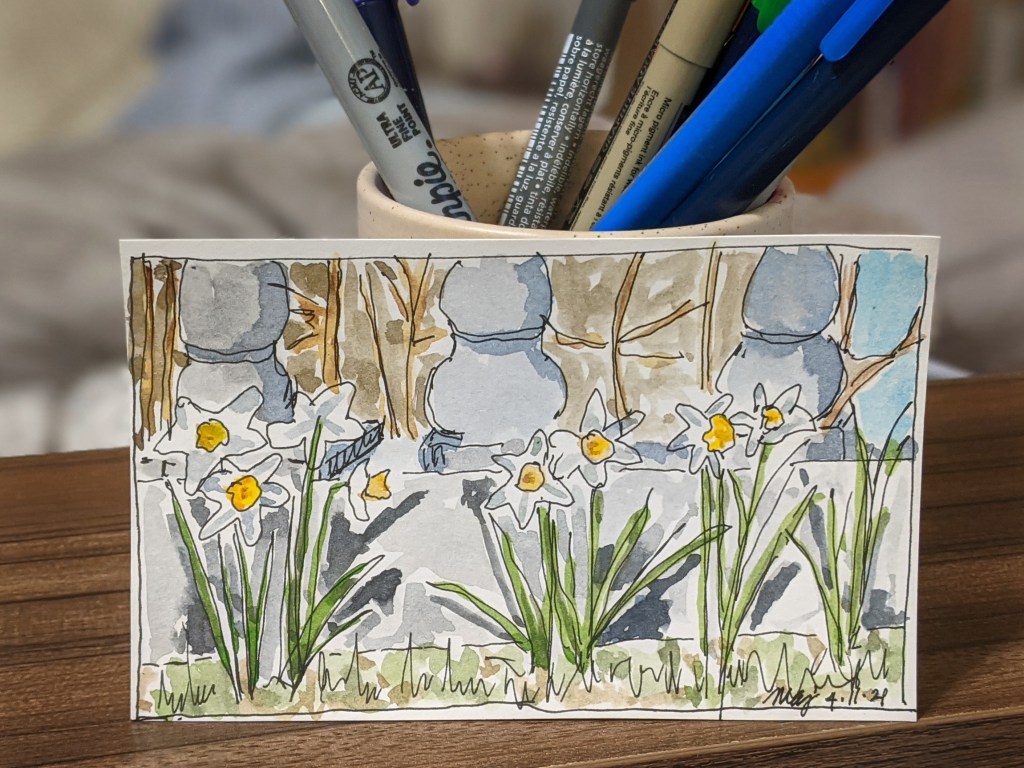
I photographed daffodils on a recent walk. Wanting to make some art I grabbed a small piece of watercolor and got to work. Is it perfect? No. Is it good? Yes. Did it bring me joy? Yes. Does it bring me joy now as I look at it? Yes. Is it me? Yes. Is it my style? Yes. What more can I ask for?

For now it sits on my desk to remind myself of the joy and awesomeness that is creative and artistic me — the joy and awesomeness of creating from who we are, where we are, with all we are.

When I work with my Kindergartners I want them to have this freedom — the freedom to know they can make great artistic and creative decisions, the freedom to find joy in their process and product even if it looks different than others, the courage to create with confidence in their own fantabulousness.

From Matisse, to me, to them. Who knows where it will go from there?

Trust and Art

I’m teaching again! I’m super excited to be back, getting to know the girls, and doing my thing.

One big wrench in the works — or one gigantic and glorious opportunity for new thinking and wonderful possibilities, depending how you look at it — is that I’m teaching remotely. Most of my class is back in school, and one student continues to learn remotely.

It’s a lot of work to teach and develop relationships in person. Now I’m doing that remotely. Can you say “PHEW!”

This week I got to teach art. I could cry with happiness!

And, speaking of crying, I did cry — big ugly crying — as my colleague and I tried to work out the logistics for the art class. We went through many possible iterations, and each one seemed to have a reason it might not, or would not, work. Thank goodness, my colleague was super understanding and encouraging. She told me I was doing a great job and it was only the second day back in school. She assured me we would work it out. and it would be awesome. I decided to believe her, and signed off for a much needed moment and cup of tea.

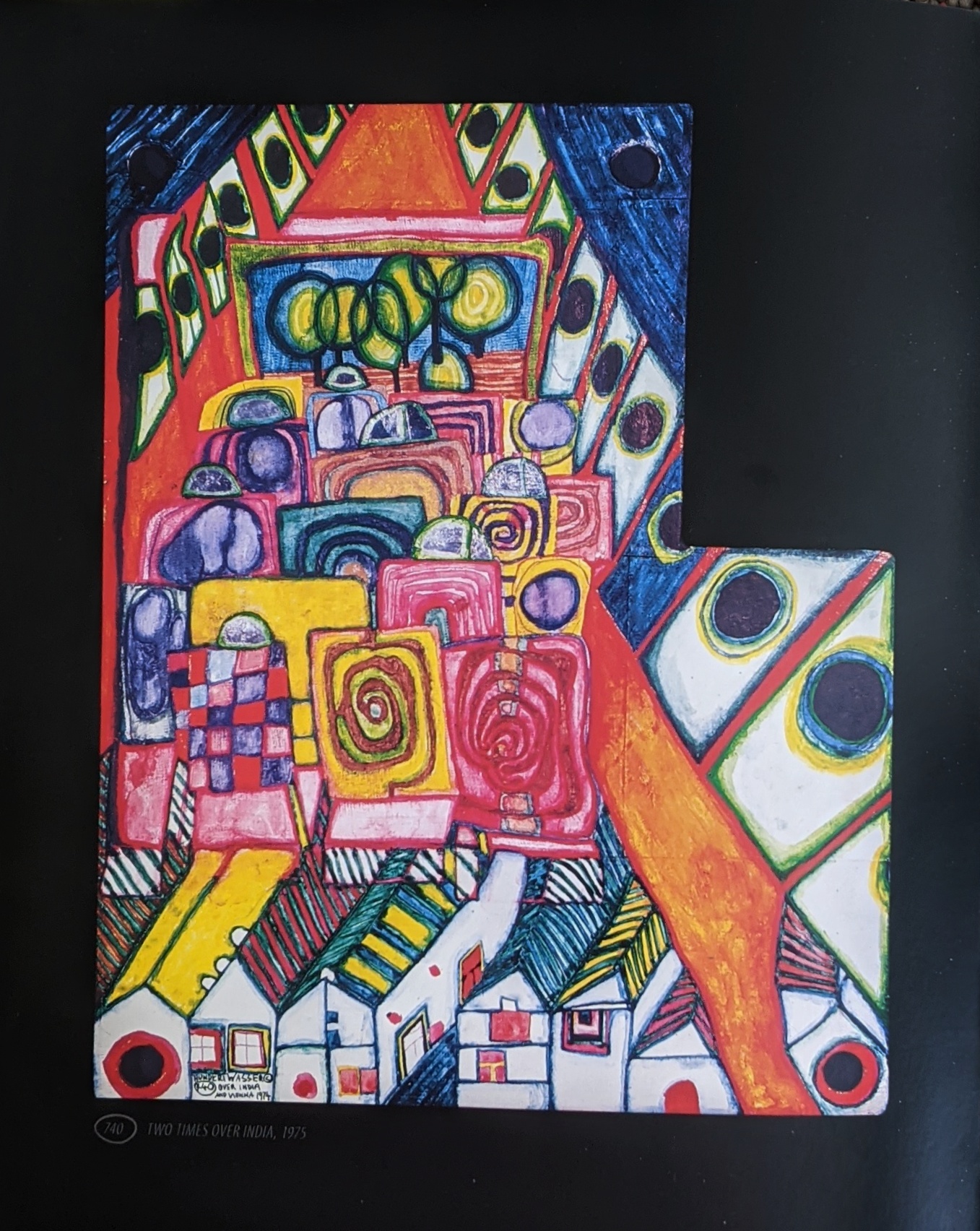
Once I was settled and able to agree — It is only the second day. I am a fantabulous teacher. It is going to be alright, maybe even better than alright. — I was able to take a breath, and think creatively about what and how to teach. I settled on Hundertwasser.

First I considered how my image might be the large enough for them to see me, and the art I shared, while still allowing me to see all of them. A friend of mine signed on to a zoom call with me — along with her two daughters — to test out spotlighting and pinning. Pinning seemed to be the best choice.

Then I looked at my Hundertwasser books. What images did I have? Could I narrow them down to no more than 5? I wanted the Kindergarten artists to have time to notice, think, and wonder about the art, but I also wanted them to have plenty of time to create their own work, inspired by Hundertwasser.

What did I want them to know about Hundertwasser? I decided on these points:

Hundertwasser was curious and couragous.
Hundertwasser did a lot of thinking and imagining.
Hundertwasser’s ideas became artwork or buildings.
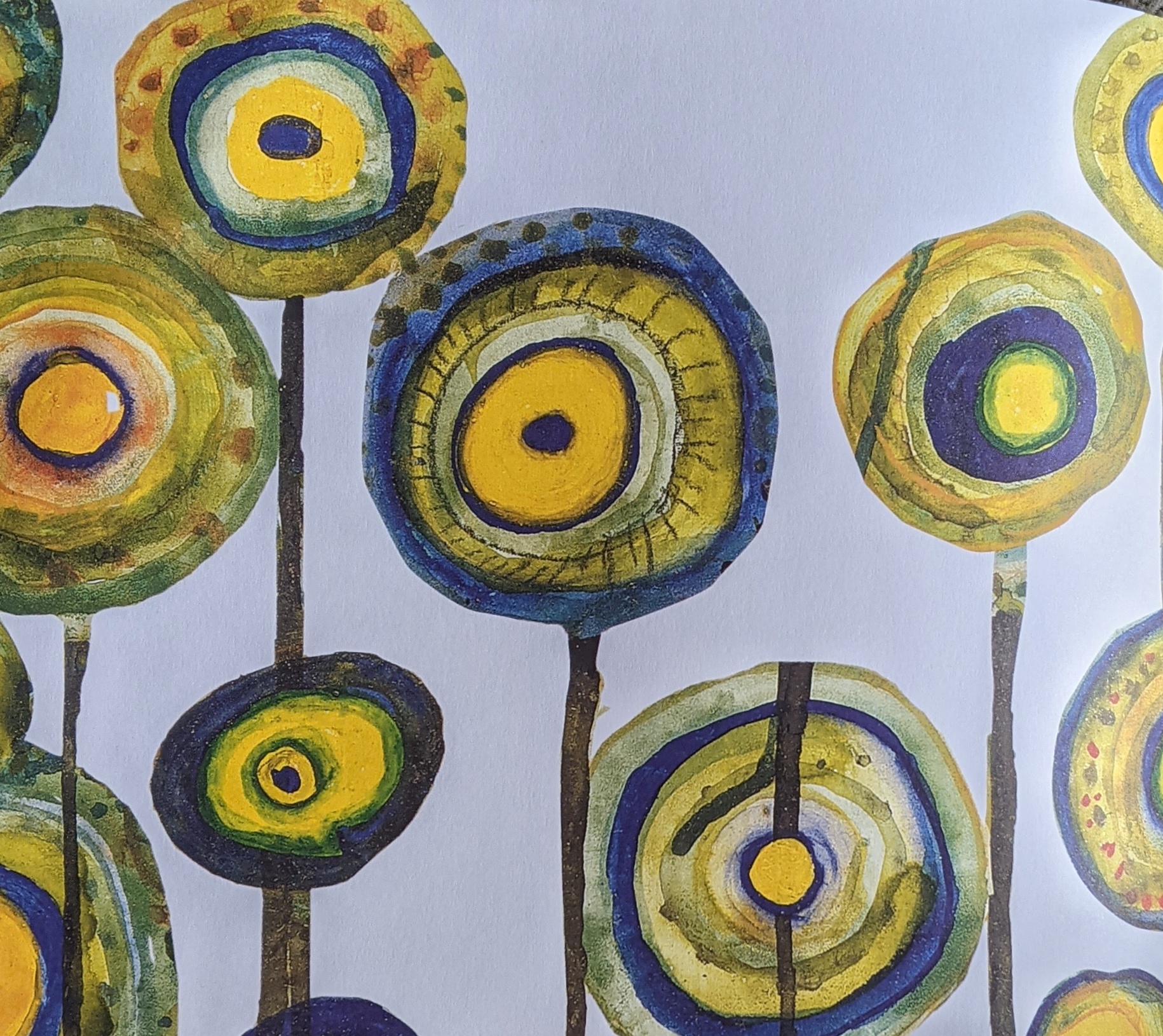
Hundertwasser liked spirals, wavy lines, bricks and stones on his buildings, lollipop trees, and color.
Hundertwasser changed his name when he became an artist.

I shared these images with the Kindergarten artists, and we dialogued about them.

Once they were familiar with Hundertwasser, I asked the Kindergarten artists to use their sketchbooks to experiment with, and practice, the various elements. They worked with determination, focus, imagination, courage, and joy. They used the classroom document camera to show their sketches to me. I shared what I noticed, thought, and wondered. I did my best to encourage their artistic freedom and decisions making, while also highlighting the elements we were using from Hundertwasser’s art.

I was surprised how well we were able to interact with one another. Even though we were miles away from one another, they seemed to be able to feel my love, respect, awe, and joy. I worked hard to express it through my emotions, language, and very self. I was very intentional with my words, and actions, so as to be able to express what I was feeling, thinking, and believing about them.

Before the second Hundertwasser inspired class, I again thought deeply about what I would present, as well as what we would discuss. The time and zoom constraints were a blessing — an annoying blessing but a blessing none-the-less. The constraints forced me to be very clear about my purpose and plan.

The Kindergarten artists and I reviewed the elements together, and re-examined the images so they were fresh in our minds. I shared a bit of my thinking as an artist. “I do lots of thinking – and often move my head or step back in order to see my art work in new ways.” I told them Hundertwasser was very thoughtful as well. I assured them that they could do great art thinking, and make great artistic decisions, too! I showed them a few watercolor tricks – using your dry brush as an eraser of sorts, and mixing colors on the page rather than a palette.

Finally I reminded them about Hundertwasser changing his name when he became an artist. Since we are all artists in Kindergarten I suggested we all change our names for this piece of art. I told them some names I was considering, and remarked that Hundertwasser changed his name to something that had meaning to him (peace and water).

After reviewing the steps – pencil first, sharpie marker next, then colored pencils if wanted, and and finally watercolor — I set them free.

I decided to work on my own art while they worked on theirs. I resisted the urge to micromanage them, but instead chose to trust them as artists. One of my colleagues asked if a teacher should see their work before they moved on with each step. Taking a deep breath, and willing myself to continue to trust those artists, I said wanting to be clear to her and the Kindergarten artists, “Nope. We don’t have to see it. They know what they have to do, and I trust them as artists. I’d love to see their work, but they don’t have to show it to me.”

My art was wonderfully interrupted by Kindergarten artists eager to share their work with me. Each time I would do what I did with their sketching. I would affirm their artistic decisions, express awe and joy, notice the elements they had included, and encourage them to think if they might add whatever was missing. But, if they pushed back that they were totally happy with their work, and it didn’t stray too far from the path we were walking together, I accepted their decision.

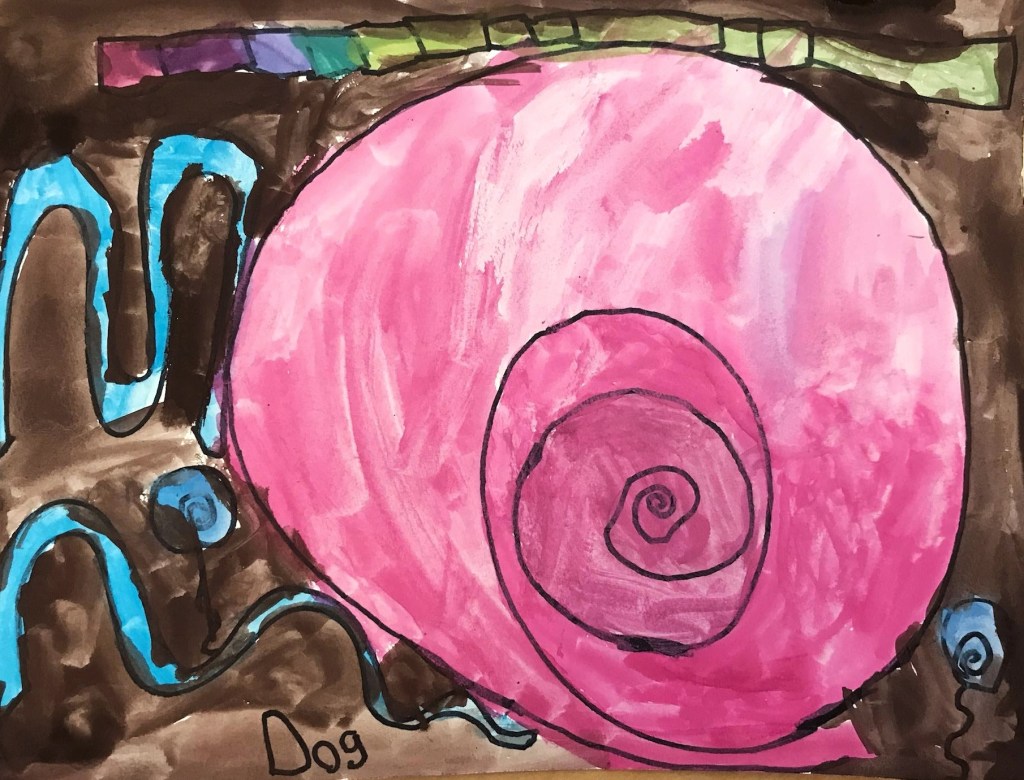
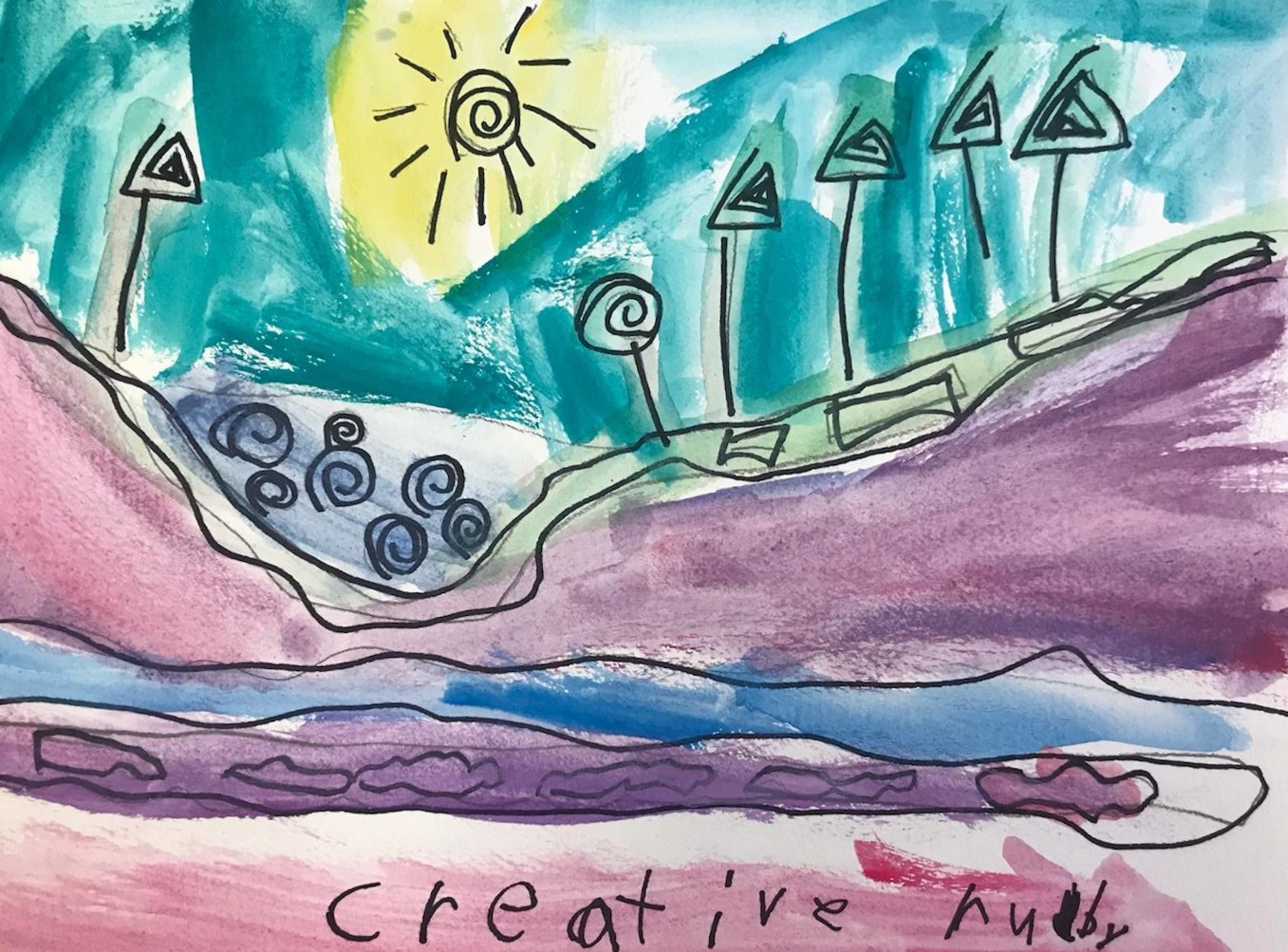
At the end of the class I heard a call “Ms. James, the artist known as Dog, would like to show you her work. And here is the work of the artist known as Creative Trees. Oh, and the artist known as Swirl, as well as the artist known as Creative Ruby, would also like to show you their work..”

I laughed out loud, and expressed my joy to these fantabulous Hundertwasser-inspired artists. Their work was amazing. Their name choices were spectacular.

I’m SO glad I took the risk and trusted the Kindergarten artists!

Their work didn’t turn out as I imagined it might when I picked Hundertwasser as our inspiration. But, that’s exactly as it should be! Their work turned out like a piece of Hundertwasser- inspired art — created by them, not by me.

A Slice of Life

It all depends on how you slice it. Pie, cake, quiche, and life. Cut it one way you have the remarkably crunchy crust. Slice it another way you get the creamy filling overflowing with delicious bits.

I’m really digging the idea that the stories we tell ourselves depend upon how we slice up that pie that is our big beautiful life. I’ve got a lot to appreciate, and it’s time I stopped overlooking those joys.


Slice of Life #1 – Glorious weather

The weather this past week has been glorious — warmer than usual. I’m not sure I’m ready for the heat of spring and summer, but for now I am enjoying the brilliant light and warmth of the sun.

Sun through the window
Warms my feet
As I sit and move
Balanced 
Upon the big red ball seat

Watercolor covered gesso 
Intrigues me
Paper protected
Colors running free
Possibility abounds

Slice of Life #2 – The woods were spectacular.

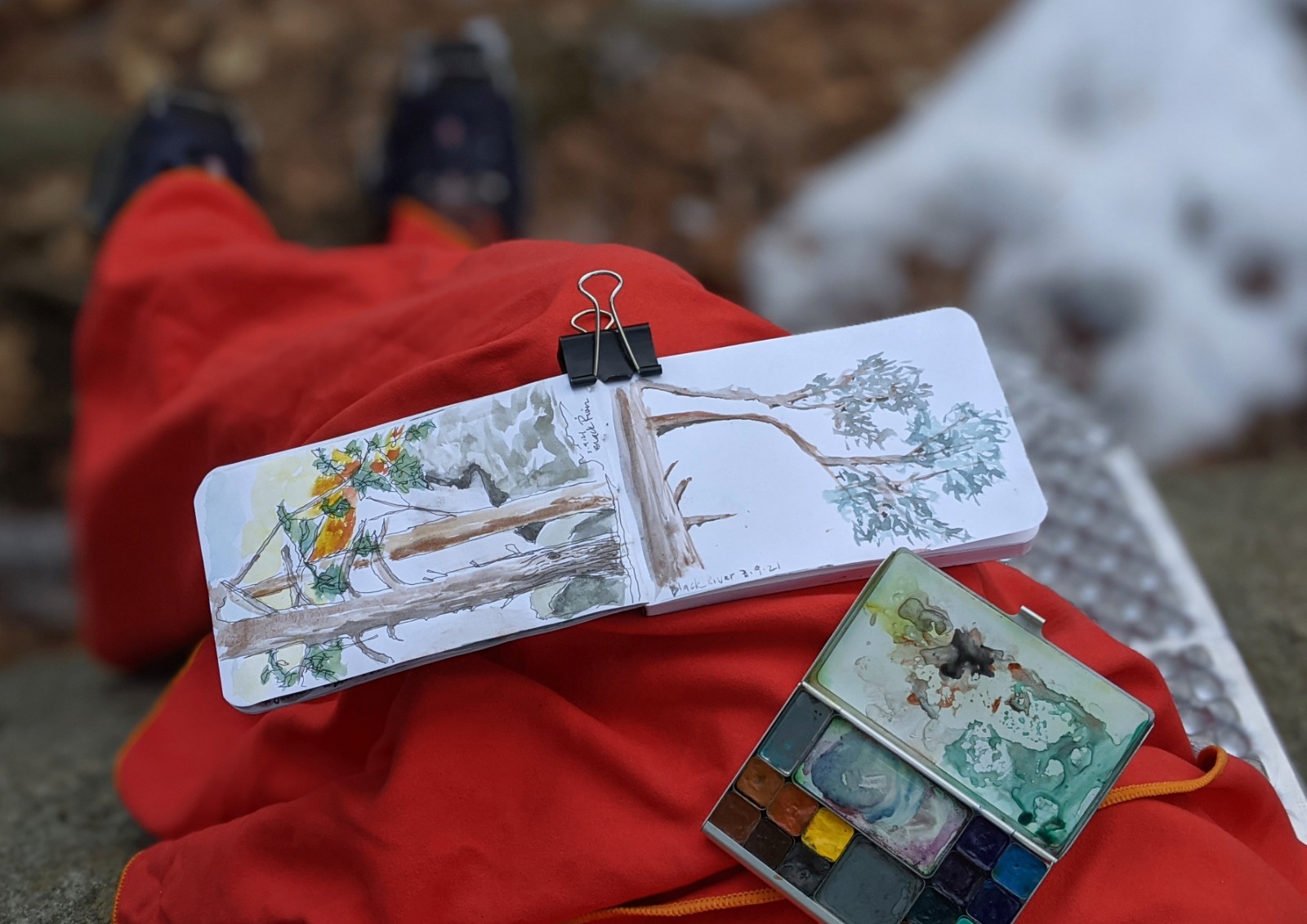
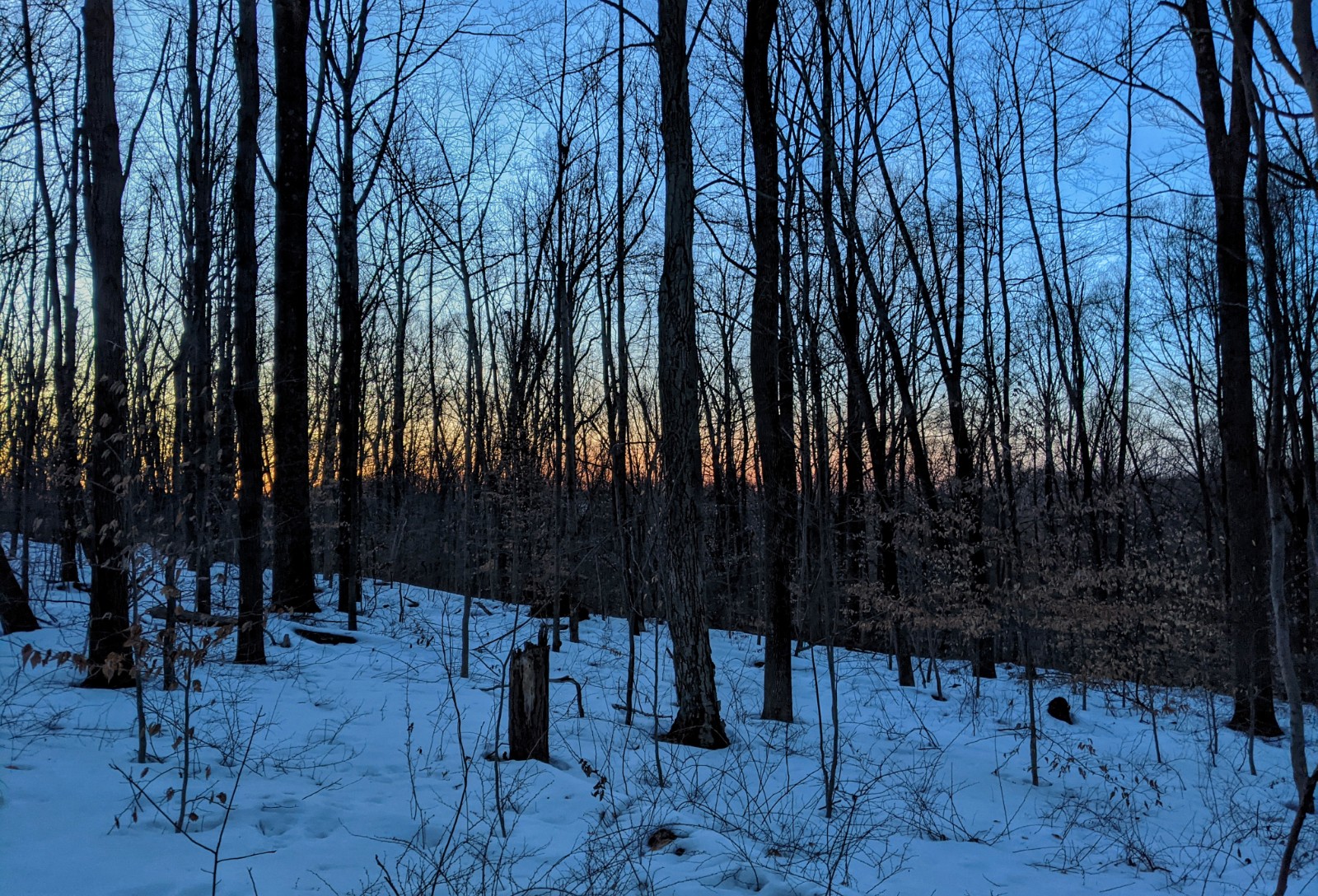
We set off on the hike with less layers, and no snow spikes. Amazingly enough, just a few feet into the woods, we encountered ankle deep snow covering the path for as far as the eye could see. Back to the car we went. Spikes strapped to our boots we set out again. 

Walking in the snow was a struggle — slipping, sinking in, pole and spikes sometimes sticking. We chuckled about the struggle, reminded one another of our growing fitness and ever present grit, and continued towards a favorite spot to sit, chat, pray, and paint. Thankfully we’ve dialed in our hiking gear fairly well, so we’re able to spend a long time sitting before the cold starts to sink in.

Talk about small joys. The list is long: 

A thermarest sitting pad
Layers, lots of layers
Woolen Wright socks – warm and thin, my perfect combo
Easily carried and eaten snacks, which happen to be yummy and healthy
Watercolors
A fantabulous travel brush
My tiny watercolor journal
My even tinier art-toolkit palette
Sun
Snow (Have I mentioned lately that I love snow?)
Blue sky
Amazing shadows
Beautiful trees
Rushing water
Chirping birds
Us 

Slice of Life #3 – A Sprawling mess

This sprawling mess of tools is taking up a rather large area of the room. I must watch my step to miss the jigsaw blade, the gigantic screwdriver, and the twist of the extension cords. 

It’s a mess for sure, but a beautiful, joyfilled, awesome mess. Why? Let me count the ways. It means I have the opportunity to make, fix, do. I have power. I have tools. I have a space. I have a brother who helps me wield these tools in wonderful ways. And, I now have a working sliding door for my bathroom. YAY!!! 

Slice of Life #4 – Creativity

Creative artistic endeavors
Feed me and fill me with joy
Acrylic paint, papers, glue
Possibilities abound

Ugh and Ah 
In the span of a few moments
The change precipitated by a simple 
Flip of the page

My fingers 
Manipulate the pieces
Ripping, moving, changing
As my eyes and brain consider

Matching spots and pieces
My fingers glue
And coax the collage 
To take shape


I wouldn’t be me if my discoveries didn’t make me think about my teaching practice.

Wouldn’t it be great if we sliced things just right for our students and their parents?

When we talk to them, let’s point out and enjoy the delicious juicy bits. Let’s celebrate all the great ingredients we have at our disposal. Let’s collaborate to change the recipe to showcase the awesomeness of each particular pie. Let’s adjust the temperature on the oven so the last bits of egg custard are cooked beautifully.

Pie, cake, quiche, life, and learning. It’s all how you slice it.

Make Lots of Bad Drawings

The full piece of advice is – Make lots of bad drawings and learn not to care. It’s a gem from Michael Nobbs in his book Drawing Your Life: Learn to See, Record and Appreciate Life’s Small Joys.

I really despise making bad drawings — especially if someone is going to see them. But somehow, the planets aligned for me when I flipped to the page that held that quote the other day. Somehow, the quote found its place in my heart and brain, and now that page is one of my favorite pages in the book.

I care about learning to draw, and being able to record what I see. I care about being able to teach others to draw. But, if I care about each mistake, each less than perfect drawing, each wonkily drawn mug handle — the ability to draw a good mug handle eludes me so far — then I will never get at what I really care about — drawing, learning, teaching, and joy. AND if I can’t sit with my own bad drawings, if I can’t embrace them, be willing for others to see them, and learn from them, then I can’t help anyone else do that either.

So I care about bad drawings, but I’m not fretting about them. I’m having fun. I’m laughing at my mug handles all askew. I’m noticing, thinking, wondering and trying again. And, every once in a while the handles look pretty darn accurate.

I started with a bit of trepidation. Eee gads, could I really do it? Could I really not care? Could I really put aside my ego and embrace a beginners mind?

All I could do was try.

I started with the first page. I grabbed a pen, and I drew it. Then I grabbed two more and drew them.

It was a great first go because it was something it could do with a bit of ease and relatively little “badness.” That ease helped my protective brain relax, and allowed my thoughtful brain to draw, learn and have fun.

I’ve been drawing little bits of whatever is in front of me. I fill in the space on the pages in whatever ways bring me joy. I am embracing, and actually enjoying, the challenge of drawing without fretting about my mistakes.

This is what we want all our learners to do — regardless of their age or level of proficiency. We want them to give it a go. Try. Try again. It’s like the creative design process. Try something. Learn something. Try again. Learn again. Talk with others. Have fun. Try again.

Ideate and iterate are two of my favorite words. That’s what Michael is asking his readers to do. That’s what we should be asking our learners to do. Have ideas. Give them a go. Stop fretting. Have fun. Learn.

I want to remember my experience with Michael’s challenge when I’m with my students. Sometimes the task in front of them may feel a bit too difficult. Instead of pushing, perhaps we can allow them to do a similar less difficult task where success is more assured. That experience may give them the confidence to try and tackle the weightier task. Perhaps, we should even construct these activities and make them a regular part of the learning process. Athletes warm up, why not learners?

There’s an archived class at the Stanford dschool called FAIL FASTER. In the course students explored ways to ​[1] become comfortable with uncertainty, [2] develop tools to navigate situations of failure, and [3] learn to turn failures into opportunities I wish that course were still being offered because I want to take it.

But, since it’s not, I’ll just have to continue to explore these things on my own, and press on teaching the Kindergarten version of FAIL FASTER!

I’m serious. This is important stuff. Failing – early and often is how we ALL learn. It’s how we learn to walk, ride bikes, spell, do math, make art, have ideas, have conversations, and collaborate — to name just a few.

Failure is NOT a bad thing. Failure is how we learn. Instead of being afraid of it, instead of avoiding it, instead of being ashamed of it, let’s embrace it, let’s celebrate it, let’s see each failure as an opportunity to learn. Let’s even develop one of two tasks where fail is expected, explored, and valued.

Some people baulk at the idea of failing early and often, or failing faster. They’re concerned it implies a lack of thinking, or the encouragement to rush rather than do your best work. On the contrary, lack of thinking, or rushing without learning, would be the antithesis of the idea proposed the the dschool.

Failing forward is a “the never-give-up attitude of being willing to fail early and often in order to learn as much as possible to produce the best possible solution through real experience.”

Being willing to fail in order to learn, and produce the best thinking, work, or product possible is a mindset I want my Kindergartners to develop with me. I want them to be confident and comfortable in their ability to try, to fail, and to learn. I want them to know it is how we ALL learn, not just how Kindergartners learn. Failure is, to quote Benjamin Zander, “Fascinating!”

If my learners, and their parents, might come to an understanding of the value of experiencing and examining failure with an eye for what might we learn, wow, that would be fantabulous.

I’m on it!