If you’re reading along with my posts, you know my recent life has been filled with caring for my dad. The stress and angst of his injury, complications, and days and nights in the hospital were pushing me to the edge. Then, my oncologist – after seeing my recent bloodwork – said, “You have got to take better care of yourself!” I nearly fell over the edge.
What’s a girl to do when she’s at the edge? Well if you’re me, you paint, write, or paint and write. I love playing with paint and words. I’m often surprised or stumped, and go through moments of deep thought and wondering, mess ups and revelations. Somehow the process brings me to a space of flow, peace, and joy.
Thinking about my process and experience, I did a bit of research to see what experts say about art assuaging angst, and aiding in health and wellbeing.
The arts also can be beneficial to your physical and mental health when you experience them — as an appreciator or creator. The American Congress of Rehabilitation Medicine says making or even just seeing art can impact the brain. Whether it’s part of a creative arts therapy exercise, or something you experience in your everyday life, art can help: *Imagine a more hopeful future. *Increase serotonin levels. *Increase blood flow to the part of the brain associated with pleasure. *Foster new ways of thinking.
Engagement with creative activities has the potential to contribute toward reducing stress and depression and can serve as a vehicle for alleviating the burden of chronic disease.
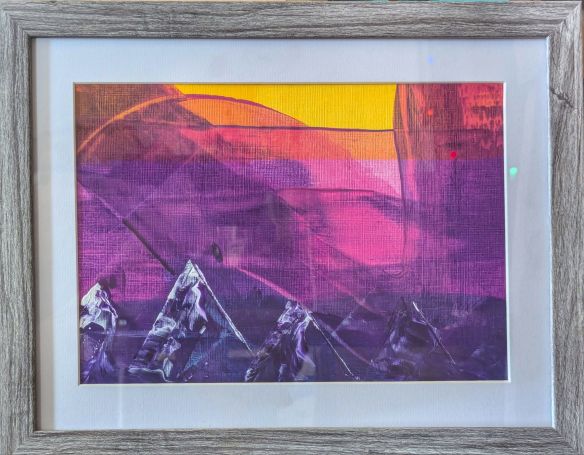
So, as I am want to do when it’s time to create, I pushed aside the many things that were in my way (in life and on my kitchen table). I surrounded myself in that small cleared space with acrylic paint, paper, an acrylic wedge, old hotel door cards (the poor woman’s answer to pallet knives), artist tape, and some hopeful enthusiasm and curiosity.
First I just sat in that tiny creative haven breathing, looking, thinking, and being. I was reminded of the invitation from our school’s art gallery curator to be part of our faculty and staff art show. In the midst of everything, the provocation of new art had sat forgotten in the back of my mind. Now, it came into my conscious mind as a beautiful opportunity.
Wonder joined my breath, looking, thinking and being. What might I do that would bring me joy, peace, and healing? Is it possible to do that, and create something I’d like to submit for the show? I decided to play and see what happened.
First I mindfully taped the edges of the paper. Then I added the paint.
At first it didn’t work as I hoped. I tried a few times to bend the paint and process to my will. Finally, I surrendered to the process and paint. Instead of trying to control it, I bent to its will, or, at the very least, cooperated with it. I began to see what was possible and beautiful, rather than what didn’t work. I switched to a more monochromatic palette and the results of my change in thought and color were surprisingly beautiful and satisfying. The things that had been so frustrating became the elements I most enjoyed.
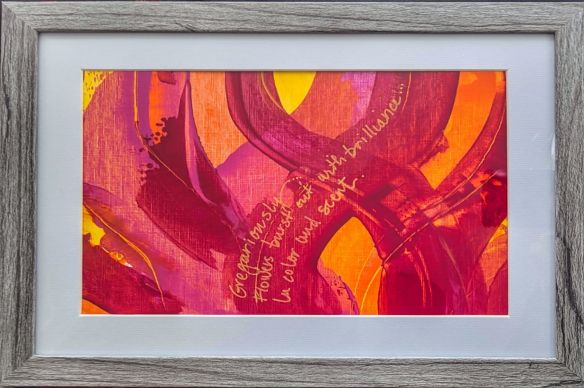
Sitting with my paintings I knew I had to add words. Haiku is a form of poetry that soothes me and brings me beautiful, quiet joy. Something about the process of forming my thoughts, and then forming those thoughts into 5-7-5 lines, changing words to match the beats, and finding unexpected inspiration in the new words, brings me into an almost parallel world of stillness. Many words flow out of me onto an old envelope. I gather them up and the haiku begins to take shape. Then, as is my usual experience, I am unable to find the right sound and feeling. I struggle on for a bit. Then I rest my head in my hands, close my eyes, breathe, and wait with peaceful expectation. As I wait, my breath deepens, my headache eases, my angst lessens, and the words appear.
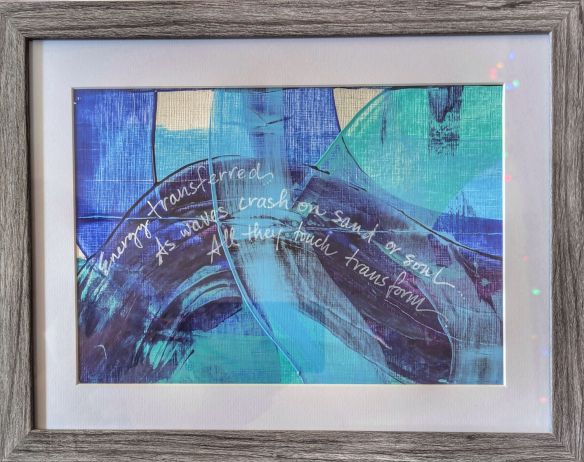
Waves Energy transferred As waves crash on sand or soul All they touch transform
Flowers Gregariously Flowers burst out with brilliance In color and scent
My brother and I are caregivers for our parents. Its a blessing in many ways, and, at the same time it’s often incredibly difficult.
These have been some of the difficult times. My 90 year old father fell on Christmas day. He broke his femur and needed a partial hip replacement. So many stressors — pain, fear, the unknown, and fatigue — to name a few.
I had hoped to ease some of my daily angst by creating a large meditative art piece over winter break, but now I find myself in the hospital with no space to paint a 24 x 24 inch canvas — could you imagine? – as my dear father (and mother) suffer.
Unable to do what I planned, I am making art with what I have in my bag. My very large art creating has turned into some of the smallest bits of creating I’ve done in quite some time.
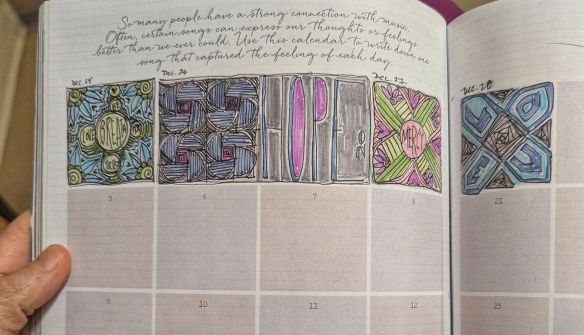
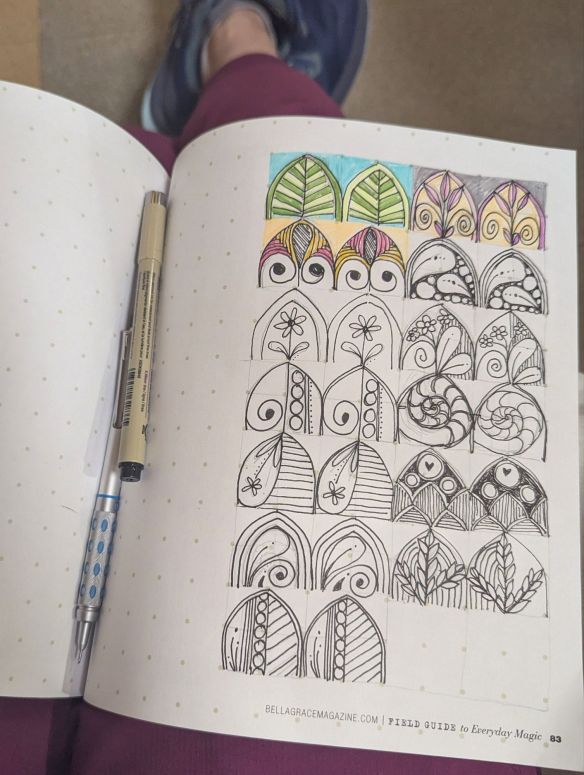
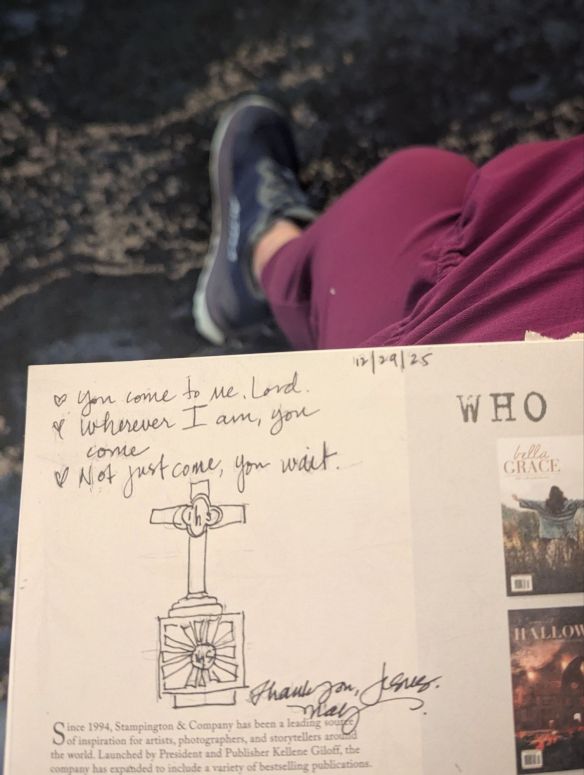
I threw the Bella Grace Field Guide to Everyday Magic in my bag with some pencils and pens as I ran out the door to meet the ambulance and my dad at the hospital. I’m so glad I did. It’s not a drawing journal, but that’s how I’m using it. I think the fact that it wasn’t made for drawing has made it an even better experience for me because it encourages me to think and play. My moments of play, focus, contemplation and creative thinking and doing have been a remarkably beautiful balm for my spirit, mind, body and soul!
Instead of songs — designs and words:
A space for my thoughts … In drawing form. I made two of each to practice. The first done with pencil then pen, the second just with pen.
This was done on a space meant for nothing but space. I wanted so much to capture a feeling and thoughts I had as I visited the chapel. As the haiku was written, and the image drawn, my breath deepened and tears flowed.
CREATIVITY Creativity What would I do without you? Surely I’d be less.
My pre-K-ers and I settled in for our read-aloud. I told them I brought seven books with me because I wasn’t sure which one I wanted to read. “I like them all … hmmm … which one shall I read?” “Read them all!” they replied. To which I responded, “We probably only have time for one or two. Let me think. (pause, look, think). OK! I got it.”
The illustrations provided us many opportunities to notice, think, and wonder. We made predictions, chuckled at some ideas, and questioned how some of rabbit and mouses ideas were possible. One of my learners exclaimed vehemently “That’s impossible. There is no way he could do that.” This gave me the opportunity to remind her, and everyone else, that when we tell stories, we are creating new worlds. As the author and the illustrator, we can decide what will and will not work in our story world. We talked about ways mouse’s and rabbit’s ideas might work out — even in real life. Our ideas were a bit fantastical but they were not impossible!
Mouse and Rabbit have many ideas, but they don’t all work. Some seem to reinforce the author’s idea that trouble follows Rabbit wherever he goes. I edited that word when I read it to my kiddos. Instead I said. “Wherever Rabbit goes there are problems to solve.” I made sure to notice and be excited by the ideas Rabbit and Mouse had and tried. I commented “Rabbit and Mouse have a great deal of ideas just like you! They’re great problem solvers just like you are!” My pre-K-ers looked at me without comment, so I asked. “Who has great ideas?” Nothing. “Who solves problems?” Again, silence. I continued. “Oh my! You should all have your hands up. You all have great ideas and solve problems all day long. I see you on the playground as you create new games. You figure out ways to include your friends. When your castle falls down in the block center you work to figure out how to fix it. If it doesn’t work the first time you try again with a new idea. You solve problems all day long!” I asked again. “Who has ideas? Who solves problems all day long?” Nearly all hands raised.
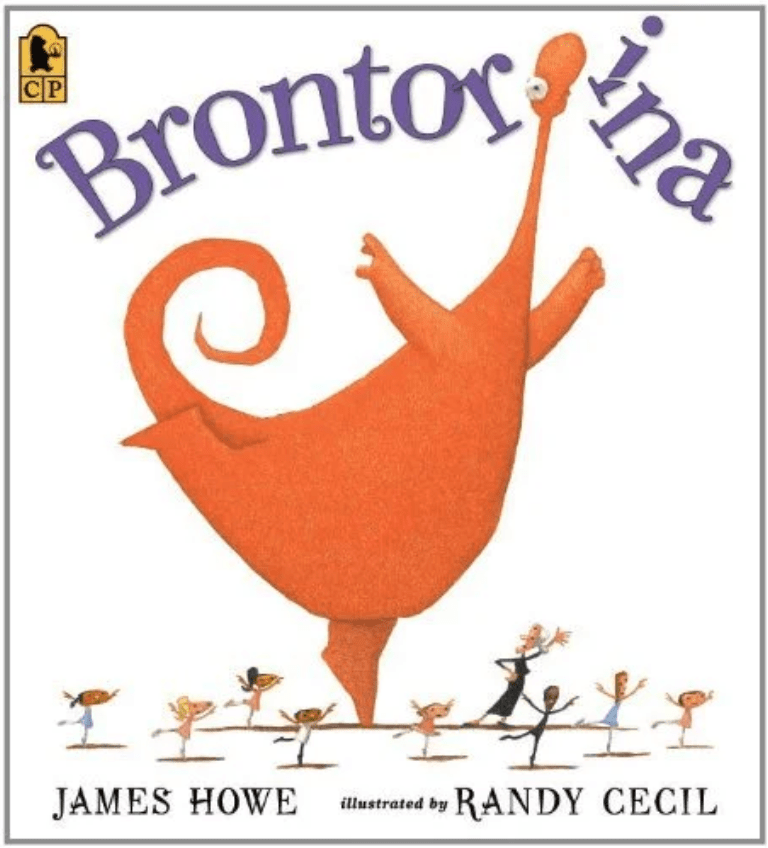
After reading that book, I excitedly told them. “Oh, yay! We have time for one more book!” I pulled Bronterina by James Howe from my pile.
As I read Brontorina, I made similar connections to ideas and problem-solving. I suggested that the two less-than-kind children should be in our pre-K class so they can learn how to be kind and how to problem-solve with their fantabulous ideas.
As I finished the story, they all sat — in, it seemed, rapt silence, and with wide eyes still on the book, they clapped! I was in awe of their awe, so I didn’t ask why they clapped. I just let us all experience it. But I’ve been thinking about it since then, wondering what it was that brought them to that moment of awe.
I am an awe-seeking enthusiast. The other day at school, I happened to notice some roses blooming. I left the path to smell them. They had such a beautiful fragrance, and it’s been a long time since I found a fragrant rose. I exclaimed, “Wow! They smell like roses!” I’m the same when I read. I’m always on the hunt, or at least open to, funny, unusual, wondrous images, joy-filled, extraordinary words, and ideas. When I read aloud to my preKinders, I try to model being an awe-seeking reader. I laugh out loud at the images, ask questions, share my wonderings, and make connections between the story and us.
Still wondering about the moment of awe with my kiddos, I Googled Deborah Farmer Kris, author of “Raising Awe Seekers” — a great book, by the way. I hoped that she would share a nugget that might help to explain my kids’ awe. She had several. Here’s the one that resonated most deeply:
Both books are stories about kindness. I’m so glad my pre-Kinders and I took the time to slow down, and talk about ideas, kindness, and each other — and experience awe together. It was a stellar moment.
We had a birthday celebration today in pre-K, and as the kids were enjoying the birthday treats, the birthday girl’s grandmother asked how I liked pre-K compared to Kindergarten. (I started teaching pre-K this year after 18 years in Kindergarten.) What a great question!
How do I like pre-K compared to Kindergarten? There is so much to love about Pre-K — so much possibility, so much joy, so much fantabulousness. There was a lot to love about Kindergarten too. It’s a gift to hold on to all of that awesomeness, and now have new opportunities, new teammates, new learners, new relationships, and new fantastic parents in pre-K.
So, what do I think about pre-K?
Oh my gosh I love the kids. They are brave, curious, joyful humans. They love to laugh, try things (sometimes with a bit of encouragement or a willingness to be with them). They are wide open to wonder, and awe. And they are always learning, making, and sharing.
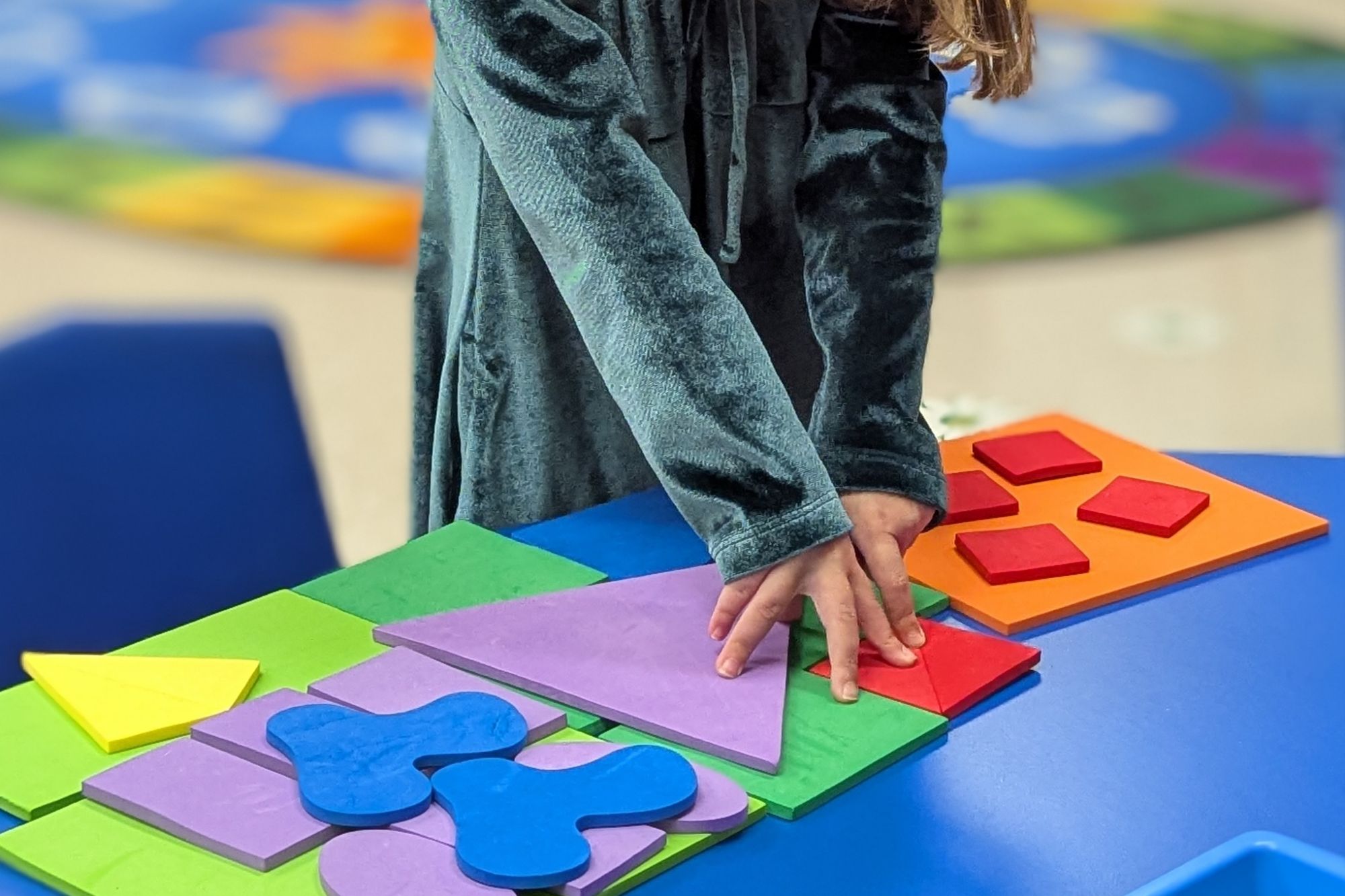
Today one of them asked if I’d come with her to our math center and make things with shapes. (Yes, please!) At one point, I asked her what she was doing. She had been giving me a running commentary, but had stopped. She replied, “I’m making it better. … See?!” Another friend joined in with equal enthusiasm.
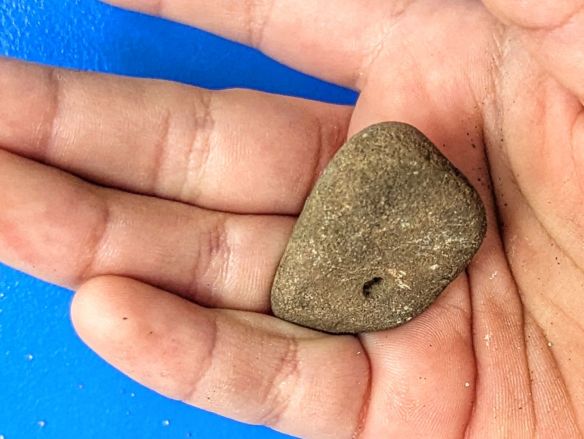
The other day, we took an “Oh WOW! Walk” outside. The super scientists looked for things that tickled their fancy through one of their five senses. They collected these things to share with one another. One mighty pre-Ker showed me her stash as she tried to decide what to take home and what to leave in our science trolley. She had several rocks. One in particular seemed to be a treasure.
Me: “Can you tell me about that rock?” C: “Oh! This rock has a belly button!” Me: “Come on!!! A belly button??!! Get out!” C” “Look!”
I laughed out loud! She was right. It was a rock with a belly button! It may sound silly to you. But, think about her thinking. She noticed similarities between this rock and a belly and belly button. She was able to use her imagination to put those noticings together. She found joy in her musings, and was courageous enough to share it with another. These are the skills, and habits of mind that are used when we problem solve and create things as yet unknown. Once again it is not the simple cuteness of the young, it is the beginnings of profound critical and creative thinking.
Another thing I’m grateful for in pre-K is time. I’m super grateful for, and really enjoy, the extra time there is to simply be in pre-Kindergarten. This gives us the opportunity to talk, share, develop relationships, play, explore, create. and learn. Today one of the girls was missing her mom. At the end of the day, she came over to me and told me. I asked her if there were anything I might do to help her. She said no, and just quietly stood next to me, her face devoid of joy. Then, she began to button the buttons on my denim jacket. She didn’t ask if she could do it, she just began to button them. Her sadness turned to determination and joy as she checked and buttoned each button — even rolling down my sleeves to button the cuffs. It was as if she felt and embodied the care and love of her mother, as she took care of me by buttoning my buttons.
Oh, and then there’s car line. When I first started teaching, we did Kindergarten car line in the morning and after school. It was something I loved because it allowed me to get to know the parents a bit, and interact with them and their children together. We stopped doing it in Kindergarten a few years ago, and it was something I’ve always missed. Well, in Pre-K we get to do it again. I’m happy to be back interacting with parents each time I have the opportunity to do carline.
And, oh my gosh, Jr. Pre-Kers! They are a joy to get to know. Since I’m in Pre-K, I get to help take the JP-Kers out of the cars, and sometimes see them before and after school. We’re working on learning each other’s names, and as they remember mine, they joyfully call, “Ms. James! I know your name!” I love the joy, the connection, and the feelings of accomplishment – for them and me.
So, to answer that Grandmother’s question as clearly as I can. Do I miss Kindergarten? I do. But, do I love PK? Yes, I do! Are the kids fantabulous? Yes, they are! Are the parents marvelous? Yup, they sure are! Are my teammates amazing? Indeed! Are the possibilities awesome and limitless? Yes! So, I breathe on, learn, grow, love, be me, and enjoy it all.
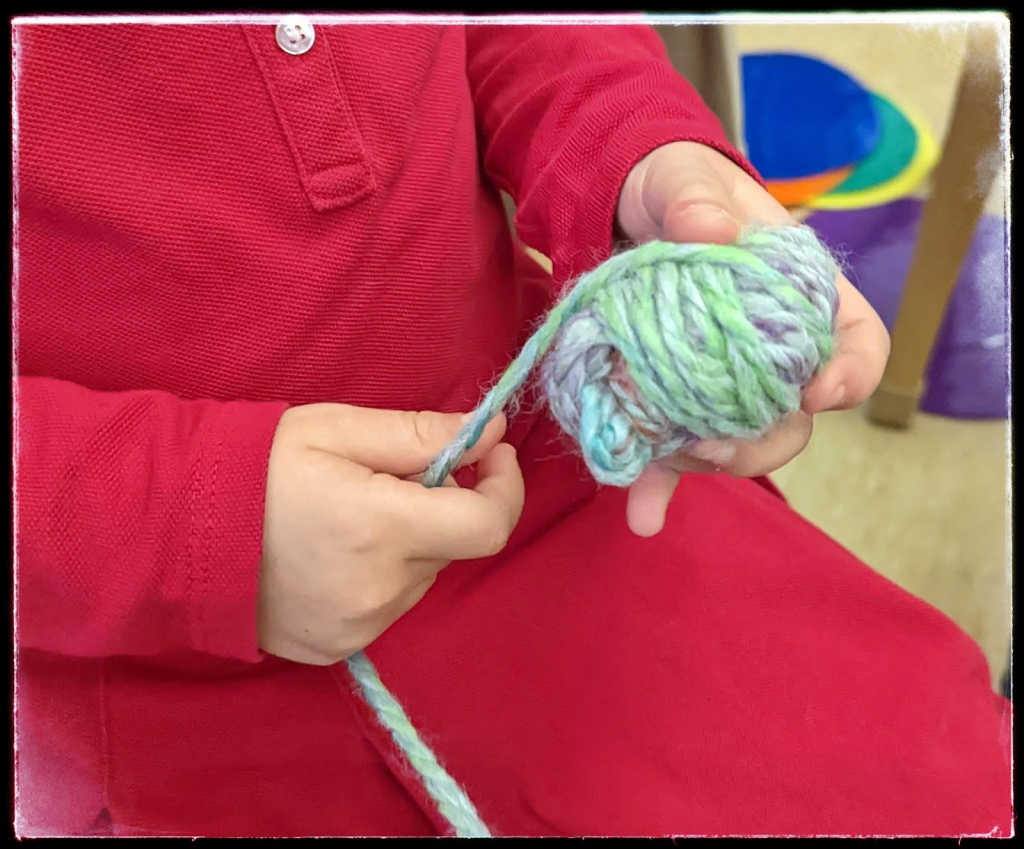
My learners love to finger-knit. It’s a never-ending source of joy, creativity, flow, and peace. When we begin, I show them two methods of finger-knitting, and then they choose their favorite way to continue. Amazingly, every year, after working with my two methods for a bit, my learners develop their own iteration of finger-knitting and teach it to me. Soon, they take over my job of teaching others how to finger-knit, make the beginning slip-knot, and wind yarn balls.
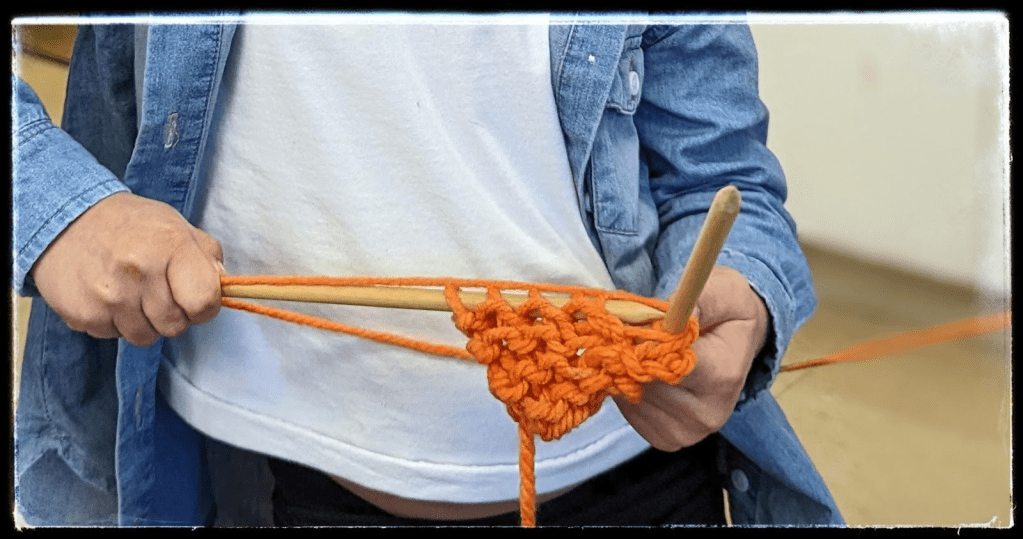
Soon after they learn to finger-knit, they are curious about the knitting needles I have in the classroom. They begin to ask questions: Can you knit with sticks, Miss James? Did you knit that on sticks? What else can you knit on sticks? Their curiosity turns to wonder and awe as they discover I know how to knit with sticks and have made many things. One by one, they ask me to teach them to knit with sticks.
They wait patiently – or not so patiently – for time and sticks, so that they can be the next knitter. At one point, five of them had work on the sticks, and I was commissioned to make more sticks so that they could all knit.
Whether they knit with fingers or sticks, the process is one of grit and growth. First, I show them, often helping them move their hands, fingers, or sticks. Frequently, they make mistakes. Sometimes they forget a step. Other times, their knitting falls off their fingers or sticks, and they accidentally pull it all apart. We breathe through our angest, and rehearse the movements and the words that describe those movements: Make a loop. Put it on your finger. Wrap the yarn around your finger in front of that loop. Don’t make it too tight! Now pull the loop over that piece of yarn. Once that’s done, pull these two ends. Finally, we celebrate and encourage: You got it! Now do it all again – over and over until you’re done.
After working with me, they work on their own – sometimes in close proximity to me, sometimes with a group of other knitters. They frequently check in, asking, “Is this right? Can I take it off now? Can you fix this, Miss James?” As their competence and confidence grow, they begin to say, “Can you teach me how to do it so I can do it by myself?” If, when helping, I miss their aha moment, they say, “Miss James. I can do it. Would you let me do it?” My response is always, “Yes, of course!” More often than not, the exact same words begin to greet me in reading, writing, and math. “Can you teach me how to do it so I can do it by myself?”
Finger-knitting is a shared experience of creating, taking chances, trying, problem-solving, teaching, learning, using tools, and creating a valuable and genuine product. It’s a lot like being a writer!
If you aren’t a knitter (finger or sticks), there are many wonderful resources online to teach you. However, it may be better for you to consider the ways you create and make in your own life. What creative love do you have that you can share with your learners? When you do it, do you have to take chances, try again, problem-solve, learn, use tools? Do you create a valuable and genuine product? Then it’s a lot like being a writer, perhaps we can consider it pre-writing skills since we are growing the mindsets and habits of a writer. Weaving, cooking, collage, mark-making, origami, calligraphy, or embroidery may be your jam; use them. Your excitement, joy, peace, and curiosity will spark the same in your learners and motivate them to give it a go.
As you and your learners engage in the creative process, you will learn about yourself, your learners, and the process. I am always amazed at how much I learn about something I have done forever, as I listen to and watch my learners. Sometimes, as we work, we work in silence, absorbed in the struggle of learning or the peace of flow. But often, we employ one of HGSE’s Project Zero’s Core Thinking Routines. We notice, think, and wonder, and share our thoughts with one another. This thinking routine allows us to verbalize what we are doing with our hands, share the new things we notice about the yarn and how it works, think about and share our thinking, create new iterations, notice similarities and differences, get suggestions from others, talk through our struggles, and celebrate our successes.
As we knit together, I noticed how often we use the phrases – first, then, next, after that, and finally. I realized this shared passion was a way to make the concept of beginning-middle-end-thinking concrete for my young learners. If we could notice the concept of beginning, middle, and end in our repeated experience of finger-knitting, perhaps we could translate that into the use of beginning, middle, and end in writing.
I set a task for my learners the next morning. During Investigate and Explore time, they were to finger-knit. My instructions and explanation were intentional and specific. “Everyone must finger-knit so you have it fresh in your big, beautiful brains for writing. As you knit, use our Notice-Think-Wonder thinking routine. You can use it by yourself or with friends. I particularly want you to think about how you are knitting. What steps are you taking? Do you always do things the same way? Notice. Think. Wonder.”
Finally, writing time arrived, and my learners peppered me with questions. “What are we doing with finger-knitting, Miss James? How is finger-knitting writing? What are we doing? Can we finger-knit again now?” As they settled in, I explained that we were going to teach others how to finger knit by explaining what we do first, then, next, after that, and finally. A plethora of hands raised, as ideas tumbled out of their mouths. I asked them to breathe and hold their excitement while I finished my explanation.
“First, I want you to work with a partner. Talk about your process. Notice what is the same and different. Think about what is possible. Do you both start and end the same way? Are you middle steps exactly the same? Do you explain them in the same way? Why or why not? Use our learning question What makes you say that? to discover what your partner is thinking. Show your partner what your words mean by finger-knitting for them. Use your art sketchbook to draw pictures. This might help you try things out and will give you a guide as you write.
Then, write and illustrate your process – your finger knitting steps – so others can learn to finger knit. Please remember to use the words first, next, then, after that, and finally. After that, share your work with your partner. Finally, when you are satisfied with your process and product, come share it with me.
Everyone – even my writers who struggle – was successful. Everyone – in word, action, and illustration shared a possible finger-knitting process iteration using beginning-middle-end-thinking. It’s only a first step, but it’s an important step in their life and growth as writers.
(Translation: First, you take it out of the finger-knitting basket. Then I do a loop and I start finger-knitting. Then I talked a friend to help me.)
These images are of my Kinders over the past few years. This year I’m teaching pre-Kindergarten. Just like my Kinders, they love to learn how to do things, and then do them — even when they’re hard things. And goodness gracious, they love to make things. I’m excited to teach them how to finger-knit, and to be their scribe as we construct first, then, after that, and finally finger-knitting plans.
My uncle — a devotee of Henri J,M, Nouwen — recently recommended Nouwen’s Here and Now to me. He assured me “You’re going to like it!”
He’s right, I do. But I wonder if he thought my like and inspiration would start with the acknowledgments and preface?
The acknowledgements reminded me of the importance of friends who give help, support, and time. Henri expresses gratitude for their “competence, kindness, and generosity.” He continued to express gratitude to others who gave him “a safe home away from home.” I love all of those things: friends, seeing the blessings given us in and by our friends, expressing gratitude, and perhaps most touching to me right now “a safe home away from home.”
A safe home away from home. My first thoughts go to a lovely couple who rent a B&B to me each summer. They couldn’t be more kind and invested in making their home a safe home away from home for me. Then my thoughts go to my aunt and uncle, who for years hosted my mother and me for each of my Dana-Farber visits. What an incredible blessing both these homes away from home are to me. I can’t imagine my trips without them, and the people who make them amazing.
Then, my thoughts turned to a different sense of home. Not a building but a feeling, not a physical space but an emotional one. As a friend, a teacher, a human, I am called to do that for everyone I come in contact with. Do I make time for the person who helps me in the grocery store or the Post Office, or do I rush through the moments that could create a small moment of home for them? As a friend, do I take the time to stop and listen, giving my friend my time, energy, and the intention and wish for safety and happiness? For that matter do I do that as a daughter and sister, or do I take our home and love for granted and crank instead? When I do, that energy removes a bit of the safety and love of home.
And finally, what about as a teacher? Is my classroom a safe home away from home? It is my goal and hope. Does the fact that my Kinders frequently call me mom mean I’m doing it? Perhaps. When they come in with joy and eagerness, willing to take risks, perhaps it’s proof my hope is realized. Even so, I am never complacent — or at least mostly never. I try to watch, listen, reflect, and talk with my students and their parents to learn if they are feeling safe, happy, welcomed, and at home.
A parent I just met at the end of last year was telling me about her experience of my learning space. She commented on its beauty and the fact that it clearly showed the care with which I curate my space. Then she said, “Your space is beautiful — your chair, the lovely things hanging from the ceiling, your tree, the lights. When I walked in, I felt like I was home.”
Wow.
I’m teaching Pre-K this year. I’m sad to leave my Kinders and all the fantabulousness we have co-created there. My sadness is totally ok, acceptable, and right. As it comes, I feel it. Then I breathe and remind myself there are endless possibilities of fantabulousness and home to co-create in Pre-K.
Kindergarten has been a safe home away from home for me and all the Kinders I’ve been blessed to have with me for all these years. Pre-K will be another safe home away from home. How do I know? Because I will be there, with my marvelous teaching team, the amazing Pre-Kers and their remarkable parents. Together, we will co-create a safe, beautiful, joyful, and magical home away from home filled with delight, curiosity, exploration, and learning.
Relationships are powerful and essential components of learning.
I’m not the only one who knows this is true. Many educators — from Vgotsky, to Frances and David Hawkins, Harvard Graduate School of Education, and Reggio Emilia (and RE inspired educators) — speak of the importance of relationships for learning, understanding, creating, and thinking.
Inspired by Reggio Emilia I value relationships between parent, teacher, learner, and the environment. – and do my best to cultivate them. And, not just my relationship with each of them, but their relationships with each other. Through these connections, learners develop relationships with:materials, thoughts and ideas – their own and others, themselves, play, other learners, and the importance and value of struggle.
I’m always reminded of relationships as the school year ends and my summer begins. My relationship with time, energy, rest, exploration, play, creativity and my own physicality are blessed with opportunity and possibility. And of course, my relationships with my current learners and parents transition and change.
I never cease to be amazed (and edified) as I experience the power, essentiality, and inspiration of these relationships from learners new and old. I never take for granted the gift it is to bump into a former student, or receive a note in my mailbox. Here are a few that touched and reminded me of the power of these relationships.
An 11th grader saw me moving things around in the classroom. It’s a normal part of my end of year routine — but not a normal one for her.
11th grader: “What are you doing, Miss James?” Me: “I’m moving some of my things out of the classroom.”
A look of confusion, then shock and horror, crossed her face. She asked a string of questions in rapid fire: “Are you leaving, Miss James? You’re not leaving are you? You can’t leave! What will the Kindergartners do? What would we do? You can’t leave!”
I took a breath, as I looked into those loving and panicked eyes of hers, and said, “Nope. I’m not leaving. Just moving some of my things.”
She looked at me as though trying to decide if I had told her the truth. Then she took a breath and said, “Oh, good. We need you.”
Then a 7th grader left me an amazing letter in my mailbox telling me about how I — and the way I teach Kindergarten — has continued to impact her life and learning. “Even though it’s been a while since Kindergarten, I still remember how your creativity, kindness, and positive energy made learning so much fun. You helped build the foundation that inspired me to grow, explore and believe in my myself. I’ll always be grateful for the start you gave me.”
And then there’s my sweet Kindergartners. One mom emailed me to share her daughter had been asking when she might have a playdate with me! And then, I a letter in the mail from another KJer proclaimed “Miss James. I love you. I loved being in KJ. Thank you for a great year. You are the best teacher.”
I know they don’t have a lot to go on when they proclaim me the best teacher. I understand it means they have experienced goodness, kindness, and acceptance in me. It means they have experienced and know that I am their (to quote Rita Pierson’s TED talk) “champion, an adult who will never give up on them, who understands the power of connection, and insists that they become the best that they can possibly be.”
Never underestimate the power of love, joy, relationships, understanding, acceptance, and dogged determination that we should all be the best we can be.
And (if you’ve read my previous post) never be afraid to share the joy of your art — cause we are all artists — with others. The crane’s flying soon!
Looking for summer art inspiration I picked up Sarah J. Gardner’s book Share your Joy: Mixed Media Shareable Art. Just now, looking for a link to share with her book, I came upon Sarah’s website — complete with a blog, tutorials, learning possibilities and, as her book suggests, joy.
I have a zillion art books. A zillion? Perhaps not, but for sure a plethora of them. Is her book filled with brandy dandy new ideas I’ve never seen or imagined? Nope. Is it fantabulous and inspiring and bringing me joy? Yes, indeed it is!!!! There are so many beautiful things about her book — the colors, the photographs, Sarah’s spirit of joy and exploration, and the idea of sharing art in easy to manage, don’t fret too much, small art pieces.
It’s been just what I need for a hot summer that has felt stifling in many ways. I’m grateful that I found her book and her site. I’m creating small things, enjoying the process, and excited to send small art treasures to friends.
The other day I wandered the aisles of a local craft store. A gift card was burning a hole in my pocket but nothing struck me.Then I found a fab set of alcohol ink designed origami paper. Much like Sarah’s book, I bought it for beauty, joy and inspiration.
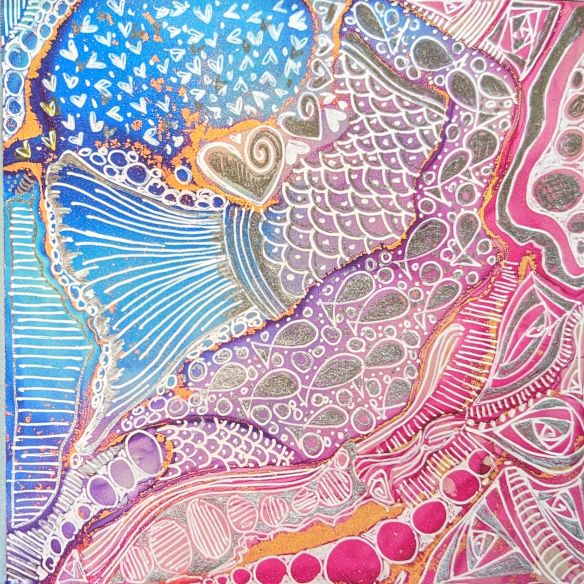
Back home, I wondered what to do with the paper. It seemed a bit of a waste to simply fold them. So much of their beauty would be hidden inside the folds. Flipping through the pages, admiring the colors and metallic designs of the ink, I grabbed my metallic pens and started tangling. At first I added strings, but as I did more pages I began to look for inspiration in the shapes on the page. It was a blast — relaxing, creative, enjoyable.
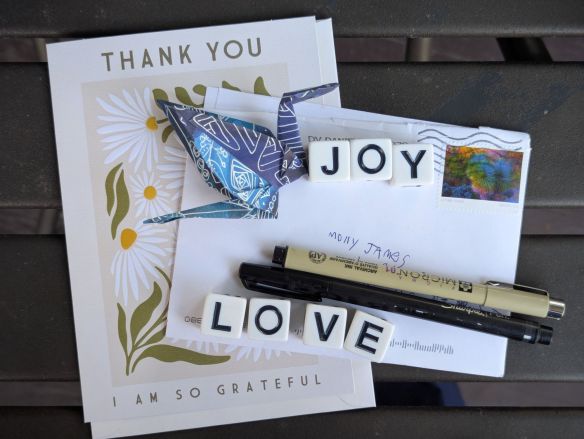
After tangling, I folded a paper crane, and sent it off to a friend in need of a bit of joy.
I made another and set it on my art desk along with a decorated but unfolded piece of paper. Passing it one evening I thought, “Oh!I have the perfect person for that crane!” She’s a fantabulous human who values creativity and joy. She’s had a bit of a rough time these past few months, so sharing joy and art seemed perfect. The package grew to include an unfolded piece of decorated paper along with the folded crane. Then, while brushing my hair I thought “Oh! I should send her an undecorated piece of paper, too! That way the joy is three fold — a finished piece, and two unfolded pieces — one decorated and one not — that she can use for anything she wants.” Can’t wait for her to get it.
Oh wait! I just had a thought. The joy is 5 fold because I get joy of making and sharing! YAY!
Life isn’t always easy. Sometimes it’s downright hard. For a plethora of reasons, now is one of those downright hard times. So, what do I do to help combat the overwhelm and find a sense of peace and control? Clean, rearrange, go through things, be inspired, or if I’m not inspired, purge.
Today I found inspiration in a sketch I did with my Kinders, and an end of course assignment from IDEO’s Creative Leadership program.
Crowned with Hope
This sketch is from an assignment I gave my Kinders. Who are you? How might you change the world. I sketched myself as the Queen of Hope, or perhaps just as myself, an ordinary human, gifted with a headpiece of hope. Did you know the first definition of headpiece on merriam-webster.com is “a protective or defensive covering for the head.” Imagine! Hope is protecting and defending me!
Hope is a wonderous, powerful thing. It enables one to face and fill the unknown and the what ifs with positive possibilities. Instead of imagining the worst, hope encourages us to use our imagination to see and create the bestpossible next moment.
I’m reminded of an A.A. Milne quote:
Supposing a tree fell down, Pooh, when we were underneath it?’ ‘Supposing it didn’t,’ said Pooh after careful thought. Piglet was comforted by this.
― A.A. Milne
Hope seems to travel with encouragement and possibility. After the sketch, I stumbled upon the letter I wrote myself as one of the final assignments for IDEO’s Creative Leadership course. If you’ve never written a letter to your future self, you might want to try it. It might feel silly. Do it anyway. Perhaps imagine yourself as someone else you are coaching. Be honest and encouraging. The process and product are powerful, and a lovely gift to your future self.
A Letter From Me to Me (Do you get the reference? It’s a gift Dave, from me, to me! )
Dear Molly,
You rock, girl! I love the path your life is taking. It’s awesome to see you continue to move forward with relentless positivity and joy. You really are fantabulous. Don’t ever doubt it!
The IDEO course was awesome, wasn’t it? I’m glad you engaged in the struggle, and had a lot of aha moments!
I’m so psyched you’re going to continue to listen, take time, and engage — eye to eye! I can’t quite decide which is most important, so I’m going to rant a bit about each. You’re shocked aren’t you?!?!!! (Not! lol)
LISTEN Listen with your eyes, your ears and your heart! Listen to yourself, your students, your colleagues, your intuition. Listen to the questions, the answers, and the lack of answers.
TAKE TIME Take time to ask a plethora of good, open ended, encouraging, hopeful questions. If you can’t think of any, take a bit more time, have a cup of tea, and trust they will come! Experiment, ideate, iterate and just have fun. Invite others to join you. Oh, and don’t forget about yourself!!! Feed your soul, and your creative self — breathe, pray, make, think, do, and just be.
ENGAGE — EYE TO EYE It’s so important, and so awesome, when you do this, Molly! Some of the most amazing times are when you engage, eye to eye, with those around you — especially those young students of yours! Don’t let others, or the job, or time, or anything else, rob you of this great joy and privilege.
Through it all, Molly, believe and trust. Believe in yourself and your creative team. Believe in the profound power of learning, relationship and creativity! Trust your knowledge, your intuition, and your awesomeness!
You have a strong point of view about your students, life, learning and creativity — – and it’s a profound one, Molly! Continue to embrace it, share it, grow it and live it!
You create cultures of trust, joy, positivity, possibility, inspiration, collaboration, creativity, learning and transformation, Molly. You encourage curiosity and a willingness to risk. And when there’s failure — and there so often is — you work to help your team, and yourself, accept it, learn from it, and move on with relentless positivity.
You are present and engaged, in really beautiful, powerful ways. Making space for your self, others, questions, possibility, creativity, joy, ambiguity, tension, mess and even chaos, is a gift, Molly, and you have it!
You really are something else, Molly. I can’t wait to see what the future holds. I’m sure remarkable things will come from your new thoughts, ideas, learning, and practice.













 Life lived with relentless creativity