I’ve been having my Kindergarten artists work in a sketchbook before they tackle the blank page of their final piece. I want them to get used to the artist practice of sketching without fretting, and without erasing. I want them to have the freedom to try all sorts of things without the concern that sometimes comes when they are creating their final piece.
They’ve been doing so much good work. They are filling the pages of their sketchbooks with a plethora of fantabulous experiments. Their faces beam as they show me their work, tell me if they love it or have more to add, and give me virtual high fives (which become high one hundreds) through the classroom D10.
This week I decided to try something new. No sketching. No exploration. No pencils. Just a sharpie, our big beautiful brains, awesome hearts, courage, and creativity! At least two colleagues chuckled and said “You are a brave woman!” I responded, “Nah! They can do it. I know they can. I’m going to tell them that!” I paused, and laughed, and then added, “And then, I’m going to cross my fingers, and hope for no crying!”

When art rolled around last week, I did just that. I started sharing that I have a sketchpad and often do sketches before I paint. But, other times I just use watercolor or pen and ink directly in my journal. As I spoke, I shared some pages from my hiking art journal. “That’s what we’re going to try today – no sketching, just being free and working directly onto our watercolor paper.” No one said a word, and since I’m on the D10 I can’t always read their facial expressions. I kept going forward. “You can do it. You’re amazing artists with big beautiful brains, awesome hearts, and lots of courage and creativity. … Are you ready?” Shouts of “Yes!” were music to my ears. With a huge smile on my face I said. “Awesome. Let’s get started.”
I led them through a few steps to create the shape of the face — complete with the asymmetry, unusual scale, and a crown we noticed in Sandra Silberzweig’s original piece. I encouraged them to follow along, but to also make decisions as the artist of their piece. Once we had finished the outline, I set them free to add details. I suggested they take time to look, and think as they drew.
The learning space was quiet as they created. I worked, and waited, with all my fingers crossed.
I am overjoyed to report that there was no crying! There was only excitement, enthusiasm, joy, and awesome art making.
Look! (There’s more, but I figured I’d just share a few.)
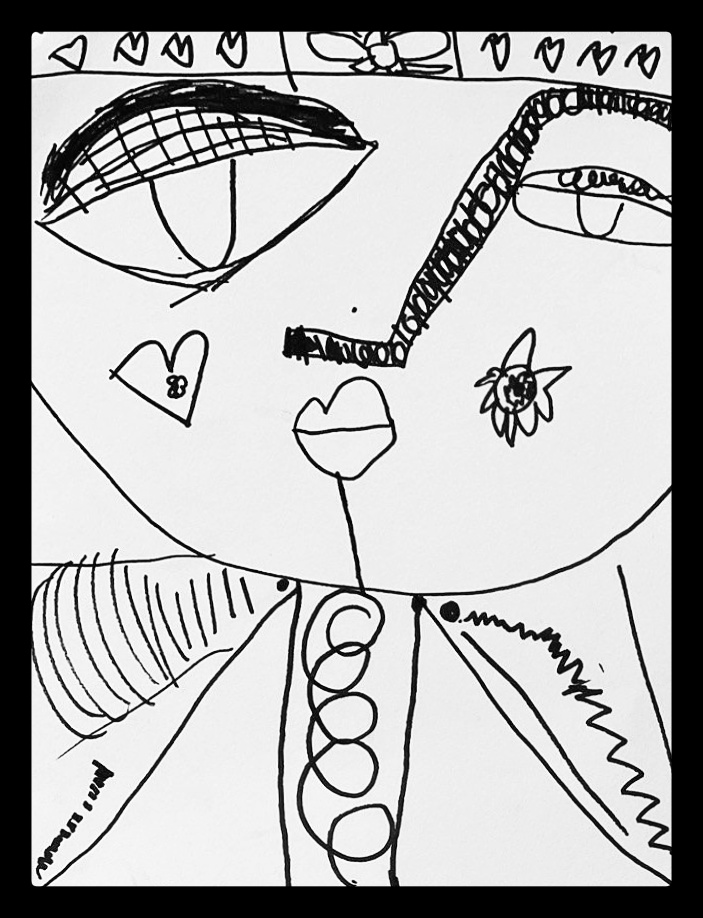

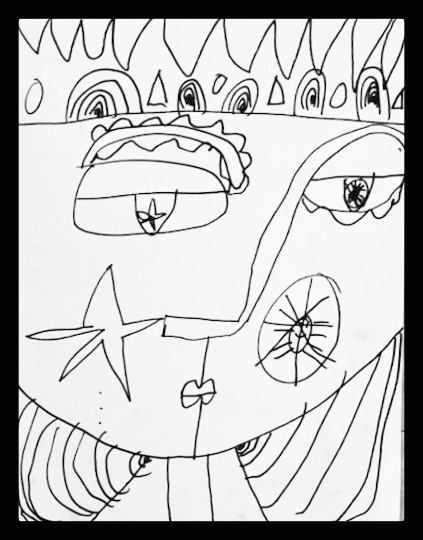
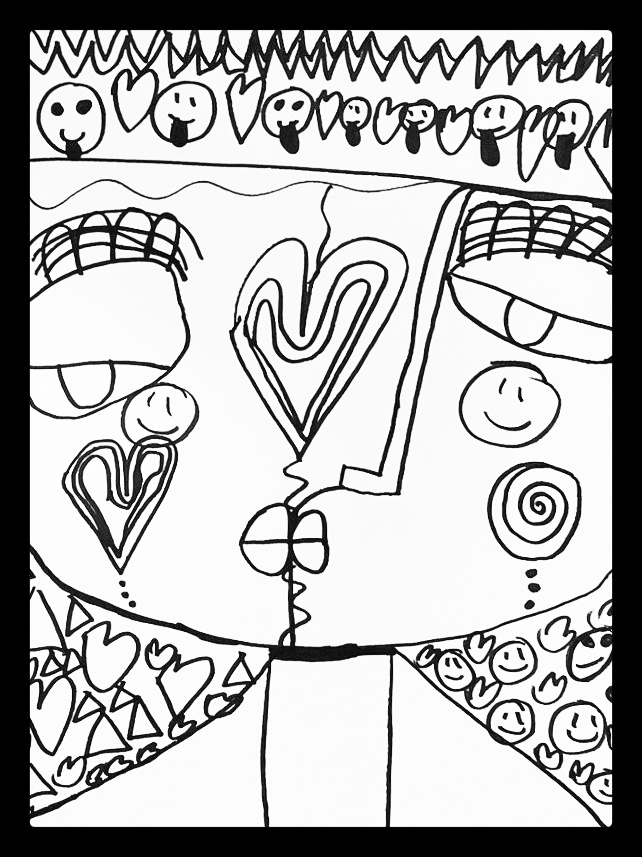
These young artists aren’t artists because I think they are. They’re artists because THEY think they are. They’re artists because they’re noticing, thinking, wondering, trying, making decisions, and creating their own art. They’ve embraced themselves as competent artists, and creative thinkers who can have ideas, think creatively, take risks, solve problems, and make great art. They are artists, they know it, and they’re loving it! So am I.
That confidence, and ability to think, and take a risk– without tears — doesn’t just show itself during art. It pops up often, and each time it’s a joy to experience. Most recently it was wonderfully evident in a homework assignment I gave them to record a video on flipgird,.
If you’re a teacher and you’ve never tried flipgrid, give it a go. It’s a great platform for you and your students to share ideas, comment on the ideas of others, be inspired, and help one another problem solve. When they record, my students practice oral literacy skills in a friendly pressure free arena. I smile each time I decide to redo my video and get the “You got this! Try again” message. A bonus is that flipgrid provides us with playful opportunities to add boarders, stickers, writing, and other fun ephemera to our videos and screenshots.
Pre-covid we did a lot of block building. When we build with blocks we play and learn. We think creatively, critically, and spatially — and we grow in our ability to do so. The somewhat transient nature of block building allows for lots of ideas, quick iterations, struggling, failing, succeeding, problem solving, learning, and sharing — all while having fun.
When Covid hit I looked for ways to to engage and grow my students imagination, creativity, courage, spatial muscles, grit and resilience through building. I wanted a building option that was compact, portable, open ended, and relatively inexpensive. I finally decided on Plus-plus blocks.
Now that I’m back — but remote — my challenge was how to share all of the greatness of our time together in the Kindergarten Makerspace making all sorts of cool block builds when we weren’t in the same physical space. I decided to give flipgrid a try.
I created a flipgrid homework assignment. I encouraged my students to play with their blocks, create things, and then record a video showing what they made, what they learned, and what they still haven’t figured out. I posted my own video in response to the assignment sharing some of my struggles and asking for their help.

The things they made were fantabulous.
Here are a few:
A baking bird – brown and white for brown and white sugar.
A statue – which when you add the baking bird to the statue now has moveable arms.
Two cars and a garage.
A rainbow bridge, a sidewalk, and a bracelet.
Saturn, Jupiter, the sun, and Momo and his magic wand.
An adjustable ring, a flag, a plane that transforms into an eagle.
A cookie and apple who become friends.
Flower and all the characters needed for the story of her escape.
A girl named Anastasia
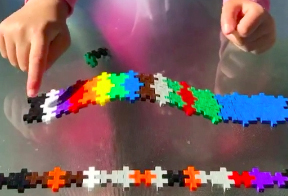


But, what really struck me was the builders themselves. I saw those same awesome artists simply working in a different medium. They shared their ideas bravely. They offered suggestions. They asked and answered questions. They explained their thinking. And, they interacted with their blocks in ways I never imagined — crafting stories and making connections.
One of them said this: “I love these blocks. You can make anything you want with these. You can just get creative and make whatever you want, and make your own dreamland.These blocks are just wonderful.” She had a beautiful, satisfied smile on her face she talked and shared her creation.
As I watched the videos — leaning in to see things more closely, chuckling at their stories, overwhelmed by their awesomeness — I was reminded of an idea of Loris Malaguzzi – Children are strong, rich in potential, powerful, and capable.
Yes, yes! Strong, rich, powerful, and capable. It’s important that we know and believe this truth about children. And, it’s essential that we reflect this belief to them. Our best selves, and our greatest sharing and learning, happens within relationships of respect, awe, and love.
They are artists. Yes. They are builders. Yes. They are awesome and fantabulous. Absolutely. But mostly they are themselves, and they are strong, rich, powerful, and totally capable. I’m so grateful I get to know them, teach them, and learn from them.


 Life lived with relentless creativity